Pascual Sisto

img_resize (1) img_resize (2) img_resize (4) img_resize (7) img_resize (5) img_resize (3) img_resize (6)

Pascual Sisto

En Plein Air at Brand New Gallery

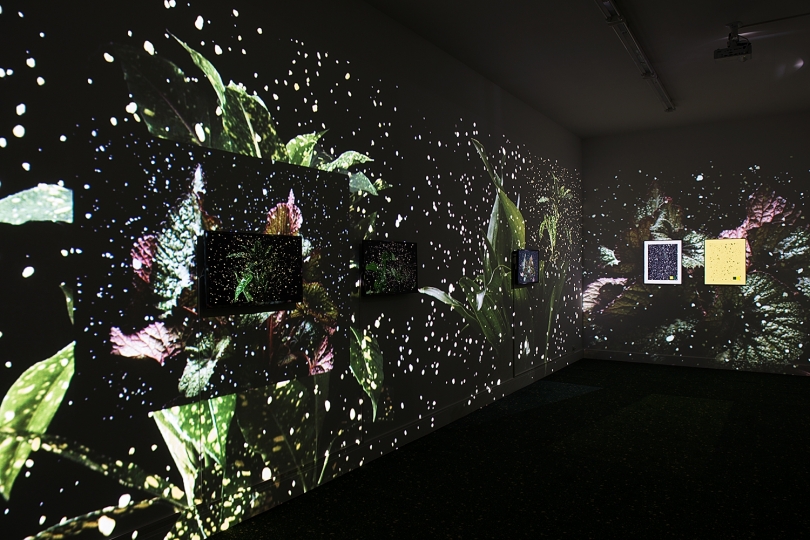
“For En Plein Air, Pascual Sisto has sampled the organic occurring markings native to a peculiar household plant commonly known as the spotted laurel or gold dust laurel (Aucuba Japonica ‘Variegata’); a plant variety that has been produced in strict cultivation by selective breeding. This sampling has occurred not once or twice but multiple times throughout different mediums, like a virus that spreads unrestricted until all distinctions between natural life and ersatz simulations become indistinguishable.

The synthesized version of the pattern is generated by a set of algorithms that randomly arranges the golden spots in space while also modifying the complexity of the edge roughness of each individual spot to closely match its source; whereas, the actual shrub the pattern is based on, is a cultivar whose green leaves are naturally and irregularly variegated with the yellow spots and blotches. Foliage color can vary considerably depending on the amount of sun exposure. Control and randomness are used in equal measure to recreate this naturally occurring organic pattern.

The golden dust pattern becomes the motif for the back gallery video installation and creates a simulated virtual environment resembling the chosen flora. The chromatic motif expands beyond its boundaries, spreading into different referent layers: through inkjet pigment on paper, dye-infused printing on a commercial carpet covering the entire space, a gobo stencil on a spotlight casting the specks onto a synthetic plant, immersive video animations and the living molecules that compose its originating plant matter. It further diffuses the domain of the senses by encapsulating the installation with a layered soundscape of wildlife sounds and a custom scent that is time-released through ultrasonic diffusers to continually affect the atmosphere of the space.

In this sense, the work acts as a house of mirrors, between the printed carpet, drawing, plants and Sisto’s amalgamation of sight, sounds and smells, including an oculus rift VR scene that transports you into your own variegated cosmos. In this mise en abyme, the hierarchies of the natural order are fused with the machine-made origins of industrial pattern design. All are blurred and merged to the point where it becomes difficult to discern the source from its copies.

Custom scent fabricated by Air Variable (www.air-variable.org)”
Justin Plakas

39b4af9ba53122b4-brokenrocks
09f98457336ec9bb-sickle
bcaed83747ef5215-hole
e10d3252de075807-shell

Justin Plakas

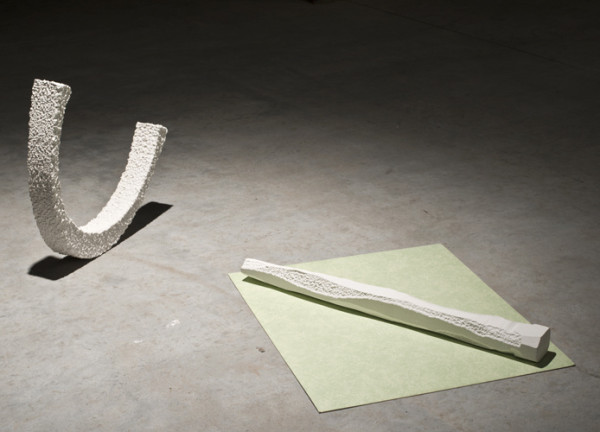
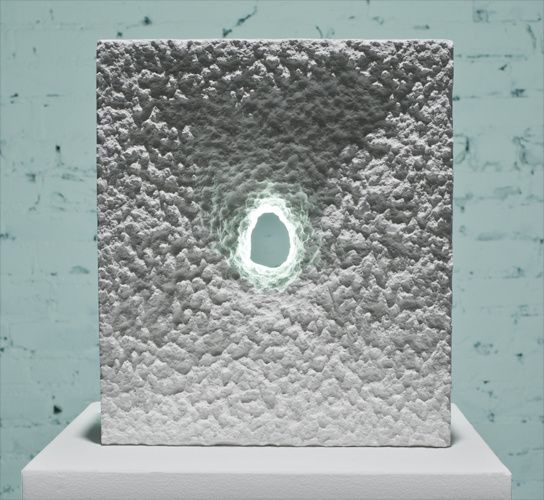
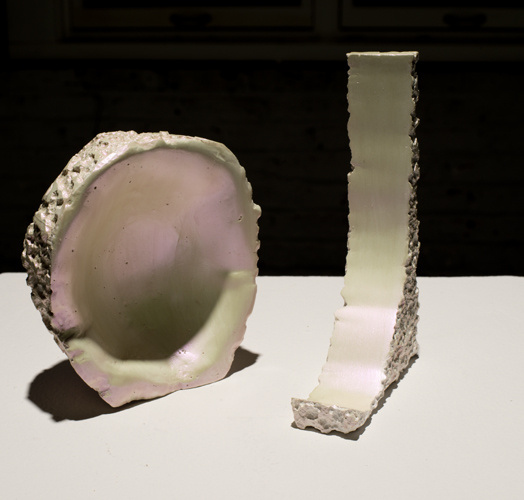
Work from Waiting Room.

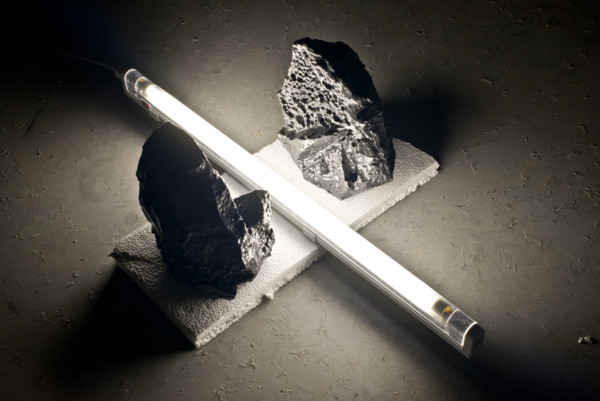
“I had spent a lot of time in the waiting room of the Shock Trauma Unit at the University of Maryland Hospital in Baltimore and then even more time within the trauma unit itself. My father had been in a really horrible car accident and for months all my down time was spent within this extremely intense environment.

Waiting Room represents a sort of mental and physical processing of that time and a new direction for my work and studio practice in a lot of ways. I had recently moved from creating completely digital 2D and time-based work to involving digital fabrication and other sculptural processes that manifested as physical objects.

Waiting Room was created during my time as an artist in residence at the Bemis Center for Contemporary Arts in Omaha, Nebraska.” – Justin Plakas

Asger Carlsen

IMG_6820
IMG_6817
IMG_6813
IMG_6814
IMG_6819
IMG_6816

Asger Carlsen

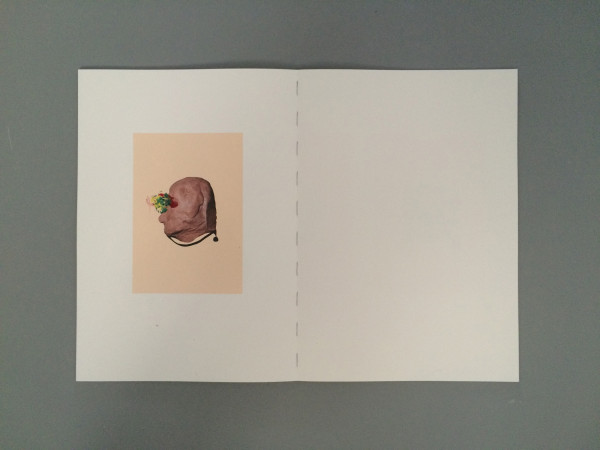
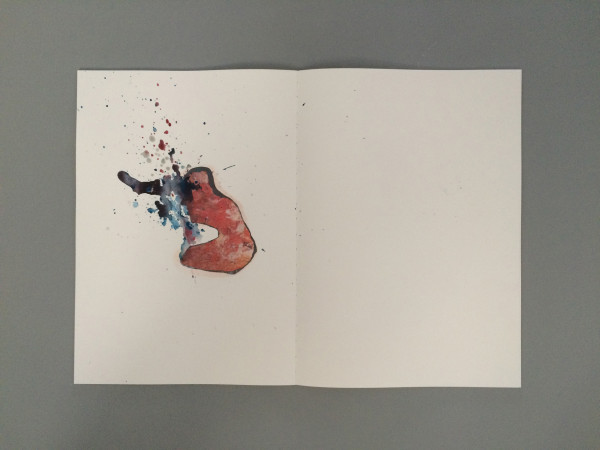
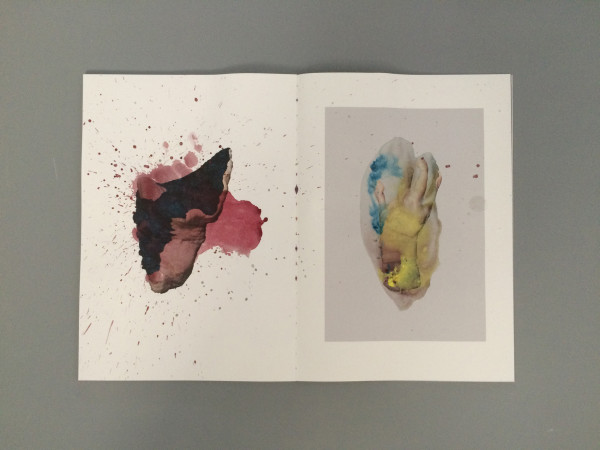
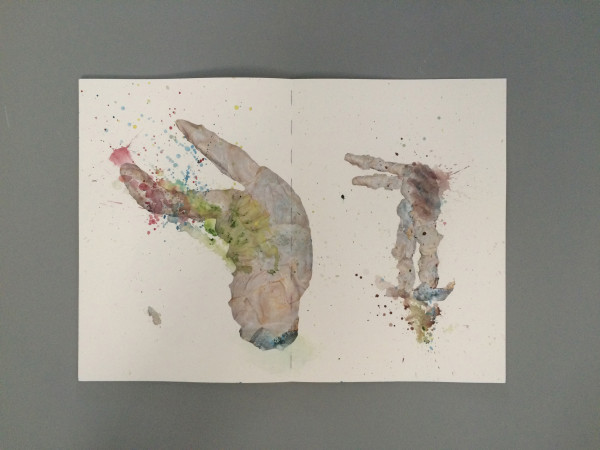
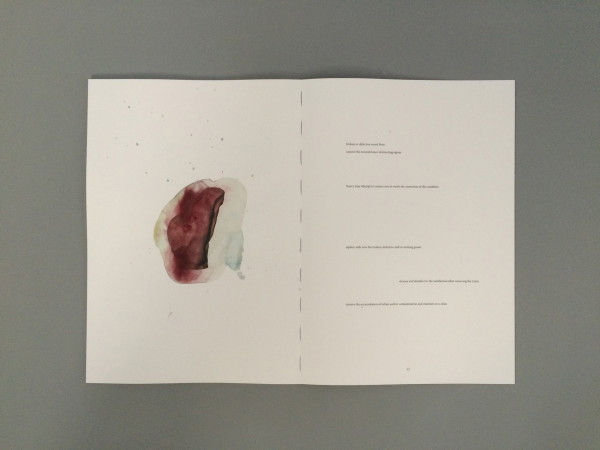
Work from Drawings, Watercolour Edition published by Lodret Vandret.

‘Drawings’ sees a distinct departure in visual style for NYC based, Danish artist Asger Carlsen. Earlier bodies of work, such as ‘Hester’ and ‘Baxter’, although surreal and bizarre, are unmistakably of a camera. Drawings, however, leaves few clues as to whether Carlsen has abandoned a photographic practice altogether as the reader is presented with images, the surfaces of which, seem to be made up of marble, clay, cellophane and meat.

The book is designed in a way that allows it to be re-worked and used as a canvas for new concepts. Thus, over time, copies will be altered in different ways and made available to the public.

The first re-working of Asger Carlsen’s book Drawings by the artist himself with the use of watercolours. 20 books in total has been re-worked with unique paintings on between two and five spreads.” – Lodret Vandret

Jochen Lempert

1-yaNj_ANf6nSB9EJbw1bcow
1-WEQh_-x5gr5fTm7ZdVVytw
1-_6qHlPYRdqoo2pzxvCTeEw

Jochem Lempert

Work from Field Guide @ Cincinnati Art Museum.

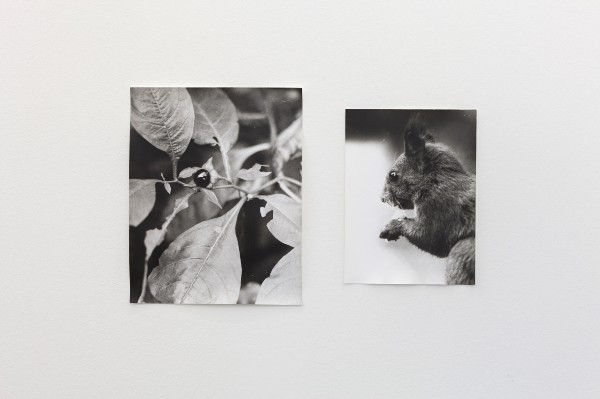
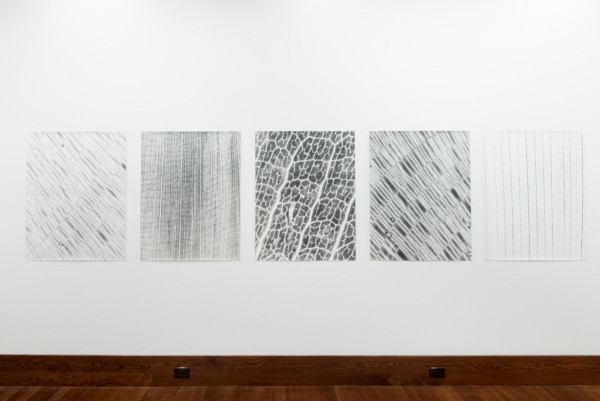
“Jochen Lempert is doubly open to the world around him. Early in his life, he trained as a biologist, conducted field work in Europe and Africa, and wrote academic papers on various subjects, including dragonflies. A 35-mm camera aided his research. Then, during the early 1990s, he began using cameras as a tool for more creative pursuits, collaborating on experimental films and making artistic photographs. This hybrid background influences many of Lempert’s artistic decisions today. It also makes him a unique figure among contemporary artists: he is as familiar with the ideas of scientists Carl Linneaus and Charles Darwin as he is the work of photographers Karl Blossfeldt, Albert Renger-Patzsch, and Bernd & Hilla Becher. The result is a photographer of nature who is not a traditional “nature photographer,” and a Conceptual artist whose subject matter, techniques, and guiding principles distinguish him from nearly all his peers…” – Brian Sholis

Jonas Lund

JonasLund_NewShelterPlan_26_1046
JonasLund_NewShelterPlan_01_0979
JonasLund_NewShelterPlan_16_1040
JonasLund_NewShelterPlan_23_1001
JonasLund_NewShelterPlan_09_1029
JonasLund_NewShelterPlan_05_0982
JonasLund_NewShelterPlan_13_1074
JonasLund_NewShelterPlan_15_0987
JonasLund_NewShelterPlan_12_0976

Jonas Lund

Work from Contemporary Gallery @ New Shelter Plan.

“New Shelter Plan is a non-profit based in an old Carlsbergs storage building in Copenhagen. The curatorial premise for a series of exhibitions is for invited artists to reflect on the division of the 185m2 exhibition space into accessible and inaccessible areas divided by a wall partition. The invited artists all deal with themes of access and restriction within their practice and are invited to challenge and expand on the concept within the space. The response of artist Jonas Lund is an installation replicating a front and back room of a commercial art gallery. A wall separates one third of the space which will be the front room exhibition space,while two thirds of the room is devoted to a back room for office,storage and behind the scenes logistical and networking operations.The internal infrastructure of the gallery has dictated the division of space via its proportional volume of activity.

The installation by Jonas Lund is a gallery space as a piece, which will put forth an group show including 6 Copenhagen based artists and one Stockholm based. The title for the installation, and the name of the gallery housed within New Shelter Plan is Contemporary Gallery.
The front room will host the exhibition that the Contemporary Gallery puts forth titled “Inaugural Exhibition”, and the backroom will have an office installation, storage, and custom made shipping crates as containers for the works in the show.

The entrance to the back room is accessible within the front room. There, you will enter into the back of the office, gaining a behind the scenes entrance to the backroom and the typical gallery operations. Contemporary Gallery looks at the nature of the gallery as a space divided by what goes on in the front and backroom: how value is created, mediated, evaluated and transported, how the logistics are dealt with, and in extension, the possible ‘manipulations’ going on in the back room.

——
Much has been said about the massive expense of museum architecture, prioritised over the budget for programming exhi- bitions within it. Much has been said about art fair tourism––that the horror of exorbitant wealth partitioned from political problems of the host city, may be a microcosm for the reality outside the tent. The particularities of these spaces, the white walls, are meant to simulate an art object’s estrangement from the particularities of place. In effect, these elements play a significant role within the circulation and presentation of art today. The neutral white space was devised for art which required to be set within places disguised as pure space. Consequentially, spatially conscious art forms began to respond to these sterilised and tightly sealed environments.

More is being said about the layers of administration which need to be financed in order to translate an artist’s ideas to the broader public. These layers of administration act as a liaison between producers of art and power. So many people are de- pendent on the production of art by artists in the form of an exhibition. From curatorial programs to art magazines, volumes of activity circulate before, during, and after, the moment we are notified that art has been made.

Emails, installers, schedules, images, in-progress images, the email announcement, install shots, photoshopping, shipping, work getting stuck at the border, Switzerland, preventing work from getting stuck at the border, art fair applications, mockup of a potential booth exhibition, INSTAGRAM, collectors, collectors paying, PDF’s, shipping, crates, what to do with all these crates, consignment agreements, percentages, certificates of authenticity, neutral monitors, do we know how to install this? and more emails, other stuff that we have to be vague about, normal press release or arty press release? A light is out, no more post-its. Cc to loop you in, Bcc just so you know. Best, All best, Let me know if you have any questions, Feel free to ask any questions, beer.

The contemporary in Contemporary Gallery focuses on the gallery as a space that operates not just to house autonomous artwork made by artists, but as a facilitator for a network of operations made around an artists practice. The life of an artwork is not just created within the moment of creative production, but continues within its circulation online, in its collector net- work, critical reception, and place within the ecosystem of logistical operations. …” – Lucy Chinen

Kaj Nyborg

KajNyborg_NewShelterPlan_02_0666
KajNyborg_NewShelterPlan_03_0670
KajNyborg_NewShelterPlan_01_0662
KajNyborg_NewShelterPlan_09_0688

Kaj Nyborg

GHOST in my house (ISOPLANT) @ New Shelter Plan.

“By showing Kaj Nyborg’s solo exhibition GHOST in my house (ISOPLANT) New Shelter Plan launches its series of autumn exhibitions that are based on a new curatorial approach. A division of the 185m2 large exhibition space into an accessible and an inaccessible part now constitutes the central premise of the coming exhibitions. The participating artists are all dealing with the themes availability / restrictions as part of their practice and they are invited to challenge and expand the concept.

Kaj Nyborg

Kaj Nyborg’s installations pinpoint the unknown in the familiar, based as they are on everyday recognizable phenomena and objects. An atmosphere of uncanniness and impermeability often emerges. Elements of surveillance and disorientation are present as the well-known objects do not contain the information or the functions that we associate them with. In this way they deny us the common knowledge that we thought we were presented to.

GHOST in my house (ISOPLANT)

Two windows with closed blinds are inserted in the wall that divides the exhibition space. Plant parts are trying to work their way through the blinds which moves slightly but not enough to reveal what is on the other side.

Impermeability is a recurring theme in Nyborg’s works, and the exhibition GHOST in my house (ISOPLANT) poses a number of related questions; to whom belongs the “home” that we are looking at and for what purpose are we looking? Does the work of art create a room of possibilities to the viewer or do we have to read the room as a locked position from which action is impossible?

Justin Morin

Screen Shot 2015-09-23 at 9.22.54 PM
Screen Shot 2015-09-23 at 9.23.19 PM
Screen Shot 2015-09-23 at 9.23.50 PM
Screen Shot 2015-09-23 at 9.23.08 PM
Screen Shot 2015-09-23 at 9.23.32 PM
Screen Shot 2015-09-23 at 9.24.13 PM
Screen Shot 2015-09-23 at 9.24.29 PM

Justin Morin

Work from Q10 at Galerie Jeanrochdard.

“What could these initials possibly stand for? Are they geographical coordinates?
Is it a mobile phone model? Or a secret code?
It is in fact a chemical term designating a coenzyme that acts like a vitamin inside an organism and activates the energy production on a cellular level. It was also used by the brand Nivea to describe a range of beauty products.
By choosing this kind of reference as a title for his exhibition, Justin Morin immediately thrusts us into a universe rich with references to the world of fashion, luxury, beauty and appearance. Some of you may also be reminded of the triptych of exhibitions developed by Éric Troncy in the late 1990s, of which the titles – Dramatically Different, Weather Everything, Coollustre (1) – were also names of beauty creams produced by Clinique. But whereas the French curator focuses on luxury and glamour, Morin adopts a radically different approach. In this exhibition, his interest does not lie in what these products and brands represent, but in the way in which the multinationals that produce them communicate and the symbolic system they wish to convey to their potential clients. To do this, he seizes upon his own repertoire of conventions, which can be situated on the cross section between minimal art, Op Art and kinetic art. The artist has completely appro- priated this crossover steeped in the 70s, mixing it with more modern references and even passing these historical shifts through the filter of Pop Culture, consumerism and the dictates of appearance, as it were. This concept is symbolised by the aluminium, epoxy-painted bars that feature in the exhibition. Whereas the initial pieces in the collection – which was started in 2013 – directly echo the experimentations of Victor Vasarely or Bridget Riley, the pieces that are exhibited here have been adorned with a new layer, radically altering their meaning.
Morin’s approach is as simple as it is effective, combining various previously used patterns – lines and dots – and adapting the shape of the bars to give them a less rigid and more flexible appearance – an image mainly inspired by the diagrams of the epidermis that can be found in advertisements for cosmetic products. In addition, they have all been given the name of a skin care cream. Similarly, the draped fabrics that form part of the exhibition continue a process that was started several years ago and finds its origin in the artist’s interest in advertising, charting the way in which bodies and objects are rendered totally impersonal once printed on the pages of glossy magazines. These large pieces of silk are each exhibited in accordance with a specific protocol and are actually a chro- matic transcription of this kind of advertising, providing a much more tangible and sensual version of these often grotesque images – despite their ethereal appearance, they are still very present in their surroun- dings. Whereas the images selected for previous collections referred to concepts ranging from a Cher al- bum cover to the reflection of the light on the river Neva, the draped pieces of fabric displayed in this exhibition all echo the cosmetics industry in one way or another, whether referring to the roses used to create a perfume – How to drape a rosa gallica officinalis –, the offshore platforms extracting oil that is subsequently fragmented to naphta – How to drape the ocean that surrounds an offshore Platform – or even a picture of Rihanna on the cover of Vogue magazine – How to drape Rihanna’s red hair Vogue cover. By doing this, Morin attempts to dissect and even deconstruct the imagery used by these large cosme-
tics firms, offering a much more tangible, delicate and bright version, based on a variation of shapes and colours and in stark contrast with the extremely cold and scientific aesthetic generally used to evoke these products.

Text by Antoine Marchand.

Alexandra Gorczynski

oyifolfy2
gffgff
tttlllllttt

Alexandra Gorczynski

Work from SENSATIONS.

“Gorczynski creates two-dimensional, sculptural and video works that investigate the overlap of virtual and actual states of being. Layering together paint, photographs, and moving images, Gorczynski celebrates the formal potential of new media. She also explores the fluidity of identity, the sensuous and corporeal limitations of the virtual and the real, and more recently, a modernist approach to materials, color and form.

Layering textiles, art tools, painted gestures, and images of such, Gorczynski builds uncanny compositions allowing the audience to slip in and out of digital and actual realms. The craft components and marginal inclusions of the artist and her home occupy our world and alternate worlds tugging at our understanding of objects and reality.” – Zulong Gallery

Nina Koennemann

MG_8804
MG_8819
MG_8794

Nina Koennemann.

Work from Lithic Reductions.

“Lithic Reductions is a site-specific installation by NINA KOENNEMANN presented in the former paint spraying booth at Taylor Macklin in Zürich.

The project focuses on NINA‘s porcelain objects that look like archaeological fragments. She took an interest in the development of stone tools which is still practiced by hobbyists as ‘knapping’. The knappers attempt, according to the press release, ‘to replicate neolithic artifacts, contextualizing their works with technical speculation, esoteric projections of stone-age thinking, and imagined narratives of survival and scarcity’.

By displaying these fictional prehistoric tools made of sanitary porcelain in the industrial exhibition space of Taylor Macklin , NINA KOENNEMANN not only questions the current notions of history, universal knowledge and vernacular culture but also examines the vestiges of the repertoire of forms within contemporary art.

➝ Lithic Reductions by NINA KOENNEMANN is on view at Taylor Mackin in Zürich till August 18, 2015.

-via We Find Wildness

Maxime Guyon

display-e1438251196225Maxime_Guyon_Malleable_Composition_01Maxime_Guyon_Malleable_Composition_02Maxime_Guyon_Malleable_Composition_03Maxime_Guyon_Malleable_Composition_04Maxime_Guyon_Malleable_Composition_05  sideviewMaxime Guyon

work from Technical Exaptation at ECAL Switzerland

This project deals on the technological evolution at its large sense. Replicating the hyper-commercialization aesthetic codes, this series dissects standardized commodities and high technologies which are here listed as full species.The images are intentionally manipulated, which finally witness the hybridizations that the photographic medium as well as technology undergo. This work acts like a research on the role of a photographer nowadays while we currently experience a significant rise of post-internet art.

These 5 pieces are made of bended and laser cut steel sheet, then wrapped with glossy vinyl print, which is a function originally applied for car body printing.

maximeguyon.com/technological_exaptation