Jst Chillin / The Jogging

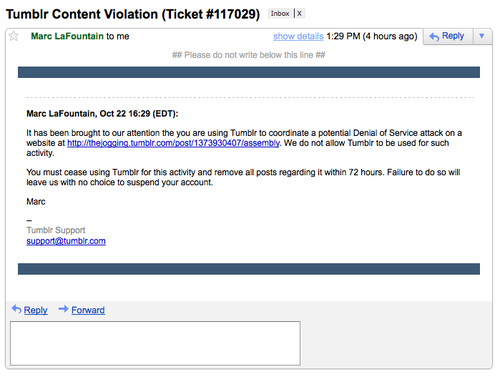
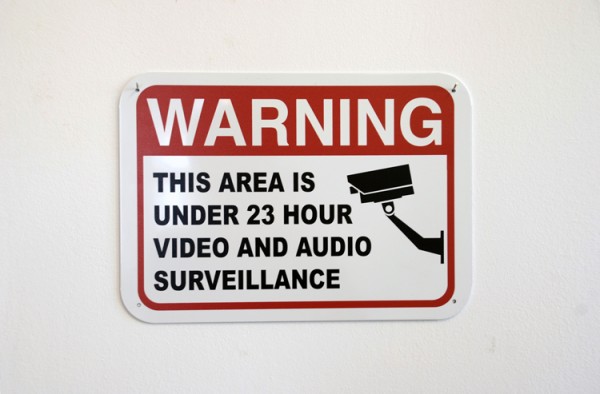
After JstChillin.org was deleted by their server yesterday for hosting ASSEMBLY, the project was moved to http://thejogging.tumblr.com Friday October 22, 2010. That day, an e-mail was sent to Jogging by Tumblr Community Director Marc LaFountain. It said the following:

Response:

ASSEMBLY

1. Assembly mobilizes the combined efforts of digital peers to critique an institution/individual/network’s website through the oppositional use of bandwidth squatting. For 13 days, participants vote to decide what institution/individual/network’s website will be the subject of this act. On the 14th day of Assembly– November 1st – Jstchillin.org will be replaced by a single page that features 25 iFrames constantly reloading the democratically decided website of political opposition. To drain the maximum amount of bandwidth or potentially freeze the website to a standstill, on November 1st we encourage you to open as many tabs of Jstchillin.org as possible and leave them open all day. In doing so, participants may group together to temporarily remove this website’s existence on the internet, putting a halt to its undesired effects on our community and the world at large. Bandwidth squatting is a method of protest, a tool historically linked with the Civil Rights Movement’s sit ins of the 1960’s. Through their undesired mass presence, protesters are able to disrupt the informational function of the website they are intervening on– a detournement of digital visitation.

1. Assembly mobilizes the combined efforts of digital peers in tributary celebration of an institution/individual/network’s website through a symbolicly supportive digital mass pilgrimage. For 13 days, participants vote to decide what institution/individual/network’s website will be the subject of this act. On the 14th day of Assembly– November 1– Jstchillin.org will be replaced by a single page that features 25 iFrames constantly reloading the democratically decided website of tributary celebration. To maximize the symbolic support for the decided website, on November 1st we encourage you to open as many tabs of Jstchillin.org as possible and leave them open all day. In doing so, participants may group together to create an honorific swell of attention, a mass of support for the legacy of the website’s effects on our community and the world at large. Digital mass pilgrimage is a method of praise that makes use of the fact that there is no such thing as negative attention online. Through bringing the website to a halt, tributary participants pose the undesired possibility of a world without the website– an eye-opening and appreciation-building event not unlike guardian angel Clarence Odbody’s intervention into George Bailey’s state of affairs in the movie It’s a Wonderful Life.

Nils Nova

Nils Nova

Work from his oeuvre.

“…is a devotee to painting, although his artistic talent is not limited to this genre. Nova paints, above all abstract, makes Videos, takes photographs and creates large scale wall or room based installations. He juggles with the tools of almost all the media available to an artist today, avoiding dogmatism’s as he plays with our contemporary patterns of perception, with digitally deconstructed forms of pictorial communication of reality and with the surface areas on which pictorial illusions appear.” – VOLTA NY

via Rick Silva.

Igor Eskinja

Igor Eskinja

Work from his oeuvre.

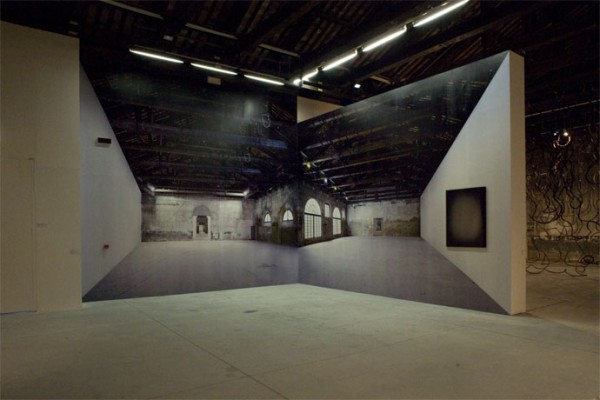
“Igor Eskinja constructs his architectonics of perception as ensembles of modesty and elegance. The artist “performs” the objects and situations, catching them in their intimate and silent transition from two-dimensional to three-dimensional formal appearance. Using simple, inexpensive materials, such as adhesive tape or electric cables and unraveling them with extreme precision and mathematical exactitude within strict spatial parameters, Eskinja defines another quality that goes beyond physical aspects and enters the registers of the imaginative and the imperceptible. The simplicity of form is an aesthetic quality that opens up a possibility for manipulating a meaning. It derives, as the artist states, from the need for one form to contain various meanings and levels of reading within itself. The tension between multiplicity and void constitutes one of the most important aspects of Eskinja’s mural “drawings” and seemingly flat installations. A void is still an active space of perception; it does not conceal; it comments on the regime of visibility, it invites the viewer to participate in the construction of an imaginary volume in an open space. The temporary nature of the artist’s spatial structures and the ephemeral quality of his carpets (where ornaments are carefully woven out of dust or ash) manifest a resistance to the dominant narratives of institutional apparatus and socio-political order.” – VOLTA NY

Xavier Veilhan

Xavier Veilhan

Work from his oeuvre.

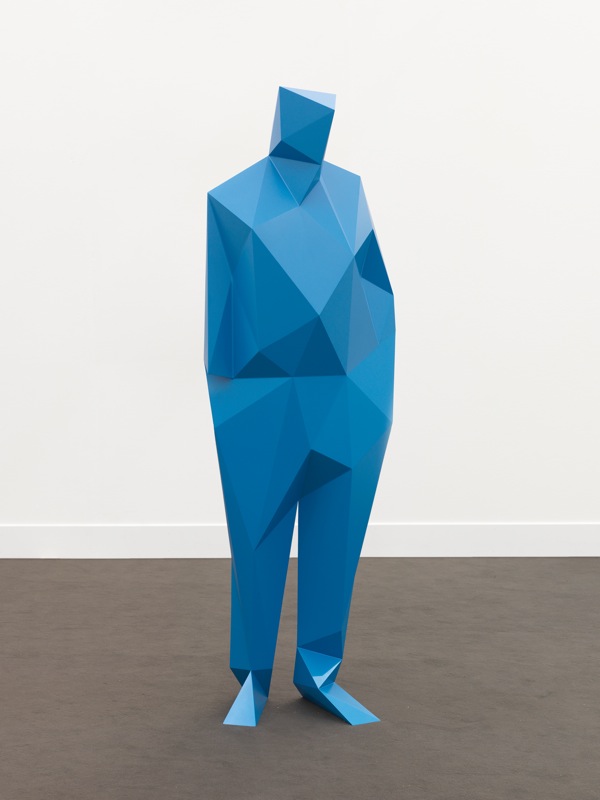
“Whether he uses digital photography, sculpture, public statuary, video, installations or even the art of the exhibition, Xavier Veilhan builds his work around the same axis: the possibilities of representation. One of the most striking features of his polymorphic practice is that he treats generic objects and shapes of everyday life so that they come out smoothed, without details, and resistant to any psychological insight. Since the 1990s, bestiaries occupy a significant place in this process, and among them, penguins and rhinoceros of unnatural colours, made of painted polyester resin. The Rhinocéros (1999), made on real-scale, was lacquered in Ferrari red, in a way that instantly modifies the perception of the mastodon’s “body work”. Already in 1995, with Les Gardes Républicaines, he had produced a completely generic set of four mounted guards. The statues stood like real size toy figures. Veilhan’s figures are archetypes reduced to essentials, prepared so as to allow the viewer to immediately project himself beyond the anecdotal. Without seeking to be a perfect copy, they manage to impose their intimidating authority over him.
Fascinated by the issues of modernity and technical progress, Veilhan was also interested in mechanical systems and in the way these are constructed. With Ford T (1997-1999), he even went against “Fordism”  by conducting the handmade reconstruction of this 1910 car, a symbol of the first mass productions. From stereotype to prototype, the artist has clouded the issue and covered his tracks by playing with the standards. The Ford Model T was then followed by bicycles, a motor scooter, and more recently, a Swiss cuckoo clock. This huge sixteen feet long mechanical artwork, equipped with colored lacquered wheels, measures an enigmatic amount of time when a metallic sphere is activated in its system. As with the bestiary, mechanical modernity has been a guiding thread all through his career (which started at the end of the 1980s), and is still present in his most recent exhibitions.
With La Forêt or La Grotte (made in 1998), Xavier Veilhan proposes visiting experiences that take place in huge environments. The framework is always visible so as not to create false illusions: in Veilhan’s art, construction is essential. Rolls of grey felt, that function as trunks, suggest a forest. The same material covers the ground. The sensible experience of this synthetic environment is plunged into a muffled atmosphere, confined and soundproofed by the material here used, as it dissects the automatisms of identification by resorting to strong cultural symbols. Veilhan employs these devices both in his major works and in isolated objects. “Transforming signs into instruments”: he likes to confess his passion by sublimating it into statues and exhibitions. In fact, after his major installations at the end of the nineties, not only did he had a go at making a scenography of his own works (Le Plein Emploi, Strasbourg 2005), he also made two others shows with the works of other artists (Projet Hyperréaliste/ The Photorealist Project, for the Lyon Biennale in 2003, or the sculptural Baron de Triqueti, in 2006). The possibilities offered by the art of the exhibition, from the Versailles gardens, through the techniques employed in constructivist propaganda, to the World’s Fairs, constitute a series of fruitful analytical issues for an artist who’s interested in the orchestration of power and its iconographic materialization. Following this logic, Xavier Veilhan has answered to a number of public commissions in France, creating a grey monster in Tours (2006), a blue lion in Bordeaux, and a bear, penguins and other characters in Lyon (2006). The archetype becomes here a catalyst that gives way to a reflection on the commemorative dimension of public statuary and on its action as a sign in our urban everyday life.” – Benedicte Ramade.

Young-Hae Chang Heavy Industries

Young-Hae Chang Heavy Industries

Work from their oeuvre.

Check here, here, here and here.

“YOUNG-HAE CHANG HEAVY INDUSTRIES (YHCHI) is a two-artist collective based in Seoul, South Korea. Using Flash animation techniques, they create fast-moving, text-based artworks that are synchronized with original scores. Using a seemingly simple format—texts on monochromatic backgrounds—YHCHI weaves complex and evocative narratives. Invoking the genre of film noir, and the hard-boiled literary styles of Raymond Chandler and Phillip K. Dick, YHCHI’s imaginative, witty and often politically pointed narratives offer layered and compelling stories in which identities are assumed and discarded, and ideologies of all persuasions are held up and questioned.” – via the New Museum.

Hollis Frampton

Hollis Frampton

Work from his oeuvre.

“Hollis Frampton was born in Ohio, United States, on March 11, 1936, towards the end of the Machine Age. Educated (that is, programmed: taught table manners, the use of the semicolon, and so forth) in Ohio and Massachusetts. The process resulted in satisfaction for no one. Studied (sat around on the lawn at St. Elizabeths) with Ezra Pound, 1957-58. That study is far from concluded. Moved to New York in March, 1958, lived and worked there more than a decade. People I met there composed the faculty of a phantasmal ‘graduate school’. Began to make still photographs at the end of 1958. Nothing much came of it. First fumblings with cinema began in the Fall of 1962; the first films I will publicly admit to making came in early 1966. Worked, for years, as a film laboratory technician. More recently, Hunter College and the Cooper Union have been hospitable. Moved to Eaton, New York in mid-1970, where I now live (a process enriched and presumably, prolonged, by the location) and work…

In the case of painting, I believe that one reason I stayed with still photography as long as I did was an attempt, fairly successful I think, to rid myself of the succubus of painting. Painting has for a long time been sitting on the back of everyone’s neck like a crept into territories outside its own proper domain. I have seen, in the last year or so, films which I have come to realize are built largely around what I take to be painterly concerns and I feel that those films are very foreign to my feeling and my purpose. As for sculpture, I think a lot of my early convictions about sculpture, in a concrete sense, have affected my handling of film as a physical material. My experience of sculpture has had a lot to do with my relative willingness to take up film in hand as a physical material and work with it. Without it, I might have been tempted to more literary ways of using film, or more abstract ways of using film.” – Hollis Frampton

Yoshioka Tokujin

Yoshioka Tokujin

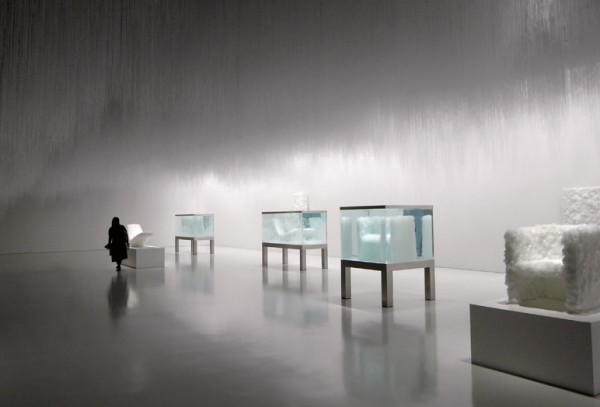
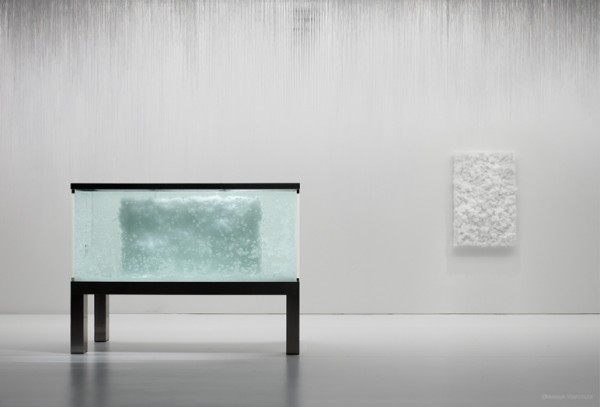
Work from Sensing Nature (that resembles the fortress of solitude).

Japanese culture and art has always been in a close relationship with nature. In Japan, the word “shizen” was selected at the end of the 19th century as the most appropriate translation of the English word “Nature.” Originally, words such as “shinrabansho” and “tenchibanbutsu” had slightly wider connotations, referring to “all of creation,” including human beings. Incorporating not only the secrets of the universe, natural phenomenon and the changing of the seasons, but also human experiences and perceptions of these things, the Japanese concept of nature became merged with an animistic sense of religion to give rise to a unique form of culture and art. Looking back at Japanese culture from the past – from its traditional performance, architecture and painting, to its postwar movements, such as Mono-ha – it is possible to recognize countless insights not only into the relationship between the natural and human worlds, but also into the abstraction of nature and ideas of designing space with an awareness of creation as a whole…

Yoshioka Tokujin is well known for dynamic spatial designs made using artificial materials, which give us the sensation of experiencing light, snow, storms and other natural phenomena. He is currently exploring the future potential of design to incorporate natural principles and effects and to integrate natural science technologies.

” – Mori Museum

Ahmet Öğüt

Ahmet Öğüt

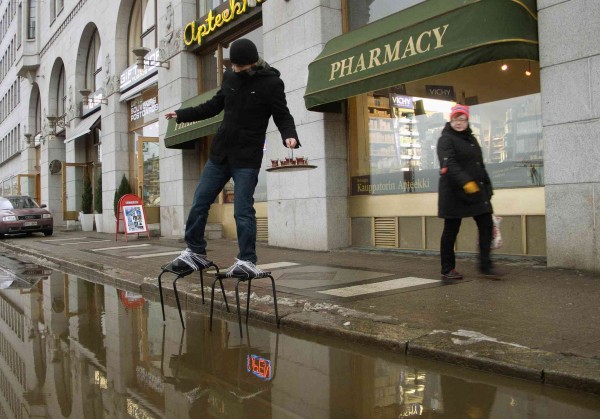
Works from his oeuvre.

“Ogut’s work is an explication of the rights of the individual and the expression of those rights in the face of the requirements of the state. The consequent struggle to make do and live with a sense of self-will sets into motion what might be called game-life. In game-life, the players improvise a way to assert and confirm their rights as they negotiate the social field of daily existence. In Turkey, under the gaze of the state, Ogut sees the invention of alternative means to live as a game that is as endlessly creative and exhilarating as it is tiring, or dangerous. That risk brings tension, amusement, and gravity to his art, giving it a disarming and often funny charge. His inventions are off-kilter, in keeping with the necessities of the life of repressed and impoverished people reacting to the will to impoverish and the will to subjugate-state policies that leave society in its condition of want.

What Ogut’s pile of dynamite signals is his gamer’s strategy, using a playful format to present the effects of the politicization of life. ‘I use this child’s way of seeing the world,’ he says, ‘so that at first the work doesn’t look so dangerous. It allows you to come a little closer, and then you understand that the stories are not that nice.’ At the Kunsthalle there was, for example, his and Sener Ozmen’s 2004 Coloring Book, in which reversals and perversions of normal situations are drawn with the simplest of outlines, waiting to be cheerily filled in-a woman on the floor with a boy looming above her about to crush her skull, or children watching a couple kiss on television while the parents avert their eyes.” – Steven Henry Madoff for Modern Painters

Georges Rousse

Georges Rousse

Work from his oeuvre.

Below is an excerpt from Rousse’s correspondences with Canadian Art Historian, Jocelyne Lupien.

Paris, January 9, 2000

Good evening Jocelyne,
Your letter has got me thinking about the camera, it makes me wonder about the meaning and evolution of my works over the years. I do not have your scientific or global view of things because the work developed over time and from a variety of sources. But I can say that what came to me first was this apprehension of space and painting. During these early years, the camera was just the instrument that defined the space of the image. The first discovery concerned the way the camera carves out a photographic field in the space. Contemporary art enabled me to act on the photographic field. For example, for me Land Art was a kind of model. Trained as I was in the mathematical reasoning that establishes a relation between definitions, rules and theorems, I logically thought that all the developments of art history were like these rules and theorems, and that I could use them not as a homage to “such and such” but as an established principle which in turn allowed me to construct other hypotheses and other experiences. I therefore introduced “action into the photographic field” and the possibility of controlling images (my own) by controlling, as a director does, every parameter of the image. Later a change did effectively occur when I realised that photography is a technique for “reproducing”, that is to say, for producing what has already been produced or existed.
My photographic images are constituted in two phases: they are produced in real space then reproduced by capturing the real. For me, the photographic image is forged within the real, onsite, in action, in direct work on the site. This notion of work is important to me. It enables me to control every phase of production. For me it is also a way to exorcise any nostalgia or despair, to eliminate the present-as-ruin and re-develop it in a different way. There are always ways of terminating or changing a situation, even the most negative ones. Alongside photography as a medium of reproduction I introduced the technique of “anamorphosis”, which the dictionary defines as a transformation that uses optical or geometrical means to make an object unrecognisable, but which allows you to restore the original figure by using a curved mirror or by examining outside the plane in which the transformation occurred. But I would like to add that this definition of anamorphosis does not fit my practice exactly because I have never sought to make the object unrecognisable, but have sought to dematerialise that object in order to make it photographic. The object is there in the photographic but it cannot be grasped. That is why I have used anamorphosis without naming it as such. I also use the wide-angle lens as a tool of dematerialisation. As a result of the powerful deformation that it introduces into the real my space becomes an oversized real, smaller than the universe (to introduce a poetic dimension). In effect, I “reorder the visible world into a new and unforeseen space”, but then isn’t showing the world in a new way what artists set out to do?

I look forward to your answer,
Georges Rousse

Marina Gadonneix

Marina Gadonneix

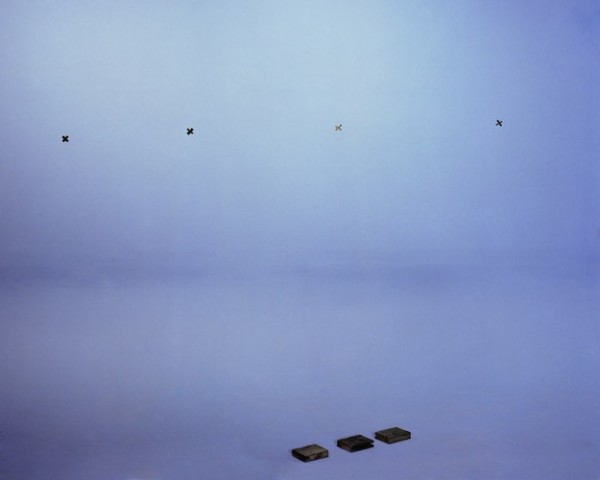
Work from Removed Landscapes.

“It does not seem very daring to describe Marina Gadonneix’s pictures as being depopulated. The emptiness of the places she presents, one after another, demonstrates – if not a preliminary rule characterizing the whole series, a constant which is merely foiled by rare, always ethereal apparitions. Here, a mannequin bending dangerously while levitating on his windsurf board ; there, five or six half-naked bodies lying under an artificial light; somewhere else, the back of a female figure standing in front of a porthole-shaped halo ; still elsewhere, a few groups seemingly made of the ambiguous fabric of dreams, tidily arranged in a row, miniatures dispersed or wavering indolently like the non-dead momentarily feasting in the hotel in Kubrick’s Shining. On the whole, nothing that would disturb the general arrangement or not follow its order; no one inhabits these places.

However there is no hostility whatsoever in these spaces dedicated to hospitality. Why then is there a void so obvious that each element constituting the images seems selected only to accentuate it better ? Is it, to borrow Benjamin’s famous analysis of Atget’s inventory of Parisian streets, the continuation of the detective role of photography ? Remember the commentary: «It has been rightly said that he had photographed these streets like one photographs a crime scene. The crime scene, too, is deserted. It is photographed for the purpose of gathering evidence. In Atget’s work, photographs start becoming evidence for the trial of History. It is there that lies their secret political significance. They already call upon a determined examination. They are no longer subject to detached contemplation. They worry the person who looks at them ; in order to understand them, the spectator guesses that he must search for an entry point» What is it that Benjamin points out in Atget’s photographs ? The conflict between two different genres: the landscape (including its urban version) on the one hand, conventionally intended for mere “contemplation” ; genre pictures, on the other hand, in which a narrative requires that the plot animating it be deciphered, and demands the « determined » movement of the eye, relating one gesture to another in order to organize their common intelligibility. The conflict between these two genres is invisible or « secret », since the traditional markers of the narrative, the characters and their actions, have given way to an empty set, having become the print of their disappearance, of their execution. Not only has the possibility of the supposedly descriptive innocence of the landscape disappeared, but a peaceful view has become proof of its opposite, the framework for another genre, a scene in which all the actors, dead victims and vanished guilty, have faded out of the scene. In other words, the « landscape » is the corpse abandoned by a genre picture, left in the suspense of its unsolved enigma.
In addition, if a large part of the landscape tradition has consisted in designating the ideal place to live, if the landscape – prosaically descending from the garden of Eden – has always traced the concrete outline of a promise, one will have understood that its reaching the ranks of « evidence » of its own assassination testifies to the beginning of an era of the uninhabitable, a time of generalized expropriation. A survey of the places no longer reveals the space favorable to possibilities, but multiplies the settings of a single impossibility. In such conditions, photography no longer benefits from a descriptive unity, nor from a temporal homogeneity : it is torn by the irony of a confused script.
It is that sort of irony that Marina Gadonneix’s pictures reiterate. Again, are brought back to life Christmas trees, rigid horses on all fours, standing bears picking fruit, sea animals caught in the middle of their nautical movements, rocky reefs, sand beaches, snow, the sea and its depths, the blue sky and the delicate fluff of the clouds. The landscape reappears at the surface. Indeed, an artificial resurrection, through the looking glass, since all this debauchery of nature and innocence is merely a sign here, an illusion of depth, a metonymic landscape in dotted lines. In addition, photography no longer captures the movement of life, it merely duplicates a stillness that very much preceded it. Frozen for an apparently short-lived eternity, justifying a contrario the taste for panoramas of mountains covered by snowy, pure whiteness, the landscape, from site has become a time indicator : revealing a time that has stopped. « The trial of History » claimed by Benjamin is over, and its verdict has been rendered: there is no more History. And one understands easily the logic that takes Marina Gadonneix from saunas, leisure centers, waiting rooms, urban transit zones (all these purgatories that Marc Augé calls non-places), to television studios. Time is also dedicated to inaction there, time out of the disappearance of the possibility of action.
Photography’s fascination for stillness (that is, for the paralyzing effect of fascination itself) is far from new. From the tradition of architecture and sculpture photography, to the original work and certain famous contemporary examples, certain critics, rightly ignoring dimensional distinctions, have inferred a relation between the goals of sculpture and that of photography: a similar monumental necessity (space stricken down by the time of History through the heavy bias of celebration) would animate them – even in failure, if one recalls Man Ray’s famous photograph of Duchamp’s Fountain in Stiegltz’s review. Obviously, Marina Gadonneix’s photographs also play constantly on the shift between the deliberate flatness of the picture (their stressed geometrical construction allows a calm symmetry, the recurrent echo of an image inside another image, including the places where they are produced, with the series on television studios) and the three-dimensionality of the sets. But what they emphasize is clearly something else. For they find no dignity in the nobility present or most generously lent to the objects they reproduce. Neither an art manufactory, nor the expression of a popular or historical genius, this strength belongs to the opposite side: on the side of the fake – and of the poorest kind, belonging to no one, but imposed on everyone, proclaimed as such. Here too, there is a precedent. We know from Diane Arbus’ correspondence how excited she was about going to photograph Disneyland’s outdoor artificial sets. Without any intermediary, without any obstacle, the image met the image. Multiplied, separated from a randomly documentary function, the power of the image would take place without referent, or rival – producing, absolutely, its own archive. But in her snapshots, an unnatural mist and a gothic atmosphere still floated, offering to the cardboard constructions a probability of existing. No trace of that here. The dream turns out to be dry, and the self-breeding of the image is turned sterile. As proof, the rare visitors shown from the back, lying dead or living dead. What is left then ? Nothing, perhaps. The violence of obviousness, if, as Edmond Jabès has suggested, the latter consists, in its own heart, in underlining the void. This means placing Marina Gadonneix at Lynne Cohen’s side, for instance, among those who renew melancholy and invent unprecedented variations around the ancient vanitas motif. This would be fair, however it would mean ignoring that which characterizes, with a real emphasis, the last series on television studios. What is that ? Color. The crime is transported somewhere else, as Barnett Newman suspected in his famous question: Who’s afraid of red, blue and yellow ? Indeed, the colors, gathered and multiplied in the test patterns populating the deserted sets, or spread out on large monochromes, are glorified. And the photographs invent a museum for them. A close-up on a test pattern recalls a Morris Louis, a red staircase a constructivist painting, etc.
What is the hypothesis behind these “commissioned landscapes” ? No longer a call for the insurrection of analysis affirmed by Benjamin, nor the sad denunciation of a daily life alienated and prisoner of its own recurrent funerals. Neither the cynicism of an image played in a loop, having become the only horizon of the image itself. On the contrary, what is celebrated here is the decomposition of the image itself, its disintegration into simple elements : the explosion of colorful sparks. There is definitely no melancholy here, or else like a mask for a profane joy : there is no more landscape, no more paradise – space is left free, like above bunk beds with no bedding, for light, for it to diffuse and diffract. For an instant, the fake is colored in real, and the real becomes an image that offers it to us like a chance, its « entry point ».
Jean-Pierre Rehm
It does not seem very daring to describe Marina Gadonneix’s pictures as being depopulated. The emptiness of the places she presents, one after another, demonstrates – if not a preliminary rule characterizing the whole series, a constant which is merely foiled by rare, always ethereal apparitions. Here, a mannequin bending dangerously while levitating on his windsurf board ; there, five or six half-naked bodies lying under an artificial light; somewhere else, the back of a female figure standing in front of a porthole-shaped halo ; still elsewhere, a few groups seemingly made of the ambiguous fabric of dreams, tidily arranged in a row, miniatures dispersed or wavering indolently like the non-dead momentarily feasting in the hotel in Kubrick’s Shining. On the whole, nothing that would disturb the general arrangement or not follow its order; no one inhabits these places.However there is no hostility whatsoever in these spaces dedicated to hospitality. Why then is there a void so obvious that each element constituting the images seems selected only to accentuate it better ? Is it, to borrow Benjamin’s famous analysis of Atget’s inventory of Parisian streets, the continuation of the detective role of photography ? Remember the commentary: «It has been rightly said that he had photographed these streets like one photographs a crime scene. The crime scene, too, is deserted. It is photographed for the purpose of gathering evidence. In Atget’s work, photographs start becoming evidence for the trial of History. It is there that lies their secret political significance. They already call upon a determined examination. They are no longer subject to detached contemplation. They worry the person who looks at them ; in order to understand them, the spectator guesses that he must search for an entry point» What is it that Benjamin points out in Atget’s photographs ? The conflict between two different genres: the landscape (including its urban version) on the one hand, conventionally intended for mere “contemplation” ; genre pictures, on the other hand, in which a narrative requires that the plot animating it be deciphered, and demands the « determined » movement of the eye, relating one gesture to another in order to organize their common intelligibility. The conflict between these two genres is invisible or « secret », since the traditional markers of the narrative, the characters and their actions, have given way to an empty set, having become the print of their disappearance, of their execution. Not only has the possibility of the supposedly descriptive innocence of the landscape disappeared, but a peaceful view has become proof of its opposite, the framework for another genre, a scene in which all the actors, dead victims and vanished guilty, have faded out of the scene. In other words, the « landscape » is the corpse abandoned by a genre picture, left in the suspense of its unsolved enigma.In addition, if a large part of the landscape tradition has consisted in designating the ideal place to live, if the landscape – prosaically descending from the garden of Eden – has always traced the concrete outline of a promise, one will have understood that its reaching the ranks of « evidence » of its own assassination testifies to the beginning of an era of the uninhabitable, a time of generalized expropriation. A survey of the places no longer reveals the space favorable to possibilities, but multiplies the settings of a single impossibility. In such conditions, photography no longer benefits from a descriptive unity, nor from a temporal homogeneity : it is torn by the irony of a confused script.It is that sort of irony that Marina Gadonneix’s pictures reiterate. Again, are brought back to life Christmas trees, rigid horses on all fours, standing bears picking fruit, sea animals caught in the middle of their nautical movements, rocky reefs, sand beaches, snow, the sea and its depths, the blue sky and the delicate fluff of the clouds. The landscape reappears at the surface. Indeed, an artificial resurrection, through the looking glass, since all this debauchery of nature and innocence is merely a sign here, an illusion of depth, a metonymic landscape in dotted lines. In addition, photography no longer captures the movement of life, it merely duplicates a stillness that very much preceded it. Frozen for an apparently short-lived eternity, justifying a contrario the taste for panoramas of mountains covered by snowy, pure whiteness, the landscape, from site has become a time indicator : revealing a time that has stopped. « The trial of History » claimed by Benjamin is over, and its verdict has been rendered: there is no more History. And one understands easily the logic that takes Marina Gadonneix from saunas, leisure centers, waiting rooms, urban transit zones (all these purgatories that Marc Augé calls non-places), to television studios. Time is also dedicated to inaction there, time out of the disappearance of the possibility of action.Photography’s fascination for stillness (that is, for the paralyzing effect of fascination itself) is far from new. From the tradition of architecture and sculpture photography, to the original work and certain famous contemporary examples, certain critics, rightly ignoring dimensional distinctions, have inferred a relation between the goals of sculpture and that of photography: a similar monumental necessity (space stricken down by the time of History through the heavy bias of celebration) would animate them – even in failure, if one recalls Man Ray’s famous photograph of Duchamp’s Fountain in Stiegltz’s review. Obviously, Marina Gadonneix’s photographs also play constantly on the shift between the deliberate flatness of the picture (their stressed geometrical construction allows a calm symmetry, the recurrent echo of an image inside another image, including the places where they are produced, with the series on television studios) and the three-dimensionality of the sets. But what they emphasize is clearly something else. For they find no dignity in the nobility present or most generously lent to the objects they reproduce. Neither an art manufactory, nor the expression of a popular or historical genius, this strength belongs to the opposite side: on the side of the fake – and of the poorest kind, belonging to no one, but imposed on everyone, proclaimed as such. Here too, there is a precedent. We know from Diane Arbus’ correspondence how excited she was about going to photograph Disneyland’s outdoor artificial sets. Without any intermediary, without any obstacle, the image met the image. Multiplied, separated from a randomly documentary function, the power of the image would take place without referent, or rival – producing, absolutely, its own archive. But in her snapshots, an unnatural mist and a gothic atmosphere still floated, offering to the cardboard constructions a probability of existing. No trace of that here. The dream turns out to be dry, and the self-breeding of the image is turned sterile. As proof, the rare visitors shown from the back, lying dead or living dead. What is left then ? Nothing, perhaps. The violence of obviousness, if, as Edmond Jabès has suggested, the latter consists, in its own heart, in underlining the void. This means placing Marina Gadonneix at Lynne Cohen’s side, for instance, among those who renew melancholy and invent unprecedented variations around the ancient vanitas motif. This would be fair, however it would mean ignoring that which characterizes, with a real emphasis, the last series on television studios. What is that ? Color. The crime is transported somewhere else, as Barnett Newman suspected in his famous question: Who’s afraid of red, blue and yellow ? Indeed, the colors, gathered and multiplied in the test patterns populating the deserted sets, or spread out on large monochromes, are glorified. And the photographs invent a museum for them. A close-up on a test pattern recalls a Morris Louis, a red staircase a constructivist painting, etc.What is the hypothesis behind these “commissioned landscapes” ? No longer a call for the insurrection of analysis affirmed by Benjamin, nor the sad denunciation of a daily life alienated and prisoner of its own recurrent funerals. Neither the cynicism of an image played in a loop, having become the only horizon of the image itself. On the contrary, what is celebrated here is the decomposition of the image itself, its disintegration into simple elements : the explosion of colorful sparks. There is definitely no melancholy here, or else like a mask for a profane joy : there is no more landscape, no more paradise – space is left free, like above bunk beds with no bedding, for light, for it to diffuse and diffract. For an instant, the fake is colored in real, and the real becomes an image that offers it to us like a chance, its « entry point ».” – Jean-Pierre Rehm