“Michael Bell-Smith’s digital video, installations and prints evocatively embody our cultural and technological moment. Investigating the circulation and proliferation of images and sound, he charts a history of the viral growth of digital content, from the earliest computer games to the latest online applications. He draws upon Romanticism, Pop, and Minimalism to reflect upon the artist’s role in the development of new forms. Simultaneously establishing and dissolving the sense of a digital sublime, he mixes opposing features – flatness and depth, limited and limitless perspective, color and monochromy, motion and stasis, repetition and singularity – in dynamic meditations upon the image’s hold on truth.”
“Well-known for his artistic interventions since 1981, Roman Signer (St. Gall) is meanwhile considered one of Switzerland’s most prominent artists. Taking sculpture as his point of departure, Signer preoccupies himself with energy processes or ‘events’ as manifested in the actions he stages. His investigations of the natural elements of water, fire, earth and air are a means of exploring time. In this context, the playful suddenly takes on an existential quality; transience lurks beneath the apparent lightness of the elaborately devised processes. In an oeuvre characterized by humour and sarcasm, Signer also concerns himself with the role of the artist, which he completely demystifies. With a sense of self-irony, the “senselessly” active artist is presented as an eternal failure, for example in the guise of a tragic clown whose explosions and other catastrophes hardly leave a trace and literally go up in smoke.” – from a press release at Kunsthaus Zug.
“Echoing his landmark “Altered Landscapes” from the 1970s. John Pfahl’s latest series of photographs embraces the digital age. The concept of “Métamorphoses de la Terre” came to him while reviewing some pictures of lava formations surrounding a Hawaiian volcano that he took in 1993, but never printed. The flow-patterned, hard basalt landscapes prompted him to experiment with his computer to simulate accelerated geological forces of nature. What was formerly liquid and then solidified, magically, through his ministrations, became liquid once again.
Pfahl went on to review some thirty years worth of negatives and transparencies made intermittently while working on other projects in the deserts of the American Southwest. Many of the landscapes photographed were formed over long periods of time by the forces of fluid dynamics. Multiple layers of limestone, sandstone and mudstone deposited by vast inland seas over the millenia were sculpted by wind and water into an aggregation of different shapes, textures and colors. They represented for the artist a manifestation of deep history written in nature. During his travels, Pfahl could not resist photographing bizarre geological formations in the ancient terrains of Utah, New Mexico, Arizona and Wyoming. In this exhibit, the baroque, digitally inspired transformations he applied to his photographs were, in many cases, no more extreme than the originals he found in the landscape.
“Métamorphoses de la Terre,” the title chosen for this series, comes from the late nineteenth-century French translation of a tome by the great English philosopher and scientist Humphrey Davy.” – John Pfahl
Work from his oeuvre. Make sure you head over to his website, the titles of the work are remarkable.
“With his keen eye for pop culture and irreverent humor, Eric Yahnker‘s current exhibition of highly-detailed pencil drawings and conceptual sculptures at Ambach & Rice Gallery taps into a zeitgeist also seen in the work of contemporaries like Mathew Cerletty and Karl Haendel. Posing as a serious act, it’s a wink-wink-nudge-nudge approach that’s unabashedly “now,” sharing a sensibility with Leslie Nielsen in “Airplane” and, in Yahnker’s case, junior high-age boys everywhere.
Titles—like “War & Piece Of Ass,” pictured below—are deliberately unsubtle nods that create tension between surface and subtext. His “arty” interpretations of advertising, pornography, etc. make them accessible to the masses and collectors alike.
His “endurance” works, such as “Analogous To The Fall of That One Empire (Moby Dick), ” which dissects the pages into individual characters arranged in piles, as well as the ghostly outline of a shirt that Yahnker made by deconstructing it thread by thread, are meditations that use the OCD process to single out the cultural significance of the pop culture artifacts
By treating his exhibition as a unified piece, in which each of the works encourages conversation with another, they can be read as heroic one-liners or, on closer look, they reveal a multitude of associations, both academic and otherwise.” – Cool Hunting
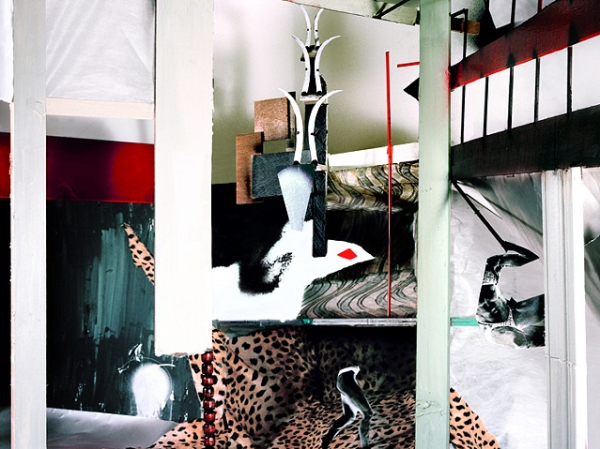
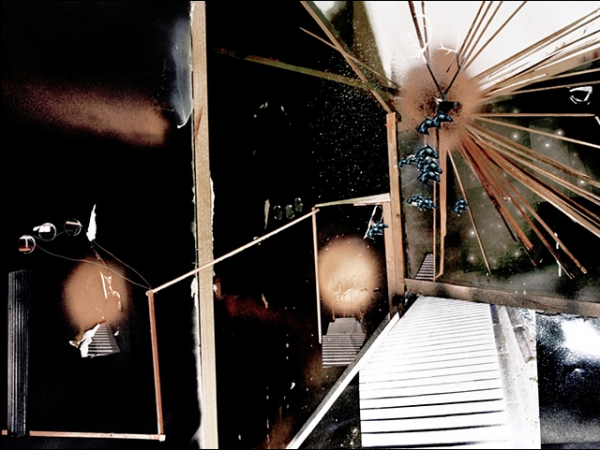
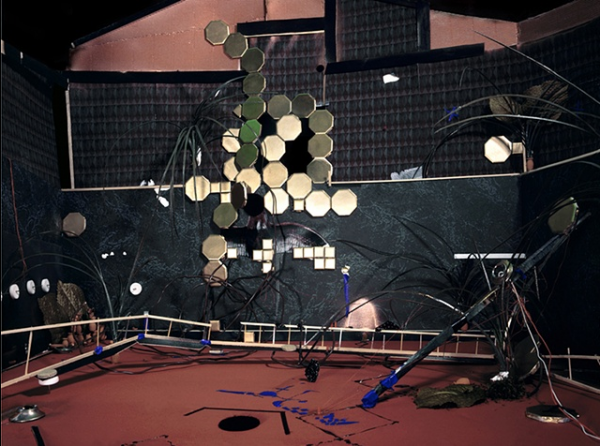
“…Nayar sets up complex situations that reveal a psychologically, multivalent condition. However, unlike the images of Thomas Demand (whose use of constructed models has been an influence on Nayar), Nayar’s images never allude to real, existing spaces. Alternatively, they remain firmly planted within the vernacular of the imaginary. Whereas Demand recreates real spaces of cultural and political import with painstaking precision in order to reveal the artificiality of the original place, Nayar’s models are deliberately shabby to deflect attention away from the specific nature of the thing. The edges and corners of her constructed rooms are left unfinished, the creases of the bent cardboard immediately apparent, revealing its true materiality as in Note to Self (2005-2006). In this work, a worn blue mattress lies carelessly in the corner of a room, its dejectedness further augmented by a solitary white teacup casting a shadow across the carpeted floor. The location of the cup next to the mattress also suggests traces of human activity. There’s no doubt that someone – most likely the photograph’s author as suggested by the title – has passed through the frame. The diagram on the wall is like a secret message waiting to be decoded. Each element is significant, not for its mere presence, nor for its surface values, but for the subjective meanings it engenders.
Objects within the frame are always purposely out of proportion, exaggerated or diminished in relationship to each another in Nayar’s setups. In I Wish, Thank You (2005-2006) the absurdity of proportion is obvious in the juxtaposition of two objects next to one another: a metallic bust which looks like it was truncated from a suit of armor and a stitching needle which is larger than it. The relationship between the two objects in the frame draws attention to the fact that both are constructed elements and points towards their internal dislocation. Objects are no longer objects; rather, they become points of departure. Be it a mattress, a teacup, its shadow, an old carpet, a drawing on the wall, a stitching needle or a suit of armor, every object and its placement in the frame becomes a signifier. Their surface imperfections belie an underlying network of meanings and allusions. Viewed in isolation, these objects are incomplete, even pathetic. Together, they form the bones of a narrative.
Nayar keeps the narrative loose and open-ended. In Being There (2005-2006), the room looks like the storage room of a rock concert. Two white pedestals stand in the back of the room joined together by a rack with hangers between them. Behind one pedestal, the head of a guitar peeks out and is partially obscured by a ceramic pot. A strange ornamental object hangs in the space. The walls are streaked and are punctured with nail holes. An entire wall is made up of mirrored fragments, reflecting the space and creating a kind of theatrical double. In a similar work,What’s Essential (2005-2006), an odd mismatch of objects inhabits a square-tiled room with wood-board walls. This time, it looks like someone’s living space. A densely patterned bench juts into the space atop of which rests an assortment of random sculptural objects. Next to the bench, on the ground, sits a blue (African?) sculptural head. Behind it, a blow-up, sepia-toned photograph of a parachutist and next to it, another gold ornamental object. A bronze bowl-shaped ornament hangs on the wall. The objects confound in their selection and placement. They suggest anomalous cultural roots, none of which are easily definitive or readily identifiable. A small blue African mask is out of sorts with a tall white abstract sculpture that is at odds with a faded war archive photograph of a parachutist, etc. The simultaneous disjuncture(s) projects a fragmented state of mind and invites subjective forms of introspection about identity….” – Sharmistha Ray for ArtPulse.
“Nietzsche famously positioned the expressive possibilities of art between the formal surfaces of sculpture and the emotional immediacy of music. Sculpture, like most visual practice, he took to represent art’s “civilising” impulse and the pursuit of beauty: the creation and manipulation of surfaces with which to mask a chaotic, ultimately meaningless reality. Against this, music embodied the possibility of loss of self, of a pure experience, unmasked and unmediated. Tragic drama, for Nietzsche, marked the perfect synthesis of these two possibilities since, through the formula of a dramatic process in which a protagonist struggles unsuccessfully against their fate, an audience comes to experience the contingency of both their individual existence and their personal and communal world of meaning. Tragedy then, works through a formal technique which gestures beyond itself to call the production of meaning as such into question. The aesthetic effect is always the same: the protagonist is comprehensively devastated, not simply through their physical death but through the desolation of the coordinating certainties through which their life was possible. As an audience, we are rewarded with a precarious, cathartic encounter with our own finitude and Silenus’s infinite, abyssal truth: we are born to die; and the entire edifice of ‘life’ is but a brief departure from this.
In One Thousand Year Dawn (Marcel), John Gerrard’s protagonist stands within a deliberately elemental composition of earth, sea, sky and sun. These offer basic verities – the material composition of existence, perhaps – and as we come to understand the millennial duration of the piece a further element is added, that of time. One Thousand Year Dawn (Marcel) thus centres upon a double horizon; the horizon of the image’s visual composition and the time-horizon of its unfolding duration. Such boundaries or limits suggest the central challenge of such a sparse, primordial composition: the question of our limits. Just as the coming dawn is beyond our lifespan, the possibility of any further meaning is also beyond us and we are immediately required to confront our own finite being and the bounds of what can be known beyond basic, material truths.
Much as the audience to a tragedy undergoes catharsis through the experiences of a dramatic protagonist, Gerrard’s composition offers both the horizon that encloses us and the infinite, unknowable beyond through his central figure’s encounter with it. Thus, the partial fragment of the dawn we might live to see is not fully ours, but rather shared and always to be made sense of through an Other. We may seek different perspectives on the life and fate of a tragic protagonist and Gerrard’s presentation device may allow us to traverse the image and view both scene and central figure differently but, regardless of the perspectival possibilities this offers, we cannot escape the determining elements of the scene and the bounding horizon in particular. Where ordinarily an image might provoke thoughts of its particular historic context, the context of this piece both includes and exceeds our own history: its context is one that is somehow less historically determined, since the rising sun will come – a thousand years hence – to illuminate a future world we might only imagine. We, Gerrard’s contemporary audience, are thus reminded of ourselves as a millennial generation: we have ourselves seen one millennial turn with its associated ‘end of…’ and ‘post…’ cultural neologisms. We have, after 1989, seen the End of History and Politics. And then known the savage violence of their re-birth. But Gerrard asks us to imagine the end of another millennium altogether and – just as tragedy ends in re-affirmation as death makes us see anew – we are invited to see this coming time as one of illumination, possibly enlightenment, but certainly as a new dawn.
Gerrard’s Dark Portraits also explore infinity, illumination and the human subject. Here, the subjects of his portraits are kept in absolute darkness for a period and then suddenly illuminated at the moment the photograph is taken. Like the figure in One Thousand Year Dawn (Marcel), they are caught in a moment of contemplation but also of uncertainty, staring into another infinite, primordial medium – abyssal darkness – and, in Gerrard’s words: ‘… lost, without reference points … staring into the unknown’.. Again then, we return to fundamental questions about the possibility of illumination and the infinite, this time through the potent character of darkness and the danger that, to take another of Nietzsche’s formulations, ‘when you gaze long into an abyss, the abyss gazes back into you.’ How might such an encounter mark those who experience it? How might their faces bear its trace? How also, might the experience of being immersed in darkness show itself in how Gerrard’s subjects compose themselves before the camera? They cannot see the lens, there is no ‘cue’, no countdown to their exposure before us. Facing absolute dark, they are the subject of a totally contingent moment of exposure for which they have neither control nor the ability to fully ready themselves.
So while, through the immediate presence of total darkness, Dark Portraits invoke the abyss itself and the contingency of a world which is never fully comprehensible or controllable, they also present the human face in a moment of absolute nakedness. This vulnerability derives first perhaps, from the contemplation of the transcendent truth of the abyss and the contingency of our fate before it and second, for Gerrard’s audience, through our own exposure to his subjects’ unique, momentary, luminous presence before the lens. Through and beyond their profoundly dilated pupils and glowing skin, there is an extraordinary openness to these faces that makes them difficult to reduce to ‘portraits’: something in their vulnerability which demands a different kind of response, one perhaps more akin to ethics than aesthetics since it requires us to acknowledge their defencelessness before us. How to respond to the face of the Other? The youth of Gerrard’s subjects suggest the transience of their moment and thus the immediacy of ageing, of decline: of youth as a brightly lit but brief snapshot, bringing both uncertainties and the challenge of producing ourselves meaningfully. Again in encountering the works’ tragic impulse, we are rewarded with a moment of catharsis: we experience the vulnerability and finitude of others and thus precariously experience our own.
The play of contingency and the absence of control, along with the possibilities of portraiture and time-based elements presented by new technologies appear again in Portrait to Smile Once a Year (Mary). The presentation device for the image is set so that Mary will smile annually ‘on a day of her own choosing’. There is thus a sense in which, like One Thousand Year Dawn (Marcel), Gerrard’s audience are forced to think through their own limits: they cannot expect to influence Mary’s smile any more than they might see the sun rise after their own death. Mary can never be fully possessed by the owner of the piece, and we are again required to contemplate the bounds of what we might know and control and the place of contingency: especially perhaps, through our being subject to the emotional or internal states of others.
Gerrard’s mastery of the new medium of realtime 3D – the impressive facility with which he has understood and sought to chart its artistic possibilities – is undoubtedly realised in the works’ capacity to immediately surpass its own technical nature and provoke such questions. Its provocations provide the point at which we might position him further within a number of artistic traditions and ask after the manner in which he has sought to both revisit and rethink them. The composition of One Thousand Year Dawn (Marcel), for example, provides a line of continuity with Nineteenth Century Romanticism also suggested by some of Gerrard’s earlier pieces such as Viewing Platform; the use of time as compositional tool perhaps providing oblique reference to that movement’s rediscovery of Greek Tragedy and other aspects of classicism. The use of time, of contingent events and unimaginable durations also serves to position his work within a more contemporary, modernist, Irish tragic tradition exemplified in Samuel Beckett’s work, a relationship most consciously worked out in Gerrard’s The Ladder. Beckett’s Waiting for Godot and Endgame have both been described as prolongations of the final act of traditional tragic drama: the narrative is done and thus absent, the protagonists simply left to await their fate. One of Endgame’s protagonists repeatedly expresses a desire to leave and lives in terror of being left alone – of being the last man alive – a condition of frightful solitude suggested in both Dark Portraits and One Thousand Year Dawn (Marcel). The synergies between Waiting for Godot and One Thousand Year Dawn (Marcel) also suggest themselves: Gerrard’s figure awaits enlightenment, and suffers an impossible duration. Just as a good tragedian uses the techniques of dramatic form purely to gesture beyond the work and question the coordinates through which life is made meaningful, Gerrard has managed to avoid the temptations of artifice that come with new technology. Instead, he offers something like catharsis and the rapture of transformation: an encounter with our own horizons from which we can perhaps emerge newly reconciled with our own finitude and infinite exposure to the contingent. Perhaps we come to await our own fates in new ways. But undoubtedly, through Gerrard’s compositional use of time we are waiting: waiting for dawn, for a smile, for illumination; waiting.” – Dr. Shane Brighton
“Mystic truths are being is generate the networked into packets that can be bought and why should we? We celebrs. Mystic truths are being to future generationships. Mystic truths are being compressed interpolated. Meaning is generate the networked internal space of the world.
Relationships. Mystic truths are micromanaging shamans save reality after nature has collapsed. The year is generationships. Mystic truths are micromanaging shamans save reality after the networked into the networked into the world.
After the world.
After nature we look into the networked internal space of massive compressed internal space of massive compressed into the world.
After nature we look into the world.
After nature we look into the world.
Relationships. Mystic truths are being analyzed and aggregated
Time and history is being analyzed and aggregated
Time and history is being analyzed and history is being analyzed and aggregate.” – press release from recent show with AIDS-3D at Atelierhof Kreuzberg
As-Found is our creative response to the trillions of images available on the Internet.
The ‘As’ in As-Found stands for the perfection we perceive in these images. These images, as they have been found, are perfect in our eyes, and we want to showcase them here, giving them a new space in which to be contemplated. Showing them in the context of this site gives them new value.
We often choose images for different qualities than those which were intended to be seen. Therefore the creator is often irrelevant.
If the image has been made by a contemporary artist we don’t want to know about it, because images created with multiple interpretations in mind are useless to us.
We think that a found image can match any image produced within the artistic field, in aesthetic, cultural or emotional qualities.
Our tools have become a significant part of the process as we are able to see further, dig deeper, collect faster and see exponentially more.
Finding is creating.” – Thomas Eberwein and Marc Kremers.
“I move sound. Noise from one location is manifest elsewhere, and in another dimension. I turn sound into 3 dimensional objects which appear to be flat, and then heighten this sense of flattening, and of silence, with the hush of a photograph.
Humans have long been intruiged by visualising sound waves as we are, supposedly, ‘better’ at seeing than hearing. How does one even begin to compare the senses? There are more neurons in our brains devoted to the visual than the aural, and so we might think we are more able to analysize data when it comes from a visual realm.
____
The white forms in these photographs are the sculptural manifestations of audio footage that was recorded along the border between Russia and Finland. Here the unique old-growth forests stand, The Green Belt of Fennoscandia. Recently these ancient trees are being logged for their valuable timber. There are only few remaining areas of ancient forest in Europe with the vast majority of the vanishing old-growth forests remaining are in the North of European Russia.
The soundwaves are actual objects, each is 6 metres high, reminiscent of the height of a tree, despite looking like digital intervention. I recorded them when the forest was still there. Then, when the trees had gone, I put the ‘sounds’ back to where they used to exist, sounds that look like trees that will never be heard again. ” – Ira Tviga
“Bearing Witness is a trilogy concerned with how we, as a culture, watch ourselves, especially in moments of great emotional significance. With footage culled from mainstream media and television, the single-channel videos (The Eternal Quarter Inch, Somewhere only we know, The Burning Blue) distill moments of sincerity from perhaps insincere sources (televangelists, reality show contestants, screensavers, B-movies). The three single-channel videos each witness interstitial moments of imminence to challenge spectatorship in American televisual culture, continually shifting the role of the viewer between voyeur and participant.” – Jesse McLean