“Sunset Solitaire references computer games, of course, in this case one played by an individual and watched by others, but there are a range of other associations. The Hudson River School painters and Mark Rothko’s glowing rectangles readily come to mind, as do the evocatively nostalgic memories of drive-in movies (for those of a certain age) or less anxious manifestations of ’60s light shows (for those of another certain age). While presenting Sunset Solitaire McKay becomes a deejay who mixes color rather than sound. There is a sleight of hand at work when he matches the fading sun’s color exactly; an effect that’s pure trompe l’oeil. One might think of Vasari’s anecdote about Giotto painting a fly on one of Cimabue’s paintings, which the older master tried to shoo away, or of Alexander the Great’s horse neighing in recognition at the portrait painted by Apelles.
McKay calls Sunset Solitaire an “intervention” rather than a performance. Perhaps this is because he responds to different environmental conditions that can’t be reliably replicated each time he presents the piece. Or perhaps it is because it is the viewer who usually performs interactively with his installations. No matter the label, Sunset Solitaire exhibits a complex layering of characteristics common in much of McKay’s recent art…” – Chris Ashley
“I investigate presentation and representation of self, others and viewpoint.
My questions include: Where and how is experience constructed? What are the possibilities of history, truth and fiction in photographic images? Can the point in which meaning adheres to representations be shifted? And what is their role in constructing personal and collective perspectives and understandings?
Questioning the ways in which my experiences are mediated, I investigate public/private negotiations of image, self and space. In reexamining common representational tropes, I explore ways of thinking about public/private representations and spaces, including the uses of and unlimited histories that exist within the millions of personal and media images created daily.” – Zach Nader
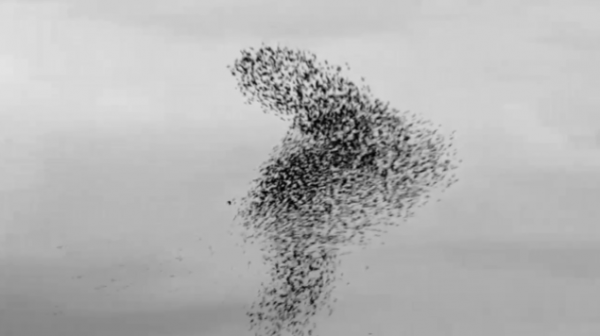
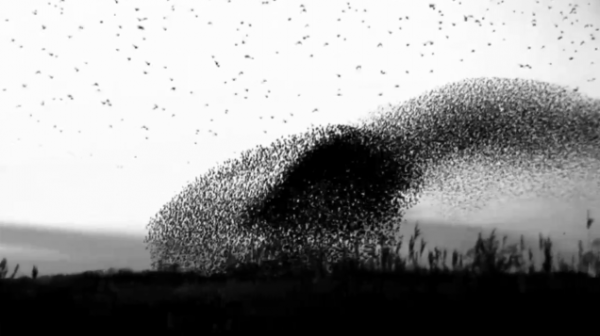
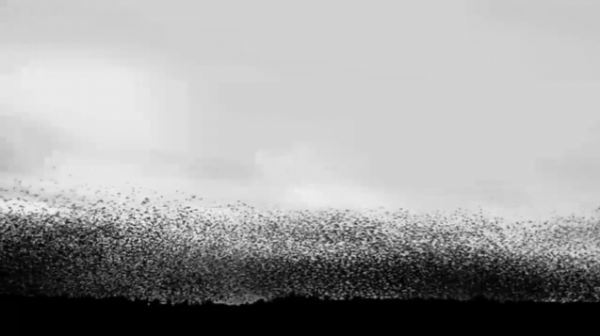
“There are no others, There is only us” is an amazing video filmed by Marc Silver in 2009. Marc was born in London and works worldwide as a filmmaker and creative director. His art installations and documentaries identify locations of power and potentials for resistance. Silver’s primary interest is in exploring the construction of physical and psychological barriers, in a time where the world is seemingly ever more connected and unbordered.
In a time where the world is ever more connected and unbordered, Marc Silver considers whether crowds are a force for oppression, or a potential for resistance. ‘There are no others, there is only us’ is a powerful visual metaphor illustrating the nature of collaboration and the power of crowds, with music composed by producer Ben Frost.” – Traingulation Blog
The older notions of photographers physically exploring their world may have in some ways come to pass. The Egglestons, Shores, Levitts, Winogrands ventured out with perhaps only the loosest intentions or framework of a “project” and allowed the world to provide. It is common now for artists to conceive of a project first and then impose that view almost filter-like upon what they are looking at. I would never argue that one approach is better than the other as long as – in the case of the latter – the work doesn’t become a mere illustration of an idea. For me, I learned photography through an ability to trust in the world and a rather strong distrust of “ideas,” so clever frameworks rarely excite unless the work from image to image surprises and transcends. Doug Rickard’s work in his book A New American Picture has me excited, perhaps a bit disturbed, and completely captivated.
Rickard’s work on this project has a clever framework. He has been exploring the world through Google street views. Google has been mapping the world from the vantage point of the center of its streets. The camera, tethered to a GPS system, is mounted on a car and takes wide angle images every twenty feet or so from a fixed height of about 7 feet. The user of Google’s street views can not only pan 360 degrees but pan up and down and zoom in on a part of the image. The final images are run through facial recognition software which attempts to blur the faces of people unintentionally recorded when the camera car passed by…” – Jeff Ladd
“Reparations is an initiative in the course of which used plastic bottles found by chance on the street are recuperated and transformed into rockets. The ballistic launching device is made up of a bicycle pump used to compress a mixture of water and air in the recuperated bottle. Through the incessant up-and-down movement of the pump, the internal pressure reaches its peak, which results in a loud explosion and the release of the bottle’s compressed contents. In this way, the bottle is transformed into a veritable rocket and shoots skyward. In walking through the city, bottles that had been abandoned in the streets were successively fired into the Paris sky.” – Michel de Broin
“Much of the material Collins chooses to work with are dated and with limited aesthetic means. There is an impending sense of mortality linked to the obsolete junkyard of the virtual realm, where things are lost, or constantly being updated or redefined. Core beliefs about identity, love and the pleasure of the visual are re-housed outside of a traditional artistic dogma or critique and re-presented as short intermittent moments; as enjoyable and entertaining as they are deeply resonant indicators of the current state of the world. ” – Dani Admiss
“We see the great city in the sky at a distance, across the water. A safe distance? Certain structures, when observed through a telephoto lens and isolated against the Rococo sky, take on the characteristics of enormous spacecraft, hovering. What are these craft? Who built them? Is there anyone inside? This project imagines a series of dormant sentinels, all that remain of a long-dead civilization. Once menacing agents of intimidation and control, they remain among us as dormant guardians of a vanished empire.” – Sean M. Eno via Hey Hot Shot.
“Every Now and Then, a solo exhibition by acclaimed artist Pascual Sisto. Pascual Sisto’s practice is a balance between what is hidden and what is revealed. Through a constant research of synchrony and symmetry he creates clean and detailed settings able to amaze spectators with a tight narrative rhythm. Each work exhibited in Every Now and Then is an ethereal surprise in between reality and fiction, urban and natural, past and present.” – bubblebyte.org – full press release here.
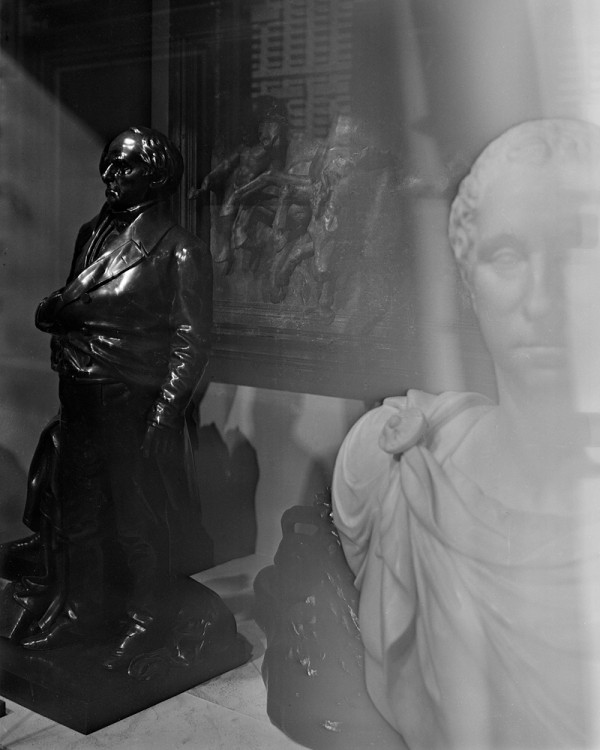
Visibile Library is available now for pre-order from Lay Flat.
“In a departure from the colorful still life photographs he is known for, artist Sam Falls brings together a series of black and white images for the first time in his limited-edition artist book Visible Library. With a large format camera and a few boxes of expired film, Falls spent a day making these beautiful and haunting pictures in the stacks above the American Wing at the Metropolitan Museum of Art in New York. Like “walking alone in the woods,” as he refers to it, Falls created what can easily be considered his most intimate body of work, a personal meditation on art, history, preservation and the photographic medium.” – Lay Flat
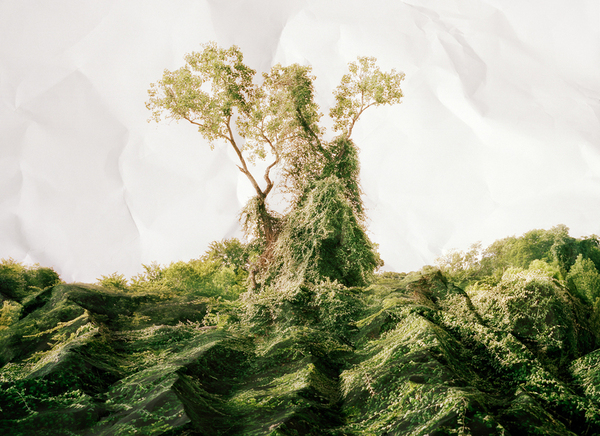
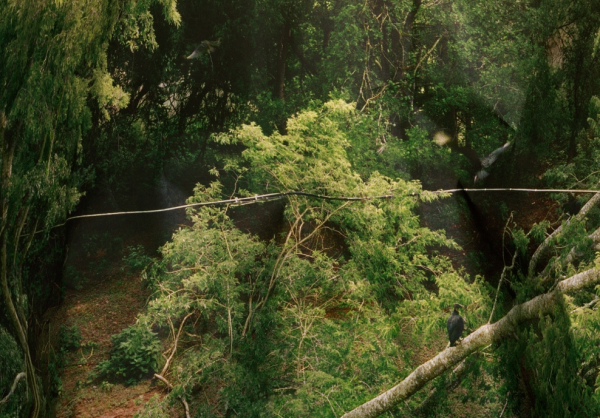
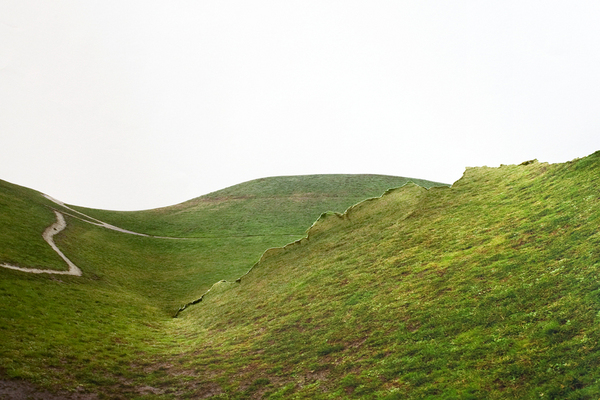
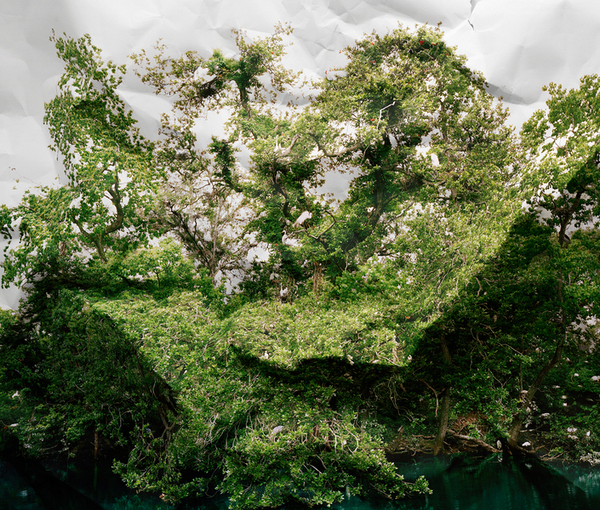
“In this series I am responding to photographs both as representations and tangible objects. Through physically altering enlarged prints and then re-photographing the results, I create works that oscillate between image and object, photography and sculpture, landscape and still life. While they may appear illusory, the resulting pictures are documents of actual events and are thus as authentic as the original representational images contained within.
My process unfolds through observation and experimentation – I let the image and its materiality dictate its direction. Playing with paper and with light in unplanned and organic ways, I look for new ways to perceive the space, form, and context of my subjects. In some works, large pieces of the original image are torn out while in others, smaller parts are more subtly altered. I use a large format view camera throughout my process so I can control perspective and record as much detail as possible. Whether focused on a ripped paper edge or a nesting bird, I hope to reach a place where picture elements interact and merge in unpredictable and expressive ways.” – Laure Plageman