“‘Cairns’ is a series of photographs that depict the aftermath of the demolition of high rise social housing in Glasgow and the Parisian suburbs, shot and printed after Düsseldorf school of photograph’s codes and photographers such as Andreas GURSKY and Thomas STRUTH, while pushing them to their ultimate stage: monumentality, frontality, absence of narration and time reference – ie impossibility to identify the season of the year or the time of the day; but instead of picturing an arrogant modernist building, only remains a pyramid of ruins. As the title of the work suggest, these mounds of rubble resemble Bronze Age cairns – structures erected to mark a burial site and, according to some archaeologists, to ensure that an interred corpse remains underground.
Cyprien Gaillard escavated a bunker which was buried in a hill overlooking the beach of Scheveningen. This is an area already undergoing drastic transformation as the existing communities and industries are displaced to make way for new housing developments. Gaillard’s project comments obliquely on this process of gentrification and the way in which outmoded architecture is buried or hidden beneath new layers of urban development. This work, titled Dunepark – a rough translation of its location – can be seen as the embodiment of the ‘Bunker Archeology’ carried out by the French cultural theorist Paul Virilio in his eponymous 1975 book and exhibition. For Gaillard, the physical process of excavating is a form of negative sculpting. He sees this submerged bunker as a buried readymade. With the help of large earth-moving equipment and volunteers of the Foundation Atlantikwall Museum Scheveningen, Gaillard digged out this massive form to reveal it in all its brutalist glory, before recovering it once more.
In The New Picturesque series (from 2007), Cyprien GAILLARD questions the representation of nature through the notion of ‘picturesque’, literally ‘what is worth being painted’: originally, in the 18th century, rough or rugged landscapes, far from the ‘beautiful’ landscapes the notion later designated. Intervening either with white paint on 18th or 19th century landscape paintings or with torn white paper on old postcards of castles, GAILLARD covers all narrative elements and decorative details, thus revealing their truly ‘picturesque’ quality.” – Budgada & Cargnel
Work from his oeuvre, text from his website, translated by Google.
I WOULD GLADLY MAKE SECOND HAND SCULPTURES.
(I would gladly do sculptures by hand).
– – –
I like to say that I am the little free time I have to fix the world with a jigsaw (and some other utensils).
(I like the idea of making art with a jigsaw).
(Repair to start: we re firewall and then re hand).
Objects that can be seen as involuntary sculptures interest me. By mixing my own achievements with found objects and my images with images collected, it pleases me to introduce also some ambiguity as to the authorship.
Duplicate an object is a way to make it my own, to question the difference between a thing and its reproduction. I take this opportunity to disrupt the temporal sometimes wishing that the object exists before its representation, the original before copying, etc..
– – –
I belong to that generation which has seen technology become ubiquitous and wither the know-how and values of the working class. At the same time appeared on supermarket shelves, electrical equipment within the reach of everyone with the incentive (the free time has increased a little) to become perfect handyman. The manual labor was somehow quietly folded plants to garages and garden sheds.
I do not know if this is enough to explain the popularity of DIY techniques shown by many artists of my generation (and next) but I can attest that in my case it has played.
If we add to this that my studies in post-colonial period, made me discover the various tribes in a new light illuminated by André Breton, Jean Rouch, Claude Levi-Strauss and others, it is understandable that the discovery of the sculpture assembly (including through the so-called primitive arts), combined with the fact that it is today much easier to dispose of chipboard that block of marble, led me to materials, techniques and forms closer to the inventions of Professor that the achievements of Bernini.
(…) Based on images, on which see a child holding something made of wood, contained either a car door or the wing of an airplane, Joshua Rauscher built these things, wood, back across the shot. Finds two meet, taking the readymade against the foot and the volume of wood that we see leaning against the wall straight out of the image displayed next. The first idea, placing the object behind the cliché, is bereft of all reason, like the image found. Curiously, the place of these objects on the ground makes sense in that support image is to the wall. It establishes the ground for this game which is against the wall. The volume prepared by Joshua Rauscher then appears as an oblique sail between the mast and the water emerges. (…) Mathieu Provansal.
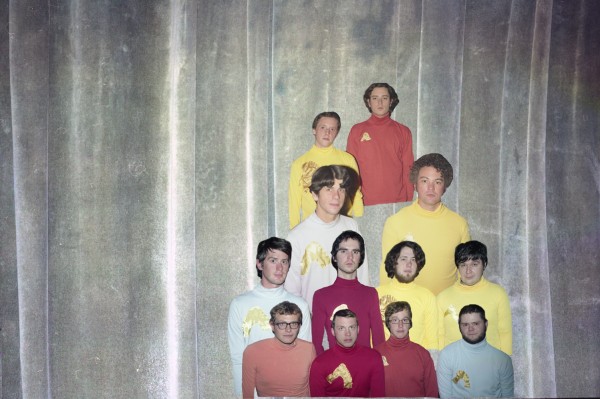
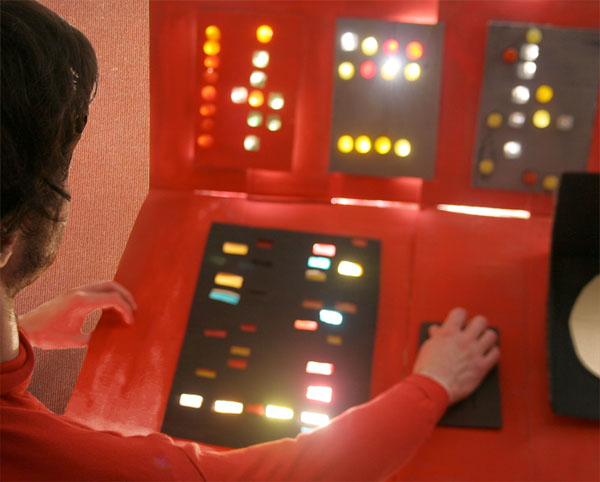
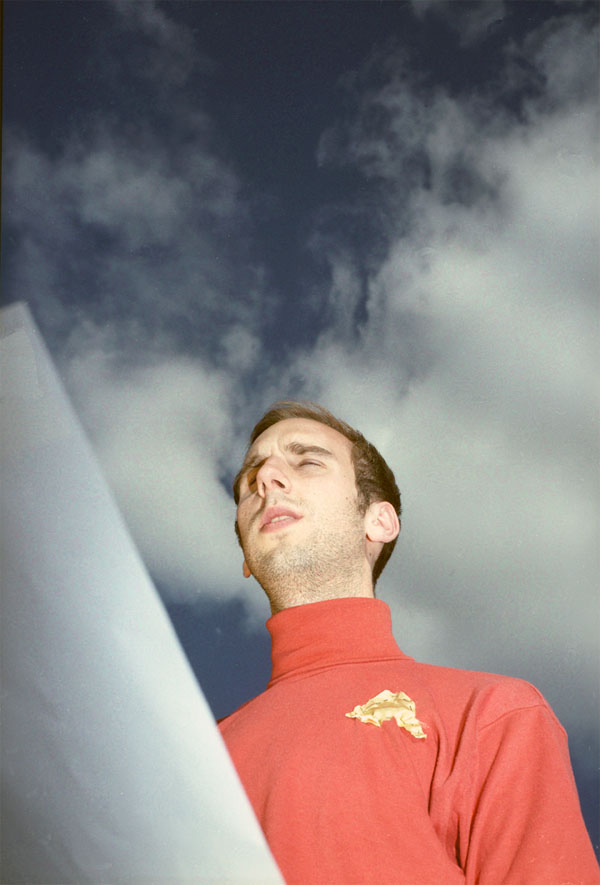
Maloney’s works lack subtlety with the same mix of self-awareness and self-deprecation that would permit one to wear a faux-star trek uniform constructed of a pastel turtleneck and what looks to be American cheese. This is the power of the work, it expertly capitalizes on the nostalgia driven zeitgeist that breeds the desire for reassurance/escapism that space exploration in the futurepast provides. Teleplay Part I stands awkwardly at the precipice of critical image making and a personal archive of a Sunday afternoon cosplay/LARP group that explores the depths of space while wearing turtlenecks while eating (and wearing) cheese slices in the comfort of their parents basement. While is immediately difficult for me to engage with the work on a critical level, Maloney is clearly very aware of the depth of the well from which she draws for these works, solidified the men’s off-frame gazes squinting at the blinding brightness of the future.
“In 1944 a Cold War began, a war that was brutal, inhumane. A war that has now been almost forgotten. The Western powers continued to consider the occupation of the Baltic and Eastern Countries by the Stalinist powers to be illegal despite the post war conferences that had recognized the borders of the USSR. Hidden behind the Iron Curtain, the occupation of the Soviet block continued for 50 years and destroyed the lives of millions. It is estimated that there were at least 20 million deaths. Many believe that the real figure is closer to 60 million.
Despite not receiving any backing from the West, the partisans’ resistance fought against the Soviet regime. These partisans had to abandon both their families and homes and seek sanctuary in the forests. In numerous villages and towns, domestic dwellings were attained by KGB officers for use as control centres, interrogation, imprisonment and torture. These homely spaces were converted into places of terror. As a result the forest not only became the place of refuge but also the place of mass graves.
The most active and forceful resistance came from the Lithuanian ‘forest brothers’, which lasted for 10 years.”
Indre SerpytyteWork from”In 1944 a Cold War began, a war that was brutal, inhumane. A war that has now been almost forgotten. The Western powers continued to consider the occupation of the Baltic and Eastern Countries by the Stalinist powers to be illegal despite the post war conferences that had recognized the borders of the USSR. Hidden behind the Iron Curtain, the occupation of the Soviet block continued for 50 years and destroyed the lives of millions. It is estimated that there were at least 20 million deaths. Many believe that the real figure is closer to 60 million. Despite not receiving any backing from the West, the partisans’ resistance fought against the Soviet regime. These partisans had to abandon both their families and homes and seek sanctuary in the forests. In numerous villages and towns, domestic dwellings were attained by KGB officers for use as control centres, interrogation, imprisonment and torture. These homely spaces were converted into places of terror. As a result the forest not only became the place of refuge but also the place of mass graves. The most active and forceful resistance came from the Lithuanian ‘forest brothers’, which lasted for 10 years.”
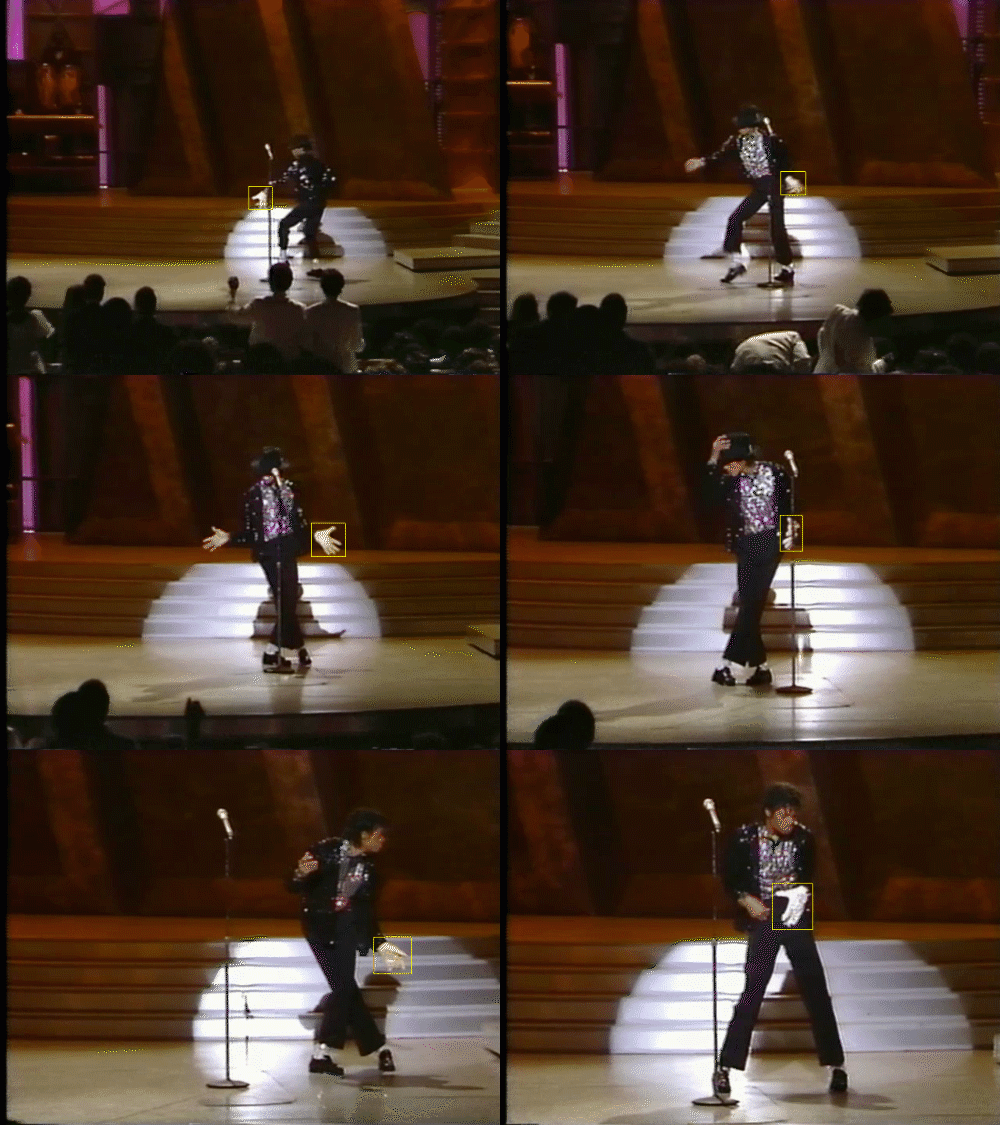
“There are 10,060 frames of video in Michael Jackson’s 5 min 34 sec nationally televised landmark performance of Billy Jean. The White Glove Tracking project (W.G.T.) is an effort to isolate just the white glove from this moment in pop-culture history. Rather then write unnecessarily complex code to find the glove in every frame of the video I am asking for the assistance of 10,060 individual internet users to simply click and drag a box around the glove in one frame. In the end this data will be shared freely for all to download, visualize, and use as an input into other digital systems.
W.G.T., much like Nasa’s Clickworks project, is an exercise in crowd sourcing. Interested users can donate small bits of time by analyzing single frames within a much larger video (in this case the first televised performance of the Moonwalk). This enables the production of information that otherwise would be prohibitively labor intensive. Working under the principal that useful data can be gathered by asking internet users to perform “…tasks that require human perception and common sense, but may not require a lot of scientific training.”
(~NASA)
White Glove Tracking Is an open source initiative which shares both the source code and the resulting data.” – Evan Roth
“OUTNUMBERED, a brief history of imposture is an audiovisual installation that examines the strategies used in making documentaries, Fact Fiction novels and popular scientific equivalents. Jasper Rigole examines concepts such as authenticity and objectivity by taking on a quasi – encyclopedic approach to his subject matter and presenting it with pseudo-scientific precision. The result is an apparently detailed study of the history of falsification.
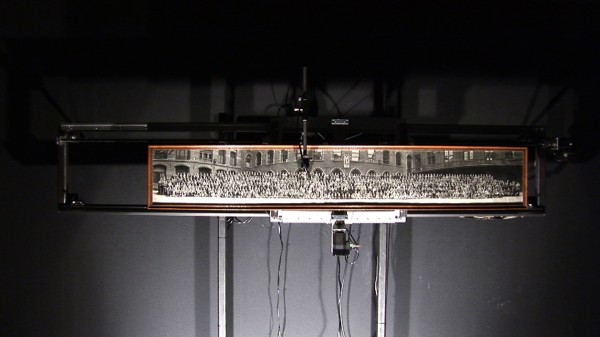
The video projection in the first part of the installation shows a camera moving over an old school photograph, using the pan-and-scan effect. This technique is frequently used in documentary films to animate still archival footage. As the camera moves from one face to another, a voice explains who these students are and what their mutual relation is. According to the narration, the boys depicted are historical figures, some well known and others more obscure. They all seem to have a link to imposture.
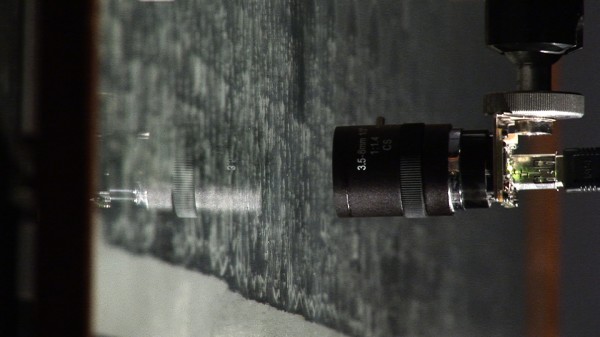
In the second part of the installation, it becomes evident that the first image is live and generated by a machine on which a panoramic school photograph for 1936 is hung. The machine is an inversion of the traditional rostrum camera. Instead of the camera moving above the photograph, the photograph moves in front of the camera.
The whole system, its movement as well as its narration, is controlled by a computer that runs through a complex database which includes the names and biographies of 888 figures. Each biography is provided with metadata referring to different categories, such as occupation, specialities, peculiarities and so on. By detecting similarities in this metadata, the computer is able to link related biographies and generate a plausible story. This perpetual narrative follows an aleatoric system that allows for an infinite number of changes to occur. As the computer does not take all the categories into account and sometimes uses irrelevant information, it will often make mistakes and broadcast historically incorrect data. But because analogies in the successive biographies occur and the transitions seem logical, these mistakes can be seen as possible histories.” – Jasper Rigole
“The world is a very overwhelming place for an infant. With a brain that new, the different neural pathways that perceive sensory information are still taking shape, and transmissions sometimes get lost in a soup of subcortical and cortex confusion. Scientists have successfully shown that when babies are stimulated sonically or visually the corresponding neural sensory mode will not be the one firing. For example, a baby will hear a loud noise but neurons in her sight modality will fire. Simply put, a baby can hear sights, see noises, and touch smells, and does so frequently. As a result a baby lives in a disorienting cognitive stage in which sensual boundaries are still developing.
This condition is not unique to early childhood, as many adults have developed fixed cognitive functions that classify as synesthesia. The neurobiological mechanisms of synesthesia work as follows; stimuli in one sensory modality registers as a sensory experience in a different modality. The most popularly referenced synesthetic function is grapheme-colour synesthesia, in which graphemes (letters, numbers, punctuation marks, etc.) illicit a strong color association from the synesthete. The Russian painter Wassily Kandinsky famously used his synesthetic condition to relay cross-faculty experience in artistic depiction. Kandinsky paintings arrange musical composition as it relates to his color and movement-based associations of them.
Artists frequently attempt to mediate the space between art object and viewer perception. Ostensibly that space involves eliciting synesthetic-like interpretation of artistic gestures, although rather than causing an actual synesthetic experience, the visual information triggers specific emotional histories that lead to cross-sensual engagement. If one’s response to an object or image is visceral, often specific personal memories are recalled. That archive usually contains information that refers to not just sight, but also touch, taste, smell, etc. Although synesthesia is a neurological condition that cannot simply be willed by the unafflicted, the effect of this type of response to art work mimics a genuine synesthetic experience. In both cases, the stimulation of one sensory organ gets channeled through more than one cognitive pathway.
This sensual boundary crossing has profound implications for artistic practice. Background Noise connects the sonic with the visual, using the photograph and printed image as a starting point. Many of the photographs in this publication trigger sonic associations because of simple cognitive functioning. If an image contains an object or gesture that is characterized by the noise it makes (a bomb for example), we see the sound almost automatically because our perception is based on a vast semiotic archive. Consider Yann Gross’ avalanche, an inherently violent gesture, which allows us to quickly feel the rumble and hear the cacophony of moving earth. Many other images contained in this book also reference aggressive movements or objects either as they are happening or after the fact. Although making that sonic association represents standard cognitive functioning to an adult, the neurology remains complex and fascinating.
Some synesthetes claim that their cross-modality sensory experience is actually what they might experience. For example, the letter “A” isn’t just associated with red, but it appears red in the external world. Or in the case of Gross’ avalanche, they actually hear the rumble of the avalanche or some other sound (a bird chirping) as a result of the signifier. That sound actually exists in their objective experience. Most other synesthetes allocate their experience to purely internal perceptual associations. “The letter ‘A’ feels red,” subjectively.
Other images in Background Noise evoke sound in a more subtle matter. Stephanie Gygax’s diptych navigates memory in a way that parallels the viewer’s neurological response. We see the image, understand its sentimentality and once again reference our personal memory archive which may, in the example of Gygax’s images, set the backdrop of city noise. How does each image in the pair elicit a different sonic association? In one the figure is sharp, in the other the figure is blurry, an automatic association most people connect to memory because of the history of the printed image. Do they sound the same or different?”- Daniel Shea
“…In reexamining everyday objects and technologies, I make images to explore the uses of and potential histories that exist within the millions of personal and media images created daily. Evaluating the ways in which my experience is constructed, I investigate everyday uses and underlying structures of photographic images, process and re-present them as new images. Using photographic imagery as a way of interrogating ideas of representation and how meaning adheres to cultural objects, such as snapshots, home movies, advertisements and images of news events, I create both conceptual and visual abstraction, examining how authenticity, memory and nostalgia function. Considering the relationship of the viewer to the commonplace, the tangible and the unrepresentable, I investigate presentation and representation of self and viewpoint.” – Zach Nader
“TO QUOTE B.I.G. “I BEEN IN THIS GAME FOR YEARS/ IT MADE ME AN ANIMAL/ THERE’S RULES TO THIS SHIT/ I WROTE ME A MANUAL/ A STEP BY STEP BOOK TO GET YOUR GAME ON TRACK” IMA HELP YA’LL MAKE IT IN THE ART WORLD WITH MY SIMPLE INSTRUCTION YA’LL!” – Hennessy Youngman