Hugh Brown

Hugh Brown

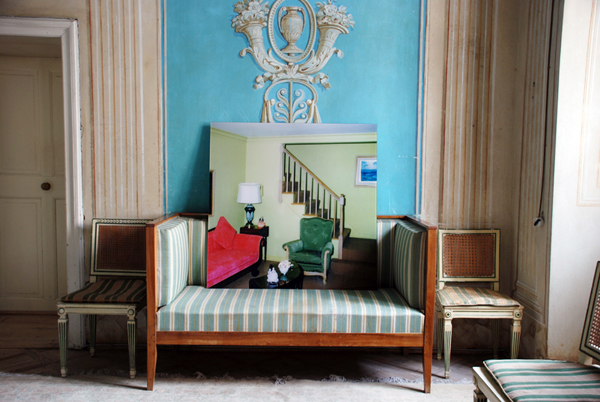
Work from Allegedly: New Chainsaw Works.

“Hugh Brown first cut his teeth as a chainsaw collector and punk rock aficionado; an unlikely pairing that spawned a Grammy award-winning music-packaging design artist and an obsessive appropriation artist compelled to insert chainsaw references into brilliant forgeries of Ed Ruscha, Jackson Pollack, Ed Keinholz, John Baldessari and dozens more contemporary art heavy hitters.

While the images stand on their own, there is humor and wit lurking within each Allegedly creation for the true art insider to uncover. Take the Hiroshi Sugimoto piece entitled Vista Theater (Texas Chainsaw Massacre 2) – Brown rented out the theatre and used a large format camera and an extremely long exposure to capture the entire film on a single print, just as Sugimoto did in his photographs of old American movie palaces and drive-ins as an expression of time. Or the Alexander Calder wire sculpture depicting a chainsaw held up by a three-person pyramid entitled Three Acrobats, One Chainsaw – a nod to both Calder’s primary medium and his fascination with the circus.

Each piece is as unique as the story behind it. He studied Hans Namuth’s footage of Pollock’s wrist movements, bought the same brand of gouache as Henri Mattisse and used Bruce Nauman’s neon fabricator to spell out Was/Saw in place of the iconic Raw/War. Not only are the works so convincing that many mistook them for authentic pieces when shown last year at the California State University Fullerton Grand Central Art Center but the process by which they were fabricated is an artistic expression entirely unto itself.

A photographer, printmaker and assemblage artist for over 35 years, Brown has had seven solo shows and many group shows including two at the San Francisco Museum of Modern Art and three at the Triton Museum of Art. But Brown’s standout achievement is a second place finish in the “Design a Chair for Barbie” competition sponsored by Vitra Design Museum, Metropolis Magazine, Mattell and W – not because of the second place finish but because the entry caused a fist fight amongst the judges.” – press release from Robert Berman Gallery

Recent with Juxtapoz.

Aristide Antonas

Aristide Antonas

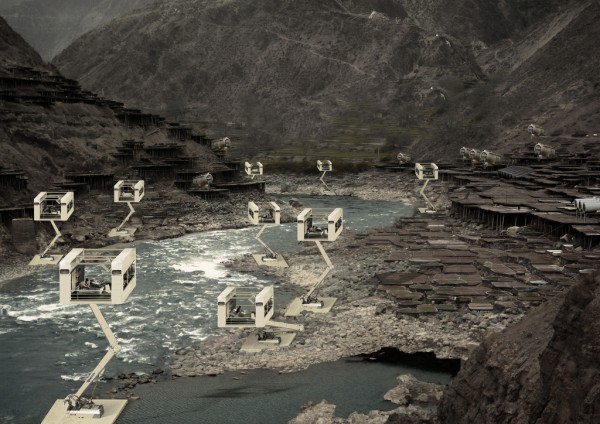
Work from Crane Rooms.

“Simple concrete foundations and elementary water pools are proposed to be installed in non hospitable beaches or arid hills nearby the sea. The room units form independent cells, they can be covered by tissues during the day; they provide a quality connection to the Internet. The private or public character of each room is regulated by the chosen high of every unit. The high control system is located inside every room. Platforms go up and down following the will of every provisional inhabitant. A bigger screen, related to the bed, serves as a home cinema structure; a small office, a wardrobe and a shower are placed in the same moving platform. A common underground kitchen serves the needs of all the complex; a reverse osmosis desalination plant provides drinkable water to the invisible kitchen and to the units (the water pipes follow the length of the crane).

An identical design for “crane rooms” can be undertaken within a system of moving vehicles in order to form a dispersed, moving “crane room hotel”. Rooms moving up and down provide summer shelters with changing views.” – Aristide Antonas

Adam Sajkowski

Adam Sajkowski

Work from Les 400 Clicks.

To really appreciate this work, you must visit the website.

“Les 400 Clicks is a multimedia project referencing Francois Truffaut’s 1959 French New Wave classic, Les 400 Coups (The 400 Blows). The original film has been reduced to 400 still frames taken arbitrarily from throughout the entire film, which can be played through in order by clicking the mouse, 400 times. This action is also synchronized with the film’s original title score” – Adam Sajkowski

Simon Menner

Simon Menner

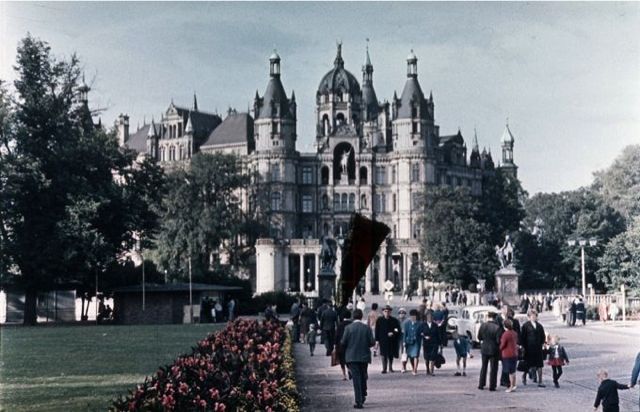
Work from Images from the secret STASI archive.

“In a time that is more and more defined by mechanisms of surveillance the “gaze of the Big Brother” seems ever more omnipresent. This brings me to the point to ask myself what it really is that the Big Brother sees. Can the terror such a repressive system spreads be found in these images? Or is the “gaze of evil” pretty banal and we have to attach the terror ourselves?

Mostly the results of surveillance remain hidden. An outstanding exemption is the work of the East German Stasi, which has been made widely accessible after the fall of the Berlin Wall. I believe that these archives can broaden our understanding of the function of surveillance and repression.

Due to the wonderful support by the BStU I was able to perform a very wide research in these Archives and I am able to show some images that present the viewpoint of the oppressor.

My very special thank goes to Mrs. Kühlow and Mrs. Schulenburg of the BStU for their patience and friendliness towards me and my project. Thank you very very much!” – Simon Menner

via A Photo Student.

Bernard Gigounon

Bernard Gigounon

Work from his oeuvre.

“”Cinema, Cinema, Cinema. The three things that can make us see the world like we want to see it, the way it is and the way it can be”, Alfred Hitchcock once said. Precisely this perceptual ambiguity, the multiple layers of reality involved in the moving, time-based image, incited Bernard Gigounon to start using the video medium. Before that moment, after his studies at the Department of sculpture in Ensav-La Cambre (Brussels), he mostly made sculptures based on traditional materials like metal and wood. But even then his work was based on a fascination for the tiny, apparently trivial aspects of our everyday lives, from which he tries to draw magic and poetry.

It has been said that cinema is in essence a special effect. The video work of Gigounon reduces that notion to its minimal essence: cinema as an illusion, created by the manipulation of images in time. He does not create this effect with advanced, multi-dimensional digital technologies, but rather through simple, transparent magic, referring in several respects to the optic fantasies and the ‘persistence of vision’ techniques from the pre-cinematic age. But this is not about the simulation of reality through optical illusions, or the creation of immersive ‘scripted spaces’, but rather amazement itself, purposely allowing oneself to get carried away by the unreal, the surreal, the deviant. In an age when our outlook on the world is constantly mediatized and determined by all kinds of special effects, Gigounon carries us back to a proto-cinema: the experience of a train journey, the amazing effect of a cuckoo’s clock, the projection of a magic lantern. He uses video as an instrument to recreate everyday life, to tilt our perspective through a “suspension of belief” into an enchanted reality.

Fantasy worlds are always there, anywhere, just like images, the only thing we need to do as a spectator is to allow our imagination to run free. Gigounon gives us a boost to let go of trivial reality, even if just for a while. This results in tiny phantasmagorias, like Jour de Fête (2005), in which skyscrapers seem to free themselves from their foundations, recreating the Brussels’ skyline into a setting for an elegant fairy dance accompanied by euphoric applause. Or Starship (2002), a visual investigation of a passing ship, which turns into a weird and estranging object through the juxtaposition of its symmetrical reflection. The work of Gigounon supplies a key to our imagination, even though we have to create the opening ourselves – a reflex slowly rusting away. The simulation of reality, in television, cinema, 3D games, encloses our reality more and more tightly, it breaks through our perspective and undermines the experience of astonishment.

Gigounon makes us believe again: in the stop-motion animated images in Cascade (2001) or Interlude (2001), in the unreal, chronology-defying stunts in Héros (2001), in the tiny airplane, stuck to the train window in Remédie à l’ennui – shooting past, skimming over the treetops, always defying our lack of imagination.

Magic is often the result of convergence, of unexpected associations between one image and another, between a voice and a character, between image and sound. In Standing Ovation (2001), originally part of a concert by Martha Argérich, a fragment from Jean Renoir’s Une partie de campagne is extracted and inserted into a new context, of time and sound. The backward travelling of a landscape in the rain is given new meaning on the sounds of a roaring applause. In Prélude n°3 (2003) Gigounon plays a graphical game with musical onomatopoeias, dancing and interacting within the confines of the white screen. The minimal chords and melodies of Debussy’s ‘Prélude N°3’, connected more by logic than by surreal observation, are given a visual counterpart in a pallet of coherent letters, constantly moving, shifting colour and size. Just like the composer paints an impressionist musical world with warm notes and tone colours, Gigounon creates a language of his own from sterile, achromatic graphical elements, in which the letters don’t merely derive their existence from the music, but their meaning as well. Gigounon, isn’t merely a visual artist, he is a composer as well. Like Debussy he is looking for suggestion instead of description. Like Debussy he collects tonal compositions of everyday observations, parallel visions not merely transcending reality, not even resisting it, but rather liberating and poeticising it.” – Bernard Gigounon

via pietmondriaan.

Mike Ruiz

Mike Ruiz

Work from his oeuvre.

For a little extra context see here.

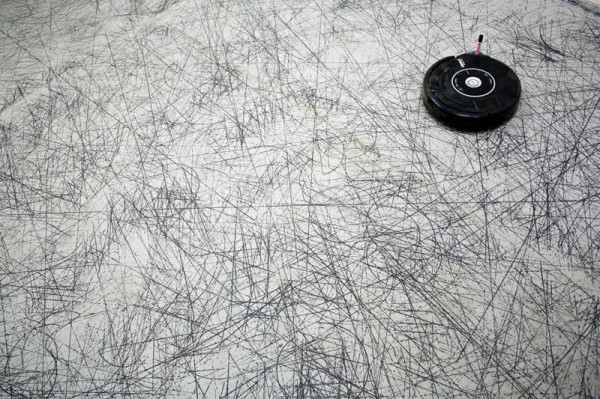
“The work is not original. I mean it is original in the sense that it is mine, and I made it, but I didn’t make the pieces of which it is constructed, those are all found. For me the process of exploring and discovering the material I want to work with is the real art. I then synthesize these found or preexisting elements into fresh arrangements or compositions. Sometimes things just fit together and they make sense, perhaps not in any practical way but in a symbolic or poetic way. I am big fan of achieving more with less, by performing very minimal gestures. Often times the content I am working with is already so ripe or loaded with meaning that it only need be altered or manipulated slightly. I like playing with the power of context.” – Mike Ruiz

Michael Huey

Michael Huey

Work from his oeuvre.

“The physical, hands-on part of my work takes place in the archive. It involves sorting, searching, and seeing. Mentally – and physically – it is fatiguing. Conceptually, the work revolves around the idea of loss…disintegration…and the attendant themes of legacy, inheritance, and inventory. In a phrase: ‘what remains’. Things – often photographic materials – that are overlooked, considered insignificant and/or trivialized play an important role, and presenting them anew is part of what I consider their rehabilitation. Indeed, I have often found that the most compelling images and objects are the ones I (and others) at first dismiss. Sometimes I have the feeling of being sought out by the material, not the other way around; as Ernst Bloch wrote: “We are not born simply to accept or write down what was and how it all was before we were here; rather, everything awaits us, things seek out their own poet and desire to be associated with us.”

There is perhaps a curatorial aspect to this, and though it is benevolent, it is not entirely passive. I am an intervening, authorial curator, and my goal is transformation, reconciliation… redemption. Though I do not intrude into existing narratives, I nevertheless make use of them to tell new stories.

I take an interest in how things become connected (and separated again), and this spills over into the organization of my exhibitions. There is often a kind of quasi-genealogical structure to the way the images become associated with each other in the shows and, in a larger sense, as components of my own body of work. Given the fact that I often select materials from family archives, these connections can be quite literal – Baroness Johanna Kotz von Dobrz, who as a sixteen-year-old made the sketches I discovered and re-used for my work 1862, for instance, was presumably a niece of the missing Prince Auersperg (le Prince Auersperg) from the Ruined Album series, which emerged from a completely separate source and archive. The works Library and Study represent, among other things, systems of classification in two successive generations within my own family. Other combinations of images are less literal and more akin to matchmaking on my part to promote ‘intermarriages’ between families; this was the case when I combined images pertaining to the history of Pompeii with objects from my family and other anonymous images in the exhibition ASH, inc., a meditation on ashes in a variety of their forms and meanings. The idea of ‘Pompeii’ bound the seemingly disparate items together as a metaphor for things cataclysmically lost, long buried, later rediscovered, excavated, and put to new uses. As it happens, this also describes the individual trajectories of most of my works.” – Michael Huey

Lernert & Sander


Lernert & Sander

Work from Chocolate BunnyHow to Explain it to my Parents and I Love Alaska (full video here).

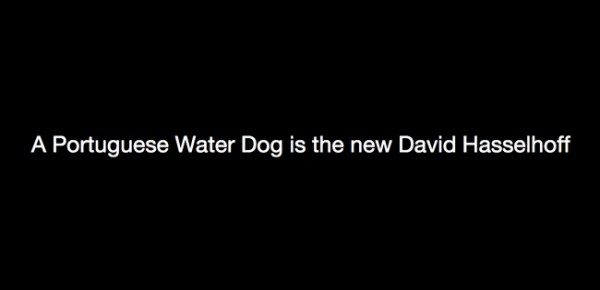
How to Explain it to my Parents is a documentary series in which 9 artists explain to their mom/dad what their work is about. For context, the artists’ work should be viewed if you are not familiar with it Martijn Hendriks, Arno Coenen, and Harm van den Dorpel.

“August 4, 2006, the personal search queries of 650,000 AOL (America Online) users accidentally ended up on the Internet, for all to see. These search queries were entered in AOL’s search engine over a three-month period. After three days AOL realised their blunder and removed the data from their site, but the sensitive private data had already leaked to several other sites. I love Alaska tells the story of one of those AOL users. We get to know a religious middle-aged woman from Houston, Texas, who spends her days at home behind her TV and computer. Her unique style of phrasing combined with her putting her ideas, convictions and obsessions into AOL’s search engine, turn her personal story into a disconcerting novel of sorts.

Over a period of three months, a portrait of a woman emerges who is diligently searching for like-minded souls. The list of her search queries read aloud by a voice-over reads like a revealing character study of a somewhat obese middle-aged lady in her menopause, who is looking for a way to rejuvenate her sex life. In the end, when she cheats on her husband with a man she met online, her life seems to crumble around her. She regrets her deceit, admits to her Internet addiction and dreams of a new life in Alaska. Click here for all search queries of user #711391.” – Lernert and Sander

Petra Petileta

Petra Petileta

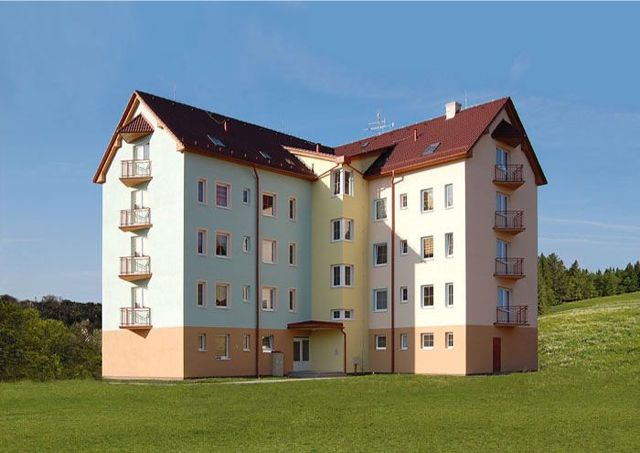
Work from Unit-Houses

“Once I got commissioned by Developer company in Prague. I got an assignment to retouch all the “disturbing” social aspects of their houses built for a lower social class in Slovakia. Photographs were retouched till the utopian view (social “fairy – tails”), even the surroundings or “natural” urban environment was erased. Photos have size 50 X 70 cm and for more decorative tone are adjusted in IKEA wooden frames.” – Petra Petileta

Kim Asendorf

Kim Asendorf

Work from her oeuvre.

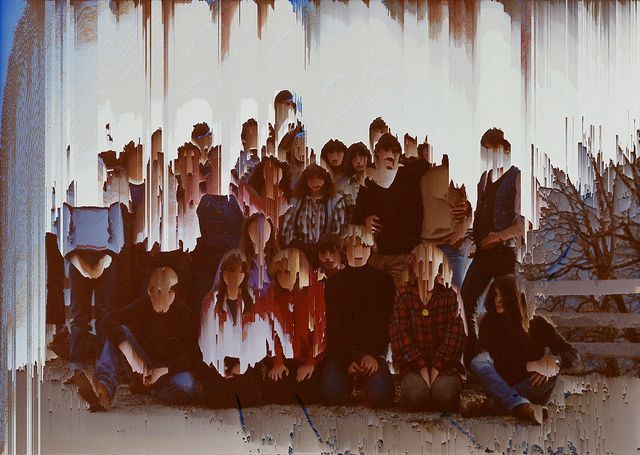
“Inspired by social behavior, the thinking of large media groups and the resulting gaps in these systems. Driven by curiosity and the basic idea of a do-gooder, he uses all the known techniques and methods to express oneself.

Creativity is the act of rebellion by definition. You have to be downright subversive to break the rules and to confront conventional wisdom, don’t you? And if everyone accepts what you are doing when you are doing it, you’re obviously not on the forefront and you are doing something that is within the paradigm. If every accepts what I am doing, I’m in the wrong field. (Prof. Allan Snyder)” – Kim Asendorf