Gilles De Brock

IMG_19185 IMG_1601

Gilles De Brock

Work from Liquid Design and The New Public Space 

Liquid Design

Imagine, you’re living in the 14th century, somebody tells you the printing press will be a catalyst in a scientific revolution. You would probably think this person is exaggerating. You do understand the principle of reproduction and distribution of thought, that’s not the problem. However, you can’t imagine that such a simple thing as a change in medium can have such a profound impact.

The inability to understand the transition to a newer medium can have severe influences. From the moment the printing press made it’s first appearance a new group of disadvantaged became apparent, the illiterate. This group was unable to read, spell and write and could therefore not interpret the new medium. For them the world became more and more a place they could not understand.

In the 21st century not only the illiterate are the ones that are unable to understand the new current medium. A new group is created, those who can not understand an ever changing medium. With the arrival of the internet it becomes relevant to ask if a human being and the graphic designer can really cope with an ever such changing medium.

The modern illiterate
There is a new group of disadvantaged because of the nature of a developing or established medium. This, in essence, is what happens with every new medium, as it asks of it’s user to undergo a process of unlearning and learning. Besides vocal language, people had to learn how to interpret written language, they had to unlearn to write the same as they spoke and refinements were expected along the way .
But what happens if a new medium is introduced that is not only different from it’s predecessor but also constantly changing? The process of learning and unlearning becomes a constant state. Alvin Toffler wrote the following about this:
“The illiterate of the 21st century will not be those who cannot read and write, but those who cannot learn, unlearn, and relearn.”

If we take a look at which medium might be the biggest change towards the printed word, the internet is likely to be picked. Our environment is more and more designed for quick communication in which we are hardly limited to geographical location, our social relations are maintained by platforms and applications and the amount of people that use smartphones, tablets and laptops is growing exponentially. All developments largely dependent on the internet.

With our daily and sometimes even uninterrupted use we give ourselves the interpretation that we also understand. We use a smartphone so we “are” on the internet, we use google so we use the internet. But do we truly understand what internet is? Is using applications that are on the internet the same as understanding? Maybe we are fooling ourselves, and maybe we are the new generation that does not understand it’s environment. And perhaps worse: we aren’t even noticing it.

From solid to liquid
An important cause of if we do or do not understand the internet is most likely the wrong interpretation of it’s nature. Up until we had internet all our media was invariable, as soon as they were produced. A book, newspaper, flyer or poster: as soon as they are produced they are solid. The internet on the other hand is not solid at all. For example news-websites can add and change content at any moment of the day. If you look at a news website you merely see a snapshot of an ever changing image. But if internet knows no solid state which state does it have then? Maybe liquid?

In core the difference between solid and liquid is easily described, however it is very clearly defined by Zygmunt Bauman “[…] in simple language […] liquids, unlike solids, cannot easily hold their shape. Fluids, so to speak, neither fix space nor bind time. While solids have clear spatial dimensions but neutralize the impact, and thus downgrade the significance, of time (effectively resist its flow or render it irrelevant), fluids do not keep to any shape for long and are constantly ready (and prone) to change it; and so for them it is the flow of time that counts, more than the space they happen to occupy: that space, after all, they fill but ‘for a moment’.

Not only the visual qualities but also time plays an indispensable role. A picture of a liquid form needs a time indication, because when the picture is taken, the liquid form has already changed. A solid shape however is hardly affected by time. As easy as liquid shapes change they manoeuvre around solid shapes and hardly feel impact. They can ‘flow’, ‘spill’, ‘run out’, ‘splash’, ‘pour over’, ‘leak’, ‘flood’, ‘spray’, ‘drip’, ‘seep’ and ‘ooze’. Even better, just as it takes energy to hold a liquid form stationary, it takes energy to make a solid form move.

The comparison between solid and liquid is highly relevant when we are talking about internet. The internet doesn’t know the solidness as we have known in media up to now. The internet does not feel any friction when being moved: it flows from one side of the world towards the other in a fraction of a second. Images can be duplicated with a friction that is almost negligible. News-reports don’t have a specific moment in time they are only snapshots of a liquid form.

Liquid Design
The underestimation of changes and their impact, and the wrong interpretation of the nature of the internet, can have profound effects, as Toffler indicated: the rise of a new generation that can’t interpret the media around itself. Especially because of these factors it is very important to address a group that is extremely dependent on the medium of this time and it’s interpretation: the graphic designer.

The printing press was on it’s own nothing more then a technique; it was the human who by a (specific) implementation gave value to it. He duplicated documents, made books, made posters, flyers and derivatives. From this development the graphic designer evolved, a person who has the task to visualise a message in the media of it’s time.
Here arises a paradox: graphic designer is rooted in history of solid forms, but it’s his task to use the medium of nowadays which is mainly liquid these times. Because the medium is so different, omnipresent and growing, it is the graphic designer who should critically review himself. The graphic designer must go from solid (static) design towards liquid design. We shouldn’t learn to write and read differentially in order not to become subordinated; we need to learn a skill to handle constantly changing state of our new media. This is not a simple task for a graphic designer, because he is inclined to think in terms of solidness, rules and grids. It is almost an inhumane transition. It is in our nature to think in heuristics in order to make our daily life manageable: who are and are not our friends, what I do and do not like, etc.
Maybe the transition to liquid design is still ungraspable and we should take a step back and realise that we underestimated the internet, it’s nature and impact. Even language limits us.
Comprehending, grasping, materialising are conceivable descriptions of a change in thinking in which statements are made in terms of solidity.
Factors like these make it an excellent task for a graphic designer to rove the internet in a visual way. By not only understanding it and holding it down but also by letting it ‘flow’, ‘drip’ and ‘ooze’.

The New Public Space

If posters can be created on demand, what does that mean to our perception of them? This project is an experiment on a poster that refreshes itself endlessly to current relevant matter. Can we design a poster that shows an interpretation of the current world at all times? And what happens when you do, can this application be thought of as a representation of the future?”

Peter Wu

With_sixty_seven_words_f 4 The_cold_did_wrench_detail Between_the_crooked_discourse

Peter Wu

Work from his oeuvre.

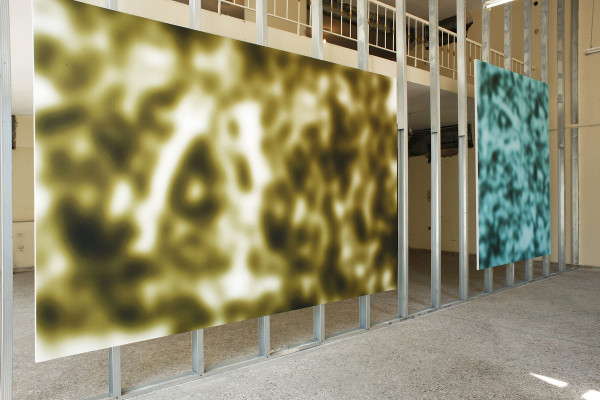
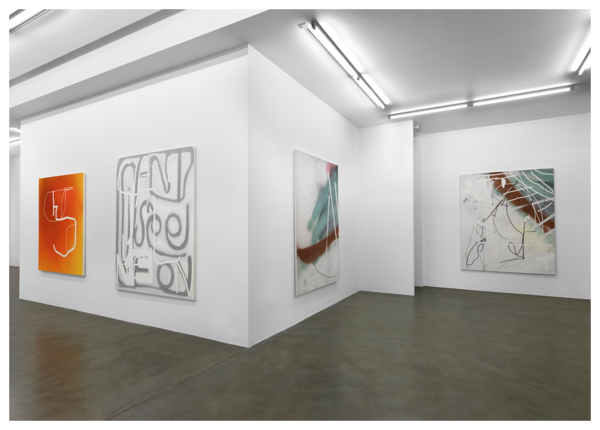
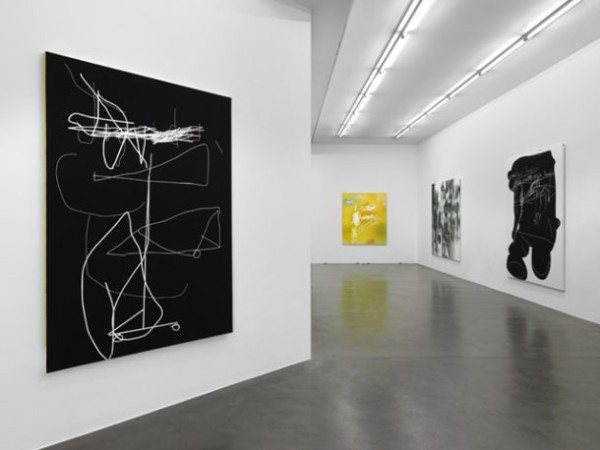
“Wu questions the relationship between painting and drawing. The two are interwoven, building up forms and images creating a dense space that recedes into a macabre, yet psychedelic, world of patterns, motifs and pure abstractions. It is a visual battlefield where electric color explodes through compacted and intricate ink drawings which seem to float on the surface like apparitions. Sometimes functioning like a Rorschach test, the viewer becomes indelibly involved within the act of seeing. Wu constructs an all-over composition, searching for significant new forms and combinations.

Seemingly chaotic, these paintings on the contrary are painstaking in their construction. Wu renders a tightly organized presentation of chaos. The obsessive and meticulous nature of the work is contrasted by, yet bound to, his intuitive process of creating the work. This results in a hypnotic and visually arresting experience. ” – Patrick Painter

Alex Da Corte

FUN_SPONGE_2new_900 BODY_WITHOUT_ORGANS_2_900 FUN_SPONGE_1new_900 Artspeak - Alex Da Corte - Bacon Brest DEAD_ZONE_1_900 BODY_WITHOUT_ORGANS_1_900

Alex Da Corte

Work from his oeuvre

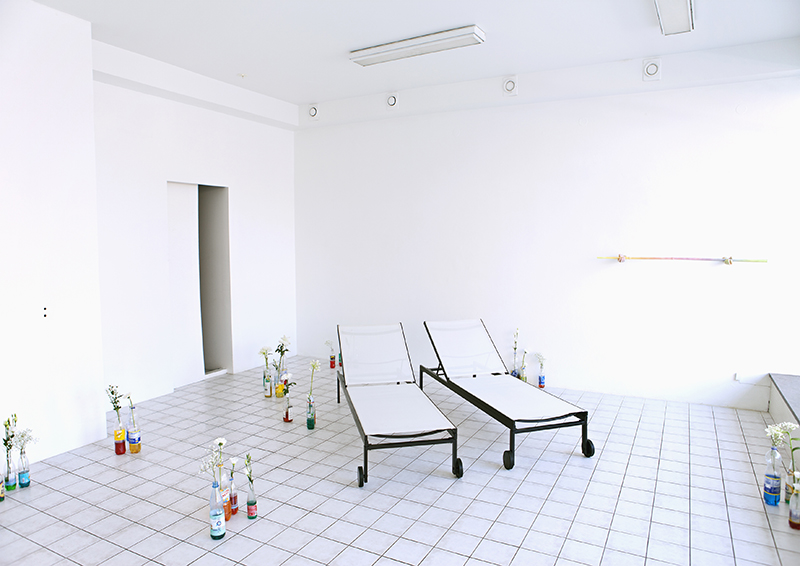
“Unquestionably, 29-year-old artist Alex Da Corte is an heir to the American school of pop. But Da Corte, who was born in Camden, New Jersey, also lived in Caracas, Venezuela, until he was eight, and some of South America’s appreciation for bright, lysergic colors, swirling surfaces, andcelebratory life-and-death imagery can be seen in his rambunctious multimedia productions. “There is a certaindecorative motif to Latin American culture that inspires me,” he says. “Like the festive nature of the Day of the Dead and the life-size piñatas with lots of sequins and glitz.”
Da Corte, who is currently at Yale University getting his M.F.A. in sculpture, seems to revel in that kind of gleeful explosion of candy and papier-mâché. His sculptures operate partly as high aesthetic comedy—one of his first serious works was a hand-sewn 15-foot-long ketchup bottle madeof vinyl—and more recent projects have included stuffed-animal snakes, rattlers made of crystals and acrylic fingernails, and homemade batches of cola repurposed on the floors of P.S. 1 as dried, minimalist grids.

Nevertheless, this pop appeal doesn’t come without an ensuing punch in the stomach. Many of Da Corte’s sculptures turn mournful or macabre—or just plain heartbreaking—right in the center of the party. In one work, a Christmas tree appears almost strangled by the extension cord that allows a second tree to be illuminated. In others, a bouquet of flowers is on fire, happy lightbulb faces are mixed with frowns, anddeclarations of love are amended with slurs like “so much it makes me sick.” “The idea for a work trickles down from everything I see, watch, and collect,” Da Corte says. “I take one idea and I want to add to it, flip it, or just turn it on its head. That’s how it mashes into my own.” Currently, for his thesis, Da Corte is building an elaborate sculpture based on Rainer Werner Fassbinder’s cult classic film The Bitter Tears of Petra von Kant (1972) that includes a fur island and the figure of Petra floating in the center and holding a hose that shoots out soda. “It’s her choice,” Da Corte explains. “She can leave the island or stay, but the soda that is pouring out is slowly cutting her off.” It is an image that neitherFassbinder nor the ad execs at Coca-Cola might have ever envisioned, but it is one that says everything about consumption and self-destruction—the interchangeable anthems ofDa Corte’s work.”

text via Interview

Jamian Juliano-Villani

1530389_619022634818061_1780446269_n 1491583_1375593689366310_1578432853_n 71454_617831008270557_13966493_n 1511130_617505394969785_230320165_n

Jamian Juliano-Villani

Work from “Gamblers Choice” at Retrospective, Hudson.

“Juliano-Villani’s recent work renders hyperaware chaotic scenes in a bright, rich palette. Informed by a wide range of sources from ancient Eastern art to 1980s American cartoons, Juliano-Villani resists the notion that all paintings have to be about the history of the medium.  While she may borrow elements and reference work from a range of sources including the curvaceous women in Ralph Bakshi’s cartoons, she makes use of inherent overstatements in imagery to play games of role reversal.  In several compositions, small accessory objects hold equal weight to larger figures.  Creatures of different species and ethnicities lounge against backgrounds of patterned curtains, bold plant life and spilt drinks.  Although visually complex and layered with references, the artist presents control within chaos.” – Retrospective, Hudson

Walter de Maria

DEMARIA_New-York-Earth-Room-high-res-1-21
5686b69fe781bd5a789ff89c6233f43b
Walter-De-Maria-The-5-7-9-Series-Variation-5-7-9-1992-1996-View-3.Courtesy-of-Gagosian-Gallery.Photo-by-Matteo-Piazza
Walter-De-Maria-13-Sided-Open-Polygon-1984.-Courtesy-of-Gagosian-Gallery.-Photo-by-Matteo-Piazza

Walter de Maria

Work from his oeuvre.

“…He was best known for large-scale outdoor works that often involved simple if rather extravagant ideas or gestures: a SoHo loft filled with two feet of earth, for example, or a solid brass rod two inches in diameter and one kilometer long driven into the ground in Kassel, Germany, so that only its smooth top was visible (a work consistent with an artist who once noted that “the invisible is real”).

In other works Mr. De Maria favored shiny metals and pristine floor-hugging geometric forms that were often repeated in great numbers. Early in his career, he earned the unwavering admiration of a German art dealer, Heiner Friedrich, who went on to become the founding director of the Dia Art Foundation in New York. Dia was dedicated to enabling a handful of mostly Minimalist artists realize ambitious, permanent, pilgrimage-like projects, and Mr. De Maria became one of its leading beneficiaries. The foundation financed four of his best known site-specific pieces and continues to maintain them.

The most famous is “The Lightning Field,” which opened in 1977 in western New Mexico after several years of trial-and-error construction. The work is a grid of 400 stainless steel poles averaging 20 ½ feet in height and spaced 220 feet apart covering an area 1 kilometer by 1 mile.

The possibility that lightning would strike the poles was rarely fulfilled, but the piece could look glorious at dawn or sunset, and its hard-won perfection — all the points of the poles were at the same level — brought a striking sense of order to the desert.

Another work that opened in 1977 was Mr. De Maria’s “New York Earth Room,” also a Dia project, which consists of a 3,600-square-foot loft at 141 Wooster Street in SoHo filled with 22 inches of dark loamy earth (specially treated so that nothing is supposed to grow in it). The piece, which recreates one the artist first executed in Munich in 1968, exudes a slightly moist, muffling atmosphere and affords a sight so surreally, deliriously startling as to be simultaneously ridiculous and sublime….” – New York Times

Compression Artifacts

compression01a
compression02
compression04
compression03
compression06

Compression Artifacts

A project by Joshua Citarella featuring Wyatt Niehaus, Kate Steciw, Brad Troemel, Artie Vierkant and Joshua Citarella.

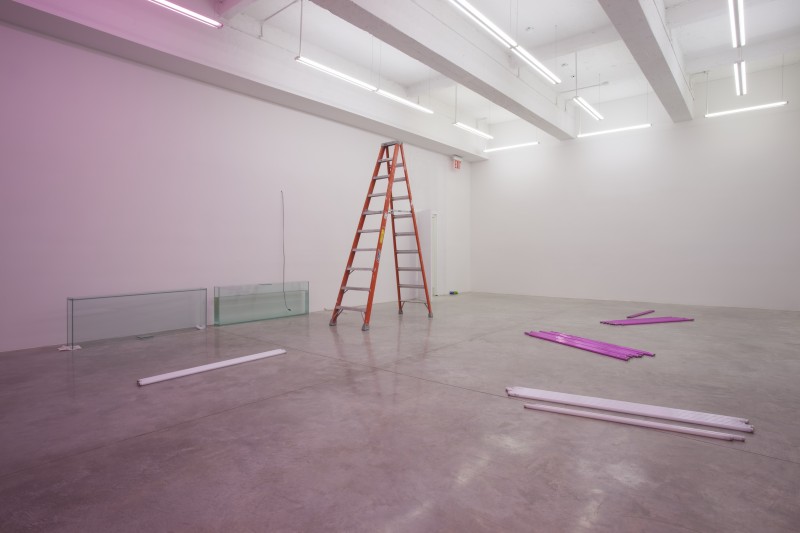
“Compression Artifacts is a comprehensive investigation into the specific agency that independent artists may access through the contemporary means of image production and distribution. When viewership now occurs at the screen, we may at certain careful instances reassess the values of physical space and material production.

As of their date, the images herein represent both the heights of success and inherent failures of photography-with-software to create value through the description and contextualization of an artwork. Following this line of inquiry, Compression Artifacts presents a curated selection of works which anticipate their transmission as images and have so taken on certain characteristics native to graphics editing software. Material production once shifted to accommodate the lens. It now shifts to accommodate the algorithm.

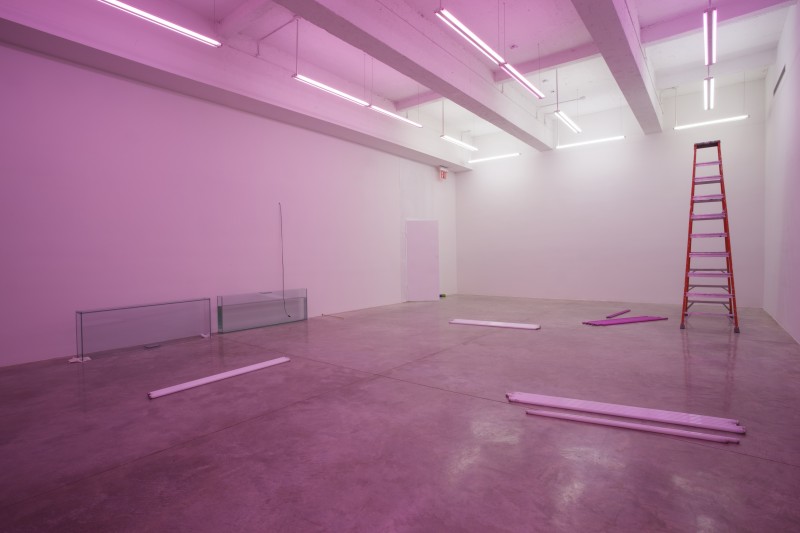
Compression Artifacts was conceived and built as a set within which to make photographs, designed to facilitate its own sublimation into digital images. The lighting installation mirrors the physical dimensions of the space, rendering an identical exposure on each surface. This static exposure allows photographs of the space to be almost seamlessly composited and reconfigured. The exhibition may expand or contract to fill any dimensions.

Material, photography and software are here considered in conjunction with one another. Art objects and exhibition spaces may now be partially fabricated, documented and through software hyper-realistically transformed into idealistic states whose physical manifestation would reach beyond the material means of their producers. In a universe comprised of images, where cultural exchange occurs through the screen, the ability to create the outward appearance of value becomes a means of empowerment.

The presence of graphics editing software has allowed increasingly hyperbolic descriptions to pass under the same critical rubric as conventional lens based photographs. As a means of documentation, conventional photography aims towards the most perfect reproduction, to close the gap between the world and its picture, while software aims to close the gap between the world and its image; not its visuality but its conception. At all instances software has been written to deliver digital captures into their ideal states, to unburden photographic images from the constraints of material, time and space.

A new ethical framework is beginning to form around documentation. The impetus of the contemporary photographer is to uphold the virtual concerns of an object and the space within which it exists. Knowledgable practitioners have long understood the inadequacies of photographic description. Fabricators have understood the constraints of material. Graphics editing software enables image producers to more acutely address the distortions inherent to lens-based photography and the limitations of material production; to more more mimetically, albeit less indexically, represent the world around them in accordance with their subjective experience and desires. Not yet so in title but clearly in practice, unedited images are now considered to be further from the real than their hybridized photography-with-software counterparts.

Contemporary culture straddles the threshold of an ontological shift which would value the digital image over the actual. The proliferation of idealized software-altered-photographs works to disenfranchise viewers from materiality. Yet for all its radical potentials towards transcendent immaterialism and horizontality, this technological revolution seems to have alighted at little more than a gilded veneer atop an old and familiar leaden substrate.

Images continue to serve as the primary instrument in the cultivation of desire. As part of our immersion into a global network of images we become ever more fully encircled by the photographic universe. Its descriptive system is now expanded through the presence of software but it continues perform the same essential function; representations working to recast our individual and collective conceptions of the body, material, time and space. The tools evidenced here are already present within all images now circulating in contemporary culture. Compression Artifacts may serve as a critical intervention to reorient viewers’ relationship to photographic images here forward.” – Joshua Citarella

Jerry Birchfield

01_©JerryBirchfield_ExerciseExorcise_2013
03_©JerryBirchfield_ExerciseExorcise_2013
04_©JerryBirchfield_ExerciseExorcise_2013
10_©JerryBirchfield_ExerciseExorcise_2013
Screen Shot 2014-01-16 at 9.42.50 PM
Screen Shot 2014-01-16 at 9.43.10 PM

Jerry Birchfield

Work from his oeuvre.

“Back and fill is a term that refers to a series of small movements for maneuvering a sailboat through a narrow area. It is also an idiom that refers to reneging on a previous statement or promise. It is appropriate here for describing the work of Jerry Birchfield, as both his work and process are dependent on a series of small shifts that result in its operation and form.

His photographs are as much built as they are taken. They function as a result of their material construction and as a document of their making. While subject matter is constructed for the photographs and materials are registered on film, the frame of the camera shifts, crops, translates three-dimensions into two, and functions as a documentary device. Signs all but fail, the photographs operate like sculpture, and the frame of the camera is reflected by the relationship between subject and object. Viewing the photographs becomes as equally latent with potential as pictorial and material content.

As the work maneuvers through narrow spaces, and reneges on statements it just made, sense must be made of its parts. As a result of the specificity of indexical information and the ambiguity of legibility, in combination with referentiality to myriad sources, the photographs are not allowed to reconcile. Once the operation of parts are acknowledged, a position can be identified and formed in which understanding is questioned then reaffirmed or changed.” – Jerry Birchfield

Mateusz Sadowski

4-THE_RESONANCE_2014_MATEUSZ_SADOWSKI_EXHIBITION_VIEW_GALERIA_STEREO_2 1-THE_RESONANCE_2013_MATEUSZ_SADOWSKI_FILM_STILL_1 7-THE_RESONANCE_2013_MATEUSZ_SADOWSKI_FILM_STILL_6 2-THE_RESONANCE_2013_MATEUSZ_SADOWSKI_FILM_STILL_2 6-THE_RESONANCE_2014_MATEUSZ_SADOWSKI_EXHIBITION_VIEW_GALERIA_STEREO_3 kadr6-copy

Mateusz Sadowski

Work from The Resonance 

@ Galeria Stereo 10 January – 22 February 2014

ML: Can you briefly describe the technique in which the film “Resonance” was made?

Mateusz Sadowski:

To simplify things it’s enough to say that the film was made in the technique of stop-motion animation. Technically speaking the realization of “Resonance” can be also described through the process of transformation that the image underwent: from the video registration, through the separation of the stills in the computer, then printing of these different stills, achieving a new physical form, and then photographic registration in a studio, again returning to the computer and editing in order to achieve the format of a film.

Do you think that the process of reshaping of the film material can be considered as a metaphor of some inner, mental process that is connected to perception of the world?

Yes. I think perception of the world is tightly attached to the constructing by the brain the structure of what we perceive. Such structure isn’t complete, it contains mistakes and is open to transformation, to corrections. Thanks to that an increasing over time understating of various phenomena in the world is possible, although it isn’t a linear process, of course. Coming back to the film. It took me quite a long time to discover the method step by step, not to mention the technical difficulties. Building the whole process of making of this film led me to changing or transforming the earlier scenes. In the end plenty possibilities of presenting appeared that I wasn’t able to forsee previously. When closing the production I felt pleasant insufficiency due to the appearance of ideas for the next film, because I could not fit them all in this one.

„New physical form” of the image that you mention is a writting-pad of film stills – a two- and three-dimensional thing at the same time. How did you decide to place an animated image in a wider static frame and show as an element of a composition?

From a desire to show several “realities” that have different qualities, which together form one. At the very beginning I was thinking about recreating an idea for sound piece that haunted me when I was 15 years old. The pieces was meant to be impossible to be listened to from the beginning till the end. Its structure was meant to be based on a consonance of different harmonies, melodies, rhythms and other attributes in such a way that they last simultaneously and are coupled with my emotional state. I believe that it was a vision that, if there were such necessity, could be classified as religious.

Back then I had no means through which I would have been able to express something like that and religion still does not appeal to me. In order not to fail again after 14 years, I began to write a visual piece. I read and thought about different physical theories that propose parallel worlds, about the disputes whether the world has continuous structure (analogue) or non-continuous (discrete). I had a lot of time for those meditations because the work on the animation required performing arduous tasks, which without some “material” in the head would have been beyond endurance. For keeping the balance I read also different literature, Robert Walser’s, among others. The film was being made parallelly. It was meant to be just like a strange theory made up during a crazy stroll when the world seems beautiful.

The cycle „Once and for all” consists of a number of photographs that in short can be divided into two series: the first consists of studio photographs that present variety of models, the second is a series of photographs of real objects or calibrated details of objects. What concept hides behind the second series?

In the second series I create divisions in space that is in the frame and I do it by registering such cut-outs of an apartment-space that are anonymous, which means that they could exist in many places, they have no important pecularities. In the “first” series I also create divisions in the image of the frame, however I construct them relating to models created from the scratch. What’s interesting, I notice common features of both methods. One of those characteristics are perceptual qualities of the image, the possibility of manipulation of the space in different scales. Another one is the realization that “real” space that I photograph, unifies itself with the “model” one. I speak about that moment when a wall starts to resemble a sheet of paper, out of which then I create a model in 5 minutes. Thus a wall can acquire the features of a model. I should add that it is not a concept that the photographs of the cycle illustrate, but only my secondary considerations based on the images that I make. The fundamental problem of the whole cycle is like that: how to achieve an interesting image using the weakest means possibly, or: how to strengthen the power of expression with the use of uninteresting matter. A strong image for me is the one that stimulates imagination.

What is according to you the role of the „point of view” in finding an image of the right power?

It is a necessary element that I try to make use of consciously. Most often I place the photographed three dimensional objects in a way that takes into consideration the point of view of a standing man. Thus, I can influence the impression of the scale of the shown space, enlarge and diminish it. Thanks to the fact that the used materials are recognizable, so the real scale is not actually hidden, the power of the image is build through the tension that accompanies the decoding, recognizing what is familiar.

Although the result of these endeavours is two dimensional photograph, the viewer has an impression of dealing with a three-dimensional object. Flattening does not deprive the objects of spatial features. That seems to be the leading thread of your latest works – suggesting an additional dimension of things, in a literal and metaphorical sense.

I begin work at the moment when I begin to lack the words, and in order to check something I need to do it, in order to see it. I am interested in creating such meanings of visual situations that I am not able to meaningfully verbalise. Perhaps this is where this additional dimension of things comes from.”

Interview by Michał Lasota

via Dust


Vettor Pisani

MG_8622 MG_8594 MG_8233 MG_8601
Vettor Pisani

Work from “Eroica/Antieroica” at MADRE, Naples.

“Vettor Pisani figure appears to us today radically contemporary, that of a true precursor who successfully combined conceptual investigation with irony, the play of language with role playing, masking with the search for truth, major history with the chronicle of the trivial, the sacred with the profane, the art of the past with provocations of the present. From his solo exhibition in 1970 at the Galleria La Salita in Rome, and presence at Documenta V, through his many participations in several editions of the Venice Biennale, Vettor Pisani gradually revealed himself as one of the most important witnesses and exponents of artistic research in Italy from the ‘70s, as well as one of the most personal and visionary authors on the art scene of his generation.

Studded with triangles, circles and semi-crosses, mirrors and tables, labyrinths and pyramids, pavilions and architectural models, alembics and hourglasses, pianos and violins juxtaposed with busts, mannequins, casts, fusions of religious figures like Christ, the Virgin, the angels, or pictures of Oedipus and the Sphinx or Arnold Böcklin’s Island of the Dead, and populated by a veritable personal bestiary (turtles, rabbits, chickens, monkeys, goldfish, snails, guinea pigs, cats, peacocks, eagles and pigeons), the works of Vettor Pisani are imaginary theaters of memory and knowledge, philosophical and cognitive representations “of the history of modern Europe” and its contradictions, ephemeral scenographies of moral issues and intellectual questions as unavoidable as they are insoluble, forms of introduction to the complexity of speculation expressed through the ordinariness of everyday life, spacetime thresholds between different eras, codes of communication between opposing states or entities (hero and antihero; human and divine; human and animal; man and woman; life and death)  and, finally, provisional museums of the inevitable destruction and constant reconstruction of art, in which the kaleidoscopic variety of the artist’s artifacts and references, the dimensions of history and myth, gender, the different cultural traditions and identities of the artist all come together in a unicum, indefinable in its critical status and aesthetic consistency.

Pisani’s output has some of its most significant achievements in the many versions of RC Theatrum  (a veritable Rosicrucian Theatre presented for the first time at the 1976 Venice Biennale and then resubmitted and extended over the years in various versions, including The Theatre of OedipusThe Theatre of the VirginThe Azure IslandThe Theatre of the Sphinx, The Theatre of Artists and AnimalsThe Crystal TheatreVirginia with the Goldfish), in cycles devoted to the islands of Capri and Ischia and “Napoli Borderline,”  in political works that have as their focus the themes of Judaism, Nazism, the compromised European identity (dealing also with the issue of migrants),  and in the design of the Virginia Art Theatrum / Museum of Catastrophe, a work  produced from 1995 to 2006 in a disused travertine quarry at Serre di Rapolano, Siena, configured as the culmination of all his research: dwelling, philosopher’s stone, opus  which condenses his idea of art itself. These are projects and works that will all be reconstructed, reordered and documented in the exhibition. In all these works and projects, art history, politics, psychoanalysis, popular culture, everyday news, hermetic philosophies, Masonic symbols, alchemical rituals and Rosicrucian doctrine  inextricably overlap, often in ways that are oddly dissonant or even ironic and often self-deprecating, yet paradoxically always coherent in creating a sense and a world of his own.

Offering an in-depth vision of the principal aspects of this research, at the same time broad and deeply complex, stratified in time and articulated in expressive media adopted, the exhibition – curated by Andrea Viliani and Eugenio Viola  and under the scholarly supervision of Laura Cherubini  – is the most comprehensive to date to deal with the artist. It brings together the most substantial group of works, both historical and recent, ever united in a single exhibition on the artist, enabling visitors to trace his whole output, from site-specific installations to drawings and collages, from paintings on canvas and PVC to performative actions, from photographic and filmic images to works in mixed media, with an essential endowment of documentary materials.  At the conclusion of the exhibition, in 2014, the Madre will produce a major monographic bilingual publication (Italian/ English), to be issued by Electa. A second exhibition  will be presented, in the early months of 2014, at the Teatro Margherita in Bari  (the artist’s birthplace). Designed specifically for the spaces of the Teatro Margherita and organized in collaboration between the Fondazione Donnaregina Naples and the City of Bari, the exhibition will bring together works and documents from the 1970s down to his most recent production.” – MADRE, Naples

Marian Tubbs

mazoe_12_1000 doctor_1000 Marian_Tubbs_2012_1000 Marian_Tubbs_12_2012_1000 5_1000

Marian Tubbs

Work from her oeuvre 

“The installation art of Marian Tubbs collapses tropes of high and low visual culture. Her work examines how materiality can be manipulated to produce art that delves into notions of pleasure, utopia, and reality.”