Monday, 20 June 2011


Neal Fryett
Work from his oeuvre.
“An exercise in expansion (on the utility of a thing)
1. A door-wedge, door-stop, or door-wedge-stop is a utilitarian apparatus most often associated with the holding of a hinged or otherwise swinging door at a preferred position.
2. It may, however, be utilized for a multitude of purposes – the most notable being to hold any given door either in an open or closed state.
3. A door may be held at any angle of opening, so as to prevent it from being closed or to hold it such that the door is prevented from being opened from the outside.
4. In the conventional sense, a door-wedge is most effective when the tapered edge is positioned in the space between the door and the floor.5. It may be pushed, kicked or pressed tightly into place such that a frictional three-way relationship is initiated between the underside of the door, the top-sloping section of the wedge and the area directly beneath the wedge.
6. One may forcibly push or pull the door upon the wedge, particularly if the wedge is made of a soft material such as pine or rubber. Unless the wedge is secured to the floor, however, it is advisable that the door be pulled upon the wedge while being foot-held in place.
7. The door-wedge may be slowly or quickly positioned (or removed) at the convenience of the operator.” – Neal Fryett
Tags: alternative processes, photo sculpture, sculpture, seattle
Posted in Uncategorized | Comments Off on Neal Fryett
Sunday, 19 June 2011


Ruth Van Beek
Work from her oeuvre.
“Ruth Van Beek or the Poetics of Paper Weights
Ruth Van Beek’s collages play a particularly clever and intricate game of hide and seek with the truth of an image. ‘The result is a picture of something that never existed,’ she explains on her website. Ruth Van Beek was born in 1977 and graduated from the Gerrit Rietveld Academy in 2002, and I believe her work belongs to a new tradition of collage art. The clash of worlds, of technology and human nature, that sparked the great surrealist tradition has now been internalised into a new, more controlled and intimate form. No more rockets or planes, no more vacuum-cleaners, no more explosions (except flat explosions of colour). We are dealing here with a clash of inner realities, or the clash between inner and outer realms.
We have swallowed the scissors. They’re now inside each and every one of us, cutting reality up and reassembling it. To us, collage has become as natural as breathing. Let me explain this through an example. What happens to us when we visit a museum? As we wander through the galleries the pictures drift by, some of their details lingering in our minds, growing, superimposing themselves onto others, gathering in corners, de- and then re-contextualising themselves, slipping into other pictures, into memories, narratives, movies, who knows… We head down to the cafe and open a newspaper or a magazine, the images from the museum getting mixed in with those we’re leafing through, so that by the time we’ve left the museum (having stopped by the shop to browse through yet more images and maybe even buy a few postcards) the experience has transformed itself in our minds into a completely new entity, something akin to a collage, or a number of collages. The same process continues as we head home past advertising posters, or sit down at our computers, or simply turn the television on. Our brains are constantly cutting and reassembling, trying to make sense of a visually saturated and conceptually fragmented reality.” – Marc Valli for Foam Magazine
Tags: collage, fold, mashup, mix, remix
Posted in Uncategorized | Comments Off on Ruth Van Beek
Saturday, 18 June 2011



Craig Kalpakjian
Work from his oeuvre.
“In my earlier sculpture and installation work, I used found and fabricated elements–barriers, detectors, and security devices. I was interested in the technology of deterrence and passage, movement and restraint as well as crowd control and traffic flow. This is what I was thinking about with the work involving bullet-proof barriers and waiting line stanchions.
One of the things I wanted to do with these sculptures and installations was to call into question notions of safety, security, protection and vulnerability, and to confuse the sense of inside and outside. While I always liked producing slick and seductive objects, in some sense I was more interested on their effects, both physically and psychologically, on the space around them. This charged mental space is already, in a sense, virtual, so working with 3-D software (at first just to arrange and visualize installations) seemed a great way to explore these ideas.
Narrative and cinematic movement were always important to me, and the first 3-D works I did were in fact animation loops that were output to video. Nevertheless I quickly became fascinated and obsessed by the great detail possible in still images. The sense of imminence and the implication of the covert, of a beyond just out of reach, is of central importance to me. This is what leads me to say that the spaces I depict are in a way haunted. I do love the almost cheap or tongue-in-cheek sense of mystery involved, but the emptiness of the images speaks to a sense of absence and loss that works on many different levels, and I think loss is very important to technology in general.
Although they are often seen as institutional or bureaucratic, I prefer to call the places I depict simply ‘shared’ spaces. While I enjoy warmly and lovingly depicting things usually seen as cold and uninviting, the choice of these types of spaces also reflects my love of High Modernist architecture and International Style. These too are haunted by the aspirations and ideologies which are historically associated with them, as well as the futures envisioned around them.
Aren’t we always haunted by the future?” – Craig Kalpakjian
Tags: 3d model, artificial, computer, fabrication, installation
Posted in Uncategorized | Comments Off on Craig Kalpakjian
Friday, 17 June 2011
Kate Gilmore
Work from her oeuvre.
“Kate Gilmore has ideas of her own about site-specific video installation and sexual stereotypes. Entering her New York solo debut requires stepping through large holes in two closely set temporary walls. You can pause between them and watch Ms. Gilmore in the video ”Walk This Way” as she kicks and claws her way through the very wall you are about to step through. She wears a demure dark-gray dress with heels. The silk flower in her hair matches the magenta of one of the walls.
Ms. Gilmore makes a point of dressing like a lady, color-coordination included, in all her short, methodical videos. Then she goes against type, parodying the task-oriented, implicitly macho Process Art pieces and performances of the early 1970s. Richard Serra in an ironworker’s mask and gloves throwing molten lead comes to mind, and like him, she rarely shows her face.
In ”Between a Hard Place,” another video, she wears a black dress and gloves as she bashes through five gray walls to reach one that’s pale yellow, a color cued to and by her matching yellow heels. In ”Down the House” she climbs onto an unstable stack of old furniture and white plaster blocks strung with pink plastic police ribbon and proceeds to smash them to smithereens with a sledgehammer. Her hair ribbon is pink, of course.
”Higher Horse” affirms the traditional division of labor. Ms. Gilmore maintains her balance atop a precarious pile of plaster blocks while two men wielding sledgehammers reduce her pedestal to rubble.
There is a focused, thought-through quality to Ms. Gilmore’s exercises in destruction; this gives them clarity, despite the noise and mounting chaos. They reprise early-1970s feminism and Post-Minimalism with an unexpected addition of formalist satire in her use of color, as well as in the punctured monochromes and the flattened pedestals.
Somehow it is not surprising to learn that Ms. Gilmore studied at the School of Visual Arts with Jackie Winsor, who made her name in the early 1970s with strapping, tough-minded sculptures, even as Mr. Serra did.” – Roberta Smith for the New York Times.
Tags: endurance, feats of strength, performance, video
Posted in Uncategorized | Comments Off on Kate Gilmore
Thursday, 16 June 2011


Laurie Kang
Work from her oeuvre.
“My practice is based in film photography, collage, sculpture and installation. I employ the photographic image’s ability to capture an image and present it as an apparently true document in time and history. Using both created and found images and objects, I merge fact with fiction, distorting and challenging perceptions of reality, dimension and space. Merging 2D with 3D – photography, collage, sculpture and installation, I explore a staged abstraction using the camera, paper, and found and created objects to make images that focus on symbolism, composition, colour and shape. Following elementary rules of design, more complex questions of space and reality are formed in contrast. The resulting images evoke tensions between fact and fiction, ultimately blurring their distinctions as they become sur-realities with ambiguous open narratives.” Laurie Kang
Tags: berlin, folded paper, installation, meta-photography, paper, photography, sculpture
Posted in Uncategorized | Comments Off on Laurie Kang
Wednesday, 15 June 2011
undef and Joshua Noble
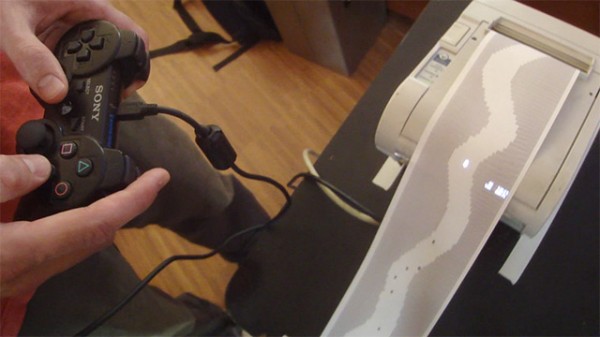
Work from Receipt Racer.
This entire post came from Today and Tomorrow, if you aren’t familiar with the site, check it out.
Receipt Racer is a microproject by undef and Joshua Noble. It a simple game which they developed during the “Let’s feed the future workshop”, part of the OFFF Festival in Barcelona on June 8th 2011. The goal of the game is to drive a car on a race track and to avoid the obstacles. The game is self was made with openFrameworks. The design of the race track was live printed on a thermal receipt printer and the car was beamed on top of that. A very simple game very well executed! – Today and Tomorrow
Tags: awesome, computer, games, interactive, repost
Posted in Uncategorized | Comments Off on undef and Joshua Noble
Tuesday, 14 June 2011

Marco Cadioli
Work from Abstract Journeys.
“Abstract Journeys is a screencapture series from Google Earth that explores the different surfaces and forms which have been transformed by man’s work in an abstract geometric composition.
Tags: computer, google, new media, satellite, screencapture, video
Posted in Uncategorized | Comments Off on Marco Cadioli
Monday, 13 June 2011


Nicole Hametner
Work from Schwarzes Licht (Black Light).
“On the white walls are hung at first sight only visible large white sheets of paper, replace the ceiling black light tubes, the conventional fluorescent lights. While the bright sunlight mixed with the artificial, is of the screen printing is barely visible. Only at dusk, when the artificial light shining from above, dominates the subjects enter into Erscheinung.Giftige nightshade family, which have been used since the Middle Ages to the relief of nightmares are faced with images of drug addicts. During the course of a day, the slow appearance and disappearance of the image and the resolution of the body is visible. The idea of an inversion of dark to light rays in the black light, leads to a confrontation between life and death, between beauty and disease. A duality that causes the sense of the sublime, fascination and horror at the same time. As a link of the work is the motive of the box choice of Sigmund Freud. It deals with the myth of the three options, which shows the example of the choice between three women, that this is about the confrontation with death. Since the choice falls on the third party fails to do so after Freud, the interpretation that it is the three women to the Fates, which will be the inevitable self-selected third parties. The name of the so-called irreparable Atropos leads directly back to Atropa – belladonna. A highly poisonous nightshade family which can lead to shortness of breath and eventually death. Each print shows in its place only an existential absence. what you look at the film, is never there. Each photo thus presupposes that there is a sign and there is a speaker, both clearly separated from one another. You can even take the view that the effectiveness of photography, especially in the movement is leading from this to that here there. These transitions, these shifts, these oscillations do literally and in a thousand ways the game of the observing gaze at the photographs. The image is latent, and we are compelled to wait and all of our impatience is powerless against this fatality.” – Nicole Hametner via Google Translate
via Mrs. Dean
Tags: awesome, black light, chemistry, installation, kickstarter, light sensitive, screen prints, super fun, swiss
Posted in Uncategorized | Comments Off on Nicole Hametner
Sunday, 12 June 2011
Ethan Breckenridge
Work from his oeuvre.
“TV Ads
A scientist, after driving his electric/eco friendly go-cart like car to an observatory,
looks through his telescope to discover an apocalypse-heralding asteroid tumbling towards the earth. In a heartbeat he is online finding his nearest Hummer dealer, and then off in his go-cart to the dealerships.
The suspension or postponement of progressive social ideals (generalized here as scientist-cum-survivalist) in theatrical, exemplary circumstances, allows in this case General Motors Corporation but in most instances, globalized corporations – to identify self-excessive behaviour as a natural instinct at odds with a disinterested pursuit of a progressive idea of humanity. This reaction becomes awakened by fear. However, the rhetoric of a manufactured natural as a producer of the real exists in an age-old opposition to the progressive ones it dismisses.
Thus, progressive ideals always leave the rhetorical door open for an appeal to nature, insofar as the methodology of these higher purposes (to the advantage of others) define themselves as solely cultural in relation to a construction of nature. Ideas of what is realistic or natural are, as we know extremely powerful and persuasive. The development of these ideas creates an artificial platform that all discussion, no matter what opinion or side is taken, is held to. So, in art as in life what we oppose we then can never move beyond. not only is art’s general opposition limited in its reach beyond what it opposes, but rather its antagonistic relationship in effect is dependent on the terms defined by what it opposes. but more to the point it is the conventional strategy of the established acts of opposition that is incompatible with any real notion of progress.
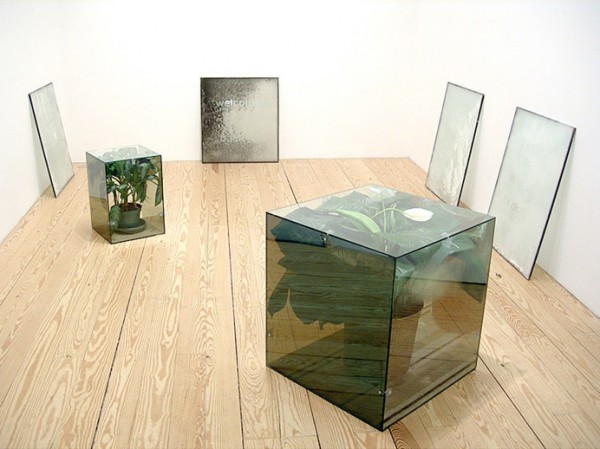
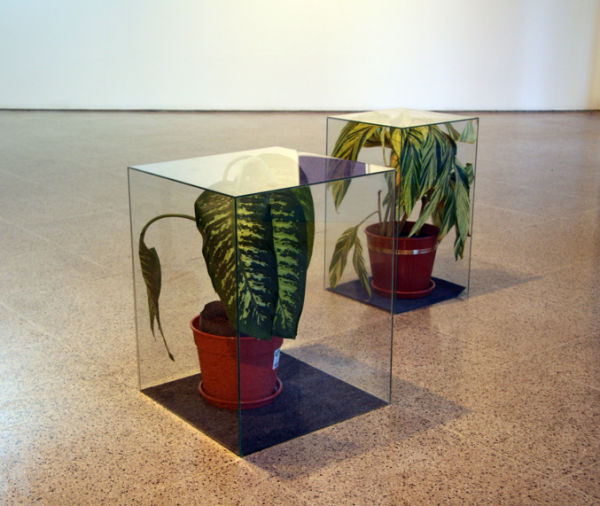
I am interested in the presentation and rhetoric of social systems: transitory places and objects, office plants, hallways, shelving units, filing structures and others, a standardization within the work creating a flexibility in the functional aesthetics nature, allowing for observation while the specificity of the object itself becomes quite invisible.
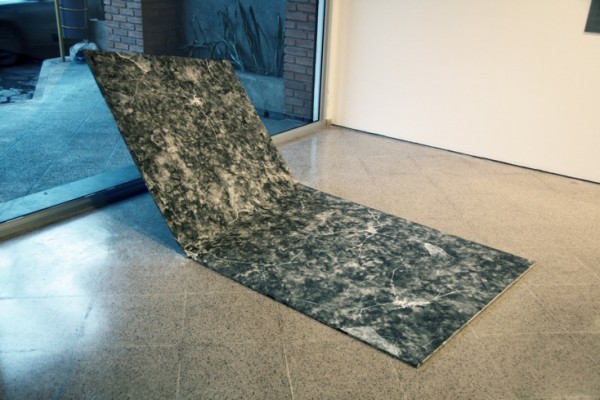
My work presents an encounter, where the literal, metonymic and metaphoric locate a endless space. The work never exclusively becomes a representation of an experience, or a literal object, rather, the division and displacement of both.” – Ethan Breckenridge
Tags: gallery, humor, meta-art, plants, sculpture
Posted in Uncategorized | Comments Off on Ethan Breckenridge
Saturday, 11 June 2011


Laura Piasta
Work from her current show at LES.
“This exhibit of new works by Laura Piasta uses geometry as a motif to signify a system that can stand in for an abstract concept. Using repetition to focus the viewer’s attention on relationships between forms, one is drawn into contemplation of the conceptual narratives behind the work in a way which goes beyond a rational understanding of them. Piasta’s practice derives from her experience as a dancer, where music and emotions were revealed through the lines and positioning of the body. This same disclosure of concepts through placement of the physical is echoed in this exhibition. By engaging the viewer with the perceptual, experiential and physical properties of the pieces one is able to understand the conceptual framework of the works in a way which touches on a transcendent or an intuitive awareness of meaning.” – LES Gallery
via Zero 1.
Tags: exhibition, geometry, painting, superdutch
Posted in Uncategorized | Comments Off on Laura Piasta