Monday, 1 October 2012


Vincent Dulom
Work from his oeuvre.
“…I manipulate pigment without premeditation, carefully avoiding imposing a gesture. painting is subtle. Trying to intervene as little as possible, I work intuitively, so as not to pre- judice the result. uncertainty informs my attitude. When I begin working I do not want anything in particular, I only respect the recomposed, physical, organic state of pigment laid on the surface….” – Vincent Dulom
Tags: circle, gradient, pigment, surface
Posted in Uncategorized | Comments Off on Vincent Dulom
Sunday, 30 September 2012


Simon Denny
Work from his oeuvre.
“In a clipping from a 1914 edition of The New York Times, it is reported that dancer Paul Swan collapsed in the middle of the stage during his vaudeville debut. Almost a century later, on the evening that Simon Denny’s most recent exhibition opened at Friedrich Petzel Gallery, a perfectly aligned row of freestanding double canvases imitating flat-screen television sets crumbled like dominoes after a visitor inadvertently knocked them over. Like the seven paintings on duty that night, the performer billed by the press as “the most beautiful man” soon returned to the stage, put back on his feet by assistants, and finished his number to ecstatic acclaim.
Appropriately opening with a physical collapse in the gallery, Denny’s first solo exhibition in New York drew its material from two market crashes. “Corporate Video Decisions” is the title of similar exhibitions he presented at Michael Lett gallery in Auckland, New Zealand, and now at Friedrich Petzel in New York – but also that of a trade magazine from the late 1980s, circulated to corporations to help them boost consumer confidence using video after a market meltdown. In addition to a company website called Diligent Board Portals offering “paperless solutions” to corporate boardrooms, the defunct magazine provided images and text that Denny appropriated for works shown at Petzel – digital prints on canvas, videos, and found objects tracing an arc in time between the current recession and one that took place some 20 years ago.
In the video “Corporate Video Decisions Archive Interface Design” (2011), played onto a Samsung LN46C750 46-inch monitor at the entrance of the gallery, one recession is literally dragged and dropped into the other. Produced with the help of a corporate DVD designer, the video is based on Cover Flow, an animated, three-dimensional graphical user interface integrated within iTunes and other Apple Inc. products for visually flipping through content. Loaded with a digital archive of the magazine Corporate Video Decisions, Denny’s video endlessly cycles through issues of the publication as one would through a collection of mp3s. Like a rare album downloaded from an obscure blog, the colorful 1980s graphic design and zany creative photography of the cover pages were imported into a familiar interface – not just that of Cover Flow, but of Denny’s work, in which the creative subjectivity of the artist virtuosically hearkens back to the artist’s role as a consumer free from the needs of production.” – Friedrich Petzel Gallery, New York
Tags: berlin, corporate aesthetic, televisions
Posted in Uncategorized | Comments Off on Simon Denny
Saturday, 29 September 2012
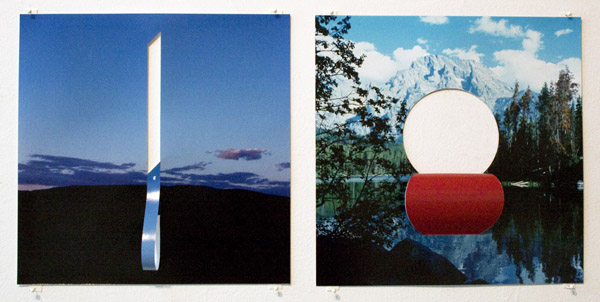


Letha Wilson
Work from her oeuvre.
“…Starting with images of idealised American landscapes – Yellowstone, Yosemite, Utah – Letha Wilson transforms and alters her photographs by various physical means. In some works careful cutting, folding and curling of the paper creates enigmatic but immersive environments. In other more extreme (and for us more interesting) work she treats the prints more brutally, crumpling and crunching them up and pouring concrete on them in rough lines and pools. When set solid the prints have a heavy, almost sculptural, physical presence to them, as if Letha had managed to transport a cross-section of a national park into a gallery space. It’s a really interesting approach because giving the prints this physicality invites the viewer to interact with and interpret the pieces in their own way, instead of simply being presented with a landscape to look at…: – Field of Vision
Tags: installation, meta-photography, rad, refresh, sculpture
Posted in Uncategorized | Comments Off on Letha Wilson
Friday, 28 September 2012


Erin Shirreff
Work from her oeuvre.
“…Erin Shirreff … among them—are addressing (or redressing) the issues attendant on becoming familiar with an artwork through its photo- graphic reproduction.6 Most of them have a studio-based practice that involves more than one medium—some are not even primarily photographers—but thinking about photography is central to what they do. Often their work includes handmade objects as well as photographic reproductions from any number of sources. They might build a sculpture based on a reproduction of an existing sculpture. They might videotape or photograph an object or setup they have created, destroying it after (and sometimes during) its docu- mentation, or create an installation whose sole purpose is to generate photographs. Viewers consider the artwork before real- izing that the object or situation they are contemplating no longer exists (a realization that is sometimes accomplished by reading some form of accompanying text). All that is left is the photographic trace—an objet manqué, as I think of it, using a somewhat antiquated art historical descriptor…” – excerpt from Photography and the Objet Manqué, Art in America via Lisa Cooley.
Tags: blak and white, collage, folded, meta-photography, representation, reproduction, sculpture
Posted in Uncategorized | Comments Off on Erin Shirreff
Thursday, 27 September 2012


Dan Holdsworth
Work from Transmission: New Remote Earth Views.
“In
Dan Holdsworth’s latest series Transmission: New Remote Earth Views, he appropriates topographical data to document the ideologically and politically loaded spaces of the American West in an entirely new way. In his images of the Grand Canyon, Yosemite, Mount Shasta, Mount St. Helens, Salt Lake City and Park City, we see stark, uninterrupted terrains where meaning is made through what it is absent, as much as what is seen. What at first appears to be a pure white snow-capped mountain is in fact a digitally rendered laser scan of the earth appropriated from United States Geological Survey data, a ‘terrain model’ used to measure climate and land change – to measure man’s effect on the earth.
Belying his empirical methodology is the fact that each of these terrains has a rich and conflicting cultural legacy. Beginning with the idealised aesthetic of the Romantic sublime via the deadpan industrial frames of the New Topographics photographers a century later, each has been subject to the gaze of artistic, political, and sociological categories claiming this territory as their own. Extending ideas of the frontier and seeing anew, Transmission captures the world as if from space, functioning not only as a map of the land but as a mapping of the discourses that these lands have come to represent.” See more;
“Working outside of the wilderness myths that render the images from the photographic avant-garde the ‘after’ to nineteenth-century visions of Carlton Watkins’ ‘before’, Holdsworth opens up a working territory that is open to the ambiguous and ethereal, oscillating between realms of art and science, the familiar and the alien, the industrial and the natural. Without the signifiers of the natural there is no idealised wilderness or picturesque aesthetic, no invoking of the Romantic version of the sublime; and yet at the same time what is antithetical to these visual tropes – the man-made, the artificial, the vernacular of the New Topographics photographers – is also absent.” –
Brancolini Grimaldi via Triangulation Blog.
Tags: greyscale, maps data, photography, rad, straight, topography, white
Posted in Uncategorized | Comments Off on Dan Holdsworth
Wednesday, 26 September 2012



Yuri Pattison
Work from focal-plane
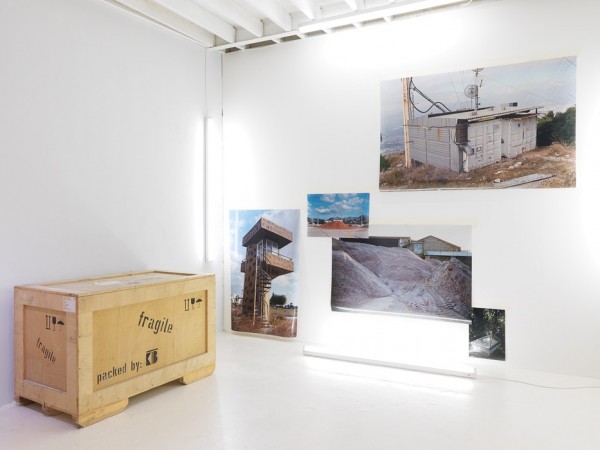
“Son Gallery are pleased to present Yuri Pattison’s solo exhibition ‘focal-plane’. In the installation, traditional museum vitrines are used as a display area for screens playing video material. This includes found video from nuclear surveys, carried out in the aftermath
of the Japanese earthquake in 2011, a series of shots taken by Pattison at the derelict site of the 2004 Athens Olympics, recordings of holographic cigarette adverts and a simulated tour around an art gallery. His subjects pit the functionality of technology against their aesthetic.
Pattison’s display methods elevate the impermanence of the digital file alongside the permanence of traditional artistic media. He says, “this mirrors my interest in how the internet has collapsed time: that while everything is changing at an amazing pace, the recent past is also as present as ever.” A semblance of permanence follows: for example, in the ever-presence of current affairs or in the inextinguishable traces of our activities on social networks. As a result, dystopic themes recur as an increasingly accessible past haunts the increasingly disposable now.
The dystopic element is countered by the creative opportunities afforded by a key facilitator of this haunting, accessibility: A virtual tour around a museum of contemporary art is hijacked by the artist and the backlit prints that are scattered on the end wall of the gallery – displayed as if resized, dragged and dropped on a computer screen – are whimsical images drawing on connectivity and construction. Further to this, Pattison’s website focal-plane.org, an ongoing projects, is a labyrinth of images and links charting his own observations, on travels and excursions, found imagery from related research, as well as documentations of artworks and collaborations. The portrait is of an artist intimately connected with a diverse series of networks and with an eye fascinated by the often extraordinary forms that ground this connectivity in the physical environment. The gallery itself, painted in an unconventional, neutral colour and with the vitrine packing cases left in situ, subverts the conventions of a white cube gallery and further focusses attention on the physical manifestations of Pattison’s content.”
Tags: basement, crates, fluorescent lights, lcd screens, london, photograph
Posted in Uncategorized | Comments Off on Yuri Pattison
Tuesday, 25 September 2012


Else Marie Hagen
Work from Det Synlige (The Visible).
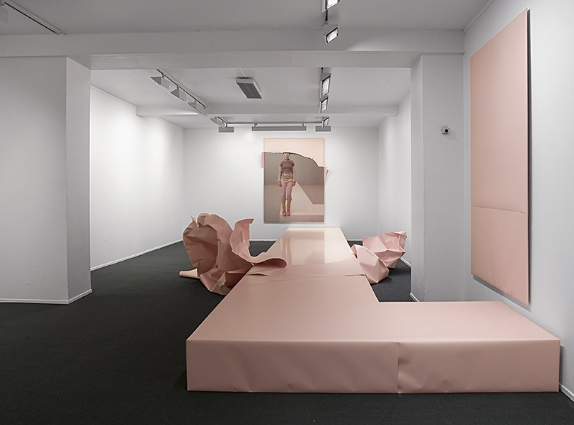
“The challenge that lies in spatiality and site-specific possibilities is an essential element that comes strikingly to view in the installation Cover from 2010. The space is dominated by a shiny pink podium covered with paper which is torn at one end. It is formed in the shape of an L and covered in paper of the same color. At each end of the podium photographs are hanging, partly or completely packaged in the same pink paper that is wrapped around the podium.
One photograph depicts the same podium with a model teetering on its edge, indicating that this podium is a catwalk. The model stands with eyes closed, clothed in disheveled layers. This creates a measure of disquiet in the otherwise serene, pastel pink and flesh-toned surroundings. We notice that the subtle tearing in both the models clothes and the paper on the catwalk creates a tense conflict between what is covered and what is torn. The combination of photographs and sculptural objects which both relate to each other on several levels, affords the viewer possibilities for relating to Hagen’s dualities and reflections of well-known themes.
Hagen employs the same devices that the fashion industry uses in its subtle advertising and staged shows. Our perception of ourselves as human beings is strongly qualified by this industry’s insistent, but nevertheless subliminal communication in society. Else Marie Hagen was born in Stavanger in 1963. She lives and works in Oslo.” – Randi Godø
Tags: convention, fashion, norwegian, photography
Posted in Uncategorized | Comments Off on Else Marie Hagen
Monday, 24 September 2012


Lotte Geeven
Work from her oeuvre.
“Throughout her work Geeven reveals splintered structures, reducing them to lines. Her city is a subway map and her mountain is a stripped vista. Working in multiple dimensions, she reveals a private and whimsical world hidden around the city, creating a non-existent space so that we can partake in her imaginative journeys…
…’This city doesn’t exist, only in your mind and only in form language. This is the place where we’ll meet.’
A journey to a far metropolis starts in my head as a book; she grows and gets intertwined with the everyday until I meet her counter image; this encounter into the heart of distance is the beginning of my story.
Upon arrival the city functions as a décor but when time passes by gradually I become part of her. This fading of the border between identity and location I research within my artistic practice. To stimulate the shifting of this border I make endless walks with all my senses sharpened, this way the city wins terrain in me and I in her and this is crucial. During my walks I make notes of ephemeral background details I come across, they become the main ingredients of my story.
There are many ways of storytelling; I am researching storytelling with only these background details: the information in between. The way a whole city can unfold from a single detail and a landscape can grow around a single smell. Using drawings, objects and installations I want to construct in tones the layers and coulisses of this scent. Large-scale drawings here function as the base tone, the backdrop; in here observations of smallbackground details from the place I’m staying grow rank in patterns and maps. The repetitive characters these patterns are an image type that function as a landscape you look over without focusing. It is in fact an image that functions as a Trojan Horse, something seemingly benignant that plants, with the power of spell, a story in your mind through a backdoor.
In my three-dimensional work, thinking as a draws man I build props that create the front layers of this coulisses. While building I try to construct an image vocabulary in the dialect of me and the city I am at; here the shape, material, intensity and size have to justify the character of the encounter with my new surrounding.
In the final stage I’m bringing together thecoulisses, creating a net of landmarks that together tell you the edges andcorners of a mystical border area between me and the city I’m at. An abstract mental domain where the viewer is left as overwhelmed, unstable ore surprised as I was.” – Lotte Geeven
Tags: color, color is a fundamental conceptual building block of our time, dutch, internet, meta-photography, photography, photoshop aware, sculpture
Posted in Uncategorized | Comments Off on Lotte Geeven
Sunday, 23 September 2012


Trisha Donnelly
Work from her oeuvre.
“..video, sound, photographs, drawings, and performance, Trisha Donnelly explores the power of the human mind to will ideas into existence. At the same time, her work acknowledges the limits of language in any guise to fully contain our ideas and thoughts. In Night Is Coming the title words pulse in and out of view. Reminding us of the passing of time, the message is open and allusive, tapping into our own assumptions and circumstances. Do we fear or welcome the night? When will it come? Does “night” really mean the night at all or any number of symbolic connotations? The associations are as varied as viewers’ myriad referents. Donnelly harnesses our imaginations with the lightest possible touch; her interventions are sometimes barely visible but just enough to “slip into the back of people’s minds…” – Carnegie International
Tags: american, clean, european aesthetic, minimal, sculpture
Posted in Uncategorized | Comments Off on Trisha Donnelly
Saturday, 22 September 2012

Melissa Dubbin & Aaron S. Davidson
Work from Volumes for Sound.
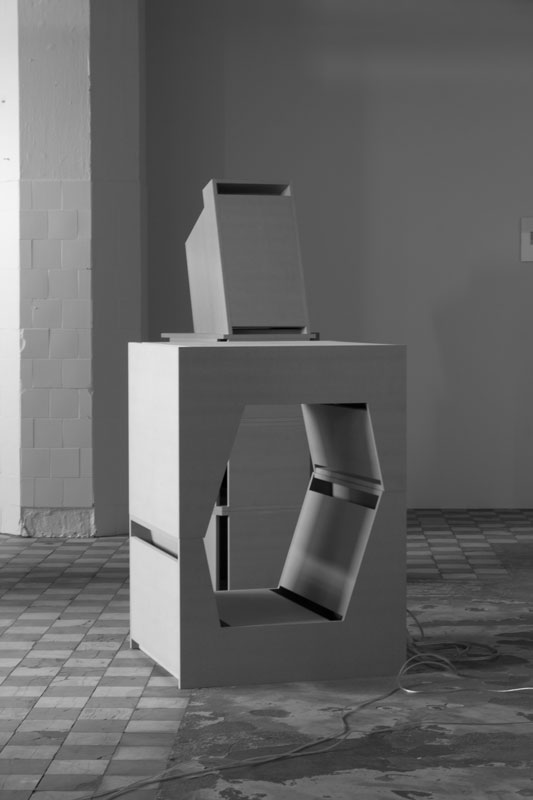
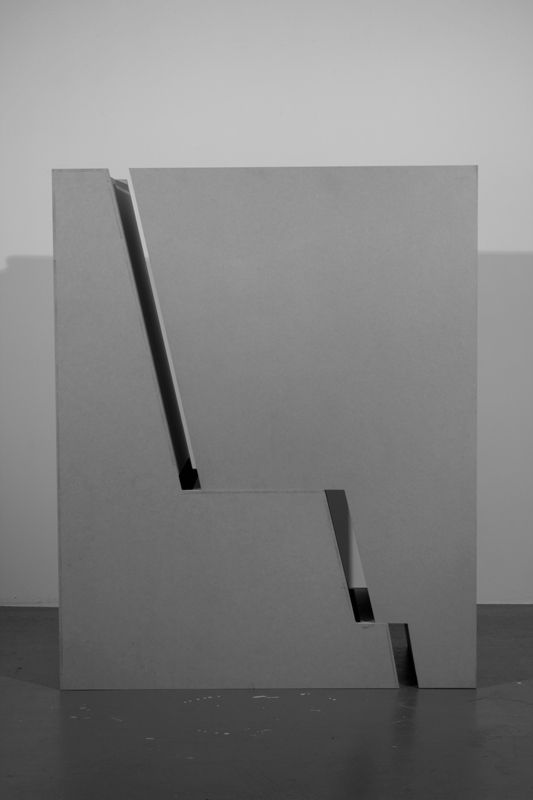
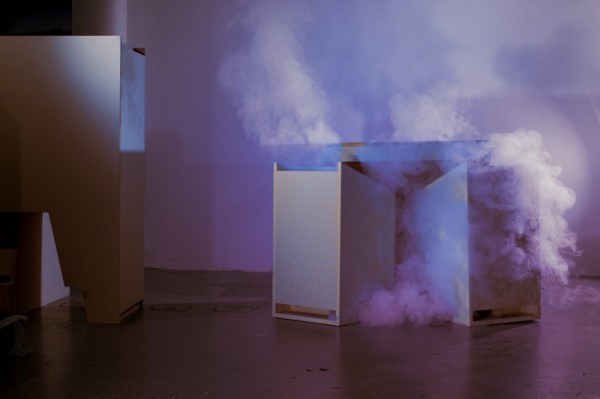
“Throughout much of our practice we have sought to give shape and physicality to the immaterial. Many of the ideas surrounding these transformations are inspired by the processes used to record, playback and encounter sounds.
This project focusses on nested forms, sculptural works that elicit an architecture of sound. These Volumes for sound are concerned with materializing the funneling, folding and porting of sound.
These nested forms stem from objects that are manufactured independently, then drawn together as a result of relationships in domestic and architectural situations. For instance, the triangulation that occurs when a listener sits in a chair in front of a pair of stereo speakers. These forms are also inspired by historical sources such as the famous 1979 Maxell cassette tape ad campaign, the intricate interiors of modern loudspeakers, and artist Kurt Schwitters ‘Merzbau’ constructions.
We have collapsed the listener/loudspeaker triangulation into objects containing several variations for configuration. They can be encountered in spaces as forms that silently evoke the potential for sound, be played and reconfigured by performers using them for sound amplification, and appear in photographs of their various configurations, providing a record of these instances.” – Melissa Dubbin & Aaron S. Davidson via Triangulation Blog
Tags: cardboard, color, installation, rad, smoke, sound
Posted in Uncategorized | Comments Off on Melissa Dubbin & Aaron S. Davidson


