Rashid Rana

Rashid Rana

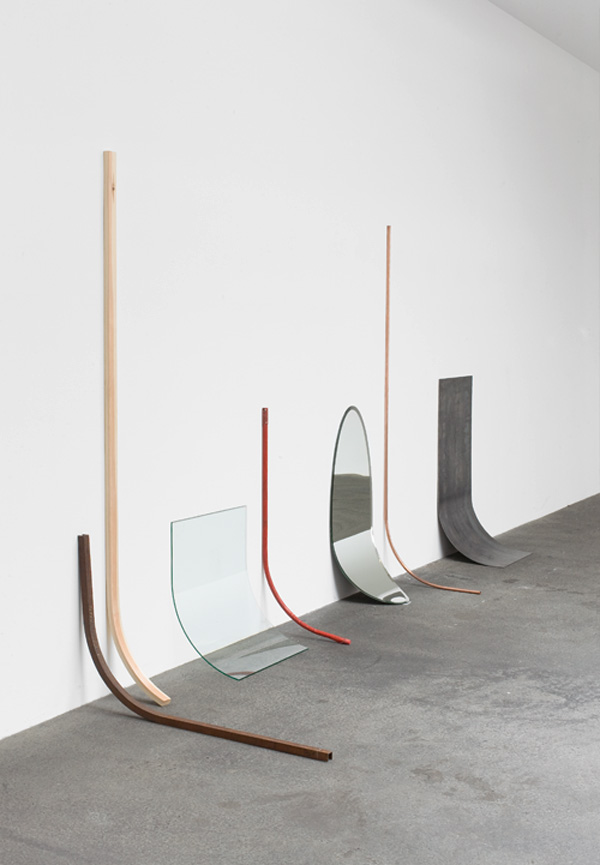
Work from his oeuvre.

“Through his work Rana explores constructs of media and identity, reflecting upon and critiquing the impact of globalisation worldwide whilst simultaneously exploring the local and competing influences of tradition and modernity in contemporary South Asia and Pakistan.

Lisson Gallery’s Curatorial Director Greg Hilty says, “Rashid Rana’s work demonstrates a powerful interplay between formal structure and highly charged content, creating a genuine hybrid of Asian and Western artistic traditions.”

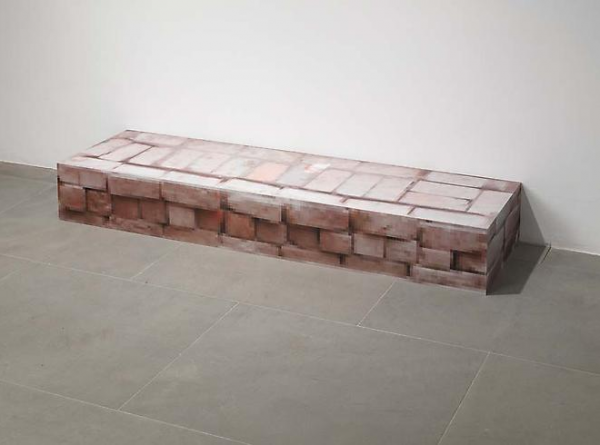
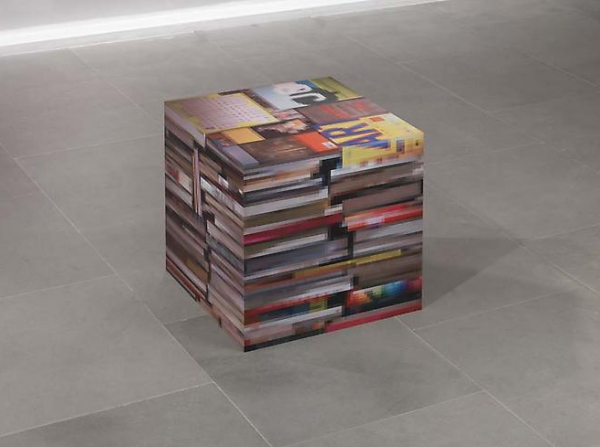
In the exhibition at Lisson Rana will present a series of key works in which he redeploys photographic imagery in varied formats including installation, sculpture, and large-scale photographic prints. These works see Rana drawing on techniques such as pixelation to problematise and reconfigure the relationship between part and whole, fragment and meaning.

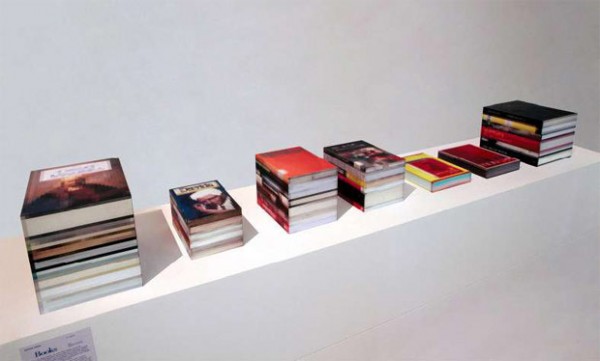
The photographic sculpture, Books (2010, UV Inkjet print on aluminium), features images of books layered on blocks that themselves resemble books. The work both maps and manipulates the distance between idea and object, representation and reality. Here Rana challenges our understanding of three-dimensional forms through the use of pixelated imagery, pixelation being more commonly associated with two-dimensionality.

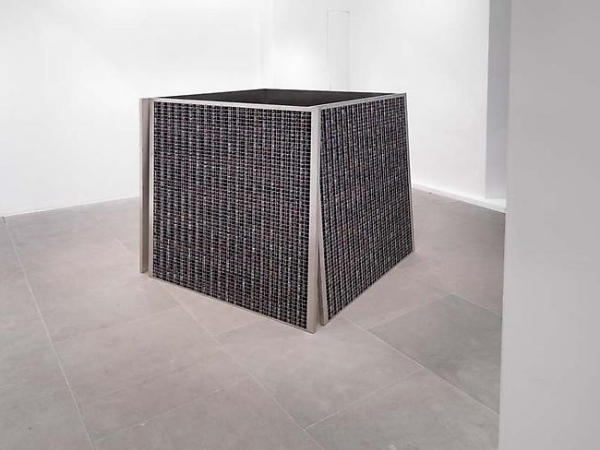
The shift between two and three dimensionality is further explored in a large-scale stainless steel cube sliced through with a photographic mosaic of image fragments. In this work, Rana manipulates reflection and printed imagery to create tension between surface and depth.

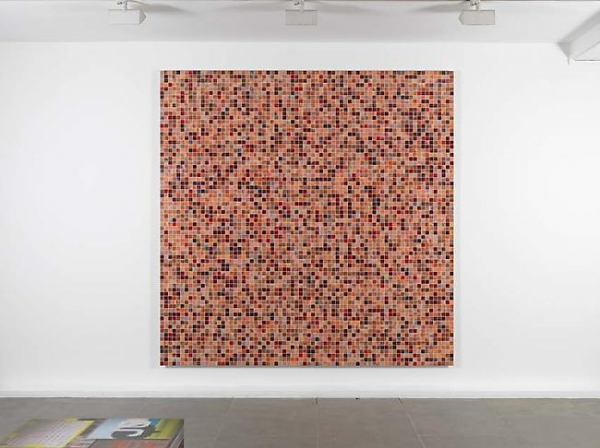
Also on display at Lisson will be a number of large-scale photographic works that Rana sees as ‘unpacking abstraction’. From a distance these works have the appearance of richly textured, patterned abstract compositions. However, on closer inspection, each work is revealed to be formed from thousands of smaller context specific digital images that offset the perceived serenity of the larger image.” – Lisson Gallery

Matthew Ryan Barton

Matthew Ryan Barton

Work from The Affects of the Effects of Gravity.

Barton has work in a show opening at CS13 on April 15th, it will be well worth your time.

“…At the gallery entrance the wind rustles through a projected forest fronted by artificial turf upon which rest real log segments that serve as seats. An oversized cutout mushroom delivers an ambivalent message: It’s a poisonous amanita but also the white speckled red toadstool of fairy tales.

The visitor passes through an arch of (photographs of) deer antlers that’s studded with an eclectic mix of gem-bright flowers — morning glories, petunias, water lilies, cacti — that could be from a garden catalog.

To the right, a forest smoulders ominously in another projection.

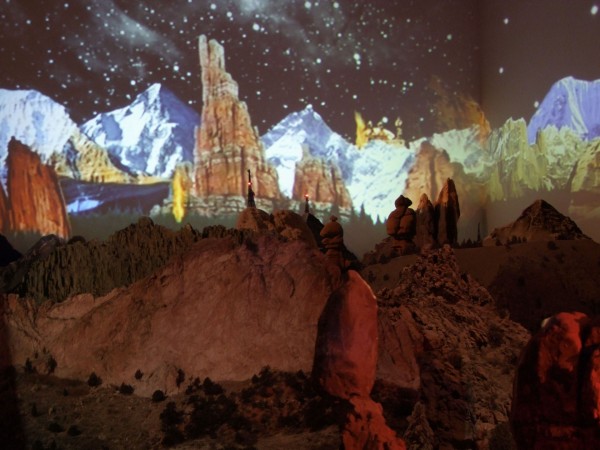
And beyond, a vision engulfs the senses. Pushing out from the far wall are the hoodoos and other eroded earthen towers of Southwestern landscapes, backed by snow-covered mountains and, behind them, a floor to ceiling night sky of drifting planets, multitudinous stars and colorful nebulae.

An occasional orb floating past seems to have a face — a man in the moon extension of one’s imagination, it would seem, until one notices the grimace on a sandstone pillar or figural forms farther off.

And then something — meteorite or missile — streaks across space, strikes land and erupts in fire and smoke. More follow. Silver slivers of lightening flash and dart into the ground. The sounds of explosions replace those of crickets. Armageddon, or just dinosaur bad luck?

Absolute kitsch and absolute cool.

And especially appropriate in this filmmaking and screening venue.

With all of that in place, does “Affects” really need the cave of skulls, the weathered wood frontier shack embellished with bleached bones?

Not really. Unless Barton wanted to add to his spoof of the sci-fi genre takes on Westerns, horror and Indiana Jones-style adventure films in this funny and clever, site-suited extravaganza.

One wonders what he’s capable of pulling off next…” – Mary Thomas for Post-Gazette

Jonathan Zawada

Jonathan Zawada

Work from Over Time.

“…The landscape topographies were derived from graph data (displayed as printed mirrors on accompanying plinths), modeled in 3D and then oil paintings created from those 3D renders. See more;

Zawada collected and compared a variety of data series that extrapolate information over time, such as “Marijuana usage among year 12 students vs. CD and Vinyl record sales between 1975 and 2000” or “Value of land per square meter in Second Life vs. Value of land per square foot in Dubai between 2007 and 2009.” The data is then manipulated through a 3D fractal program and the resulting environment becomes a virtual abstraction that mimics a mountainous landscape.

Painted on linen, the landscapes are a response to the “virtual” reality of digital experiences that are highlighted by the intrinsic flatness and surreal color palate. Invoking the robotics hypothesis of the “Uncanny Valley,” the works take on an android quality, a sense of reality but not quite, registering with the viewer as both familiar and dissimilar. This theme carries through to his drawings, juxtaposing the hyper-real with the conceptually abstract and underlining the temporality of human experience.” – Prism Gallery

via Triangulation Blog

Kim Si Nae

Kim Si Nae

Work from Browser Abstract

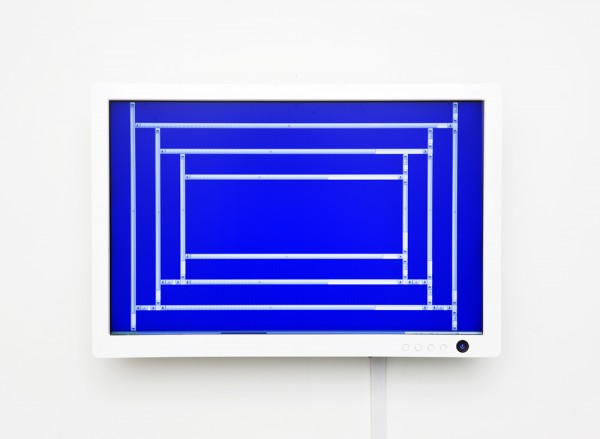
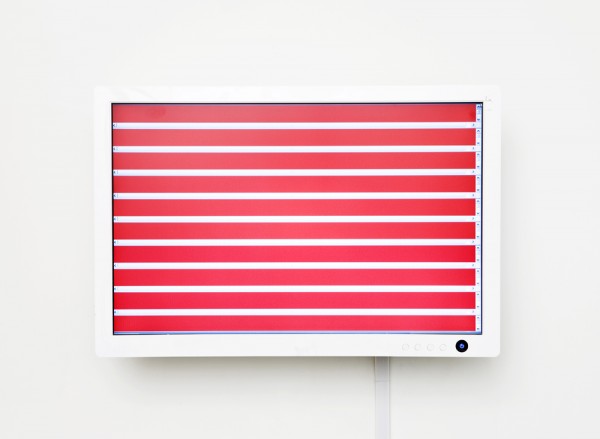
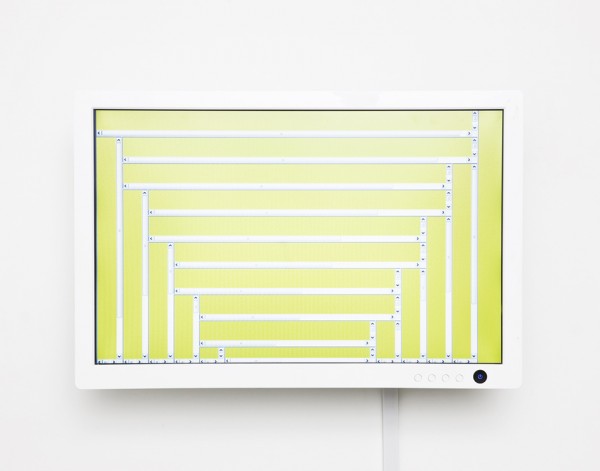
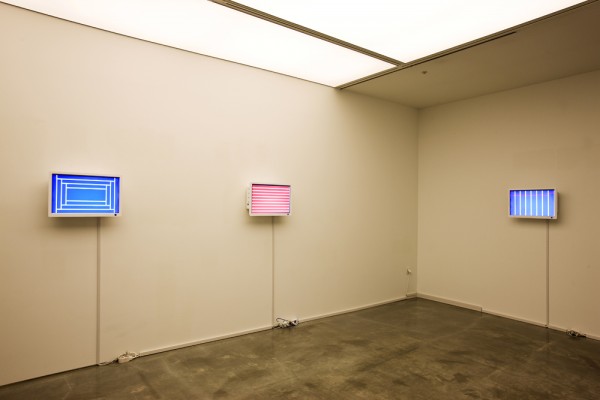
“Citizens of the world are spending their lives staring into the reflective surfaces of their mobile phones and desktop computers. I think that social context determines the value of the media, tendency itself of dispaying medium have to be thought as social message.

For me, the digital canvas is another representation tool. Browser is not only the way it looks but also an inevitable basis of existence in the new space. If the history of fine art is against the frame of canvas, new painting will be founded on the browser, a element of being. In the past, inherent trait of painting reveals through the recognitions and enactments of medium. As the tool and matarial,we have to reconsider the new medium.” – Kim Si Nae

Christian Marclay

Christian Marclay

Work from The Clock

“‘The Clock’ is constructed out of moments in cinema when time is expressed or when a character interacts with a clock, watch or just a particular time of day. Marclay has excerpted thousands of these fragments and edited them so that they flow in real time. While ‘The Clock’ examines how time, plot and duration are depicted in cinema, the video is also a working timepiece that is synchronised to the local time zone. At any moment, the viewer can look at the work and use it to tell the time. Yet the audience watching ‘The Clock’ experiences a vast range of narratives, settings and moods within the space of a few minutes, making time unravel in countless directions at once. Even while ‘The Clock’ tells the time, it ruptures any sense of chronological coherence.

‘The Clock’ plays with how audiences experience narrative in cinema, examining the conventions and devices through which filmmakers create a persuasive illusion of duration. When watching a film, an audience is removed from normal time and swept up in a new register that corresponds to the narrative at hand. ‘The Clock’ transforms this condition of cinema: time, in this case, corresponds precisely to the actual time beyond the work. The audience will have the peculiar awareness of experiencing a fictional event, or countless events, at what appears to be the same time as when they watch it in the gallery.” – White Cube

Hunter Jonakin

Hunter Jonakin

Work from Jeff Koons Must Die!!!.

“Jeff Koons Must Die!!! is made up of a fabricated 80’s style stand-up arcade cabinet, and a simulated digital environment presented in a first-person perspective. Viewers must pay twenty-five cents to play the game and the virtual environment is traversed with a joystick and two arcade buttons. The premise of the video game is to allow the viewer to virtually destroy work by the artist, Jeff Koons.” – Hunter Jonakin

via Valentina Tanni.


Alicja Kwade

Alicja Kwade

Work from her oeuvre.

“Alicja Kwade (*1979, Poland) has in her sculptures—as well as in her installations, photographs and films—long been engaged with different aspects of our value systems and with the issue of abstract concepts such as space and time. The artist lives in Berlin and belongs to a generation of sculptors who have taken up the fundamental approach of the installations of the 1960s, such as Minimal Art, and adapted their principles without pursuing their thematic contents. Above all the artists Robert Morris and Robert Smithson, who specifically in the 1990s enjoyed a reevaluation, represent an important context for regarding Kwade’s works.

Kwade occupies herself with complex scientific theories on the physical property of certain materials, which she then repeatedly attempts to circumvent. Everyday articles and mostly worthless found objects make up her main starting point. Often deploying an elaborate modus operandi, the artist transforms these objects into pieces that suggest the luxurious and the immaculate. They hereby undergo a subtle change in meaning; the objet trouvé becomes a minimal sculpture or, symbolized by its infinite reproduction, a specific historical moment.

The exhibition at the Westfälischer Kunstverein assembles Kwade’s most recent works, whose centerpiece is the video installation “Thoas, Agrios, Gration” (2009). Three canvases are suspended in a pitch-dark room and show shots of rocks that float there in apparent weightlessness. This cinematic staging is supplemented by other sculptural works in the gallery. Kwade’s objects and pictures are mostly based on simple ideas that challenge the viewer’s perceptual world. For what seems “normal” usually proves at a closer look to be a physical impossibility.

The quality and the tension in Kwade’s work lies in creating a telling form and a perfect surface, coupled with an irritating factor that takes us beyond these aspects. With her materially precisely worked out sculptures, she ventures into the field of the natural sciences, although she immerses their materiality and worldliness in a surrealist light. Mirror reflections, repetitions and waves of light and sound generate an atmospheric intensity. Kwade tries to make the invisible visible, the inconceivable conceivable. To do so, she creates forms that are at time poetic, at times absurd, within an otherwise rationally determined reality.” – Contemporary Art Daily

Stephan Tillmans

Stephan Tillmans

Work from “Luminant Point Arrays (leuchtpunktordnungen)“.

“The Luminant Point Arrays show tube televisions in the moment they are swithed off. The television picture breaks down and creates a structure of light. The pictures refuse external reference and broach the issue of the difference between abstraction and concretion in photography. The breakdown of the television picture discribes the breakdown of the reference. The product is self-referential photography.”

via today and tomorrow.

Regine Petersen

Regine Petersen

Work from Find a Falling Star.

“I use the process of taking photographs as a vehicle for thinking. When I set out to take pictures I usually have no fixed or pre-determined end-point. My method of working gives me the space to be constantly reflective and this in turn permits my work to develop in new and unforeseen directions. While the scene is being ‘thought’, I am able to ruminate on what might otherwise have remained hidden. I simultaneously engineer and happen upon my photographs.

An interest in ambiguity – like the co-existence of intimacy and of distance – underscores my work. These paradoxes are encapsulated in the photographic image: a still frame that holds so many tensions, but at the same time is entirely opaque and doesn’t provide a clear answer. One cannot look behind the image to ‘find out’.” – Regine Petersen

Yngve Holen

Yngve Holen

Work from Parasagittal Brain

Each chop a slice, a split, a cut, a crack, a selected point – a defining crop. Each chop is definite but is advanced by persistent hesitation and postponement, which has lead to a series of works that circle around a sense of ‘hit and miss’ – hit and miss in that there is a strong consciousness of the actual moment of the chop being the crucial, unrectifiable moment – the point of no return.

For his first exhibition at Johan Berggren Gallery, Yngve Holen shows a selection of electric water kettles, a ceramic sink and breakfast imagery. The kettles, halved or cut up by water using a waterjet cutter, are displayed on shelves and a table. Likewise, a sink has been divided into two parts. Incapable of fulfilling its original role as water basin, it takes on the identity of two large fruit-bowls. On the walls are canvas stretchers stretched with transparent PVC – the PVC is printed with images of the artists’ recent breakfasts. As cut off moments the imagery is divided between untouched freshly served breakfasts, and breakfast leftovers.

What guides these actions is an interest in the imagination of both the physical and metaphorical conception of the left and right brain half, and the ascribing of certain qualities to each brain half. In anatomy the vertical separating of left from right sections of the body – a separating into halves – is defined by what is called the sagittal plane. ‘Parasagittal’ is any plane parallel to the midline – an actually unnecessary term, as all parallels to the separating midline are actually defined as sagittal. Parallel to the midline, but its distance to the midline undefined, the parasagittal becomes the symbol for hesitation – the identified but not defined.” – Johan Berggren Gallery