“Absalon engages himself with spaces in systematic and successive ways. By taking questions around essential human activities and basic forms such as the rectangular, the square, the triangle and the circle as his starting points, he begins by emptying out the encountered spaces before restructuring and refilling them with the help of simple forms. These test assemblies, further developed later on by means of objects, drawings, photographs and films, come to a full circle in Absalon’s Cellules: individualized, ascetic living units for contemplation based on the measurements of the artist’s own body. Reduced to a vocabulary of strictly geometrical forms these pieces convey a sense of absolute abstraction, yet without alluding to utopian ideas. Instead, they open up heterotopic spaces, which Absalon had planned to publicly position in six large cities in order to confront his physical existence with the corpus of society: ‘They are not meant to posit any solutions in terms of isolation. They have been made for living the social.’ (Absalon)” – KW Institute for Contemporary Art
“For most, to sightsee is to photograph. Embarking on treasure hunts to tourist destinations renowned for monuments of grandeur, we pursue the extraordinary. Framing sites of mass tourism in our viewfinders, we create photographic souvenirs that are integral to the touristic experience. These products, coined “photograph-trophies”i by Susan Sontag, separate our leisurely pleasures from the real everyday experiences of work and life, validating that we had fun on vacation and were in exotic locales where exists the Eiffel Tower, the Statue of Liberty, or Niagara Falls.
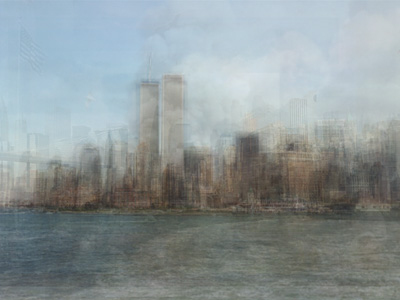
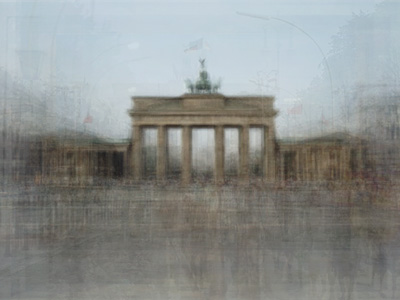
Conducting online keyword searches for monuments, Swiss/French artist Corinne Vionnet culled thousands of tourists’ snapshots for her series Photo Opportunities. Working with several hundred photographs of a single monument, the artist weaves together small sections of the appropriated images to create each layered, ethereal structure. Famed landmarks appear to float gently in a dream-like haze of blue sky. Each construction espouses the “touristic gaze”i, its distorted visual referent functions as a device for memory transport by funneling many experiences into one familiar locale.
What is remarkable about Vionnet’s findings is the consistency in online iterations of the travelers’ gaze. It makes one wonder, how do we determine the optimum spot to photograph landmarks? Maybe we stand at the gateway to the Taj Mahal to render its architectural façade in perfect symmetry, or we stand where we can frame all four American presidents in equal scale at Mount Rushmore. Perhaps we instinctively choose how to photograph known monuments as we are socially conditioned to take pictures we have seen before – images popularized through film, television, postcards, and the Internet.
Not so long ago, people would often organize their tourist snapshots into travelogues. Today, the travelogue is less likely to be a tangible album found in our homes than it is an online directory of digital images. When placed in the public realm, the travel souvenirs become anonymous products of tourism, searchable by the keywords ascribed to them by their makers. These meeting points, as Vionnet describes the sourced snapshots, may be inspiration for your next photo opportunity.” – Madeline Yale
“There is an obsessive and darkly visionary quality about much of Bayrle’s work but, crucially, there is also plenty of wry humour and pleasure in the absurd and the idiotic. Contrary to the visually pluralistic tendencies of other artists with mixed allegiances to Pop and Conceptual art as well as media critique, his work seems to have remained doggedly consistent for decades. Ever-present are his engagement with advertising and comparisons between mass iconography and systems in the East and West including religion, technology and sex. In his books, collages, paintings, graphics, drawings, computer animations, sculptures, films and videos, he has accomplished what many aspire to achieve but few actually do: to articulate a unique and transfixing visual language.” – Dominic Eichler
“The exhibition focuses on how we approach and interpret sculpture. Extending across various media, and partly site-specific, Gregory Polony’s work draws on a reduced palette of materials, including found objects, cement, wooden boards, and lashing belts.
His conceptual approach to sculpture is also shaped by intuitive and surprising moments, which he integrates into his works by means of drawings and photographs.
While the photographs show an interpretive perspective, the drawings describe a fictitious state in Polony’s works. «On the surface, the drawings are simple, quick, and efficient. While the ideas for them exist beforehand, their representation by means of a pen and the human hand are beyond control. Such uncontrollability and spontaneity enable surprise, and thereby open up new fields.»
Polony’s work centres on the art establishment and, unlike purely conceptual approaches, seeks to render it visible. His ‹in situ› work invites observers to integrate its surroundings and to develop a stance towards it. The context of presentation thereby functions as a starting point integral to the work.
What constitutes the quality of a work of art? Polony adopts a critical stance towards both his work and art. «Implementation is most important, irrespective of the context in which a particular work emerges or is shown. The point at which a work finalises itself and is mounted is a unique moment, one which also lapses immediately. The thought ‹done, next one› is forever present.»
How a work can be incorporated into and further developed in new settings after its publication and contextualisation is an essential aspect of Polony’s working method.” – Tomas Germann
“Material Test introducesimages of film gels, cellophane, mirrored Mylar that have gradually dissolved their material base, becoming molten shapes and forms that undulate through foreground and background. French critic and curator Nicolas Bourriaud in his text Postproduction considers that “precariousness is at the center of a formal universe in which nothing is durable, everything is movement: the trajectory between two places is favored in relation to the place itself”. The particularities of the path between these two ‘places’ – the original material and the image as transformed state – becomes open to curiosity and consideration.” – STATE
“Scott-Douglas makes work that refers to production itself, to its consumption and to its container, using visual cues gleaned from minimalism and op art. The central dialectic of the work springs from the tension between the need for a rigid authority figure, on the one hand, and the very possibility of establishing such an authority, given that it is so easily subverted by its own parts. This tension arises when, in each work, the authority is embedded in a severed partnership – half medium, half author. However, through Scott-Douglas’s process-oriented methodology, one of the partners is elected over the other. In each case there is an emphasis on transparency and a push towards a paradoxical state of “non-denial denial”. In Scott-Douglas’s treatment formalism is detourned to allow the medium to execute its own mutiny. Experimentation and process become central themes that allow some works to be successful and others to fail; this produces a formalism that is equally in tension – working both towards and against a static form.” – Clint Roenisch Gallery.
“Walsh is an artist who navigates smoothly between mediums while leaving a trail of great works. He’s a kind of mad scientist mixing up a fresh pop brew of interactivity, projection, appropriation, music, origami, and installation. Whether he’s playing a search engine or a guitar (clearly, his avatar is John Cage), Walsh is happy to reach into the chaos and “tune in meaning.” Underground and busy, last year he made one of my favorite videos, Untitled RPG. This year, he unplugged with stunning silk-screen constructions exhibited in the back room of a Brooklyn bodega. But his most widely unknown accomplishment of late is “Tune Up,” an infectious and demented jingle for NYC dermatologist Dr. Zizmor. I can’t get it out of my head.” – Tony Oursler
________________________
Double Waltz:
First, I select two texts. These could be taken from anywhere, and could be any type of text: interviews, stories, manuals, etc. Custom written software is made to weave these two texts together, one word at a time, in groups of three. The pace has a certain rhythm. The cadence is in a 3/4 time signature, like a waltz.
The computer can choose certian things: the word, the font, the shade of grey, the background color. The video is designed to never repeat. – JD Walsh
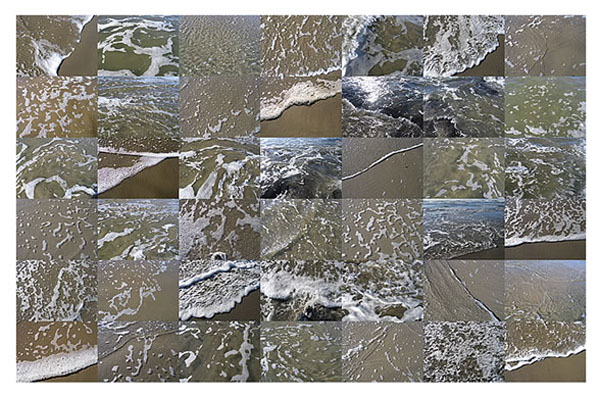
“In this series of large format inkjet prints, I set the camera to automatically take pictures each minute as I walk along familiar paths. Then, the collection of photographs is brought into Photoshop, where I create a large canvas and randomly drop each image into the larger composition. I am interested in the patterns formed between the individual images and the collective montage, as well as questioning the inherent stasis of the photographic image.” – Michael Sherwin
Sherwin will be speaking at SPE in Atlanta March 10-13.
“Whilst basically Rosenkranz’s œuvre walks a tight conceptual line, the artist’s practice features a lightness of touch, that belies the use of irony, play and humor in its making. In general, Rosenkranz’s works speak of a mercurial élan, an “inform” physicality and a pervasive sense of “mise en scene”. These distinct but intertwined notions frame the artist’s practice, directed to ponder upon a contemporary understanding of nihilism. Indeed, she investigates the possibilities of reducing the meaning of an art work down to its limit, converting her pieces into mercurial paradigms, where meaning slips through the fingers of those wishing to apprehend it. To do so Rosenkranz arms herself with immaterial parameters, such as reflections, repetitions, infinite loops, voids, crossings and obliterations. ” – The Centre d’Art Contemporain Genève
“I work with video, installation, performance and web-based media to examine notions of individuality, uniqueness and subversion after the popularization of the Internet. Inquiring into the role of the “digital native” in the cultural sphere, I blur boundaries of traditional artistic practices with vernacular uses of technology.” – Jennifer Chan