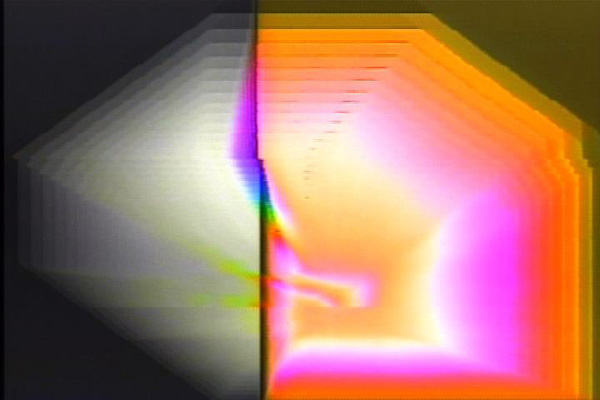
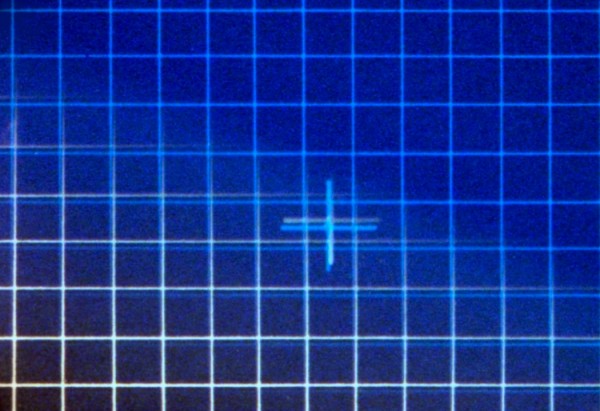
“The strobing, multicolored abstractions of S.F.-based video manipulator and musical collaborator Nate Boyce have been known to test your sensory perception to the point of “retinal fatigue.” And, as Boyce explains, it’s all part of a long legacy of video art tradition.” -XLR8R TV
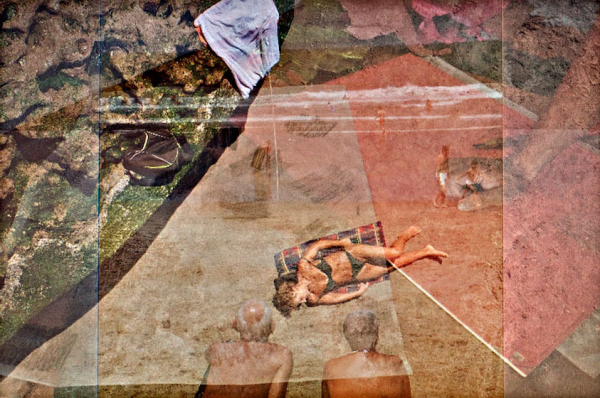
“The title of the series refers to a quote from Mark Zuckerberg, the founder and CEO of the popular social network Facebook, who was quoted as saying “We’re going to change the world. I think we can make the world a more open place.”
Each image is a long-exposure photograph of a computer screen taken while flipping through a photo album on Facebook. More than 100 million photos are being uploaded to Facebook every day.
Amid continuing growth in popularity is growing controversy in regards to Facebook’s privacy policies. Facebook’s terms state that any user automatically grants Facebook a non-exclusive, transferable, sub-licensable, royalty-free, worldwide license to use any photo that is posted on or in connection with Facebook. Does the act of sharing change in the context of these terms? How does the act of reclamation fit in?
“I am interested in our reaction to this massive influx of photos and the modern experience of engaging with this technology.
I see the combination of technology and photography as playing an increasing role as a databank for our memories. At the same time, despite Facebook’s current popularity, its lasting prominence in our collective lives is uncertain. If Facebook dies, do our memories die with it?”” – Phillip Maisel
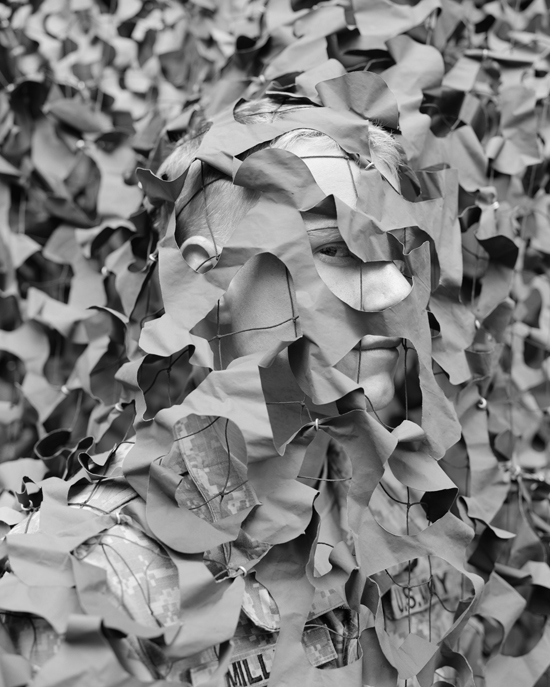
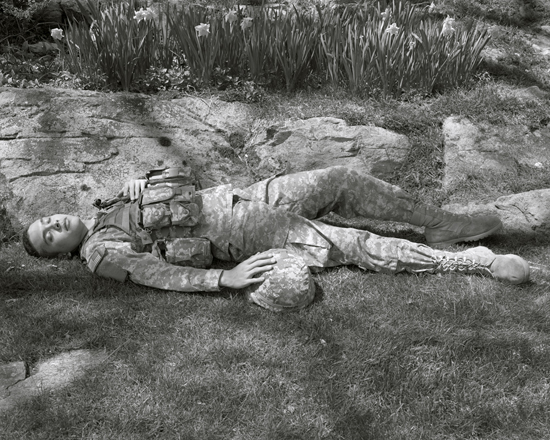
“The Gray Line, Kristine Potter’s first solo exhibition at Daniel Cooney Fine Art, culls from images made during the last four years as she has been mining her complex feelings toward the military, a subject which she has long, familial connection. For many generations most of the men in her family earned their living and defined their purpose as military officers. Growing up in this military culture, Potter’s childhood was saturated with orderliness, hierarchy, patriotism and a certain knowledge of “the enemy”. Being a child (and adult) interested in nuance, culture, progressive ideas and non-conformity, she was often at odds with the governing forces in her life. She says of her childhood, “True respect aside, I struggled to understand war and how one could take command to engage… I wanted to understand the organization of violence and power, and I yearned to humanize the tough exteriors of these men against all of the anxieties I felt when thinking of their jobs and of their structure.”
Despite the long line of military men in Potter’s family, her generation has declined to enroll, ending the long lineage.
Continuing her interest in large format portraiture, Kristine has garnered access to West Point Military Academy, an Academy that has trained a number of men in her family and has produced a greater number of high-ranking officers and politicians than any other U.S. military academy. She uses a view camera to produce images of cadets that explore ideas about masculinity, expectation, allegiance, sexuality, vulnerability and death, catching them before they are fully formed soldiers and officers. While traditional portraiture of soldiers serves to show their achievements, excellence and their sense of duty, Potter’s images describe the complicated psychologies under their developing personas. She extracts something uniquely emotional about each cadet while also imposing upon the images certain reservations and attractions she has about soldiers in training. The resulting images balance between the languages of the documentary and of the staged with an effect that provides a compelling counterweight to live-feed coverage of our wars and of traditional military portraiture.” – WIPNYC.
“Her filmmaking predicates resistance to cinema as a virtual medium – this resistance in film is what she refers to as Cold Cinema. It is a sentiment and a philosophy which places the artist in a position of resistance, akin to a soldier in a bunker, or Plato’s imaginary self in a dark cave – standing watch, reminiscing, coldly observing and hypnotized by flickers of light in the distance. With a kinship for obsolete technology, the artist uses 16mm and vintage formats as her shooting medium of choice. She explores themes of darkness, color, rituals, Goth iconography and film as a medium, with melancholy and restraint.
She places particular emphasis on the shooting stage of the filmmaking process because of its live aspect: ‘reel time’, such as pioneered by early Andy Warhol, is preferred and ‘in-camera’ editing is signature. All effects are produced ‘in-camera’ at the shooting stage and are analogue. Each film is the length of a film reel (3 minutes). No computers are used to aid this process. These are filming principles and techniques that are unique to 16mm film. The camera used, a Bolex from 1955, was a staple in documenting the Vietnam War. One of the first portable 16mm cameras, it liberated film from the studio system and was widely used by experimental filmmakers and war journalists alike. The Bolex camera in this series of films embodies cinema’s equivocal quivering between reality and fabrication.
Color is a strong component to ‘Opticks’. It is the result of the artist’s study of Isaac Newton’s principles of color, which he founded in the book ‘Opticks’, published in the early 18th century. Compelled by Newton’s writings, the artist came across an obscure scholar of Newton’s theory of color refraction – J.C Maxwell. A 19th century Scottish physicist, Maxwell ‘projected’ the first color photograph using Newton’s color theory in 1861 – the image was a ribbon of Tartan fabric, which contained all colors of the spectrum. Both Newton’s and Maxwell’s empirical approach to color deeply informed the color experiments of the film.
Sound in ‘Opticks’ is non-diegetic: it is purposefully disconnected from the original footage. The synthetic “Gamelan bells” composition by musician Sean McBride (Xeno and Oaklander / Martial Canterel) in ‘Opticks V – Rituals’ is created separately so as to depart from the ‘Mickey Mouse Effect’, whereby sound follows image. A stifling narrative film technique, Mickey Mousing was debunked in the sixties by experimental filmmakers such as Stan Brakhage. Here, separation of sound and image allows for serendipitous connection between them.
Inspired by Brechtian concepts of ‘distanciation’, the ‘Opticks’ films seek to ‘alienate’ its audience by providing philosophical space within the films. Deliberately sparse, the Cold Cinema of Liz Wendelbo is an exploration of the mechanics of the projected moving image and its mesmeric quality: what we see is the hypnotic quivering which occurs between surface and the immeasurable depth that is film.” – Liz Wendelbo
” …
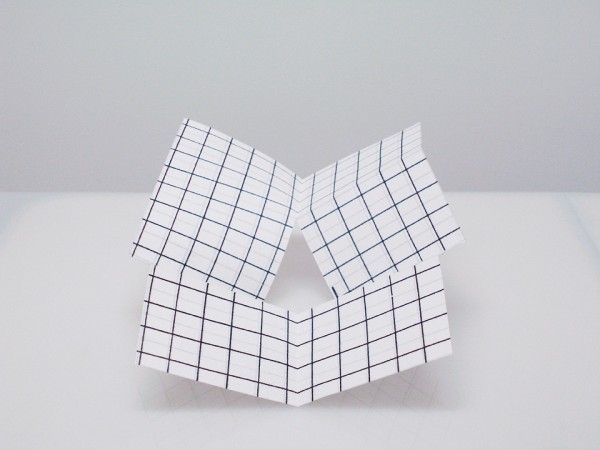
– Colin, a Moebius strip is to do with surfaces and edges and therefore only applies to planes, you can not do that to a doughnut since it is a three-dimensional object already existing in volume.
“In Colin Guillemet’s Around the world (2009), a globe is plugged into the wall. There’s nothing unusual, really, except that between this mini earth and the socket, various plug adapters are stuck together in an ungainly tube of electrical complexity. The planet is desperately reliant on these little prostheses to function; they are the only remedy for our inability – and probably unwillingness – to standardise something as crucial as power supply. For the Paris-born, Zurich-based artist, Around the world is ‘a statement piece’, a visual one-liner poking fun at international technologies’ shortcomings, or, if you are versed in 19th century fiction, the hassle awaiting a modern-day Phileas Fogg. ‘I’m interested in the fact that everything is referential’, says Guillemet. ‘The way one looks at art always depends on one’s reference.’ And it is these references that he sets out to undermine: those shared by millions, and those shared only by a few (usually in the art world).” – Catalogue Contemporary Art Magazine.
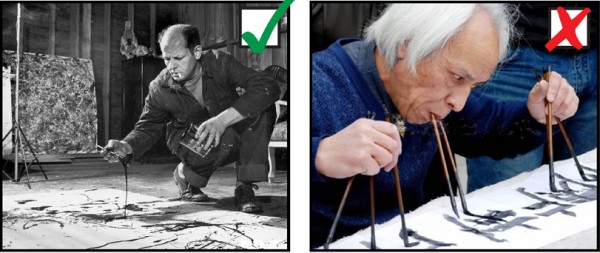
“In the Dos and Don’ts series (2003-ongoing), Guillemet juxtaposes pairs of images vaguely linked by formal affinities, and displays them as ‘safety’ cards throughout the gallery space. Each picture is associated with a sign; one bears a green tick, the other, a red cross. Do: the fingers of God and Adam in Michelangelo’s Sistine Chapel; Don’t: the hard-clasped hands of performing professional ice-skaters. Do: a concentrating Jackson Pollock pouring paint on a canvas; Don’t: a calligrapher painting with three brushes in each hand and two in his mouth. Looking at these is always a bit uneasy. While you confusedly understand why such-and-such an image was ‘approved’ or ‘rejected’, you also uncover your own deeply engrained preconceptions: the genius male artist, the kitsch of certain practices, etc. Guillemet asks you to empathise with his thinking process and then leaves you enmeshed in your own prejudices.” – via Catalogue Contemporary Art Magazine.
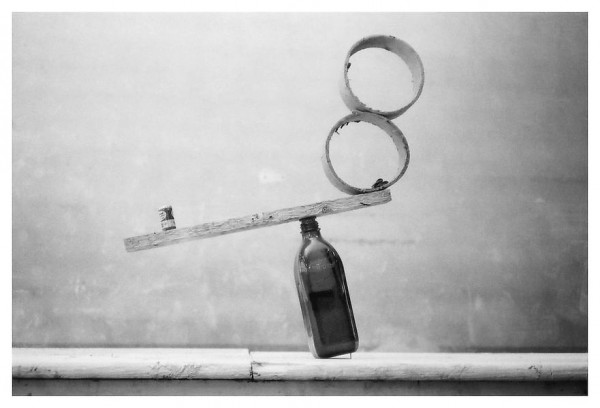
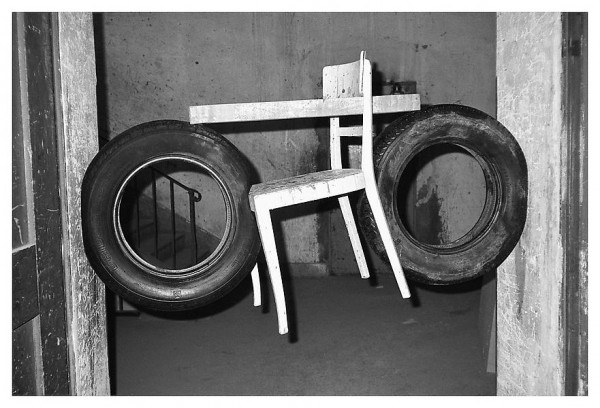
“The Equilibres photographs are images of household objects and studio detritus arranged to form tenuously-balanced assemblages, and it is from this moment of passing equilibrium that the series takes its name. The group includes both color and black & white photographs and takes as its subtitle the phrase, “Balance is most beautiful just before it collapses.” To this end, the emphasis in these works is on the beautiful, playful, transitory arrangement of the objects in space, where chairs and brooms, cheesegraters and wine bottles are choreographed into moments of delicate suspension. The assemblages do not simply look temporary; once photographed, they were disassembled, and today these photographs are the only record of their existence.
Though the sculptures varied significantly in size, the Equilibresphotographs set aside the issue of scale: each assemblage appears nearly the same size on the sheet as any other, regardless of the materials used. In addition, Fischli and Weiss gave each work a poetic, often ironic title based on its appearance: a vertical assemblage involving a bottle, a carrot, and a spatula, all held together by a piece of cord, is called The Roped Mountaineers; a bottle and metal vice form the base of an almost impossibly cantilevered construction, with a tea kettle, a trowel, and a feather duster reaching end-to-end out into space, in As Far As It Goes.
The Equilibres photographs developed into the artists’ celebrated film, The Way Things Go, from 1987. This film records the epic chain reaction of a series of household objects like the ones found in the Equilibres assemblages, such as string, soap, garbage bags, plastic pails, balloons, and mattresses. Over the thirty minutes of the film, the viewer watches the hypnotic chain of kinetic energy pass from one object to the next, and the sculpture itself is consumed.” – Matthew Marks Gallery
“The Confections series began as a response to turning 30. It was a celebration of birthdays, color, pattern and obsessive absurdity. My original idea was to bake 30 birthday cakes for myself and photograph them. I didn’t quite make it to 30 cakes in time for my thesis show, but I sure got a lot of ideas from those first cakes. I ordered a kit from Martha Stewart.com and watched an instructional video on decorating cakes. When I quickly discovered my cakes were never going to look like the ones in the video and the pamphlet, I decided they were better off in their exuberantly imperfect states. With over 70 cakes constructions to date, I’m often asked, “Why still with the cakes?” Cakes are the centerpieces of celebrations and symbolic trophies evoking nostalgia and awe. Historically, cake has played a significant role in womens’ lives. Women have used cake as both an outlet of creativity and a symbol of female power politics. In my constructions of these photographs, I am commentating on not only cake itself as a rich cultural symbol, but of the domestic fantasy world of contemporary home decorating and cooking magazines and television shows. It’s a fantasy world where entertaining, cooking and decorating unite. It’s a place where one needs to have a beautiful home, decorated seasonally, in order to entertain friends with gourmet meals and elaborately concocted desserts.” – Amy Stevens
“One of the early pioneers of both the environmental art movement and Conceptual art, Agnes Denes brings her wide ranging interests in the physical and social sciences, mathematics, philosophy, linguistics, poetry and music to her delicate drawings, books and monumental artworks.
In 1982, she carried out what has become one of the best-known environmental art projects when she planted a two-acre field of wheat in a vacant lot in downtown Manhattan. Titled, Wheatfield — A Confrontation, the artwork yielded 1,000 lbs. of wheat in the middle of New York City to comment on “human values and misplaced priorities”. The harvested grain then traveled to 28 cities worldwide in “The International Art Show for the End of World Hunger” and was symbolically planted around the globe.
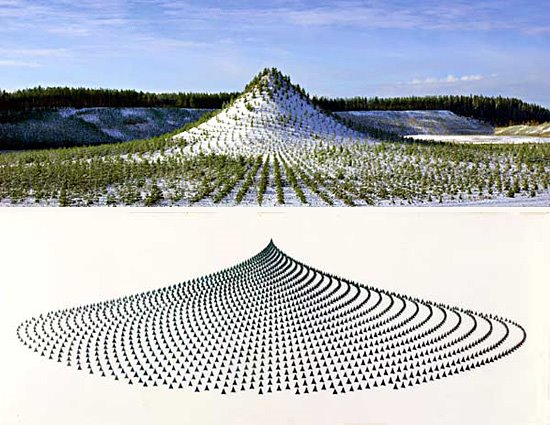
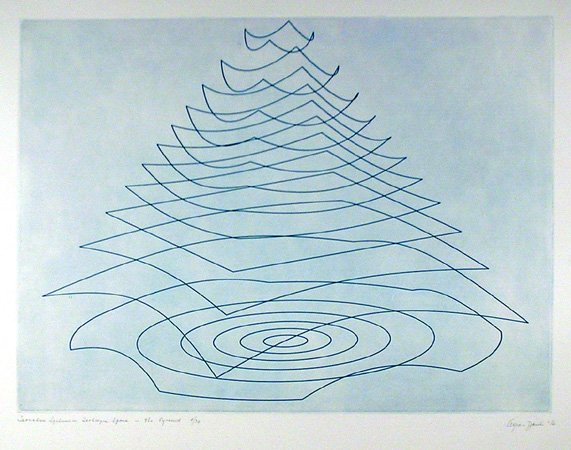
In 1996 Denes completed “Tree Mountain — A Living Time Capsule” in Finland. This massive earthwork and reclamation project involved the construction of a “mountain” on the site of an old gravel quarry and the planting, by volunteers from different countries, of 11,000 Finnish Pine trees in an intricate pattern.
The volunteers were then each given inheritable certificates (valid for 400 years) which granted them responsibility for the stewardship of one of the trees. This project was first announced by the Government of Finland at the World Summit in Rio de Janeiro as a contribution to global ecology.
Other projects have included reforestation of endangered tree species in Australia in 1998, planting crops in downtown Caracas, Venezuela as well as exhibitions of mathematically inspired drawings, book projects and installations in major museums worldwide. In a prolific career spanning the history of the environmental art movement, Agnes Denes has consistently pushed the boundaries of ecologically inspired art. She has created works of stunning beauty linked not only to the cycles of life but to notions of human stewardship and responsibility.” – via Zero1 / Green Museum.
“The instability of vanity is perhaps one of visual art’s greatest selling point. And, in an understated way, when derelict man-made objects and places are pushed to the boundaries of their own self contained and easily understood offensiveness, they often transform into something beautiful. Scott Jarrett’s recent work aggregates the refuse of urban life to create reductive montages that are both surreal and magical. While Andy Goldsworthy meticulously curates what nature has provided, Scott Jarrett uses the remnants of city dwellers to provide moments in which the understood reality of place must recalibrate and exist in a secondary—albeit curated— dimension.
The notion of vacancy in Jarrett’s work is perhaps in part what drives the soporific quality of the installations which are ultimately presented as photographs. Jarrett seeks out ghostly locales and uses the emptiness to his advantage—piling white buckets past a boarded building and pushing a used mattress unapologetically against the window of an abandoned repair shop—situations that would lose their power in a world more populated.
The photographs begin to build a loosely qualitative narrative that is resonant with individual urban journeys as well as the notion of home. When understood as a whole the work begins to address a social consciousness rendered around historical absence, memory and loss.” – via The Daily Serving.
The MIDI Opera is a little homage to the MIDI file format.Due to its limitation composing songs with the MIDI synthesizer of my laptop was always an attraction to me. The sequencer software is simple, and cheesy melodies are clicked within a second. After clicking this link you’ll find a compilation of songs squeezed into a little story about Gérald Midi, a hard working businessman, who is caught in his dreams of a colorful, exciting life. Maybe similar dreams are shared by MIDI files themselves as well.
Before we start, you might like to watch the beautiful trailer:
It’s a stop motion clip (screenshots) done with WordsEye.
↓
The story of Gérald Midi is super simple. He’s an ambitious businessman, who works always too long in his little grey office – he sometimes even sleeps there. But Gérald isn’t always on top – he loves dreaming of beaches, girls, money,… his future life!
Only in his dreams he finds joy, love and adventures.
Here are some examples:
The “Sound_Tracks” Track features following instruments: Sound Tracks, Rhodes Piano, Seashore, GS Wind, Electric Bass Fingered Electric Bass Picked, Standard Drum Kit feat. Agogos & Shaker