


Works from The Cow, The Tree, and the (Duchamp inspired) Limited Editions. Statements are provided on the website. Sculpture / Installation Art.
Barbara Hilski
Friday, 27 February 2009


Work from the series Tarnung (translation from German: Camouflage).
Hilski was in Thomas Ruff’s class at the Kunstacademie Düsseldorf, whose web page is worth exploring.
Hilski also has some other work here.
Yevgeniy Fiks
Thursday, 26 February 2009


Work from the piece Lenin For Your Library?
I saw a show the Fiks was a part of at the Art Laboratory Berlin recently and there was a fantastic piece which I could not find on the internet. Opposite the wall of letters from various corporate libraries was the piece described below (by the artist) Commemorative CPUSA Stamps, 2007-2008:
“The artist published US postal stamps baring portraits of historical leaders of the Communist Party of the USA, including Mother Ella Reeves and William Z. Foster among others. Eight different stamps (eight different portraits), ten with each portrait, eighty stamps total. During 2007-2008 Yevgeniy Fiks was using these stamps on envelops when he pays his monthly utility bills to corporations (Time Warner Cable, Con Edison, T-Mobil, CitiMortgage, Verizon, and other corporations). Fiks subverts the concept of a “commemorative stamp” baring portraits of historical figures by putting on stamps faces of forgotten and repressed leaders of American
Communist Party and using these stamps in his everyday life.”
“100 copies of “Imperialism the Highest Stage of Capitalism” by V.I. Lenin were sent out to the addresses of World’s major corporations, including Gap, Coca-Cola, General Electric, and IBM among many others. In an enclosed letter, it was stated that the book was a donation to the corporate library. Out of 100 copies, 14 were accepted and “thank you” letters were received. 20 copies were returned together with letters stating various reasons for rejection, including a particular focus of the library or their policy not to accept any gifts or donations from private individuals. The fate of the remaining 66 copies remains unknown.
Initial list of companies: Epson America, Gap, Merrill Lynch, Campbell Soup, United States Steel Corporation, JCPenney, Medco Health Solutions, Yamaha, DuPont, Staples, Pfizer, Sony, Amazon.com, Western Union Financial Services, Prudential Financial, Best Buy, Wendy’s International, General Electric, McDonald’s, Chanel, Coca-Cola, The Walt Disney Company, CVS, Wachovia, Ford Motor Company, Xerox Headquarters, Apple, Autodesk, Adobe Systems Incorporated, Bank of America, Tektronix, Intermedia Communications, Microsoft Corporation, Dell, IBM Corporation, Hewlett-Packard Company, Macromedia, Intel, Iomega Corporation, Sun Microsystems, Cisco Systems, Gateway, Lucent Technologies, Novell, Bloomingdale’s, Oracle, Yahoo!, SGI, Sybase, Micron Technology, ATI Technologies, Corel, America Online, Compuware Corporation, Morgan Stanley, Johnson & Johnson, Citibank, Citigroup, Wal-Mart Stores, Metlife, State Farm Insurance, JP Morgan Chase, Time Warner, Saks Fifth Avenue, General Motors, Pepsi-Cola, Boeing, Verizon, Texaco, Exxon Mobil, Phillips Conoco, Sunoco, Expedia, EarthLink, Sears, Roebuck and Co., CompUSA, Calvin Klein, Swatch Watch, Sprint, AT&T, Home Depot, Panasonic, Philip Morris, The Procter & Gamble, Rolex Watch, Newsweek, Nike, Mitsubishi, ABC, Fujitsu, Simon and Schuster, Sharp, Shell Oil, 7-Eleven, Gillette, Levi Strauss, Radio Shack, Adidas, Circuit City, Kmart, British Petroleum, Goodrich Corporation [sic]”
Mike Slack
Wednesday, 25 February 2009


Work from the series A Multitude on Unlike Events* and OK OK OK
“DESCRIPTION 100 units of photographic data collected by Mike
Slack from a fixed location in Los Angeles, CA,
on February 5, 2007. Each envelope contains one
unit of data, to be distributed to the general
public during the You Can Have It All group show
in New York City, February 24 – March 17, 2007.
*The momentary state of the atmosphere we call weather; its long-term state is climate. Since weather is variable, climate embraces a multitude of unlike events, and no simple method has ever been found to express all of them with complete accuracy. The climatologist knows before hand, then, that in the eyes of some he will commit sins of commission or omission; he must find his satisfaction in bringing any description to a partial state of order.
– Harry P. Bailey, Weather of Southern California, 1966 “
Veron Urdarianu
Tuesday, 24 February 2009


I stumbled across this work today and it calls to mind Ezawa Kota‘s work which I had debated posting last week. From what I could find on Urdarianu, his inspirations are not photographic, but his work reveals so much about the compositions and conventions of photogaphy.Works above were made between 2006-2008.
Marc Volk
Monday, 23 February 2009


Work from the series Speed, Raster 384, Same Time / Same Place (top to bottom).
Volk’s work (particularly Raster 384 and Same Time / Same Place) recalls Probst’s process oriented conceptual work from Exposures. In Raster 384 and Same Time / Same Place Volk uses extreme crops of a single image to provide seperate views of each individual scene. There is some truly interesting work on his website.
David A. Parker
Monday, 23 February 2009

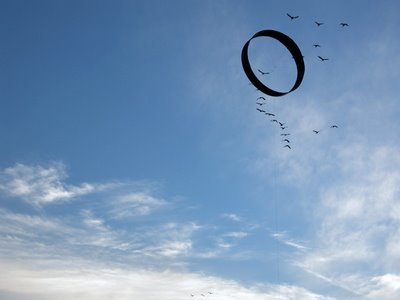
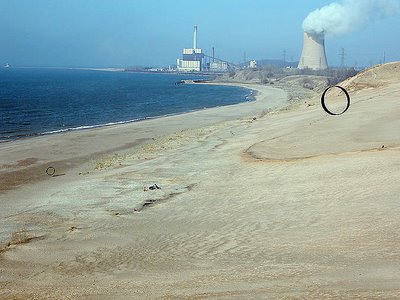
I saw David A. Parker‘s photographs in a show a couple of years back and have continued to be intrigued by his “Escape Strategies” series.


I also like the “Circular Reasoning” series:

Jasper van den Brink
Monday, 23 February 2009

I first saw Jasper van den Brink‘s photographs on the cover of Cabinet Magazine’s Electricity issue. Great issue, by the way. The photographs from the “Pigeon Lights” series are intriguing, but I also like the more performance-oriented projects, such as “Bouncing Balls”, in which 200 colored balls are placed on a drawbridge and allowed to flow freely when the bridge is opened.

Gerald Förster
Sunday, 22 February 2009


Work from the series Nocturnal.
This work is part of a double feature, it is an interesting departure from Krisár’s Close, Please and an interseting body of work in its own right.
“Sex contains all, bodies, souls,
Meanings, proofs, purities, delicacies, results, promulgations,
Songs, commands, health, pride, the maternal mystery, the seminal milk,
All hopes, benefactions, bestowals, all the passions, loves, beauties,
delights of the earth.
-Walt Whitman, A Woman Waits for Me
Women need a reason to have sex. Men just need a place. – Billy Crystal
Everyone ditches their trench coat in this series by Gerald Förster titled with the spy novel like sobriquet Nocturnal. Lush nudes flanked by cityscapes have a heightened effect because of the painterly light he captures streaming through kaleidoscope foliage. His precise balance of abstraction and clear representation unfold a sequence of perceptions peppered by glimmers of recognition that ultimately allow one to conclude these results are hardly accidental. The velvety vibe of the prints exudes all the juicy allure of a dream without the graphic gloss. Each is an origami undone to reveal a cornucopia of scenarios and types of couples choreographed by Förster in New York, Los Angeles, and Miami. Some have distinct landmarks and others are literally someone’s backyard. Förster shoots Nocturnal as still lives or architectural portraits whose human presence is enriched against panoramic, technicolor skies. Simple voyeurism is raised to a new level by inviting the viewer to participate in the dialogue of rebellion and the dangers of sexual transgression.
The Nocturnal series creates intimate, sexually charged scenarios within the context of elaborate and oddly disconcerting landscapes. Förster utilizes the scenarios as a vehicle to explore the powerful tensions between intimate physical contact and alienating physical context. They are nuanced studies in the divided nature of human intimacy as well as elaborately constructed visual metaphors for the beauty and mystery elicited in the open disregard of social taboo. Each exemplifies the exhilaration of liberated sexuality in a lost, isolated world. Within the nightscapes, human figures bound in the act of making love blur beyond distinction. Their physicality is simultaneously elevated and diminished making them appear ghostly, translucent, and immaterial.
A culture’s definitions of sexuality and its place in daily life are oft defined between public and private spaces. The majority of the population holds intercourse as an activity reserved for closely guarded spheres or isolated pleasure zones definitively separated from the wide open great outdoors in accordance with conceptions of propriety. There is the seedy motel room for hourly hire to indulge in the dirty love affair or a secret rendezvous, perhaps a gentleman’s club for an evening out with the boys; for women there are parties where toys can be bought rather than Tupperware or a class taken at the gym to combine aerobics with learning to strip and pole dance, but in general sex is done at home.
Heightened awareness of these set notions pervades daily life and relationships. Now and again though, couples are overcome in a moment or perhaps even uncover a fetish for public displays of affection beyond hand holding or kissing. The necessities of romance and soft emotion are thrown off along with their garments allowing for interaction that is raw, revealing, and risky, or if nothing else risqué. The precept and reliance of fantasy or distraction is essential for some while simply playful for others. To sing the body electric under the veil of the night sky on a dock, in a parking lot, or perhaps against a telephone pole, is an evangelical praise to the morphing of two individuals into one. The works are titillating on the grounds of sheer sex, but a realm of suppression is also critically analyzed, longings unleashed, and definitions questioned. There is something to learn from Förster’s couples in terms of finding a freedom, a balance between the entertainment and the intimacy of sex. “
Thanks to hous projects for the curatorial write-up.
Anders Krisár
Sunday, 22 February 2009


Work from the series Close, Please.
“Concealed human presences haunt the images of Anders Krisar, a Swedish photographer with an odd agenda. In ”Hiding the Hidden,” three large and sharply detailed unpeopled photographs, made in parks on the outskirts of Stockholm, the focus seems to be a tree or two: decorous, well-barked trees nicely placed in manicured natural settings.
But in each of the pictures, the trees serve as hiding places for Mr. Krisar’s parents, who are visible only by implication. The trees, in effect, become their surrogates. Make what you will of it.
Two other photographs, ”Flesh Cloud” No. 1 and No. 2, depict a section of the brick facade and cobblestoned roadway of a medieval church in Stockholm’s center. In each, a mysterious blur occurs, a result of a well-orchestrated performance. A dozen or so people (including the artist) were asked to meet at the site at dawn, strip off their clothes, then run around each other in a circle for a lens exposure of more than a minute. The long exposure time created a flesh-colored, bodyless haze in front of the building, an aura that seems to evoke the collective breath of generations.
Using the camera to conceal rather than disclose is nothing new in the annals of Conceptual art; still, Mr. Krisar gives the notion a bit of a tweak. Yet, like most Conceptual art, the photographs need explanation.
Eerily effective in a different key is a quintet of images titled ”Family Matter.” For it Mr. Krisar cast in pewter stark, deadpan masks of the faces of himself and four close family members. He photographed each cast against black paper, then melted the pewter down to make another. The five photographs, with heads lighted from the right, are shown in a sequence along with the single small cube of pewter that contains within it traces of the faces. It’s as if the photographer saw them all in death, which is, after all, the ultimate form of concealment.”
ART IN REVIEW; Anders Krisar — ‘Close, Please’
By GRACE GLUECK
Published: January 16, 2004
Galerie Lelong
528 West 26th Street, Chelsea
Found at The Exposure Project.