“This series was originally inspired by my commute home to NE Minneapolis, more specifically, the care-worn sites of heavy processing and antiquated shipping industry minutes away from the freeway. In the midst of what might be construed as an isolated, cold or even lifeless environment, I saw personality. My interest turned to focusing on the nuanced individuality of the industrial landscape. Being first attracted to the aesthetics of modern ruins, I began making photographs rooted in formalism. However, I’ve found that beyond documenting the beauty of these spaces, the photographs have cultural relevance — relaying current political and socioeconomic states. My attention to formalism remains — interested in the implications of absence of human presence and in the patterns of the discarded, displaced, and overlooked.”
Causality Labs is a collaboration between Galo Moncayo and Andy Holtin whose work is generally interactive/mechanized sculpture that functions based on (intentional or not) audience participation.
“Causality Labs pursues an understanding of consciousness through the scrutiny of the mechanisms that render experience knowable and make meaning possible. In direct attention to these mechanisms, whether physical, technical, conceptual, linguistic, or otherwise, these investigations revel in the ambiguities and vagaries of the assumptions that frame our experience. By producing and engaging with performative objects and phenomena, though convoluted and challenged, an awareness of sequence of cause and effect, is heightened. Our own attention, the intervals of memory, and the mediated connection to the material world become both the objects and means of a curiosity carried out in the theater of making, doing, watching, and listening.”
Work from the aptly named Auschwitz Tourism project. This is another great photographically referrential project and a commentary on tourism and photography.
A boy comes home from school with a note indicating he was caught stealing money from his peer at school.
His family is put to the challenge to educate him about the meaning and border lines separating private property from its “other”.
The movie starts as a TV “family sit-com”, shot in IKEA “show rooms” in 3 different countries, without permission, and explores the ideas of private property, stealing and the family as a piggy bank (a social structure built in order to “keep property from leaking out”).
The sitcom family is played out by a real family.
The apartment looks like a TV set.
Like a family photo album it inhabits the one contradiction: It is very private yet the same everywhere for everybody.
But if in the classical American sitcom the economy is separated from the show (the commercial brake) as the great repressed of that genre- here the price tags, in view everywhere,make the two spheres collapse into a single one.
Since we do not ask for permission to shoot the movie there, we need to find a different store-branch every time we get caught, and asked to leave, or stop the shootings.
“Being caught”, than, disturbs the movie’s smooth continuity, but engenders more and more kitchens or living-rooms, to take part in one scene, as a visual catalog of ideal living spaces.
In this way the director allows the IKEA staff and workers to interfere, even dictate, the editing of the movie.
Since we do not ask for permission everything is shot in secrecy, like an act of theft.
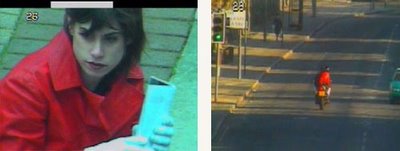
In Jill Magid’s “One Cycle of Memory in the City of L“, the artist contacts and becomes friends with the public surveillance camera (CCTV) operators for the city of Liverpool. They guide her over cell phone as she moves through the city, readily visible by the distinctive red trench coat that she wears. At one point in the video, the artist walks with her eyes closed through the city streets, and the CCTV operators steer her away from collisions with pedestrians and other obstacles. At the conclusion of the project, the surveillance cameras follow Magid as she is picked up on the back of a motorcycle to depart for the airport. The cameras follow her red trench coat as the motorcycle weaves in and out of traffic until she disappears out of range.
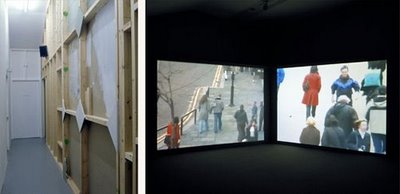
To obtain the video, the artist fills out 31 separate Subject Access Request forms, and compiles the footage into a video installation. The videos are projected on multiple screens while the viewer sits in desk chairs amid bulky filing cabinets, placed in the role of the surveillance operators.
“Lux documents the artificial glow produced by major cities in the 3 brightest regions as seen on a NASA map of the world at night”
“In a time when it is argued that no aspect of nature is unaffected by human impact, my work reflects on a lifestyle that fosters an intense need to control nature while existing in an increasingly delicate balance with it’s resources and rhythms.
I’m interested in the dialectic between the surface documentation of a photograph and the complex reality that lies beyond that surface – how beauty can suggest the simple and ideal while both subtly reflecting and obscuring an often darker more complicated truth.”
Herting makes work in which “the currency of the studio portrait is examined.” They are a conceptual departure and a critical examination of the studio portrait.
“My photographs maybe characterized as portraits, although I am not interested in capturing the uniqueness of an individual. The subjects of my photographs are not the individuals depicted but the construction of the portrait itself.
In order to make the photographs in Free Sitting I got a job as a trade photographer at a portrait studio in a department store. Despite the time and care people take when having their pictures taken at commercial studios, the resulting photographs are rarely considered to be aesthetic object. Yet, they do reveal a great deal about how we choose to image our relationships and ourselves.
The studio portrait has a very structured set of parameters that form a stylistic equation. We are so familiar with it that we are blind to its constructs. I violate these codes in effort to bring them to the viewerís attention. By breaking the rules of the studio portrait, my portraits no longer fulfill their role as social symbols.”