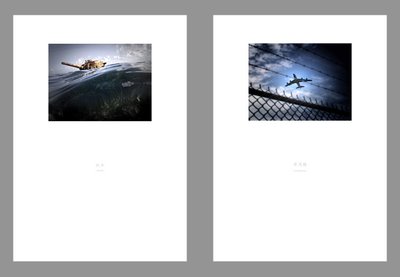
Iranian photographer whose work is photographically self-referential, really solid stuff. Work from The Encounters and Humans.
contemporary art blog
Friday, 13 February 2009
Iranian photographer whose work is photographically self-referential, really solid stuff. Work from The Encounters and Humans.
Thursday, 12 February 2009


Work from Tacking, Rigging, and Weighting and Lifejackets. All prints are 4×5 contact prints (or several of them).
Check out her video collaboration with Matt Griffin.
“I am concerned with breaking patterns. In my work, I explore personal pathologies, both inherited and invented. I spend a tremendous amount of time analyzing my motivations, tendencies, and weaknesses. Self-portraiture is a therapeutic self-examination where I play-out the process of struggling to live my life without abnormal levels of guilt, anxiety, and fear. I photograph myself as various internal characters to act out psychological meanderings, memories, intrinsic dramas and attempts at personal growth and change. I have always been aware of and reliant on the intuitive power of the self-portrait to reveal and influence my behaviors.
Many of the evocative props are tied to the interests-turned obsessions of my grandmother (collecting, but not using, sewing materials), my father (building a fully functional wooden sailboat, but never sailing it) and me (making thousands of self-portraits, most of which are kept to myself). I am attempting to make connections between our common temperaments and tendencies. Through my photographs I am trying to understand and harness these symbols of a creative life unfulfilled: a boat that lies like a rotting carcass in a shed, a stack of patterns, fabrics, and buttons in a corner of a damp basement and boxes upon boxes of unseen photographic performances.”
Thursday, 12 February 2009

Cryopreservation Unit
Cryonics Institute
Clinton Township, Michigan
This cryopreservation unit holds the bodies of Rhea and Elaine Ettinger, the mother and first wife of cryonics pioneer, Robert Ettinger. Robert, author of “The Prospect of Immortality” and “Man into Superman” is still alive.
The Cryonics Institute offers cryostasis (freezing) services for individuals and pets upon death. Cryostasis is practiced with the hope that lives will ultimately be extended through future developments in science, technology, and medicine. When, and if, these developments occur, Institute members hope to awake to an extended life in good health, free from disease or the aging process. Cryostasis must begin immediately upon legal death. A person or pet is infused with ice-preventive substances and quickly cooled to a temperature where physical decay virtually stops. The Cryonics Institute charges $28,000 for cryostasis if it is planned well in advance of legal death and $35,000 on shorter notice.

The Central Intelligence Agency, Art
CIA Original Headquarters Building
Langley, Virginia
The Fine Arts Commission of the CIA is responsible for acquiring art to display in the Agency’s buildings. Among the Commission’s curated art are two pieces (pictured) by Thomas Downing, on long-term loan from the Vincent Melzac collection. Downing was a member of the Washington Color School, a group of post World War II painters whose influence helped to establish the city as a center for arts and culture. Vincent Melzac was a private collector of abstract art and the Administrative Director of the Corcoran Gallery of Art, Washington D.C.’s premiere art museum.
Since the founding of the CIA in 1947, the Agency has participated in both covert and public cultural diplomacy efforts throughout the world. It is speculated that some of the CIA’s involvement in the arts was designed to counter Soviet Communism by helping to popularize what it considered pro-American thought and aesthetic sensibilities. Such involvement has raised historical questions about certain art forms or styles that may have elicited the interest of the Agency, including abstract expressionism.

Works from An American Index of the Hidden and Unfamiliar. There is a great Wired article about Taryn here.
Wednesday, 11 February 2009


Images from Interiors. Statement below.
“I love stories – from others, from fiction, from the news, from poetry, from memories – I imagine the desperate situations of personal relationship as scenes of tragic disasters. I enjoy the way in which words placed next to one another elicit an image. The way an image can conjure up an entire story. In this series of photographs, I strive to create a narrative that delivers the viewer into a place where a story of humanness can be contemplated.
I design and construct interior room dioramas that show an aftermath of a destructive event. The domestic spaces illustrate one fragment of a larger narrative, depicting stories of frustration and loss, implying a connection to personal relationships through titling. By positioning the viewer separate from the event through doorways, hallways and adjoining rooms, the viewer becomes the voyeur, the eavesdropper the silent observer.
The disasters depicted in the images; a room overflowing with crumpled paper, bricked up passageways, oceans of sand and car headlights on an abandoned mattress allude to past events, and the potential of events awaiting us in our future. These spaces have a constructed history that is manufactured in order to tell a story of human feelings and experiences. I titled these images with a line from a story that I feel can be interpreted on different levels and directs the viewer in the image while allowing room for personal interpretation.
After constructing these sets, I then photograph them using a 4×5 camera and print the images, using traditional color printing methods, to a final size of 24 x 30 inches. The images are matted and displayed in 33 x 38’ white maple shadow box frames.”
Wednesday, 11 February 2009


Work from Menschenkunde and Falsenfest. I highly reccommend that you read the statement as well as check out the newer Varsity work.
Tuesday, 10 February 2009
Works from recent work and Dreamhome.
” The psychological state of a society, its tendencies, hopes, and fears, are illuminated by the structures it chooses to create, and the ways in which those structures are used. Architecture is initially born from, and dictated by human need and desire. However, once a structure is complete and comes into use, it assumes a life of its own and begins to impress its self on the individuals that encounter it in unforeseen ways. My sculpture employs scaled down and streamlined versions of existing architectural forms that I either re-contextualize or re-present in such a way that the architecture’s social influence (or potential for social influence) becomes more evident.
Through the study of contemporary architecture in developed or developing countries one can also begin to realize universalities that exist from community to community throughout humanity, regardless of nationality, race, or geographical location. By being aware of the repeated formal choices in architecture around the world, a set of universal concerns and desires begin to reveal themselves: modularity, order, efficiency, and convenience. The sculptural objects I create call into question the validity of adopting these characteristics as ideals.”
Tuesday, 10 February 2009
Monday, 9 February 2009


Work from Me in America. The entire site is well worth looking at, particularly Intervention, and Hunt and Gather.
Lamson also has some great video work.
Sunday, 8 February 2009
Sunday, 8 February 2009