Koenraad Dedobbeleer

dedobbeleer_2008_12 Dedobbeleer_2008_11  koenraad_dedobbeleer_2011_A Point in Space is a Place

Koenraad Dedobbeleer

Work from his oeuvre.

“Remodelling materials into vaguely recognizable forms that suggest functional objects, Dedobbeleer’s 13 sculptures refer primarily to each other: the rounded forms of a non-functional furnace in “Thought Apart From Concrete Realities” (all works 2010) mimic a bulbous replica of large, outdoor planters – abstracted, conjoined and multiplied three times in “The Gradual Formation of a Landscape”. Similarly replicated, a series of ineffectual doorknobs in various materials including painted foam and metal, were placed on the gallery’s floors and walls. They are all copies of a brass handle on the exterior of the gallery door. The wood of a hexahedronal piece resembling a fountain, “The Subject of Matter (for Vm)”, painted as faux-marble, mimics the actual marble surface of a neighbouring piece, “That Which Is”. Set into a niche carved into the bench-top of pink marble on that piece, in a depressed area perfectly-sized to contain it, a book titled “Already Uttered on Numerous Occasions in Various Places” contains images and exhibition documentation of possible sculptures that, save for one (the book’s introduction informs us) were never made or materialized beyond the trial phase. The one work that was realized, pictured on the paperback’s small cover – a branched and colourful length of wood suspended by cords entitled “Human Existence Resides in Utter Superfluity” – hangs low to the ground precisely where it was photographed. 
” – Galerie Micheline Szwajcer

John Massey

afterLeMepris4428956_1455094663404_1038761680_n
afterLeMepris3
selectedworks-1
selectedworks

John Massey

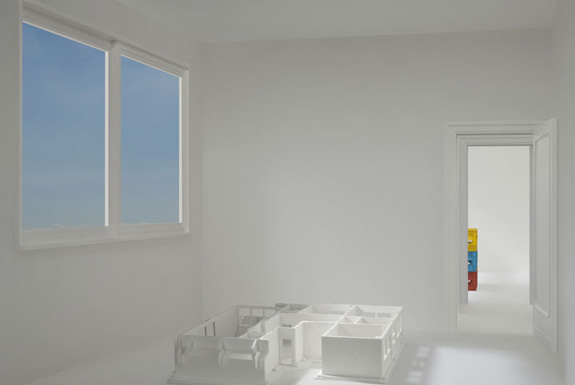
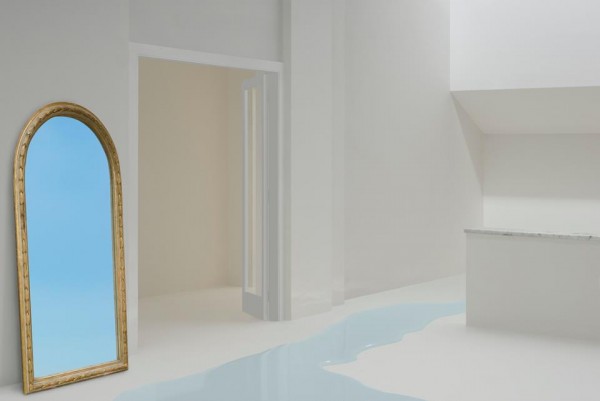
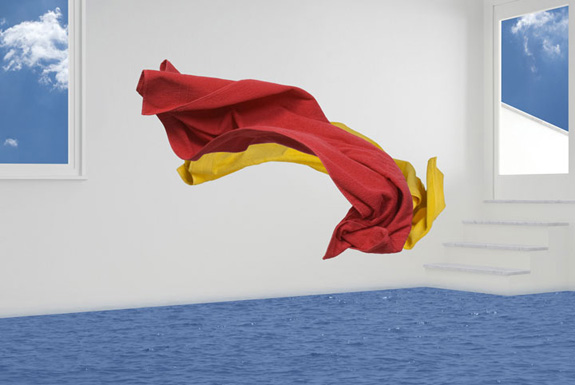
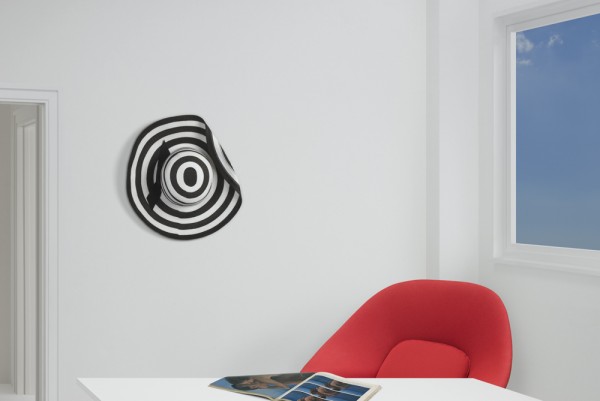
Work from After Le Mépris.

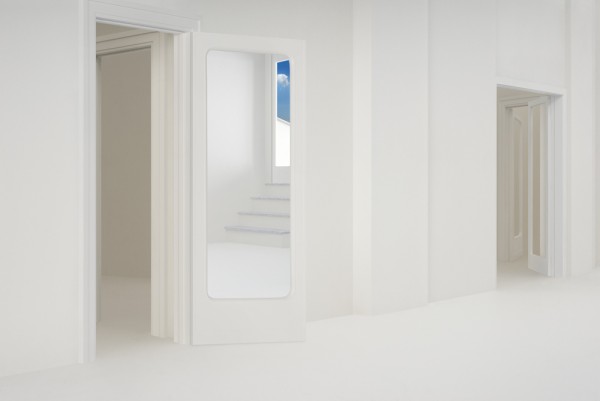
“…After Le Mépris. This new suite of iconic and bittersweet photographs was inspired by the central scene in Jean Luc Godard’s 1963 film, Le Mépris (Contempt).

Massey is known for his metaphysical dramas, enacted in pristine, idealized architectural interiors that he treats like theatre sets. In this series, the interiors are modelled on the unfinished apartment in Rome where Godard set the pivotal scene of Le Mépris, which portrays a final breakdown of communication between the two lovers. Massey built a scale model of the apartment, shot each of its nine rooms, and configured his pictures with motifs from the film, including its strong primary colours and Mediterranean light. The apartment, in After Le Mépris, becomes a shrine to the scene from the film, its lost love and parting of ways, and also to larger farewells.

The picture entitled Red Curtain, with its ghostlike image of the lovers in the window, evokes this sense of things existing in the past or only in theory or memory. And in a sense, all the pictures in the series rely on such projection. The objects and images (the flowers, clothing, pillows and towels, mirrors and puddles, bright skies, amassed clouds, lights, reflections and shadows) have been placed in the rooms as projections into a story about what might happen next – regret, emptiness, solitude and wishful thinking but also hindsight, enlightenment and the return of optimism.” – Georgia Scherman Projects

via Nick Faust.

Vasa Velizar Mihich

3722909_1_l1285
2500127_1_l
390

Vasa Velizar Mihich

Work from his oeuvre.

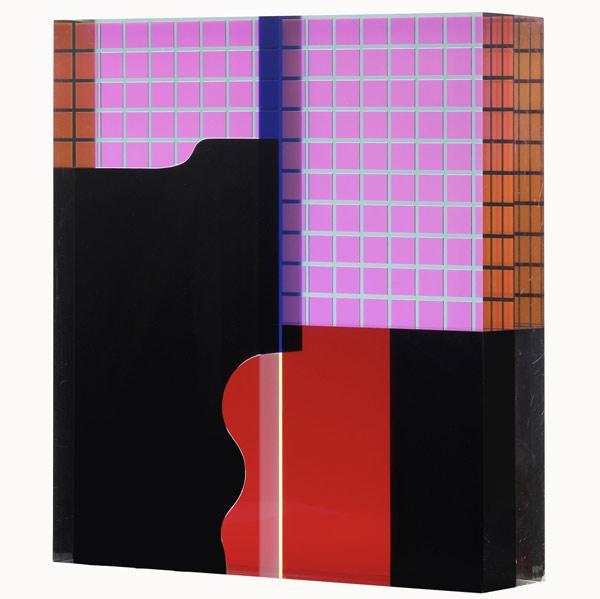
“A senior Professor of Design at the University of California, Los Angeles, Vasa is an innovative, internationally known sculptor whose creative work explores the three dimensional interactions of light and color. With an advanced understanding of optical complexities, Vasa has become, in the words of Henry Seldis, former art critic of The Los Angeles Times, “the most sensuous and sensational colorist of the southern California artists working in plastic.”

Born in Yugoslavia in 1933, Vasa Mihich, an academically trained painter, became a member of the faculty at the University of Belgrade in 1956. During a visit to Paris that same year, Vasa became aware of the growing importance of American art, and four years later he immigrated to the United States.

Influenced by the major changes taking place in art in the United States and especially in Los Angeles, Vasa began working in three-dimensional painted constructions in 1964. This work was first shown in January, 1966 in the Feigen-Palmer Gallery in Los Angeles and that same year was included in the seminal exhibit American Sculptures of the Sixties at the Los Angeles County Art Museum and other museum and university exhibits.” – TSCO

Ryoji Ikeda

testpattern-testpattern_n2-3
testpattern-testpattern_n2-4
the_transfinite
testpattern-testpattern_n3-1

Ryoji Ikeda

Work from test pattern.

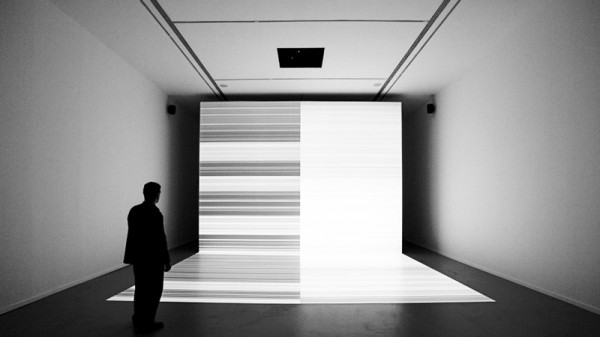
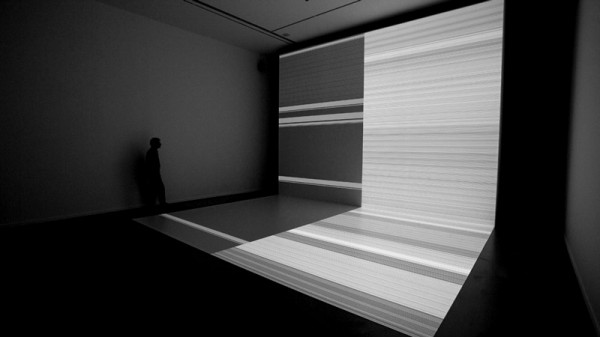
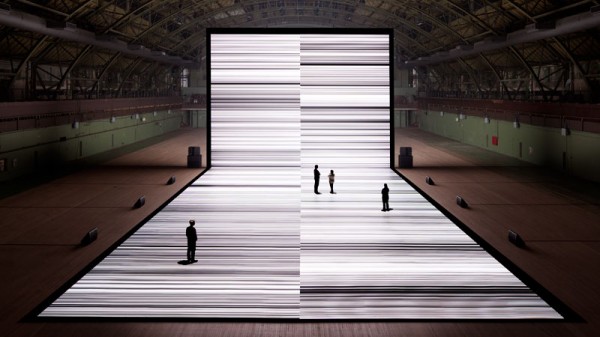
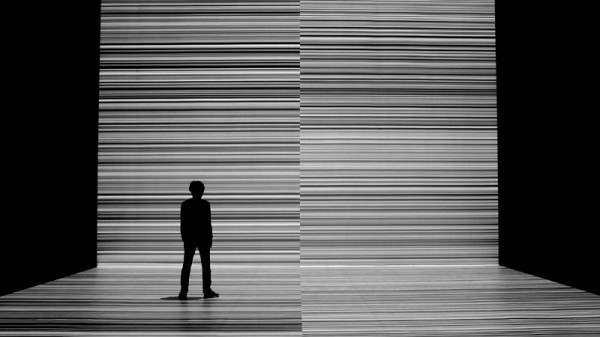
“This latest audiovisual work from Ryoji Ikeda, presents intense flickering black and white imagery, which floats and convulses in darkness to a stark and powerful, highly synchronised soundtrack. Through a real–time computer programme, test pattern converts Ikeda’s audio signal patterns into tightly synchronized barcode patterns on screen. The velocity of the moving images is ultra–fast, some hundreds of frames per second, so that the work provides a performance test for the audio and visual devices, as well as a response test for the audience’s perceptions.

test pattern is the third audiovisual concert in Ikeda’s datamatics series, an art project that explores the potential to perceive the invisible multi–substance of data that permeates our world.
Taking various forms – installations, live performance and recordings – test pattern acts as a system that converts any type of data (text, sounds, photos and movies) into barcode patterns and binary patterns of 0s and 1s. The project aims to examine the relationship between critical points of device performance and the threshold of human perception, pushing both to their absolute limits.

test pattern [n˚2] presents flickering black and white imagery that floats and convulses in darkness on two screens, one on the floor and another floor to ceiling, in time with a stark and powerful, highly synchronised soundtrack. Through a real–time computer programme, Ikeda’s audio signal patterns are converted into tightly synchronised barcode patterns on the screens. Viewers are literally immersed in the work, and the velocity of the moving images is ultra–fast, some hundreds of frames per second, providing a totally immersive and powerful experience. The work provides a performance test for the audio and visual devices, as well as a response test for the audience’s perceptions.” – Ryoji Ikeda

Agostino Bonalumi

a5 BONALUMI - Bianco 1974 - 130x180cm 1303_agostino_bonalumi___senza_titolo___nero

Agostino Bonalumi

Work from his oeuvre.

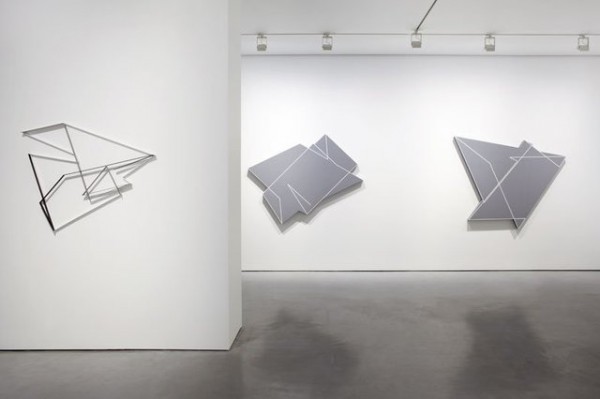
Agostino Bonalumi (1935) created works, which are strongly determined by geometrical shapes. His attempt at breaking up these stiff shapesled him to a freedom of movement of the included objects. Monochrome works appeared, whose ridges and troughs are marked by wires attached on the back. The compact structures of the canvas were broken up by moving systems of lines, which transgress the lateral limitations.” – Triangulation Blog

Taylor Holland

Taylor Holland

Work from Vector Fields.

“Animations of sports fields created with Adobe Illustrator and pirated screen-capture software. The speed of play is relative to the ability of my MacBook to process the effect in real time. Presented in two full counterclockwise rotations.” – Taylor Holland

Mandla Reuter

mandla-reuter-1
mandla-reuter-5
mandla-reuter
mandla-reuter-4
mandla-reuter-3

Mandla Reuter

Work from his/her oeuvre.

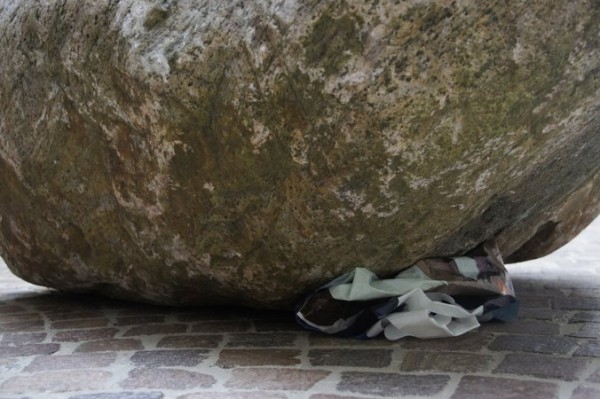
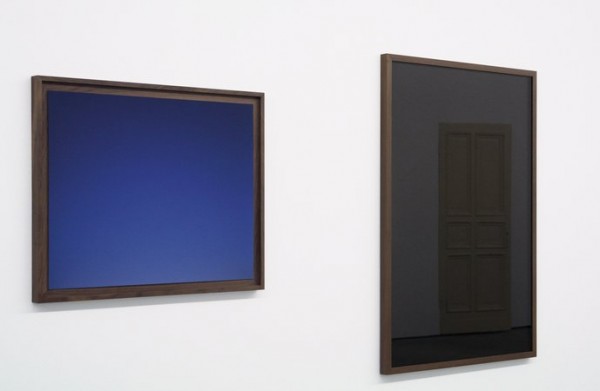
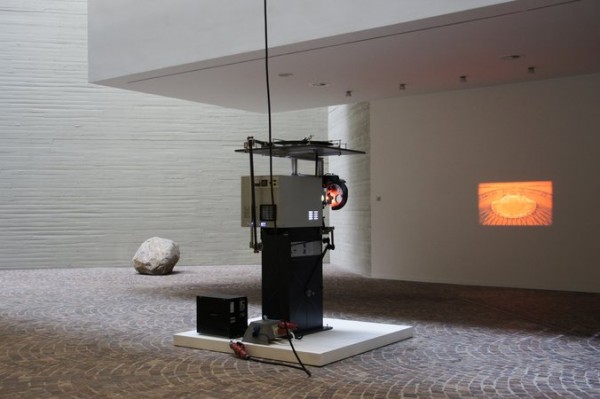
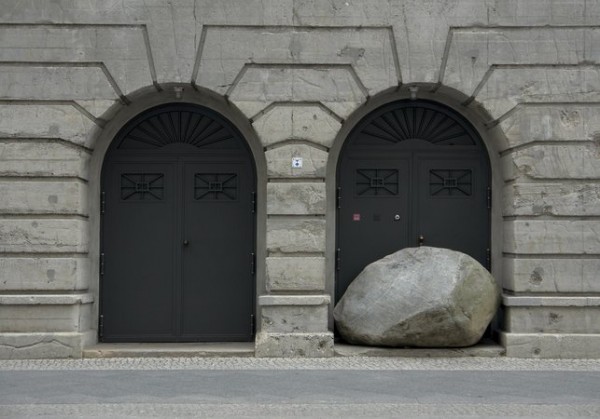
This artist was found (as many have been in the past) on VVORK, Reuter’s image marks their last post of regular daily activity. If you haven’t spent time with their archives, I highly suggest you do so – it remains one of the most relevant and rich resources I have come across.

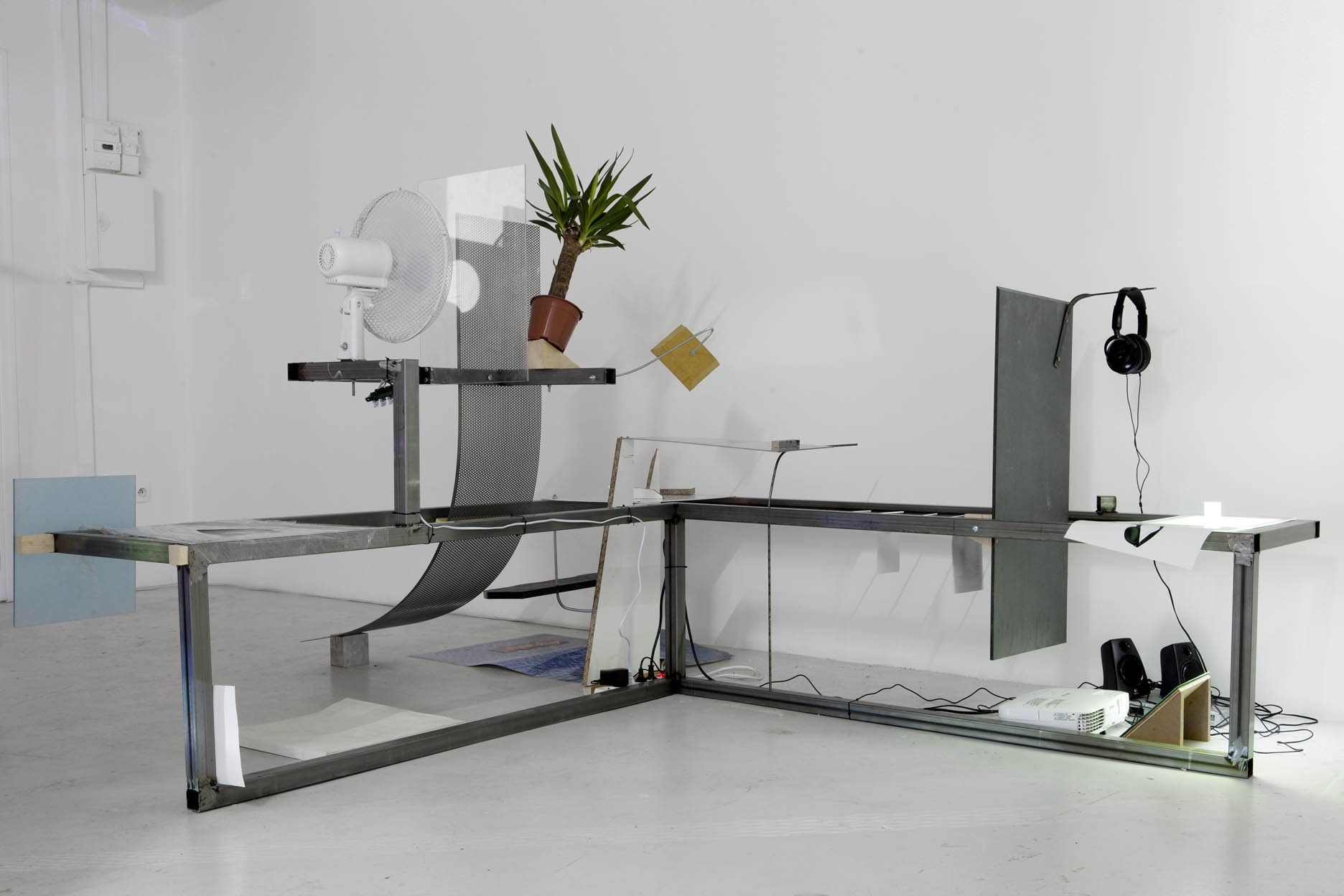
“KR: When taking a look at catalogue and press texts written on your exhibitions, your artistic approach is preferably described as one that by means of – in part explicit, in part minimal – interventions sensitizes one to specific institutional states and sheds light on the architectural, aesthetic and social conditions of art production and reception. In this context, my first question addresses concrete strategies, or rather, your specific methodology of producing shifts. What happens when rooms, architectural elements, doors, entrances etc. are ‘doubled’, for example? How does it function, how does it operate? What interests you most when doing this?

MR: These frequently mentioned shifts in my works are produced in a variety of ways; it is most often the case that an object in the room or an architectural alteration serves to create certain situations, which then form the actual core of the work. As far as I know, doubling, except for a few examples, doesn’t necessarily play a prominent role in my work, yet regarded as a very fundamental and old artistic means, it is of course interesting.

In the exhibition Isolated Human Particles Floating Weightlessly Through the Magnetic Stream of Fabricated Pleasure Occasionally Colliding (2006), doubling was naturally a pivotal moment. Two identical exhibitions were juxtaposed. They were simultaneously opened at two different locations in Frankfurt, with identical opening addresses and of course identical works. Yet the two shows each had a very different character, because one took place in a private flat and the other in a public exhibition space. The central and largest piece, which was at the same time relatively inconspicuous, was the only one that was not doubled in the classical sense.
The Move (2006) consisted in relocating the entire furniture and possessions of Meike Behm and Peter Lütje, the operators of the exhibition space rraum, to the back room of the public institution. The move was carried out by a removal firm which thus became part of the work. This lent the exhibition in the flat a relatively neutral appearance, while in the other art space the objects were stored. Less as a sculpture than as a mere mass moved within the frame of the show. Among other things, The Move played with the immense effort made in the backstage areas of large concerts, during film shootings and other cultural events. In my case it was a more or less meaningless effort standing for itself within the frame of the two exhibitions.

KR: I would like to add a further question here that has to do with the way your work is received or interpreted. Vanessa Joan Müller describes your works as “context-related installations”, and in the press release of the Berliner Flutgrabenfabrik on the awarding of the GASAG Art Prize 2007, talk is of “situation-specific installations”. What do you think: Do these positive references to the concept of installation as well as avoiding the use of the labels site-specificity and institutional critique have to do with trends in art criticism, or to what extent do they necessarily result from your work? You yourself just spoke about creating certain situations…

MR: It could perhaps have to do with the difficulty, but also the alleged necessity, of attaching a label to an artwork or trying to explain it, to make it comprehensible and place it in a context using familiar concepts. The terms used here, “context-related installation” and “situation-specific installation”, are not necessarily wrong, but they are probably more confusing than that they contribute to elucidating a working method. I would rarely describe my work as situation-specific, site-specific or context-related. The works are conceived in such a way that they can function independently of the site, and usually independently of the context as well. It is the contexts that change artworks, no matter what they are like. My work is not institution-critical either, at least that’s not how I see it. Perhaps one could have spoken of institutional critique if the works had been produced in the 1970s or 80s, but today such concepts often do not go far enough and tend to pigeonhole artistic works, thus making it almost impossible to read and deal with them in a farther-reaching, sensible way. In most cases I find these currently widespread artistic positions that present their political, ecological or institutional grounds in advance extremely difficult. I don’t want to be misunderstood here; of course it’s fine if an artwork functions as a political statement or can be very political in itself, but not as a priority and as the sole starting point of a work. Maybe that also has to do with trends in art criticism, but certain developments can be found there as well. In general I try to avoid these labels, even if it doesn’t always seem to work, as one can see. When I speak about works that create situations, I mean the circumstances and the possibilities of perception that are produced by an artistic intervention and that lead away from their actual materiality, allowing a number of interpretations. Basically that’s what happens with every picture hanging in a room. And of course I would like my works to be seen foremost as pictures; I’m an artist and artists create pictures. All one can say about the concept of installation is that any picture hanging on a wall becomes an installation, perhaps the respective artists have different priorities, but in the end what largely contributes to the reception of a work is how it hangs in the room and what it does to the room…” – from the inteview with Karin Rebbert.

Manfred Mohr

manfred-mohr-one-and-zero-installation-view-6 mm_1 mm manfred-mohr-one-and-zero-installation-view-2

Manfred Mohr

Work from one and zero @ Carrol / Fletcher.

All my relations to aesthetical decisions always go back to musical thinking, either active in that I played a musical instrument or theoretical in that I see my art as visual music… I was very impressed by Anton Webern’s music from the 1920s where for the first time I realized that space, the pause, became as important to the musical construct as the sound itself. So there are these two poles, one and zero. – Manfred Mohr

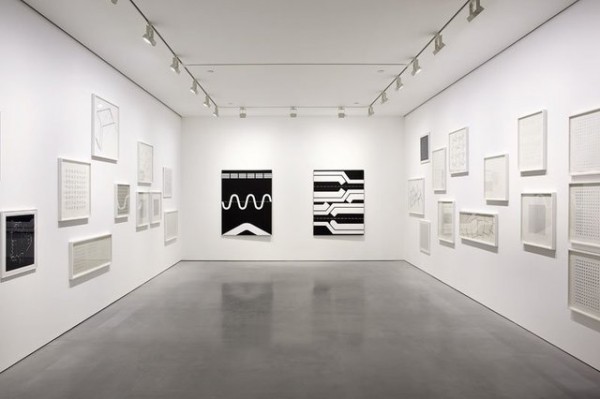
one and zero, Manfred Mohr’s first solo exhibition in London, presents a concise survey of his fifty-year practice. Harnessing the automatic processes of the computer, Mohr’s work brings together his deep interest in music and mathematics to create works that are rigorously minimal but with an elegant lyricism that belie their formal underpinnings. Through drawing, painting, wall-reliefs and screen-based works, the show examines the artist’s practice through the prism of music and the idea that what is left out is as important as what remains.

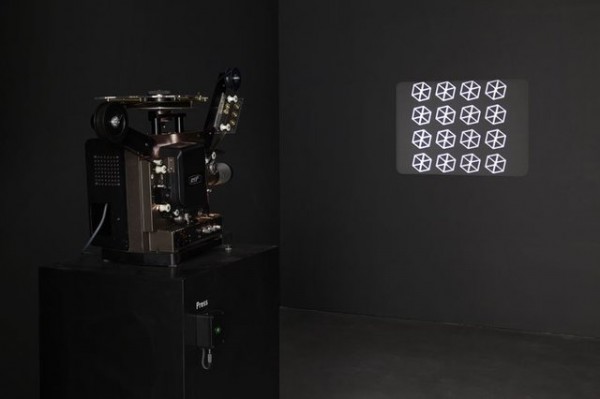
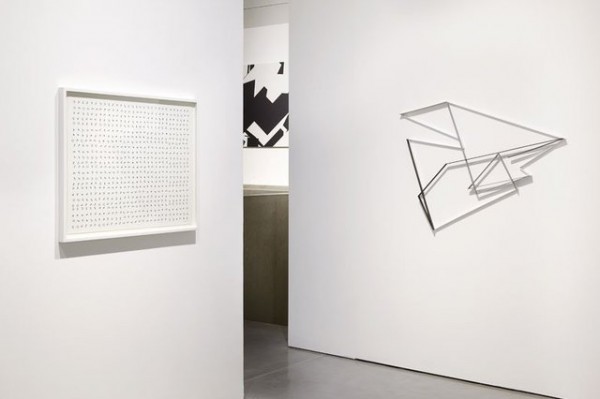
 Beginning in 1969, Mohr was one of the first visual artists to explore the use of algorithms and computer programs to make independent abstract artworks.  His early computer plotter drawings – when he had access to one of the earliest computer driven plotter drawing machines at the Meteorology Institute in Paris – are delicate, spare monochrome works on paper derived from algorithms devised by the artist and executed by the computer.  P198aa(1977-79) is an elegant rhythmic composition of nine randomly rotated and cut cubes that hints at multi-dimensional space.

In other works that pre-date Mohr’s pioneering work with the computer, his interest in systematic art-making can clearly be seen; Bild 24/768 (1968) is reminiscent of a simple circuit board with its curious symbols and hard-edged patterning.

one and zero explores how the complexity of the cube in 3, 4, 5, 6 and 11 dimensions, as well as the possibilities of going to even higher dimensions, have influenced Mohr’s practice over the course of forty years.  Originally a jazz musician, he compares the cube to a musical instrument and the detailed improvisation that the instrument allows within fixed tonal parameters. His large-scale wall relief – P-499A (1993) – is composed of fifteen unique laser cut steel pieces evolved from Mohr’s investigation into the 6-dimensional hyper-cube.

In 1999, Mohr returned to the use of colour to emphasize and distinguish between subtleties in spatial relationships.  P709b1-5 (2002), a large-scale digital painting on canvas shows five views of the 6-D rotation of a hyper-cube revealing an intriguing orchestration of solid greens, blues, purples and pink.  More recently, digital technologies have enabled the artist to create works such as P1411-A (2010), in which a generative algorithm based on an 11-dimensional hyper-cube manifests an evolving progression of colour and shape as a screen based real-time computer animation…” – Carrol / Fletcher

via Rhizome.

Neil Beloufa

IMG_0916 IMG_0912 IMG_0930

Neil Beloufa

Work from his oeuvre.

“…People’s passion, lifestyle, beautiful wine, gigantic glass towers, all surrounded by water (2011),” a pitiless condemnation of Vancouver disguised as a promotional video for the city. With a Riot Girl lilt that compulsively scoops up in uncertainty, the first subject on screen begins, “People are beautiful here … they have a really good work/life balance.” The interviewees’ meandering zeal for their utopian home paints the ideal of outdoorsy, cosmopolitan “quality of life” as a nebulous and narcissistic purgatory, and the film ends in a horrific display of fireworks over a glittering cityscape.

The works surrounding this video (one of which served as a screen) mixes pure forms with appropriated images celebrities and places. In “Definition, Cloud (2011),” for example, Angelina Jolie’s face is pasted below a crudely cut out rectangle with one undulating side. Beloufa is interested in Jolie (a k a Lara Croft) as “the beauty for new technology” — an actress who represents perfection in the digital age. Another work pairs a swerving abstract shape partially spray-painted red with a photo of Beyoncé in a red dress, her edited midsection also swerving like a vertical sine curve. “That’s supposed to be a heart, and that is a pixelated Taj Mahal, and that,” Beloufa says, pointing to an image of a group of women in a rainbow of dresses digitally streaked in a rainbowlike horseshoe shape, “is another bad joke, but it’s private.” Like his videos, Beloufa’s tangible artworks exploit a desire for an authority who knows and cares what’s going on and has organized everything in a way that explains it. But Beloufa, of course, withholds such comfort. Asked if the architectural forms that serve as the projection’s three-dimensional screen recall a particular building, he answered, “No, nothing is particular.”” – New York Times

Miriam Böhm

Miriam Böhm

Work from Before in Front @ Ratio 3.

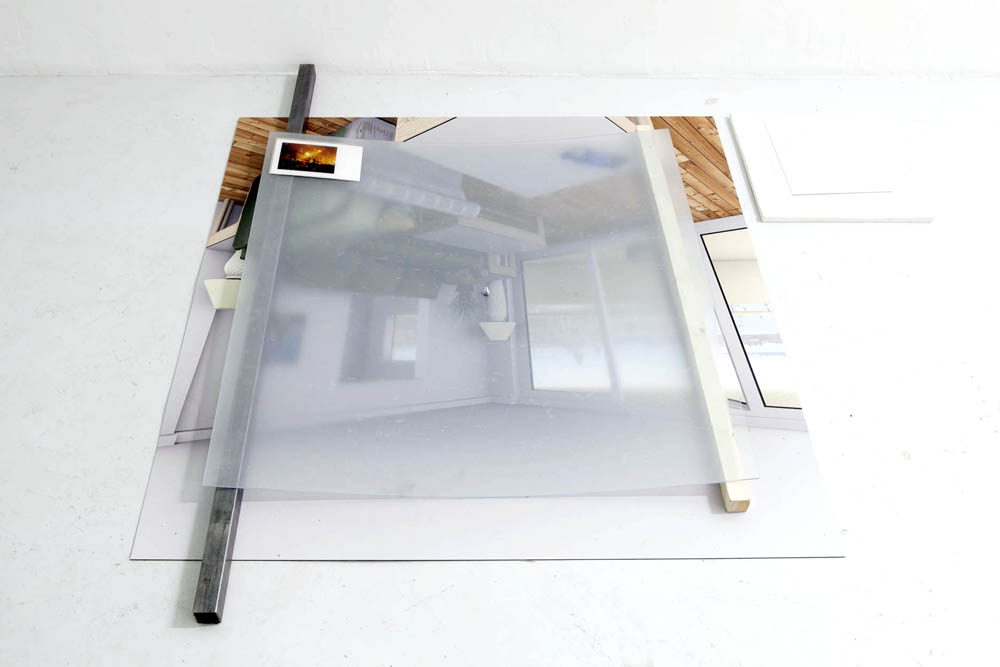
“Miriam Böhm is recognized for producing photographic images of complex, physical arrangements staged in the studio setting. The photographed arrangements are printed, mounted, placed back into the studio set and photographed again and again. The end result achieves echoing forms and disorienting shifts of perspective. Böhm’s playful approach of materiality combined with formal studio techniques create an illusory effect which often confounds the viewer’s point of view.

Böhm’s work appeals to the broadening of traditional photographic parameters by creating a dialog of interpretation between documentation and reproduction. In looking at Böhm’s photographs, the viewer is forced to engage in the process of deconstructing the pictorial narrative in order to discover what is real and what is reproduced. The elegant trompe l’oeil effect of Böhm’s compositions destabilize the way we look at photography. What initially looks and feels like a nondescript object placed in the foreground of a simple space unveils its complexity between foreground, background, form and subject. Through this process of manipulation Böhm has developed a visual vocabulary uniquely her own.” – Ratio 3