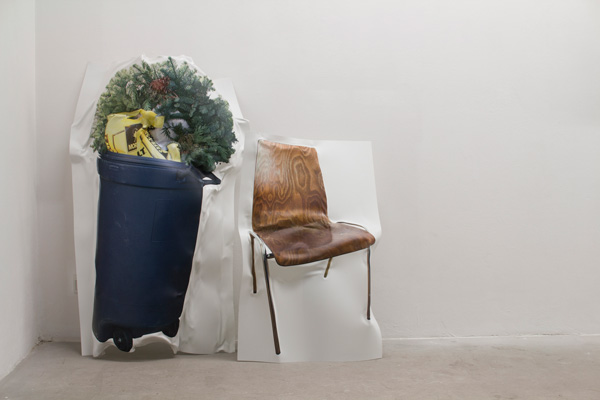
Rafman will have some works in Land Before Skype at CS13 opening on Friday night from 6-10 . The exhibition looks stellar, so if you are in Cincinnati, you should check it out.
“Some recent works over on Jon Rafman’s excellent piece Brand New Paint Job. Here so many crossovers are brought into proximity… the post-gallery, post-exhibition reality of a collectable painting largely as an adornment to the interior decor of the collector, bent around their objects like a kind of philosophical wallpaper, but in Rafman’s handling such a suggestion occurs skinned upon 3d alreadymades from Google 3D Warehouse. In this way the project may also wryly tackle one of painting’s most hotly defended and greatest historic fears: the decorative.
Each instance is a consideration between an object and a painting, potentially pitting the uselessness of paintings against the function of objects, dialing that hallowed and receding ground between art and design. Or casting painting in the lead role of Tradition for the visual, a position that blankets current image based material found within the internet. Seen in this way as an ancestor, out of context and sampled, Rafman may seem to suggest history is ultimately wrapped around whatever we do. This is interesting, particularly as history is a cumulative process, you know, history is actually increasing. The further into the future we go, the more history we must carry. We might not have to carry it as much as before if history is online, because now it’s just chilling in your pocket. In any case we could, like they did 100 years ago, always dump history by the wayside to lighten the load. Break free. Or as we see in these works by Jon Rafman, we could just continue to carry our burden awares – and do it with equal parts style and wit.
In each piece iconic proponents from the history of painting are summoned in the house of Google, relegated to the status of add-on surfaces, custom bitmap textures, literally shrink wrapped around pieces of online community objects. Is history fitting the current or is the current fitting history? Positioning painting in this way brings it into the realm of an exclusive wallpaper, a humorous play with interior designer chic. In some of the interior living spaces where Rafman has completely covered every object in a room with the repetition of a single painting, the room becomes a domestic shrine to a work, it’s facets a vortex, as objects are lost to and within a mutation of planes. Is this a new painting? Or a new paint job? With the critical Auction House Heights (AHH) of painting now represented also as google Image Search Stock (ISS), history can be understood as layers applied over or under the present, like a paint job.” – by Ry David Bradley
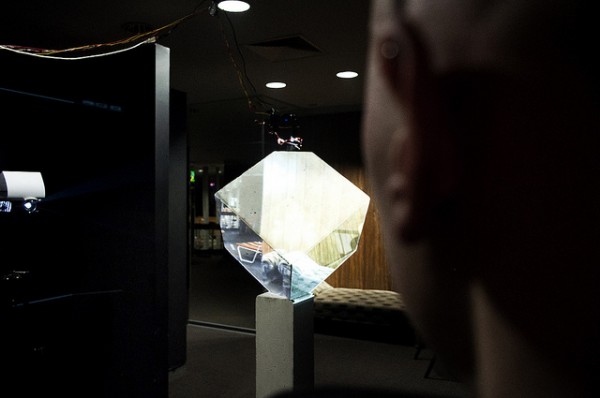
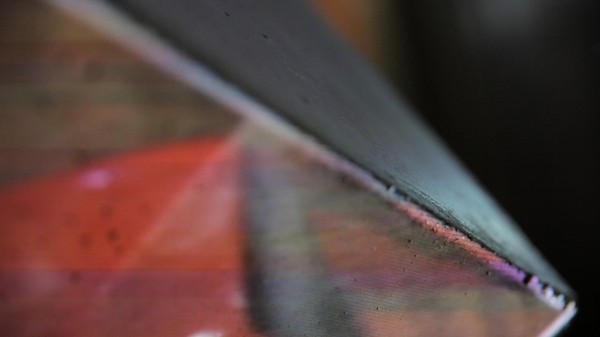
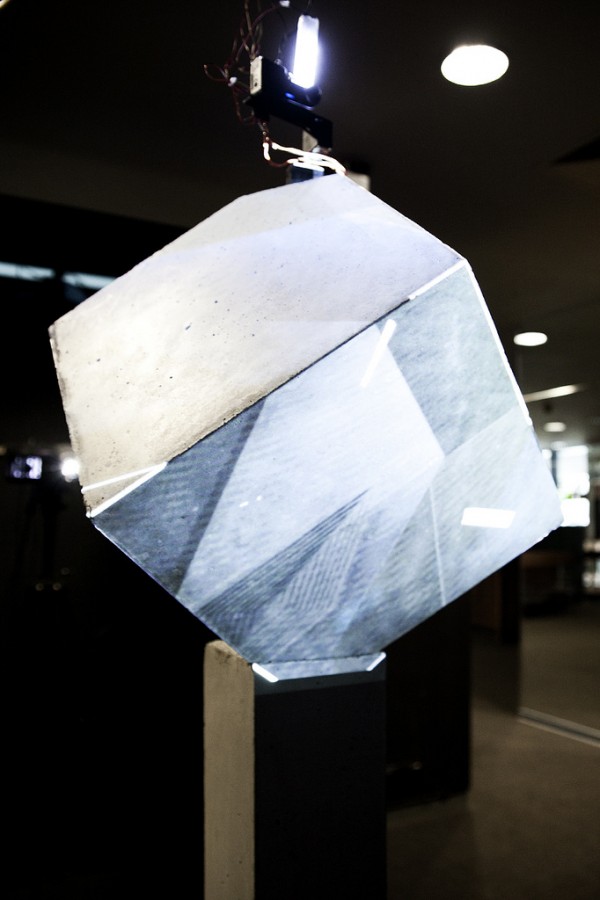
“A camera fixed on the concrete cube sculpture recognizes the presence of human faces within its scope. With a randomized choice it will focus on one of the bystanders and adjust its movement to his; tracking the eye movements of the viewer, a software computes the corresponding angle of view projecting onto the cube the very section of the space the sculpture is blocking from the viewers eye; thus making the cube appear transparent.
The video sculpture Durchsehen, Exp. 01 (augmented perspective) overwrites the common notion of perspective and plays with the significance of perspective in an art historical perspective; the work of art evades the gaze of the viewer or rather: the two are equated. The gaze of the observer coincides with the object of observance in a piece that also draws a line to former strategies of dealing with vision and depiction: the renaissance praxis of painting on glass.
Through the real-time projection on the cube a 3 dimensional depiction of 2 dimensionality occurs; the catoptric turns dioptric. The framing plane of the conventional video image becomes fragmented as work and reality intertwine in an augmented perspective.” – Markus Kison and Daniel Franke
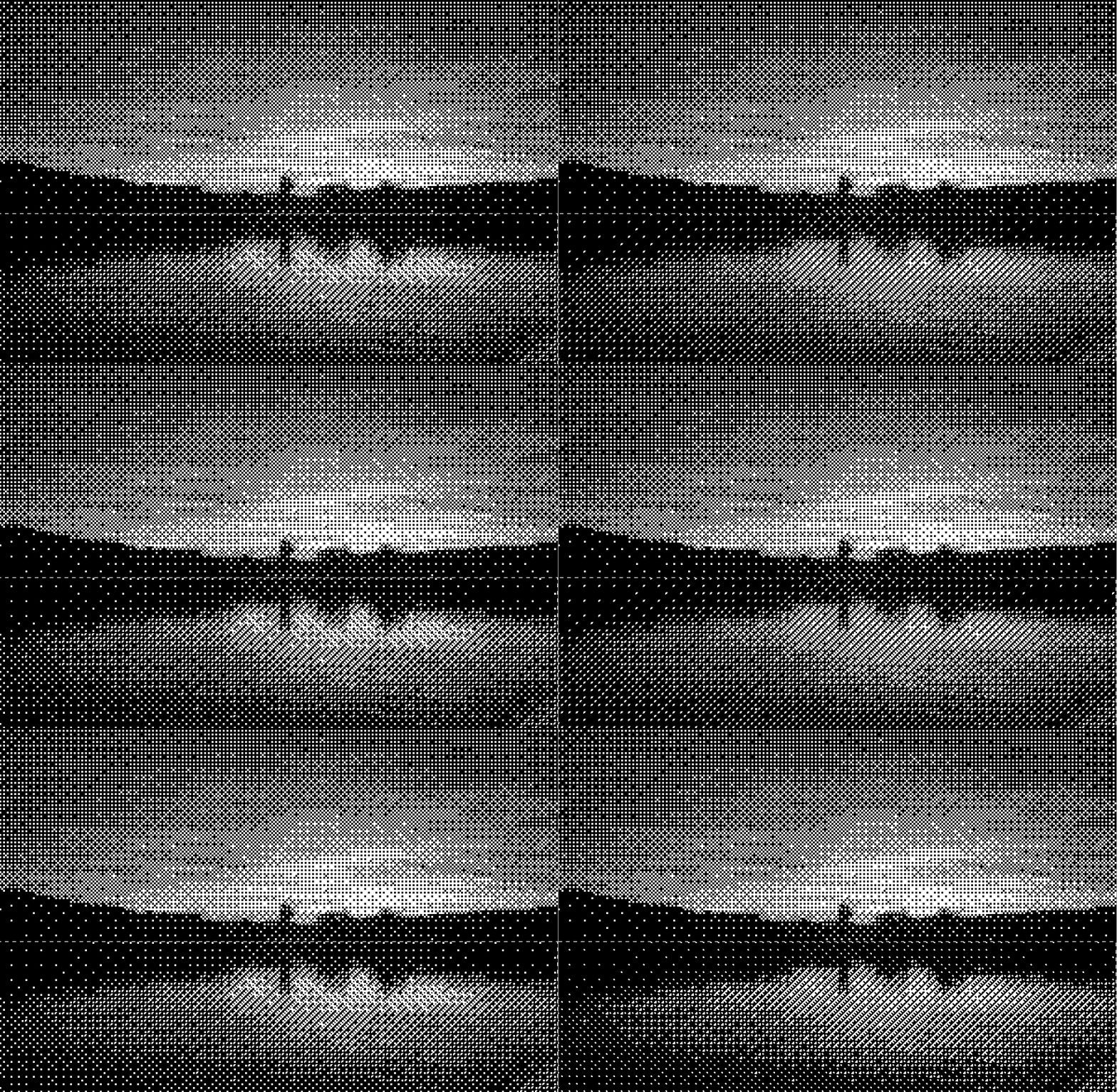
“Schwulst’s practice concentrates on the concepts of participation, technology and nature, both creating and destroying links between them, whilst also playing with visual and digital themes. Each work exhibited in Proposals for Future Parks is a different scenario, inviting the visitor to experience nature as intended in a highly technological reality.
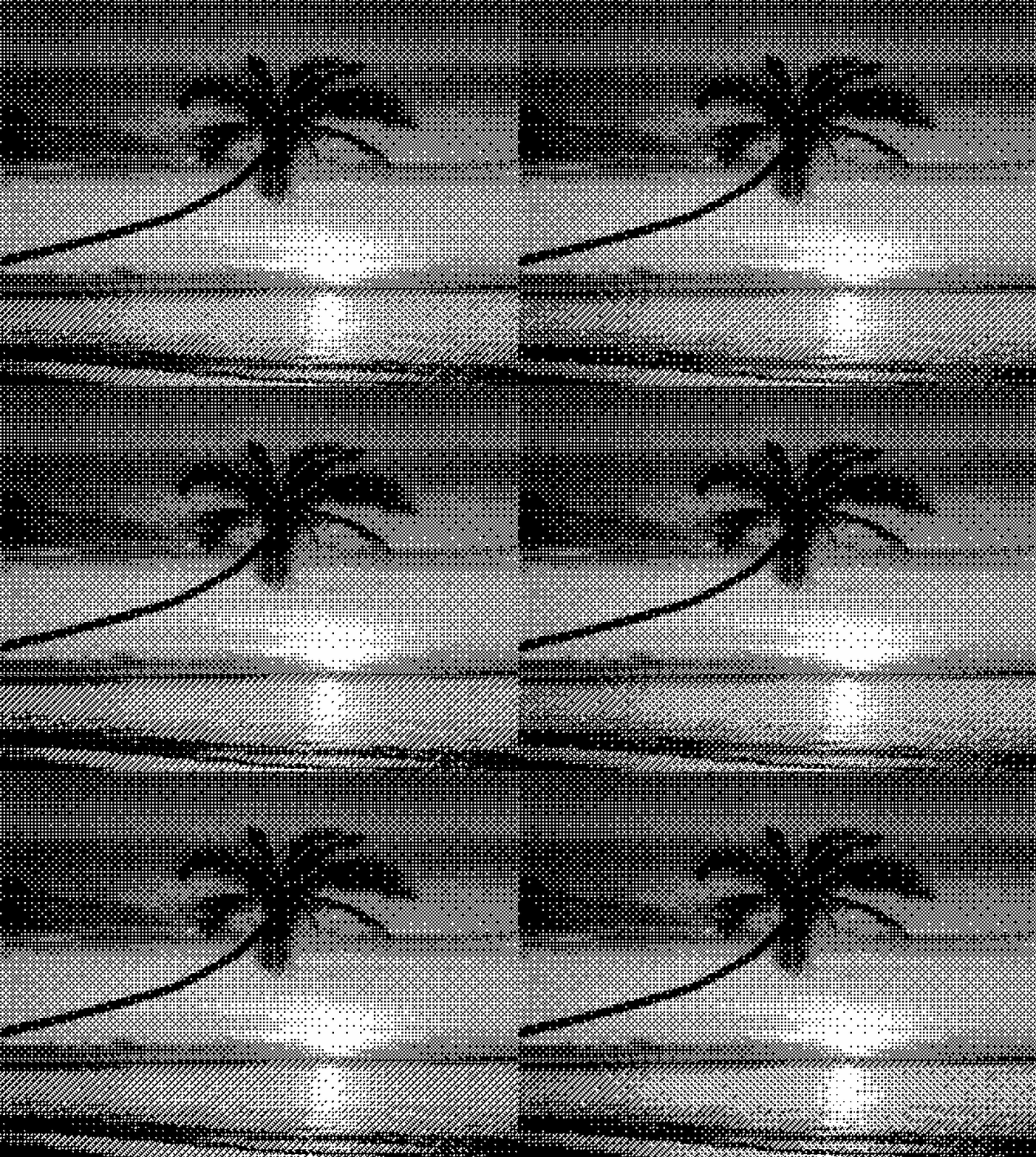
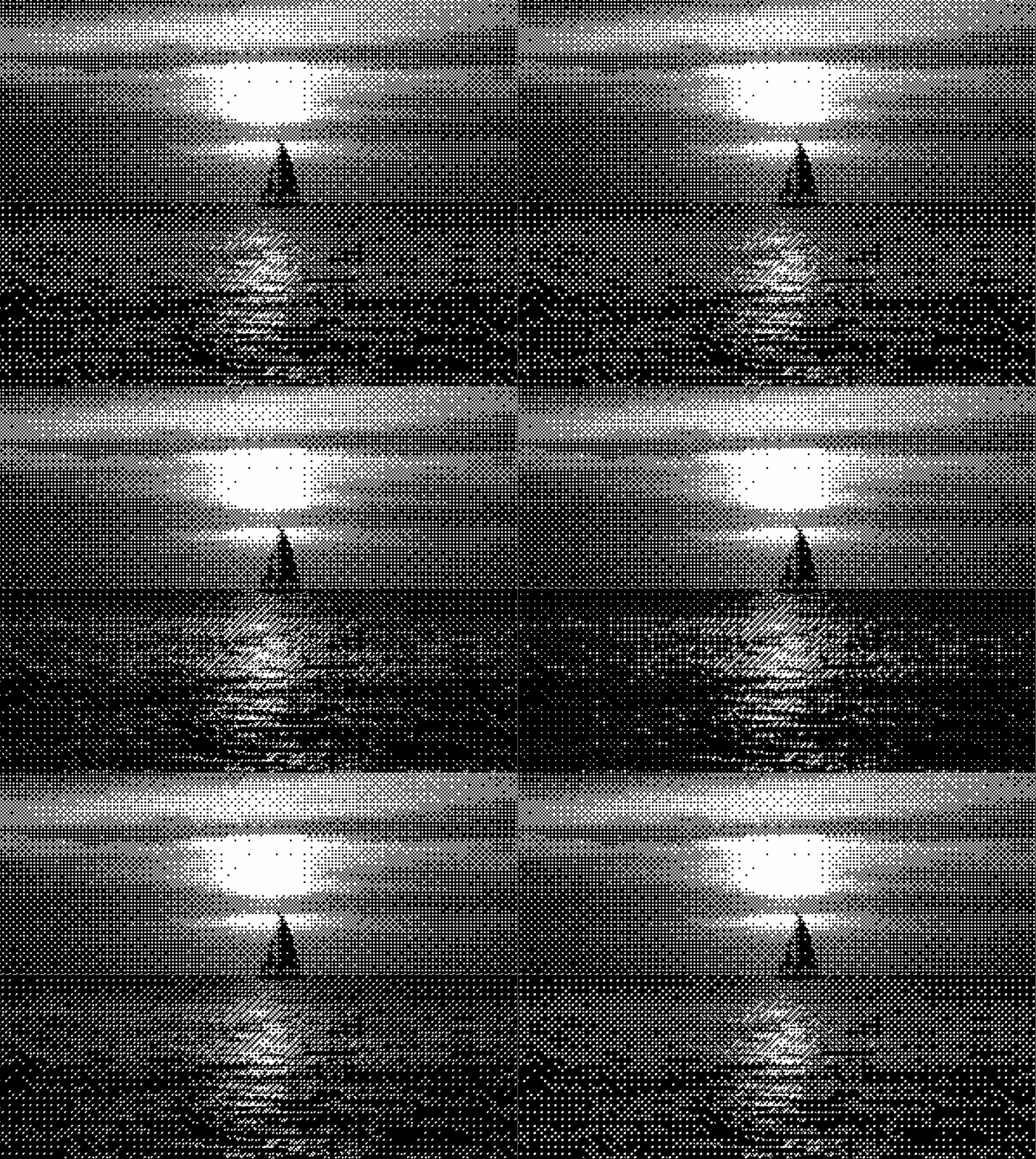
This park overlooks a faraway ocean, but is closed at sunset for the ten minutes it takes the sun to drop below the horizon line. During this time, viewers go to nearby viewfinders that translate the sunset into a more familiar language of selected bits, undulating from off to on.” – bubblebyte.org
“81 Points of View is an interactive sculpture. It proposes an electro-mechanical setup that overlaps perceived with virtual reality. The result is an elaborate manifestation of a basic principle utilizing old and obsolete technology. Due to the transparent setup the sculpture’s mode of operation turns out to be its actual subject matter.
81 Points of View operates in between modern handheld devices that implement augmented reality, and optical machines invented centuries ago. As an installation it attempts to illustrate ideas of optical illusion and virtual voyage that have appeared as new technology repeatedly during past centuries – and continue to do so.” – Sebastian Schmieg
“A series of reenactments of historical performances inside synthetic worlds such asSecond Life. All the actions are performed by Eva and Franco Mattes through their avatars, which were constructed from their bodies and faces. People can attend and interact with the live performances connecting to the video-game from all over the world. The series started in January 2007.A series of reenactments of historical performances inside synthetic worlds such asSecond Life. All the actions are performed by Eva and Franco Mattes through their avatars, which were constructed from their bodies and faces. People can attend and interact with the live performances connecting to the video-game from all over the world. The series started in January 2007.” – Eva and Franco Mattes
“Torsten Schumann is obsessed with what people do in their freetime, especially outdoors, in nature, in the garden or on the street. He collects the split seconds of everyday situations that are irritating and odd. The perfect world of suburban Germany and post wall industrial breakdown floats on an innertube of surrealist air.
Born in Dresden in 1975 Schumann began photographing in the early 90´s at a time when self-reflection of German identity allowed him to bare the touch of self-irony.” – Torsten Schuman
“I use different types of economic graphs (projections, stock analysis models, financial results …) to produce plastic forms, architectural accident. This information is forcibly displaced in the field of sculpture and landscape. Monuments in, I think there is any doubt about what to make of these forms raised in the landscape. Should we see them as objects-to banish intruders, attractive plastic forms, ecological disasters? This ambiguous poetry for me is the optimum proposal.” – Mathieu Bernard-Reymond translated by Google
“The Tamil Tiger video footage was found on internet sites of private analysts of clandestine weapon systems. The boat is patrolling river banks. The crew is captured in heroic poses, thus creating a rather theatrical appearance.
The origins of the ‘stealth’boats are the subject of much debates, some analysts believe the design and construction to be indigenous to Sri Lanka. The Tamil population are by tradition expert boat builders. Furthermore the Sea Tigers have utilised speedboats as weapons over the past few years. The frame on the front of the boat could be described as holding spikes that fasten the boat to its target once they have collided. A further indication that the boats were not originally designed for military missions are cut-away parts of one boat’s cockpit that were found lying on the jungle floor. First seen in a video-footage captured from a Tamil Tiger cameraman before he had time to destroy the evidence.
“Be Prepared! Tiger!” is a project by KR in collaboration with Peter Sandbichler and was first presented in the harbour of Duisburg in April 2006 during the exhibition “Designing the Truth”. Central to the project is the re-enactment of a stealth boat as depicted in a propaganda video of the Tamil Tigers, the rebel Tamil liberation army. The boat seems to be a formal adaption of the US stealth bomber F117, a myth of invisibility and invincibility. KR and Sandbichler gathered information inside different networks and through private contacts in order to re-engineer and rebuild the boat.
It appeared to be unmanned, although navigated in the harbour environment by a person hidden inside the boat. Equipped with a silent electrical engine, it stayed invisible for a radar station positioned on the river bank.
The Tiger Stealth Boat is opening up a space of technological and symbolical transcodings. The Tamil appropriation of technology and symbolic power relies on their equivalents in the US. In the opposite way the symbolic quality of US stealth technology is ‘infected’ by the Tamil video. Even if it was visible the boat would hardly be decodable; yet it activates the clandestine dimensions of urban space. A further layer is added to this scenario by a website through which the stealth boat is offered up for sale. It is thus fed back into a commercial public context where its technical invisibility becomes a good that must be shown. What seems paradoxical is only consequential, both in the logic of the Tamil Tigers who show off their camouflage vehicle, and in he logic of the online shop that sells the stealth boat.” – Peter Sandbuchler
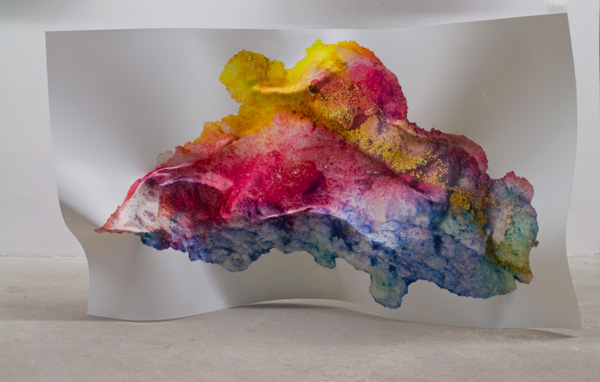
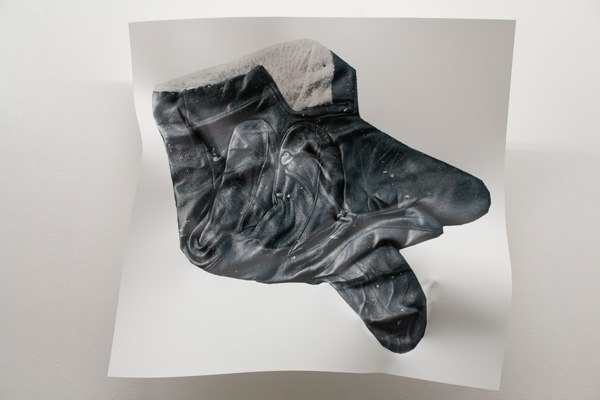
“Alterazioni Video is a group of five artists who have been working together for six years, and are currently located in Milan, New York and Berlin. The distances between the various members of the group and their constant movements have made communications between them – mostly mediated by phone and the net – one of the key aspects of their work: communications hindered by time differences, erratic connections and the inherent problems to do with operating as a group. In this way, over the years communication between the group’s members has regressed, going from schizophrenic clashes in person to shorter and shorter chatroom messages to the current situation of preverbal interfacing.
The Violent Paintings are in fact the result of an intense exchange of images found on the net, manipulated each time they change hands: a dialogue of cut and paste, the product of an irrepressible urge to create visions. At times the image becomes a work in its own right, at others it remains a study, a model to deconstruct and recombine to give rise to new representations. The Violent Paintings bear witness to the ongoing construction of an artistic idiom, the result of a dialogue between five individuals who no longer have anything to say to each other but continue to feel the pressing need to communicate. The violence in the title varies from that unleashed in the heated exchanges between the members of the group, to the content of the images themselves, images which are then transferred onto a medium, a light pvc which is bent and deformed, or that afflicted by classic painting, parodied in an appropriation and amateurish use of Photoshop, or lastly that which the images inflict on the spectator, who is challenged to make sense of this mish-mash of amateur photos, porn, hentai graphics, second-rate effects and art classics.
In this sense the Violent Paintings are also the result of the reflections of Alterazioni Video – which has always been interested in the cultural implications of the digital revolution, from copyright to censorship – on the increasingly widespread practice of social processing of images.” – Alterazioni Video