“Hello Hi There is a performance without people – a literal expression of post-humanism, and simultaneously an examination of what it means to be human. The piece goes inside the question of human nature and intelligence, both the organic and the artificial.” – PS122
“Surreal, monumental, graceful. Eagle takes Brancusi’s Endless Column and stages its repeated collapse on a classic American desert highway. Seductive, in slow motion, the demise of the structure does not disturb but soothes.” – Bloomberg New Contemporaries ICA London
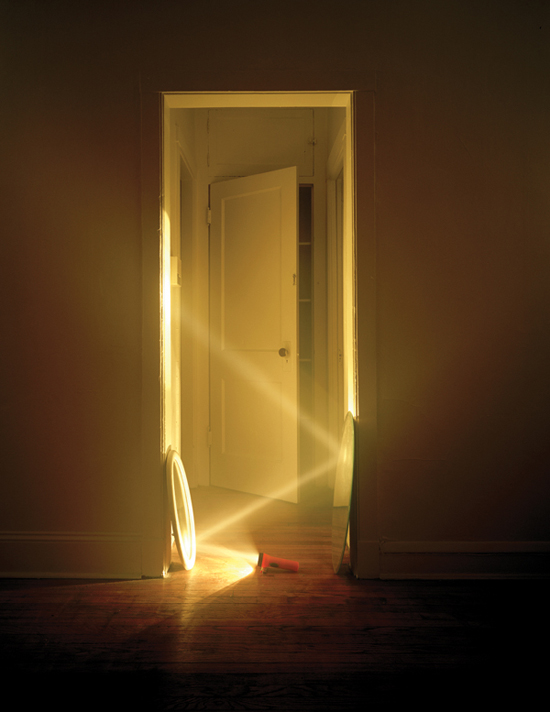
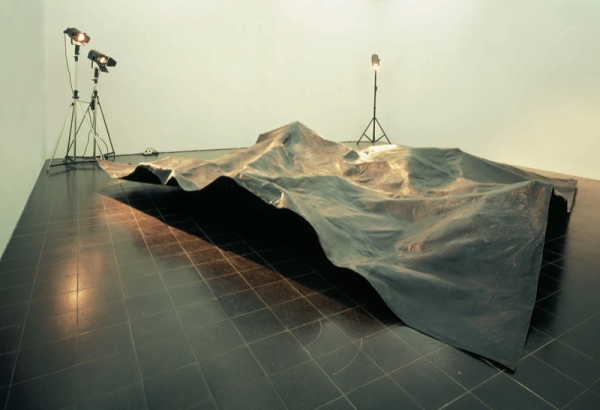
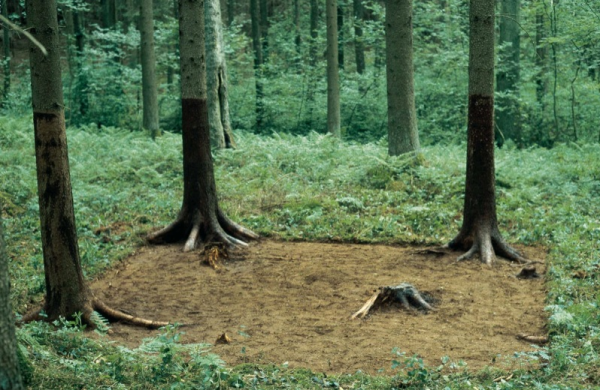
“When looking at images of the past, one becomes aware of our collective ability to elegantly compose recipes of artistic intention. Progress takes precedent over contemplation and experience, and we are acute to symbols rather than with what they signify. If the notion of progress is eliminated, what becomes of artistic intention?
This uncertainty is what I take to be the starting point for my most current body of work.
Recently I have been making photographs, videos, sculptures, and paintings simultaneously. In some of the work, I have looked to follow my own perceptions about mistakes and misinterpretation. In other instances, I have looked towards genre as a historical method to further categorize experience. In a similar way, I’ve looked to use the Internet as a structure to further diversify my work and focus more specifically on the way we perceive and use images. Each piece presented here represents a specific, and often contradictory, thought and process that aims to reflect a constant effort to ask the legitimacy of intent and purpose.” – Josh Kolbo
Posted in Uncategorized | Comments Off on Josh Kolbo
Chelsea Art Museum – 556 West 22nd Street | New York, NY 10011
Launch party: Friday, March 4, 8PM – midnight. Ticketed event.
Exhibition: Saturday, March 5 – Saturday, April 2, 2011
The Collector’s Guide to New Art Photography Vol. 2 is a 216-page biennial sourcebook that highlights some of the most challenging and innovative new photographic work from 100 photographers internationally. Edited by Humble Arts Foundation’s founders, amani olu and Jon Feinstein, with an introduction by Vanessa Kramer, Director of Photographs, Phillips de Pury & Company, The Collector’s Guide to New Art Photography Vol. 2 is a resource for collectors, gallerists, curators, art professionals, educators, and the public. This new volume continues Humble’s mission of introducing new talent to people of influence in contemporary art.
“Sonicity is a responsive installation, a sonification of the real space and environment. The sounds you hear are the sounds of the changing environment, ie the changes of noise, light, temperature of the space is turned into a real time sound stream using dozens of wireless sensors presented as an installation on 170 speakers.
This artwork focuses on the real time space and the experience of the gallery visitor as they interact with the space, using data gathered from these new technologies. My system monitors the space (the building) and the environment (the city) and captures live real time data (light , temperature, noise, humidity, position) to create an ambient sonification, an acoustic responsive environment, literally the sound of the micro incidents of change that occur over time.
This artwork explores new ways of thinking about interaction within public space and how this affects the socialization of space. The project uses environmental monitoring technologies and security based technologies, to question audiences experiences of the event and space and gather data inside the space. The project also focuses on the micro-incidents of change, the vibrations and sounds of the gallery using wireless sensor based technologies.” – Stanza
Bits and pieces is simultaneously familiar and foreign. This dichotomy, however, is not necessarily what draws me to the work. The images patently acknowledge the image as an effectof process. While one could argue that the image of image inherently addresses the function of the photograph, what is often missing is the transparency of process (the important distinction being “of”, as photography often functions as a transparent process.) The beauty of these works lies in the simple modification of the representative image by the folding of the high-gloss reproductions. This action acknowledges the image as a mediated object by reflection, and transforms the austere and stark presence of the sculptural forms into fragile and whimsical prints. In doing so Paccard introduces a malleability and fluidity that both elevates and challenges these small bits and pieces by removing their physical form from the concern of their interpretation.
“…Uncannily prescient, Ghirri shared the sensibility of what became known in the U.S. as the New Color and the New Topographics movements before they had even been named. Like his counterparts in Italian cinema, Ghirri believed the local and the universal were inseparable, and that life’s polarities—love and hate, present and past—were equally compelling. Not surprisingly, his interests encompassed all the arts: he worked in Giorgio Morandi’s studio and with architect Aldo Rossi, while influencing a generation of photographers, including Olivo Barbieri and Martin Parr…” – via Aperture.
“In the middle of this room is a rather simple/elegantly constructed cut-out of a human figure entitled ‘Green Screen’ by Sreshta Premnath . The negative space is suspended by a frame while the actual figure is defined by the cutting; umbilically attached to the fabric it drapes across the floor. Perfection, as in e perfect proportion of the Ancient Greek and Renaissance concern is what comes to mind. The figure being as it is still attached to the fabric from which it is (mostly) cut, the negative(silhouette) and positive (figure) are presented as inseparable from each other, drawing again the exhibitions thematic comparison between perfect and imperfect; in this case suggesting that what is ‘perfect’is defined by dividing it from what is not. Michelangelo’s comment that ‘David was in the block of marble’, that he only released it because he saw it there, comes to mind.” – Artlurker
“Transformations, contextual adjustments, spatial appropriation – in Sailstorfer’s work one is quick to recognize his interest in everyday objects, materials that surround us, his hands-on fascination with the specific identity and history of these objects and the fate they may evoke – in short the inherent associations they trigger, and which he can now make use of. He really has a good go at these objects, striping them down, taking them apart, deforming, adapting and putting them together anew, displacing reinterpreting and rededicating them. Such a deformation of the meaning and purpose of the object, while at the same time using and retaining its formal qualities does not result in destruction; the aim, rather, is a fresh configuration and a change in meaning. Here, both the space these objects occupy and the space that surrounds them are of essential importance. In this sense even Sailstorfer’s smaller objects are installations, integrally bound in context with the identity of the place they are exhibited. This is the first formally accessible level. But this does not account for the strength and originality of Sailstorfer’s works. In all his oeuvres there lingers also an immensely poetic spirit. A feeling for sentiment which is not construed or calculated but which is an integral part of the work and absolutely certain to have been experienced by the artist. Even a year spent studying at Goldsmiths College in London, one of the training grounds for theory-laden artistic work, did not detract Sailstorfer from this path, quite the contrary, it perhaps even strengthened it. We recognize, with something akin to relief, that the artist does not get lost in a whirr of highly complex, self-referential, formally aesthetic configuration of objects, but rather proves to be a practical dreamer in the animated world of objects. What makes Sailstorfer’s works so extraordinary are the flashes of longing in their objective, the melancholic humor in the way they are produced and the conscious tragedy in the moment the objective is achieved.
…
This particular storyteller gets to work with a power drill and a jig saw and has everything well under control. You want to see how to make a tree house out of a glider? No problem, coming right up – and in a flash two glider planes are quickly turned into the standard product of juvenile escapism. His installations are based on simple, comprehensible basic structures and are not experimental technical arrangements. They are often also to do with a human aspiration for self-occupation and articulation and the necessity of leaving behind traces, or destroying them, as the case may be. There can scarcely a be more impressive, melancholic and dreamy work than Bethlehem(2004) which is about precisely these states of existence as well as the artistic striving that articulates itself in precisely these moods, a self-developed, drivable message of sensation and pleasure, or Elektrosex (2005), in which two lanterns are placed opposite each other, united by discharging electric current, but otherwise placed at a distance from one another, eternally unmovable. Confronted with works such as these, which are sensual, comprehensible in rational terms, extremely practical in terms of their construction, yet at the same time absurd, one recognizes the poetry of yearning, of the euphoria involved in the process of achieving a goal and the melancholy of fulfilling a task. Home, travel, arrival, relationship – Sailstorfer, a surreal storyteller who addresses fundamental themes to do with our existence as individuals, is above all a rediscovery of sentiment in art and the objects of our time.” – Max Hollein.
“Grazia Toderi chose to project video because her material is light that travels and that appears when it encounters a surface, and also because it can be transmitted simultaneously throughout the world. Light also makes our existence possible, arriving from the stars, a mysterious energy with which we play and live. And it is while looking at the light that draws luminous geometries in the sky, the constellations, that man has built cities, seeking a continuous relationship between sky and earth. “Orbite Rosse” (Red Orbits, 2009) is a double video projection created for the Venice Biennale. The projected light brings out a stratification of transparences and lights, of cities that are superimposed and continuously transform, and two broad ovals, celestial or terrestrial maps, colored planispheres or cosmograms, upon which luminous tracings dance, trajectories, “invisible cities,” imagined thinking of Italo Calvino and the large lithograph “Venetie MD” (Venice 1500) by Jacopo de’ Barbari, now in the Palazzo Ducale in Venice. “Projections” of light that penetrate our consciousness through the two mysterious “red orbits” of our eyes, which direct the images of our head-world.”