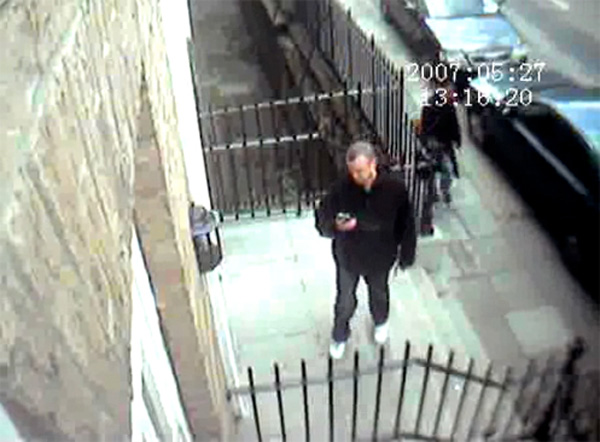
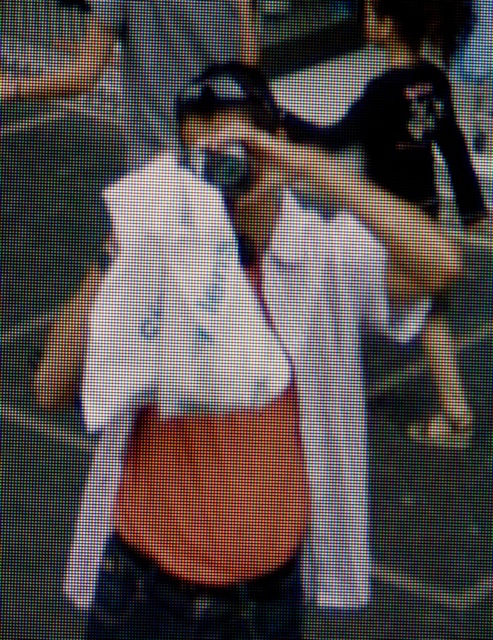
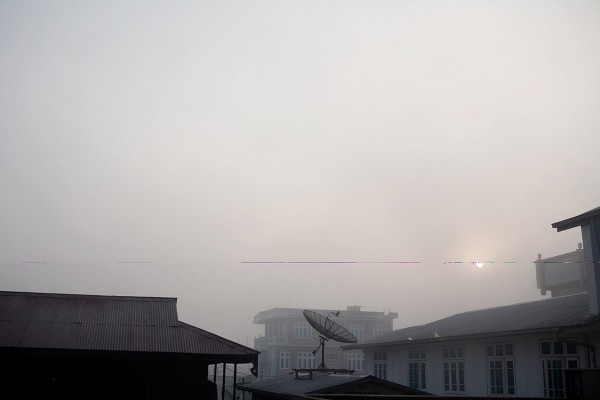
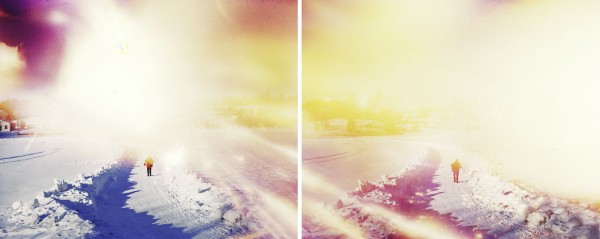
“The 2.4Ghz project uses a wireless video receiver to hack into wireless surveillance cameras. This device (which is now part of consumers popular products), can be used for wireless surveillance cameras, but it can also be used for parents to monitor their children. Such systems are becoming more popular as they get cheaper.
But what most users of those devices don’t realize is that they are broadcasting the signal.
This project (in progress) has several layers. Initially, I have been walking around different towns in Europe to collect and record footage received with the device (see below for the collected movies).
The second part of the project (also in progress) consists of placing the device in the street to reveal the presence of the cameras and to make obvious the fact that anyone can receive those signals.
The third stage of the project consists of a series of workshops: 2.4GHz Workshop, where participants are invited to explore the CCTV wireless networks of their city by searching and recording 2.4GHz surveillance video signals. The recorded material is then compiled into a movie of the event.” – Benjamin Gaulon
“The art of machinima is as old as id Software’s Quake, and popularized as a form by the popular Red vs. BlueHalo shorts… but we’re hard pressed to think of any machinima as bold, inventive or massive of scope as The Trashmaster, a feature-length machinima movie made entirely within Grand Theft Auto IV using the PC version’s video tools.
Created by Matthieu Weschler, The Trashmaster’s plot is described thusly:
The “trashmaster” divides his time between collecting garbage and cleaning up other forms of trash fouling up New York City’s streets: dealers, small-time criminals… When the dancers in his favourite strip club are mysteriously killed, the trashmaster finds himself hot on the trail of a particularly twisted serial killer.
To say that The Trashmaster is an impressive undertaking is an understatement: it took Weschler over two years to make in-game, and it employs a dizzying array of impressive camera angles and cinematic tricks. Unfortunately, the same attention to detail can’t be said of the voice work, which is painfully amateur… and forced me to turn the video off twenty minutes in out of sheer aural disgust. Your mileage may well vary, though.” – Geek
“As many young photographers, I always dreamt about flying around the world, visiting spectacular spots and places, just like Superstar Andreas Gursky does. So finally I decided to stop dreaming and just do It …in Google Earth.” – text via Flachware
“Recently, rather than taking photographs you deal with the materiality of photography, whether it’s the symbols on rolls of film or material (Sintra) on which photos are commonly mounted. Can you talk a bit about your relationship to photography and exploring the non-image side of it?
You seem to be suggesting that my practice emphasizes the ends of a linear process when in fact I’m more interested in the cyclical nature of photography. There are many “non-image” aspects to photography, but they are no less photographic than a photograph. I make photo-based sculptural work. It began with photographic cutouts arranged in space, and led to the current pieces we are focusing on here, the photograph-less photo-based work.
After spending some time researching various types of storage devices, I began to think about photography specific containers and the various devices/image supports used in the life cycle of a photograph. Film is inherently a container of light and time. The film backing paper is the material that initially supports the actual container. Sintra is the material that supports the image. 2 ¼ at 103 ¼ is a recreation of the information printed on the backing paper that supports a roll of 120 film (Fuji NPL to be exact.) The components were scored on a CNC router and finished by hand with a box cutter. Applying the information from the backing paper to the gallery, makes the walls the image support structures and the contents within the space of the room become the “image.”
In “an untitled cloud” you mount the material used to back photos in a cluster with the corners of each piece curled, disrupting the possible flatness of the image. I’m wondering if you can talk about the absence of photography in “an untitled cloud” and the ideas behind the curl of the surfaces.
Photography is not absent in “an untitled cloud.” It’s just not visible. This piece is made up of 29 separate parts sized according to standard paper and photo paper sizes. The initial shape is based on the document icon on the computer. More specifically, it is a blank or corrupt document icon. If an image file has been corrupted, there will be no descriptive info on this icon. For example, most jpeg files are the document icon with the jpeg overlay. The icon is designed to look like a piece of paper with the corner curled up, a 2 dimensional-digital representation of a 2-dimensional object in 3-dimensional space. I wanted to play with this inter-dimensional back and forth to see what would happen when the representation is exported back into three-dimensional space as a rigid object.
Photographs often don’t even make their way out of the computer. They may never really exist physically in the world. But now, they may make their way to a “cloud.” The branding of cloud server technology relies on the notion that clouds can be anywhere and everywhere. That they are light and don’t really take up space. I find it funny that one can imagine all of their valuable data floating effortlessly above them and accessible at any given time, when the truth is that clouds are, by nature, ephemeral and can disappear at anytime. This is not the most reliable metaphor for information storage. The weightless cloud is really a huge, server filled warehouse that requires energy to be maintained. There is nothing light and airy about it.
In your earlier work you explore what a photographer encounters before she or he takes a picture–the film itself. What does your focus on the “before” and “after” of the actual photograph mean, for you, in terms of leaving the space of the photo itself a blank?
I don’t think I have left the space of the photo itself blank. There is a difference between blank and not yet filled with information. In actuality, I don’t know if it’s even clear what “the space of the photo” means anymore. Is that space on the film? Stored on a hard drive? On a blog? Is the space the time held within the photograph? Does a photograph have any actual physicality at this point? The physicality of the photograph transforms/changes as it uploads and downloads, as it compresses and expands, as it moves from one screen to the next.” – i heart photograph
“Surprising and often hilarious images from Google Maps Street View circulate around the internet as fast as curious virtual tourists can uncover them. I’m sure you’ve seen your fair share of these, which include crime scenes, LARPers, flashers, public urinators, digital marriage proposals, and even Norwegian spear fishermenchasing the Google van down the street. Some of these are happy accidents; others are pranks. Either way, looking at them seems to satisfy in us a search for wonder and mystery in the everyday world, one often erring on the side of humor in our time of viral memes and hyperlinked attention spans.
International artist Michael Wolf has mined Google Street View’s tremendous visual archive, revealing and also creating a new type of street photography. He refigures the “decisive moment” into the “decisive cut”, creating photographs not from the anticipatory release of the shutter, but through the editorial acts of searching and cropping…It attempts to represent the almost exhaustively photographed Paris in a new and meaningful way.
Paris is the city of Atget, Cartier-Bresson, and Doisneau, and we can’t help but filter its representations through their iconic images. Through the indiscriminate and mechanical eye of Google, Wolf’s Street View project depicts a modern Paris in a state of transition. His images are new and urgent, yet like his predecessors, Wolf still manages to capture the city’s signature combination of romance and edge. He uncovers intimate embraces, like a public kiss inarguably reminiscent of Doisneau’s Kiss by the Hotel de Ville, and flashes of public temper. A motorcyclist flashes his middle finger; a woman smokes in the shadows; weary pedestrians recuperate on a curb; and lots of people navigate the streets and sidewalks, minding their own business.” – ArtSlant.
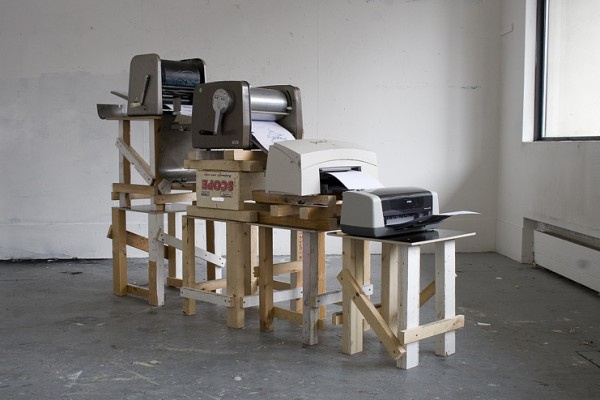
“Xavier Antin is for sure the unsung king of creative desktop printing. In “Just in Time, or A Short History of Production” he aligned up four generation of desktop printers to produce, all in one go, a 44-page full color book in an edition of 100 copies. A stencil machine from 1880 was first printing the magenta. The spirit duplicator (1923) provided the cyan. The black was made with a laser printer from 1969 and, last but not least, the yellow was printed with a vintage ink jet printer (1976). I would expect an enormous difference in terms of alignment as the paper handling is different with every machine, but the samples on the website just looks great.
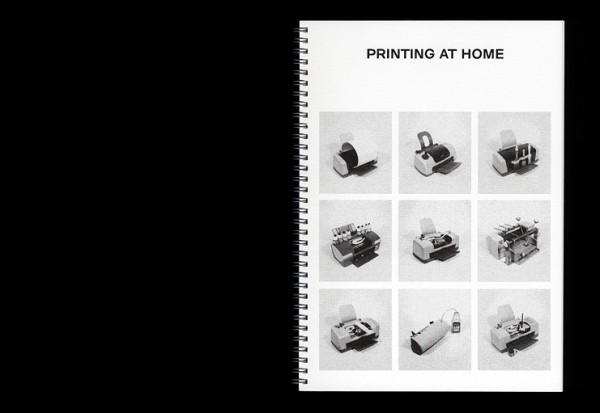
Another very nice book by Xavier Antin is “Printing at Home”, which is “A series of nine archaic ink jet printers hacking meant to disturb or disrupt the printing process, documented as an overly didactic printing manual.”” – via Mrs. Deane
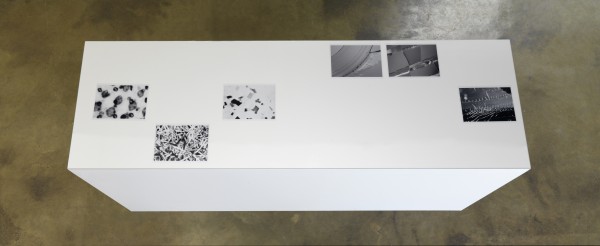
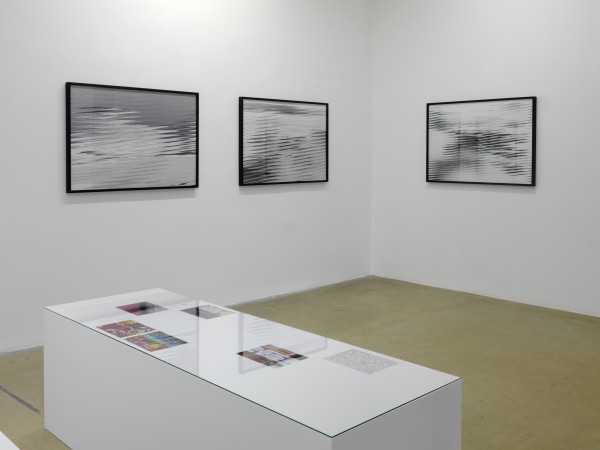
“The various works consist of a series of experiments made by the artist in the process of digitizing and destroying his archive, in which the materials themselves become the subject of investigation. Included is documentation of the physical storage matter such as printed matter, scratched CDs and DVDs, celluloid, and disassembled electronics. A series of larger format works is based on the mistakes and corruption of data encountered in the transfer between imaging formats. The various works on display outline the process by which the material of the archive were catalogued and destroyed. Using various imaging techniques including microphotography Snyder attempts to identify the underlying decision making process and vocabulary used working with images and their ideological construct.” – Contemporary Art Daily
“I’m interested in the idea of visual “noise” or disruption in your images and was wondering if you could talk a little bit about the role that this noise plays when making an image.
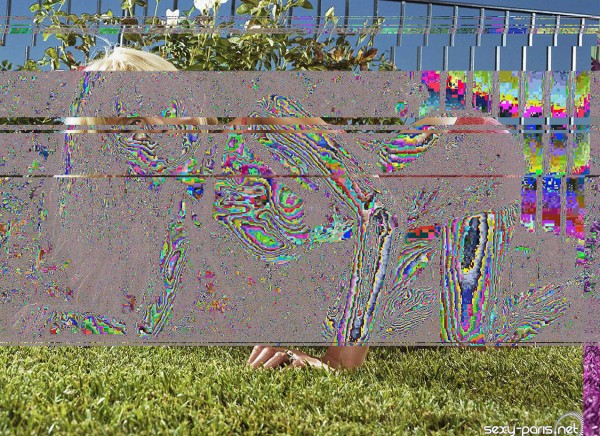
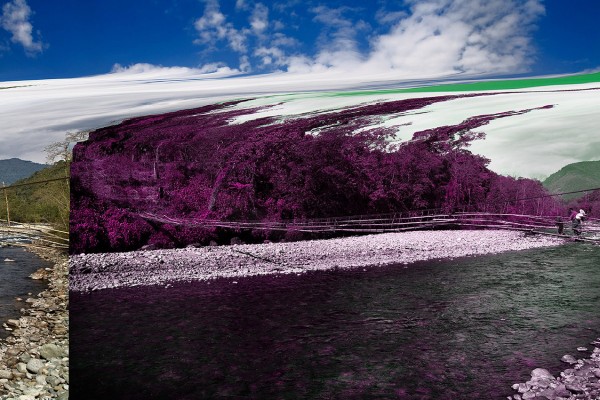
I think that it is important to shed first some light over the technique or method, which is used when creating these images. Images are modified by alteration of digital image file’s source code: inserting or removing data. For example Paris Hilton (Dog Chromosome X, Poodle) has dog’s genetic data and Broken Idyll (Bridge) has phrases from the Burmese propaganda newspaper New Light Of Myanmar inserted to the image file. Image is taken in the Burmese Himalayas. With the picture Removing White, I literally removed all parts of code re-presenting white. Image originally depicted a tank from the World War II.
In a way I destroy the image, but on the other hand, I attempt to create something aesthetically surprising and interesting.
The noise also has the function of distorting or obscuring parts of the original image. For you, how do you choose the images and what choices to you make in altering an image?
I try to choose images which, after manipulation results particular connotation, political or otherwise. Whether I use a image from the web or choose to photograph it by my self, the aesthetics naturally affect also a lot during the process.
The results after insertion of scientific or political data might appear as random, mistakes or destructive to the original re-presentation. But are in fact results of analyzing the image file and careful consideration where to insert the data. There is also some trial and error involved, especially when I first started making these images. Nowadays I have gained quite a lot of control over the effects.
The distorted images also push the photos toward abstraction, and I was wondering if you could talk more broadly about the role of abstraction in your work.
It seems to me that abstraction in photograph is fundamentally different comparing to that of painting. Photograph, as an abstraction may actually be impossibility, since it always tied to its origins in the real world.
I don’t consider these images as abstractions, but rather as information re-ordered in a way, which isn’t quite understandable through conventional methods of reading an image. For me the abstract-looking areas symbolize the visual noise and the identity vacuum of the contemporary society. Images also act as metaphors to the religion like faith in science and technology; Belief of creating something beautiful and good, even if it might not always be the case.” – interview via i heart photograph.
“Here, the big utopia of a new medium, as it was the theme of classic late nineties net.art, is no longer an active concern. The work of the participating artists is characterized by the prosaicness of computer and Internet use, as it became normal for a wide range of the population, in particular for the generation of the “digital natives“ who grew up with the Internet.
The artists of the exhibition investigate the mechanisms and aesthetics of the Internet. Today, the Net is largely commodified and increasingly controlled, e.g. under the pretext of copyright issues (as suspected in the late nineties). On the other hand, it still provides opportunities for anarchic, uncontrolled thinking. It is not so much about strict separation, but about the natural or playful use of the paradox exemplified by the possibility of political and aesthetic alternatives taking place within commercial platforms such as Facebook or YouTube.
…
As a memorial for the “.yu” domain – subject of conflicts during the war, now switched off as of the end of March 2010 – she developed a series of paper sculptures. They consist of several thousand printed A4-sheets. Stacked, they make a picture appear, showing nationalist Ultras in Belgrade’s football stadium.” – text via the exhibition Surfing Club.
“Nowhere is a three-dimensional milling machine that carves a landscape relief on a 70x70x10cm large block of hard foam. The machine receives a stream of live search requests from the german search engines metager and metager2 (www.metager.de) via the internet.
The users search movements erode rivers and canyons on the surface. Search requests that shoot through the internet just for a fraction of a second and generate an answere on the searchers screen, cause the machine to write a constant growing sculpture into the space. The continuous stream of changing search requests defines form and rhythm of this process. ” – Ralf Baecker