Lyota Yagi

Lyota Yagi

Work from his oeuvre.

“Appearing from out of the darkness, Lyota Yagi opens a small box and takes out a number of remote controls – those everyday items that one uses to operate household appliances from a distance. When he moves the arm which is holding a remote, while also holding down a button, a stuttering kind of noise comes out of the speakers in front of him. Somehow, the electric signal from the remote is being received by a device and being transformed into speech sounds. Watching this, you notice that the sounds change according to which remote is being used, and that the position of the remote itself affects your sense of distance from the sounds and even the balance between the left and right speaker outputs. Seemingly in response, the lighting turns on and off and a camera flashes like a bolt of lightning. After a while you realise that this is a work which takes what can’t be seen, (the signals sent from the remote controls) and actualises them (through our perception of the sounds from the speakers).

This was one scene from a live performance on April 18 at Snac, a new performing art space in Kiyosumi-shirakawa. A collaboration between contemporary artist Lyota Yagi and musician Shuta Hasunuma (who has had music released on the Weather/Headz label, among others), the performance employed Yagi’s piece ‘Remote Con-Troll’ as a musical instrument. It’s this work which forms the focal point of his current solo exhibition, ‘Jisho sonomono e / Zu den Sachen selbst!’ (‘Towards the event itself’).

Lyota Yagi has the image of being an artist who deals with themes involving time rather than sound. This rap is largely due to his work ‘Vinyl,’ which was exhibited at events like his solo show ‘Emergencies #8 “Kai-ten”’ (NTT InterCommunication Center, 2008) and the group show ‘Winter Garden: The Exploration of the Micropop Imagination in Contemporary Japanese Art’ (Hara Museum of Contemporary Art, 2009). ‘Vinyl’ is a record player that plays records made of ice. As the ice melts, the pleasant sounds turn into noise. Critics tended to focus on its expression of how the passing of time brings about change, rather than the changing of the sound itself. Yagi felt that perhaps he needed to correct this mistaken kind of perception, and his current exhibition actually focuses on making the viewer perceive those things they are not aware of.

For example, in ‘Remote Con-Troll’, what we are usually unaware of is the signal being emitted by the remote controls. In another of his works, ‘Tsukue no shita no umi’ (‘The ocean underneath the desk’), a waist-high tabletop has been made to look like the surface of the ocean, and there is a pair of headphones for the viewer. If the piece is viewed while standing, the sound of waves can be heard, but if you crouch down, it changes to the sound of being underwater. It brings to mind the world seen from the perspective of a child, an experience that everyone has had in the past but perhaps has forgotten.

Yottsu no isu de dekiru koto’ (‘What you can do with four chairs’), is like a game where you have to guess what is written on your back – and takes the idea even further. One person has to imagine what is being drawn on a canvas close to their ear simply by listening to the sound of the pencil moving across the canvas, then that person has to draw that picture on a canvas near the ear of the person next to them – in that way a message keeps on being passed on. It makes us recognise the imaginative power contained in these messages, messages that use a kind of communication which pre-dates language.

Lyota Yagi’s way of thinking, which takes the functions and meanings found in everyday tools and diverts them to completely different uses, is childlike in its simplicity. He uses things so familiar and so ordinary – those things that we don’t usually even notice – and that is what makes his work so surprising, like being suddenly attacked from behind. Before we know it, we are reflecting on our own lives too. Is he a terrorist without a crime, or simply a mischievous child? In any case, his work makes us acknowledge all of the things that we pretend never happened or never existed, because it makes us feel better or more content. Yagi shoots at the blind spots in our consciousness with a deadly accuracy.” – Time Out Tokyo

via VVORK.

Scott Short

Scott Short

Work from his oeuvre.

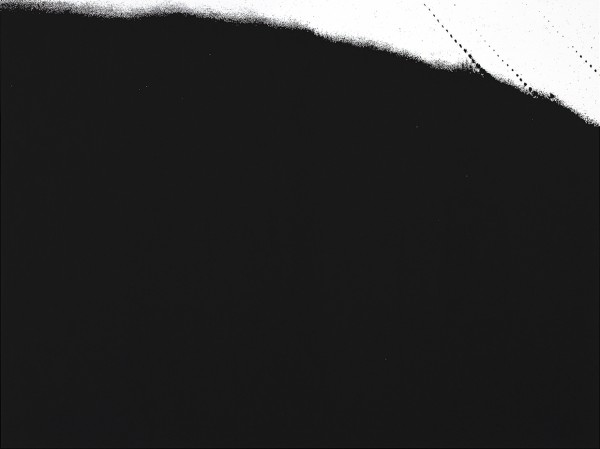
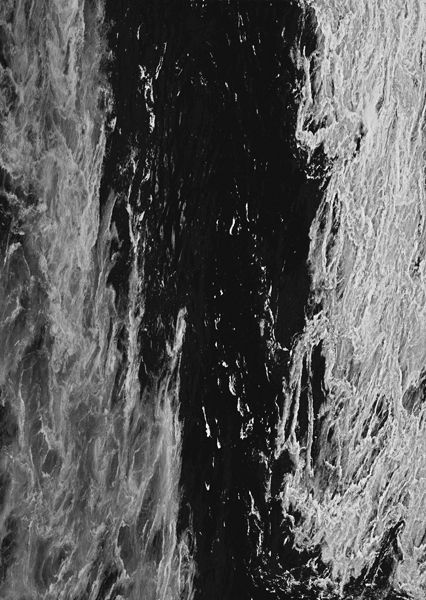
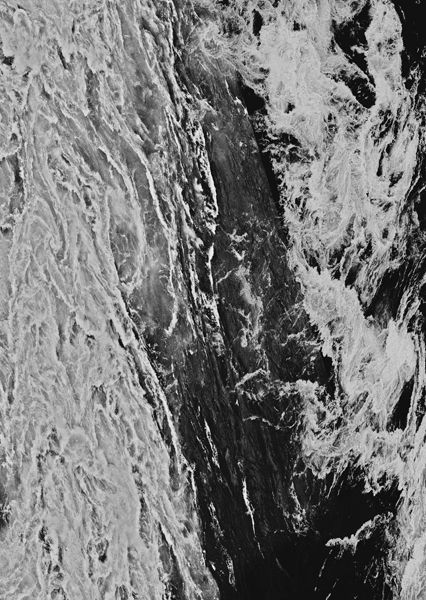
“Scott Short’s recent paintings are the product of disciplined and structured procedures, the seriousness of which is relieved by a healthy dose of idiosyncratic intervention. Procedure first: For the past nine years, Short has produced all his paintings by taking a letter-size sheet of white, black, or colored construction paper and making a black-and-white photocopy of it. He then makes a photocopy of that photocopy, then a photocopy of that one, continuing this process several hundred times. He makes a slide from one of the late-generation copies and projects it onto a canvas, finally–and painstakingly–reproducing in black paint all the stray visual incident that accreted on the page in the process.

This seems, at first, like an abjuration of both composition and subject matter: Short allows the vagaries of his original piece of construction paper and the tendency of copying machines to emphasize any deviation from absolute blankness to provide him his source material. His repetitive photocopying leads to what could be called “abstract tonerism,” as the ink often clusters in textured bands, creating a kind of diffused grid. Some of these paintings look like details from a Georges Seurat crayon drawing. A few darken to almost pitch black, while others pick up so little ink that when painted they are practically blank white canvases. (Short started with a white piece of paper seven times here, using a yellow piece four times, and gray, red, blue, black, and green once each.) It’s all a bit like John Cage’s “Music for Piano” series (1952-56), in which the composer overlaid putatively blank sheets of paper with staff lines, thereby transforming the imperfections into notes to be played, silence ensuing wherever those random incidents were absent.” – James Yood for ArtForum.

Alain Delorme

Alain Delorme

Work from Totems.

“the images were captured during two art residencies (supported by ailing foundation) de lorme participated in shanghai throughout 2009 and 2010. fascinated by migrants’ loads, he has photographed piles of stacked ‘made in china’ products which form unusual sculptures, symbols of a form of fetishization of the objects themselves.

the verticality of these formations echoes the incessant expansion of the urban area, constantly under construction. here, de lorme gives a new vision full of humor and poetry of those porters – both super heroes and ants with impressive loads of tires, water containers, office chairs, flowers… distanced from the typical photos of china portraying immense crowds, he has focused on the individuality of these workers, as opposed to all those identical and interchangeable objects.” – via Design Boom

Alejandro Almanza Pereda

Alejandro Almanza

Work from his oeuvre.

“In the 1960s sci-fi writer Philip K. Dick coined the term “kipple” to explain the astonishing ability of household objects to accumulate in piles of unwanted clutter. He imagined kipple not merely as mess or disorder, but rather as an irreversible, entropic force—a perverse electromagnetic power binding inanimate things in defiance of human organizational systems. A character in his 1968 novel Do Androids Dream of Electric Sheep? imagines walking into a temporarily unoccupied apartment to find nearly everything—furniture, carpets, old magazines, junk mail, even empty match books—huddled high above in a corner of the ceiling. To Dick, this derelict stuff, without the constant oversight of its former owners, succumbs to strange, ineffable compulsions to shed the restraints of domesticity.

Encountering Alejandro Almanza Pereda’s recent sculptures evokes Dick’s notion of kipple; both projects explore the agency of objects to overturn the types of deliberate control evident in their production, consumption, and use. For example, in Almanza’s Untitled (mesa) from 2006, the viewer confronts a table and television hovering mid-air in a seemingly impossible, gravity-defying contortion. The table and TV are kept aloft by a taut electrical cord plugged into a socket that provides power for a set of lit fluorescent tubes buttressed by a pillow that are the table-TV’s secondary, though no less precarious, supports. The fluorescent bulbs, bound together with pairs of neon yellow children’s inflatable arm floats, seem hopelessly incapable of holding up the immense weight of this arrangement. Beneath the pillow, resting on a small telephone table, a tea saucer cantilevers unstably off the table’s edge, held in place only by a counterbalanced cup poised to topple at any moment. To add to the overall mayhem, the suspended TV, itself hanging only by that single cord, is on; caught half-tuned between channels, the picture is but an indistinct blur.

Like Dick’s conception of kipple, Almanza’s outmoded junk of the everyday has an irresistible attraction to itself, and an almost conscious volition to form enigmatic accumulations. Yet Dick attributed an inert, “pudding-like” character to kipple that masked its tendency to covertly reproduce itself. In contrast, in Almanza’s sculptures objects behave more brazenly; they are more acrobatic. Though the objects Almanza chooses for his sculpture brim with what he calls “lurking forces,” these things are then put into arrangements that openly flout the conventional, predictable, earth-bound solidity of normal objecthood. The quotidian household object for Almanza is not sneaky, passive-aggressive kipple, but rather flamboyantly defiant kipple. Almanza’s objects charge past wilted entropy and go straight for the jugular, staging hijinks of total domestic pandemonium.

Almanza, a Mexico City-born, New York-based artist, describes his work as exploring registers of risk that are generally unacknowledged in everyday encounters in cities like New York. For Almanza, Mexican building construction uses hackneyed techniques and improvised materials to produce hybrid structures assembled without strict adherence to safety codes. The bricolage element forces pedestrians to maintain a vigilant awareness of their surroundings that can seem like wariness. In contrast, in the U.S. the acceptable level of risk for objects behaving unpredictably is much lower. Almanza perceives his sculptural environments as exacerbating viewers’ feelings of anxiety triggered by possibly unsafe spaces; as he contends, the “hope [is] to give the viewer an uneasy tension… it is through this tension that the installation ceases to be static.”

However chaotic Almanza’s sculptures appear, the countervailing delicacy and dexterity required to assemble his balanced works produces a paradox of stasis and dynamism, control and disarray. As he harnesses precariousness, he creates, or perhaps organizes is the better word, protocols of how to produce chaos: Almanza uses order to produce the appearance of disorder. The work I described previously, Untitled (mesa), is typical of Almanza’s sculptural configurations in that it involves a multitude of objects joined together in sequences of improbable cooperation. Each individual element is part of an intricate system of balances. For example, the tenuous placement of the teacup and saucer bears no structural connection to the jerry-rigged engineering of the suspended TV and table, yet the saucer’s improbable point of balance mirrors the implausibility of the air-borne forms. It is as though the entire lopsided arrangement depended on its smallest component to avert a disastrous collapse. I find myself rooting mightily for that little cup.
It may be paranoid to suspect that nearby objects will at any moment defy familiar patterns, and perhaps delusional to believe they can transgress basic laws of gravity. Yet the idea of the inanimate becoming animate is not only deeply troubling to our sense of stable subject-object relations, it violates our entire construction of privacy and interiority. The psychoanalyst Jacques Lacan postulated that objects do “look” back at us. In a famous anecdote, the young Lacan traveled at sea among a group of fishermen. He spotted a glittering sardine can tossed among the waves, which caused one of the fishermen to taunt, “You see that can? Do you see it? Well it doesn’t see you!” Initially it seems merely a silly joke, yet Lacan recognized it as a put-down at the most basic level, implying that he was unworthy of even a sardine can’s attention. As Lacan explained, “If what [he] said to me, namely, that the can did not see me, had any meaning, it was because in a sense, it was looking at me, all the same. It was looking at me at the level of the point of light at which everything that looks at me is situated.” Things look back at us because our identities are constructed not by a coherent and complete “I,” but by a subject that knows it is seen by others as a “you” or even as an “it.” Self-consciousness about being looked at by any being or thing in the world can be a symptom of receptivity or paranoia, hence the two meanings in the phrase “I become one with the world.”
The awareness that the external world views us can transform people into objects, or can imbue objects and commodities with lively power. Like something we can’t afford that shines under a protective case, certain objects flaunt their scarcity. Almanza makes use of such haughty objects that are animated by their exclusivity. In Almanza’s Untitled (reja), 2006, a half-dozen lit fluorescent tubes placed on oriental rugs prop up plastic Coca- Cola crates filled with full glass bottles. The length of the tubes means the bottles are unattainably high on the wall. If you get thirsty, forget about getting those down. The theme of scarcity recurs in Untitled (aguas), 2006, in which simple l-bracket storage shelves are perched near the ceiling, high above the viewer. Three one-gallon jugs of water are placed on the top shelf; the next contains several nondescript cardboard boxes of various sizes. A pair of chintzy brass sconces holds electric lights that imitate fake candles. The scenario is familiar—ok, this is just a bunch of stuff stored in the garage—but the extreme height of the objects’ placement is troubling. Fundamentally, it is stuff you can’t get to. The basic nature of what kind of objects it is that are out of reach is disquieting. What happens if you or I need that water? Almanza’s sculptures propose a world of objects charged with rebellious energy, defying the common tendency to take them for granted. Though we know he creates these gravity-bending situations, their improbability makes us personify their old TVs, furniture, and Coke bottles as disobedient protagonists in a drama of triumphant junk. They ask us why we produce so much we don’t need, why we treat this stuff so poorly when we don’t need it any longer, why we don’t distribute it among ourselves more equally. Ultimately these objects are animated by the histories of their former use; Almanza imagines what a mutiny of kipple would look like.” – Eva Díaz for Arte al Dia International.

Derek Frech


Derek Frech

Work from his oeuvre.

This work has been on my mind for quite some time now. While I can’t quite put my finger on what it is about this work that I find so compelling, I can’t stop thinking about it. I am intrigued by how Frech exposes his process and allows it to function transparently (and in tandem) with his understandings of contemporary internet works, as his work is so acutely aware of the visual language of internet based and immaterial pieces. The function of this process-work is that all of the pieces acknowledge the materiality of some subject while existing only as pixels on a screen. The dichotomy of materiality present in Frech’s work rest on the constantly shifting ground of the internet as a means of production and presentation. It is in the tacit acknowledgment of process and production of an intangible product that Frech’s work finds its place, among the virtual/virtual pieces in the very appropriately named An Immaterial Survey of Our Peers.

As a piece of background information, Frech is one of the curators at EXTRA EXTRA. I mention this because his work is so acutely aware of the visual language of internet based and immaterial works.

Luis Gispert

Luis Gispert

Work from his oeuvre.

Jacob Hashimoto: This last January, you opened an enormous two-part exhibition at Zach Feuer and Mary Boone Gallery that represented well over two years of sculptures and images and was crowned with a hugely ambitious short film, Smother. Having had the opportunity to watch you labor over this diverse body of work over the past couple of years and having visited the exhibition numerous times…and, of course, having followed your work for the past 10–12 years, I came away from this exhibition with an uneven sensibility of the exhibition on the whole. That’s not to say that the shows weren’t conceptually coherent, consistent, and intriguing, they were. I think, however, that I felt like a lot of the work relied heavily on obscure or hidden references that made the work somewhat opaque for the me conceptually. How do you feel about this assertion? Have others expressed such concerns? How does this opacity or ambiguity function within your artwork and when do you think it becomes problematic?

Luis Gispert: The work always starts as a personal exploration of themes, ideas, or feelings I’m wrestling with at the time. Like stumbling in a dark room looking for the light switch, you reach out hoping to make interesting connections or juxtapositions with the ideas rattling around your head. By the time the work is finished a world is created with references and markers interesting to me. As I work in the studio I think about the audience but at some point you have to follow your own intuition with a piece and hope it connects with other people. Some might say it isn’t generous work. I don’t try to make ambiguous work, but I might like making labyrinths of meaning. It could be like a game, it’s art that makes people work for meaning – they can play the game if they care enough to do so. People probably don’t get half the references but respond to my work on a visceral level and that satisfies me. The work has a certain attitude. It’s like a stranger that you meet on the street who’s giving you a dirty look.

JH: I feel like I’ve had a lot of opportunities over the years to “scratch” beneath the surface of your work and feel like it’s sometimes difficult for me to do any more than scratch. Complete excavation seems difficult, if not impossible. I see your work generally (and this applies to the film work, flat work, and sculpture) as a collection of references that have an implied narrative that is essentially the core of the work…Sometimes I feel like I can glean a sense of the narrative, while other times, I feel like the narrative is buried so deeply in references that I don’t understand or am not aware of the overall message of the piece. This is frustrating. Regardless, the formal elements manage to convey a sense of the emotion of the artwork—the work “feels” a certain way…How much am I missing as a viewer if I’m not equipped to decipher your references and I’m only able to scratch under the surface at a few of your metaphors while being overwhelmed by the overall formal sensibility of the works?

LG: That’s unfortunate if my work frustrates or bores people. What can I say; I probably don’t know what I’m doing. I’m just throwing a bunch of stuff together trying to make meaning or create new metaphors out of shit that’s already out there. Working like a hack DJ with a terrible record collection. Art that interests or moves me has to intrigue, confuse, or challenge me. For anything to have resonance with me it can’t come easy. It must be some latent blue-collar complex that hard work equals truth. When I finish a piece it makes sense to me and I hope some of that information is transferred to the audience. If not all the information is exchanged it’s okay, I don’t understand why some people want to “understand” everything about a piece of art. It’s not like a relationship with a person you love where there can be no secrets. Art is allowed to be secretive and vague, advertising and design are not….” – excerpt from an interview with The Highlights.

Sophie Barbasch

Sophie Barbasch

Work from her oeuvre.

“In her statement for this body of work, Barbasch wrote:
I started this project to understand how three people could share the same emotional narratives and never see or speak to each other. Coming to terms with our separation has meant normalizing an inexplicable void… I hope to show that the idea of togetherness is hard to dismiss.
Sophie Barbasch’s new images, submitted here, are compelling fragments of a tale that has yet to be told; in fact one that may be indefinitely withheld from being spoken or fully shown. My choosing of the phrasing “fragment” is deliberate, because Barbasch’s intention is to provide us fragments of stories without the context for more; a point in a narrative that, by nature of her investigation, the whole of which is to remain obscured.

In viewing these images, I’m uncertain whether they are personal in the autobiographical sense that Come Home is personal to Barbasch, or whether they are slices of the impersonal personal, seen and taken from the lives of those who are strangers to the photographer. I suppose that ultimately it doesn’t matter which is which, but it is my suspicion that the new images are related to the older body of work by virtue of what is left unsaid both literally and in the frame; that the story we are being shown is only part of larger whole, and the privilege of omniscience is not granted to us, or even perhaps to the photographer wielding the camera, either.

From her statement on these more recent photographs:
These images track an ongoing sense of being without an owner, a context, or a map. They are about inscrutable communication and disrupted stories. I explore my failure to graft my experience onto a linear, predictable template, expressing my feelings by photographing shifting spaces and unpredictable, unprotected scenarios.

Barbasch has a gift for piecing out the startling or the unseen disquiet that, were we as attuned to it as she, we would probably find on the peripheries of all of our lives. It will be interesting and instructive to see whether and how far she can take disjointed splice narratives.” – Hey Hot Shot

Tokihiro Sato

Tokihiro Sato

Work from Trees and his oeuvre.

There is a lecture this afternoon by Sato @ Indiana University in Bloomington, IN in conjunction with The Center for Integrative Photographic Studies. Trees is currently showing at Haines Gallery in San Francisco.

“Tokihiro Sato’s images of the stately trunks of Japanese beech trees amid the undergrowth of the forest operate on several different levels, proof that there are still original ways to take on a subject as traditional as the grandeur of nature in the wild. Sato’s frontal tree portraits sparkle with unexpected pinpricks of light, clusters of bright dots mysteriously hovering around the base of each tree.

For the process minded, Sato’s works have plenty of technical complexity. Using an 8×10 view camera, he makes long exposures (measured in hours), intermittently moving into the frame with a mirror, aiming vectors of sunlight back at the camera lens; the result are various points of light, made by an invisible photographer.

For those with a conceptual bent, these works seem to tie back to the Land Art movement of the 1970s, or to more ephemeral examples of similar ideas from artists like Andy Goldsworthy. Sato’s gestures with light are like those of a surveyor, using light to measure and define the natural space; he calls the process “photo-respiration”.

And for those with a sense of whimsy, Sato’s lights become fireflies and fairies, or ethereal ghosts from Latin American magical realism. The difference in luminescence between the textured grey of the trees and roots and the sharp light of the pinpricks is so strong that the lights seem to literally jump off the paper, drawing all the attention to the movement and excitement they capture.

Overall, I found these images be quietly elegant and serene without being boring or gimmicky, mixing the straight and the conceptual with a deft hand.” – DLK Collection.

Carrie Schneider

Carrie Schneider

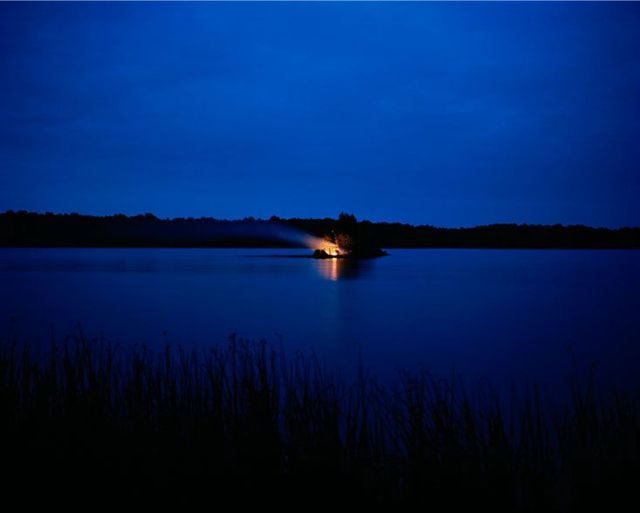
Work from Burning and a spectacular homage to British battleship dazzle camouflage.

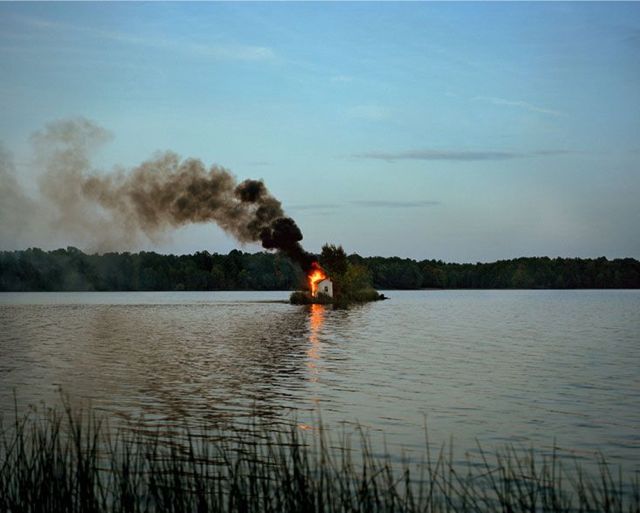
“Over the course of several months, I built a series of identical wooden houses, placed them on an island in the middle of a lake (that my grandfather helped to dig during the Depression through the CCC), and burnt them down…” – Carrie Schneider

John Opera

John Opera

Work from his oeuvre.

“Working simultaneously with the culturally historicized trope of landscape photography and the conceptual, experimental photograph, John Opera is concerned with the way the natural, exterior world and the abstract, interior world converge. Opera creates heavily charged landscapes that directly address presence and absence, being and non-being, in the choices of his details. In Forest, the brush has been flattened, disrupting the plane and uncovering an otherwise hidden interiority. In Meadow, one bare tree rises from the tranquil space as a sculptural presence. His landscape photographs are documentations, not constructions, as is demonstrated by the title piece Zoar, where an image of a lone male figure pensively sits at his campfire near the bank of a quiet stream. The image is captured from a far, caught with the subject unaware. The location, Zoar Valley in western New York, is also critical to the implications of the photograph. In biblical history, Zoar is one of 5 cities, along with Sodom and Gomorrah that was to be destroyed by God but was ultimately spared. In Hebrew, Zoar means ‘small’ or ‘insignificant.’ The implications of the photograph’s space intersect with this solitary figure to create a singular, unabashedly contemporary mythic moment.

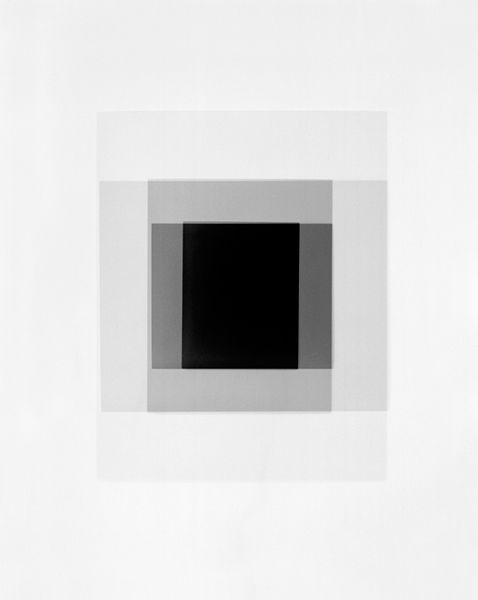
Opera has paralleled his continued exploration of landscape with an investigation into abstraction through experiments with light and color. His abstractions are an extension of the landscape, more directly revealing his symbolistic relationship to the visual and physical world around him. They have a lexical connection to his ‘outer’ works and provide a way of reading what and how he is seeing. Darker Diamond, created by multiple exposures to the same terrestrial color field, is part of a series of minimal painterly abstractions that the artist has created over the last year. At once geometric and clean, the overall effect is still painterly, with the layers of trace color, creating a photographic sfumato effect. The result feels eerily created by a brush. Where his romanticized landscapes draw from the history of photography, the abstractions quote from 20th century painting to reveal the camera’s ability to capture something simultaneously resonating outside the natural world and yet ordered by its rules.” – via Andrew Rafacz Gallery.