Thursday, 19 March 2009


Elise Rasmussen
Work from the series, Within These Walls and Stendhal Syndrome. I wanted to continue the tradition of finding any out-of-focus work I can and posting it. While I can’t determine whether she has ever lived or worked in Germany (to strengthen my theory about blurry photography and Germany), she did have a residency in Austria.
Stendahl Syndrome
“‘Life was drained from me. I walked with the fear of falling.’
—Stendhal, Naples and Florence: A Journey from Milan to Reggio, 1817
In 1989 psychiatrist Graziella Margherini published the book La Sindrome di Stendhal. The account chronicled numerous incidents in which tourists experienced sensory overload related to the exuberant art and architecture in the city of Florence. The Uffizi Gallery is said to be a popular locale for victims of this particular syndrome, and houses a recovery bed in a small room off of the gallery’s main corridor for those in need of rest or further care at nearby Santa Maria Nuova Hospital.”
––––––––––––––
Within These Walls
“‘Within These Walls features portraits of seemingly melancholic individuals situated within blurred domestic interiors. Subject and setting become one as the relatively nondescript interiors are permeated by the moods of the figures, and the occupied spaces are transformed by our emotional reading of the portraits.’
—excerpt by Sally Frater: Determining Place in 10 Days in July”
Tags: blur, Canadian, chicago, conceptual, out of focus, photography
Posted in blur, Canadian, chicago, conceptual, out of focus, photography | No Comments »
Wednesday, 18 March 2009
Lindsay Page
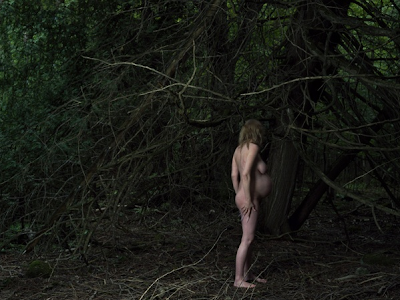
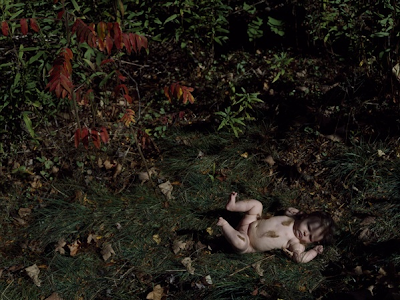
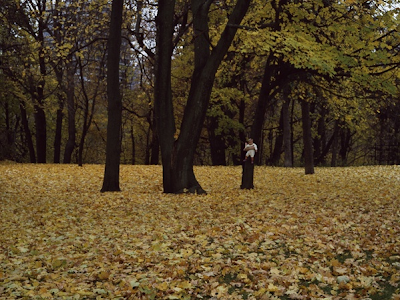
Works from the series Spawn (still in progress). Titles (in order), Werewolf 1, Werewolf 2, and Unitled. I also recommend the Basement Performances Series.
“This body of work examines motherhood as an event steeped simultaneously in the intensity of anxiety and exhilaration, momentous gain and the spectre of loss. It is both a personal inquiry as well as public commentary on the dominant narrative of birth as a celebration. The transformation of pregnancy brings promise but also a horizon of threat, the loss of control and autonomy. The body begins to strain against the conditions of its existence, seeming to act with a will of its own, becoming unfamiliar and foreign, grotesque even, as it creates a presence unseen and unknown.
Upon birth, identity is suddenly submerged, focus and purpose are shifted out of love and necessity. Yet such a shift inevitably forces a confrontation with the prospect of one’s own disintegration and disappearance to be subsumed under the generic label “Mother”. This body of work highlights the contradictions embedded within motherhood and birth by exploring these shifting frontiers of visibility and invisibility. “
Tags: lighting, motherhood, photography, portrait, saic
Posted in lighting, motherhood, photography, portrait, saic | No Comments »
Tuesday, 17 March 2009
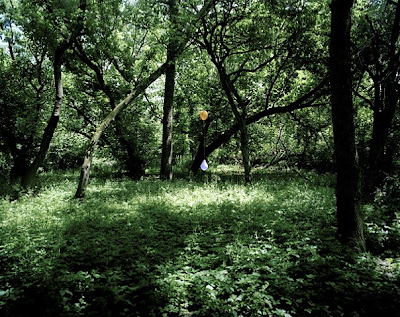
Precise Equilibrium, 2008.
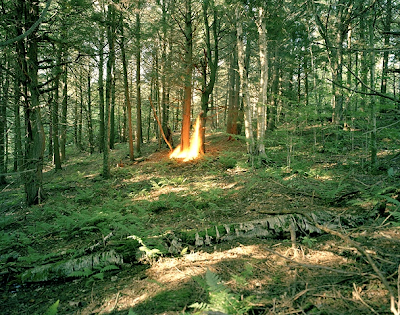
Fire, 2008.

A balloon in a room, 2008.
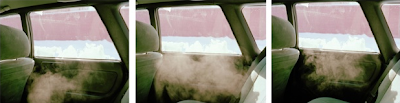
My breath in a car #1, 2008.
Adam Ekberg
“Using large and medium format cameras as well as video to document performances, constructions, and lens-based phenomena; my images function as traces of a presence. The photographed interventions range from very simple gestures to elaborate stagings; what they have in common in an implied trace. This residual presence is established through a host of different stratagies- juxtaposing banality with the phenomonal this body of images explores the activation of environments through gesture and lens fallibility.”
Tags: conceptual, document, moment, photography, staged
Posted in conceptual, document, moment, photography, staged | No Comments »
Monday, 16 March 2009


Benjamin Stern
Work from the series Topologies.
“Spring begins in Wisconsin when the snow starts to melt off the fields, and the streams flood their banks. During these times, I remember running up and down the hill by my house as the cars occasionally drove by. Spring was the time I tried to control the floodwaters in an attempt to keep a consistent water level in the stream. I created dams of leaves and dirt all the way up the street in an attempt to prevent the water from running into the stream. No matter how hard I tried to hold the water back, I never succeeded. When I look back at the things I once did in my childhood and compare them with larger events occurring in today’s society, I start to understand and question people’s and my own interactions with the environment.
Humans have always tried to control and manage the land to some degree, and photography has played a large role in the effort. Throughout the evolution of photography, photographers have been using the camera to record sites and events and show them to groups of people. Due to the reproducibility of a photographic image and the ability for the image to be widely recognized by culture, many individuals and institutions have employed this influential tool to project their points of interest.
I feel that landscape images throughout history have helped define for us what a landscape is. In the United States, landscape images were used in the 19 th century to justify westward expansion, aid in the development of the railroad, and draw investors to the “untamed” land. Photography also influenced the passing of laws to protect areas of land from being stripped and altered for other uses. In addition, photography has been used to document cities as they expand into the deserts, fields and woodlands. Landscape photographs have allowed for the aestheticization of the land, as well as investigation of its history. These investigations and processes of photography still continue today. Since photographs are everywhere, our cache of visual information is continually updated. Images we see daily shape our ideas and influence our thoughts.
I choose locations to photograph by investigating the evidence of human interaction within the spaces I select to observe. My investigation is based on the arrangement of these spaces and apparent changes through time. In order to document locations in the landscape with extreme detail, I use a grid method that is similar to the arrangement of longitude and latitude lines that map the earth. Hundreds of close-up images of the chosen area of land are combined, creating the exact photographic reproduction of the site. Apparent in the images is evidence of human interaction revealed through marks on the surface of the land. The topological approach to photography gives us insight into how land has been used, organized, and controlled through time.
Land use is something we all take part in on a daily basis, but is not necessarily something we think about all the time. The spaces I am investigating show how I have interacted with the land, as well as make reference to the interaction with land by other individuals. They can give us insight into human values, priorities, and other interests in the land. Through the topological studies of an area, one cannot only read the landscape for events that have occurred there, but they can also start to understand the people that have inhabited the areas. J.B. Jackson, a critic of modern architecture, refers to this type of landscape as “vernacular landscape.” I am interested in the vernacular landscape and what the marks reveal about human interaction with it.”
Tags: aerial, perspective, photography
Posted in aerial, perspective, photography | No Comments »
Saturday, 14 March 2009


Isabelle Krieg
Work curently showing at Substitut-Berlin if you are in Berlin, go to this show. There is a great range of work, and some fantastic artists’ books on sale.
Tags: berlin, conceptual, humor, materials, sculpture, swiss
Posted in berlin, conceptual, humor, materials, sculpture, swiss | No Comments »
Friday, 13 March 2009


leonardogillesfleur
An are collective consisting of Leonardo Giacomuzzo and Gilles-Fleur Boutry, leonardogillesfleur’s work addresses the temporal nature of video work and photography, with many pieces serving as (mostly) static re-enactments of snapshots, where physical strain/time betray the nature of the pieces as video. They also have some fairly hilarious visual pun and analogue mash-up work (the piece above with two VW Beetles is called Fucking Car Crash).
New York Magazine had the video, and a short article.
Tags: conceptual, performance, photography
Posted in conceptual, performance, photography, video | No Comments »
Thursday, 12 March 2009


Nina Katchadourian
Work from the series Sorted Books. She has dozens of amazing projects. Video, Sculpture, Public Projects, Photography, and much more. Spend an hour on her website.
“The Sorted Books project began in 1993 years ago and is ongoing. The project has taken place in many different places over the years, ranging form private homes to specialized public book collections. The process is the same in every case: culling through a collection of books, pulling particular titles, and eventually grouping the books into clusters so that the titles can be read in sequence, from top to bottom. The final results are shown either as photographs of the book clusters or as the actual stacks themselves, shown on the shelves of the library they were drawn from. Taken as a whole, the clusters from each sorting aim to examine that particular library’s focus, idiosyncrasies, and inconsistencies — a cross-section of that library’s holdings. At present, the Sorted Books project comprises more than 130 book clusters.”
If you are in Berlin, you should go to her opening @
Carnival Within – An Exhibition Made in America
Curated by Sabine Russ and Gregory Volk in collaboration with Uta Grundmann
March 28 – May 3, 2009 (opening on Friday night, March 27)
UferHallen
Uferstrase 8-11
13357 Berlin
www.discover-us.org
Tags: conceptual, photography, sculpture
Posted in conceptual, photography, sculpture | No Comments »
Wednesday, 11 March 2009


Michael Love
Work from the projects, Self Portrait with Rifle, and the Library Appropriation Project. I bumped into his website today, and he may just be one of my new favorite artists. Good job Canada.
Statement from Library Appropriation Project below, statement from Self Portrait with Rifle attached to image above (done by me for formatting) and here.
” In the Library Appropriation Project I continue with the theme of appropriated space. Instead of strict documentation, I create machetes inside of books to be placed in the library. Unexpected discovery of the inserted art objects creates a rupture for the viewer doing research. Not only do I appropriate the function and space of the library, but I also appropriate history and the subjects that are meant to be found in the books I have chosen. The function the library is temporarily negated, bringing into question the predetermined form of this structure. “
Tags: canada, conceptual, performance, photography, process, sculpture
Posted in canada, conceptual, performance, photography, process, sculpture | No Comments »
Tuesday, 10 March 2009


Liz Deschenes
Work from Registration.
I am hugely into the process/photographically referential work by Deschenes, and the critical approach to the medium. Below is a section of the press release from Miguel Abreu Gallery.
“If the photographic image can be said to have replaced the immediate experience of nature as the common ground of human perception, it can be argued that Liz Deschenes works to reverse that very evolution. Through her intense exploration of various photographic processes, she diverts both the eye and the mind back onto nature. Ironically perhaps, one of the keys to the fulfillment of this ongoing effort has been to insist on treating photography as primary, that is on turning it into a basic category of perception itself.
In traditional photography, the surface of photosensitive paper is imprinted by light with the image of a delimited, and forever inaccessible time and space—a captured event past. To be grasped, the common photograph requires the viewer to momentarily defer his or her present reality and enter a cross-section of frozen pictorial space.
Liz Deschenes relies on traditional photographic principals. In her recent Moiré series, she begins with a sheet of perforated paper placed against a well-lit window. She opens the shutter, closes it, and registers the silhouetted pattern of the paper on an 8 x 10 inch black and white negative. However, Deschenes does not print this singular photographic event. Rather, duplicating the negative, she superimposes two copies in the enlarger distorting the original image. Printed in color, the final image does not reveal the perforated paper, but, through the artist’s mis-registration of the two negatives, a unique moiréd formation.
At close range, Deschenes’ large Moiré prints may overwhelm the visual field – from further away they pulsate like electronic screens transmitting a live current. The optic nerve rapid-fires information to the brain as it negotiates the moiré’s ceaseless fluctuation of figure and ground. With the viewing of each Moiré, the brain instructs the eyes to open and close, registering with each blink, a new perceptual impression of the same physical image on the film of the retina. Circulating the room, the viewer’s attention oscillates, attempting to capture the image at hand while being deflected towards the out-of-frame. As if working against photography’s forced
function to depict, this general movement activates the in between space andphenomenologically regenerates something akin to a direct experience of nature.
We exist in a world of imagistic clichés; wherein, Deleuze would claim, it is not that there is no reality for images to describe (à la Baudrillard), but that it is our contemporary dilemma to make an image that sufficiently describes our reality. The tendency is to allow the photographic image to stand in as a generalized representation of experience. However, with Deschenes, the experience is perpetually and variously occurring with every viewing. The gaze may not enter the distilled moment of the photograph, but is engaged by the photograph in the very moment of viewing.”
Tags: abstract, conceptual, meta-photography, photography, self-referential
Posted in conceptual, meta-photography, photography, self-referential | No Comments »


