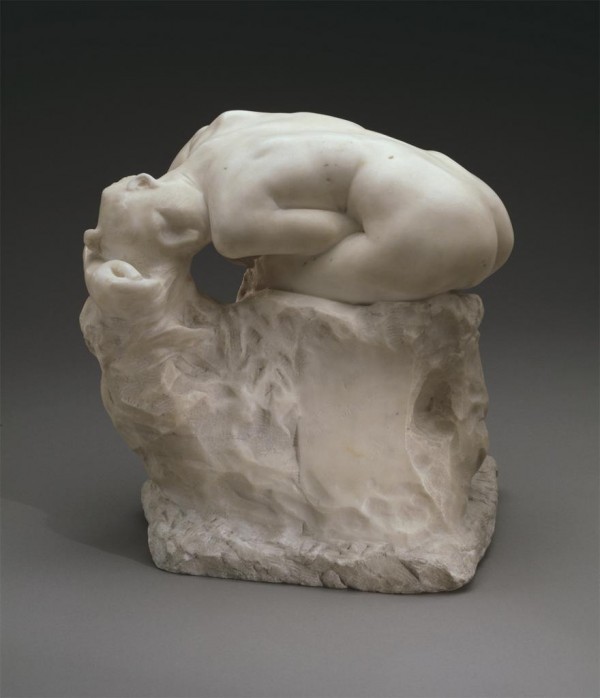
Auguste Rodin

Rodin_1

Rodin_2

Rodin_4

Rodin_3

Auguste Rodin

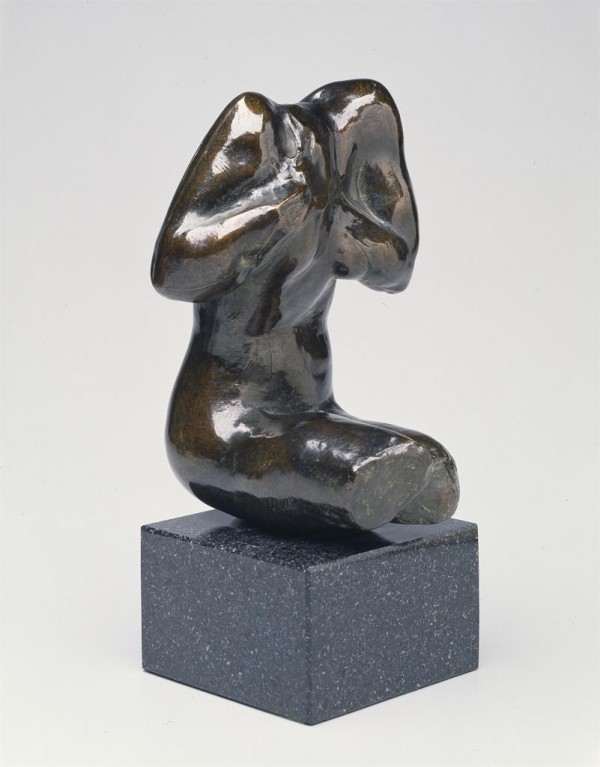
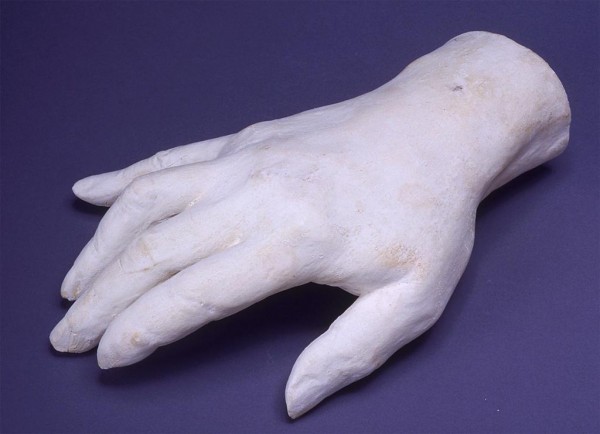
From top to Bottom: Small Seated Female Torso (N.D.), Hand of Dumas (N.D.), Andromeda (before 1917), Hands Clasping (N.D.)

“Born to a working-class family in Paris, and despite promising talent, Auguste Rodin (1840–1917) struggled hard to obtain the international fame he would enjoy by the 1890s. After repeatedly failing to gain admission to the prestigious Ecole des Beaux-Arts, he supported himself as a decorative object craftsman and studio assistant. His sculptures from this era were radically different from traditional idealized figures—an indication of the rugged, realistically imperfect forms that would characterize his signature style.

Rodin finally gained state patronage in 1880 after a group of artists petitioned the government to provide him with a studio, financial support, and official commissions for public sculptures, many of which he failed to finish. One such project was the bronze doors known as The Gates of Hell. This unrealized masterpiece obsessed the artist until his death and spawned numerous sculptures enlarged from its figural elements.

Bewildered by their rough edges, tool marks, and lack of finish, the public often considered Rodin’s sculptures unacceptably incomplete and frequently obscene for their sexually charged nature. Nevertheless, Rodin achieved fame and status by the turn of the century. In his groundbreaking modernity, he laid the foundation for twentieth-century masters such as Pablo Picasso, Henri Matisse, and Constantin Brancusi.”

-Hirshhorn Museum and Sculpture Garden
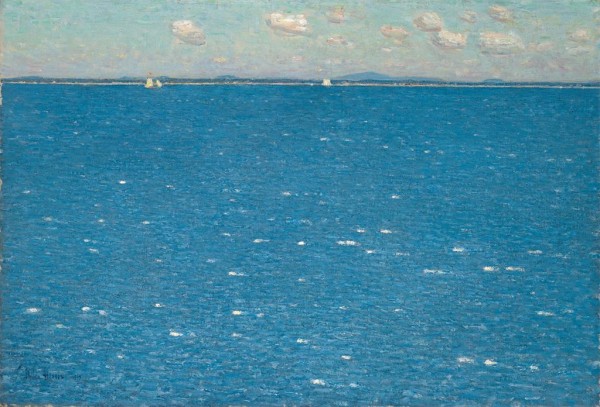
Childe Hassam

CH_3

CH_1

CH_2

CH_4

Chile Hassam

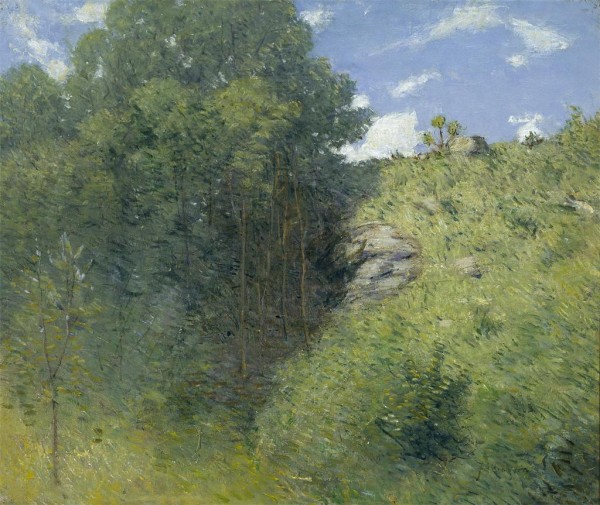
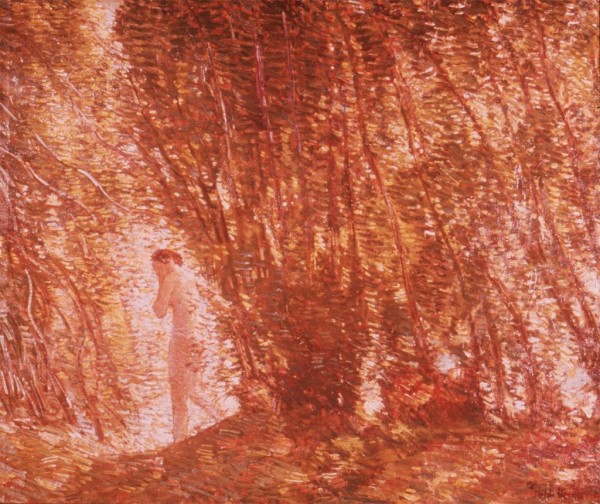
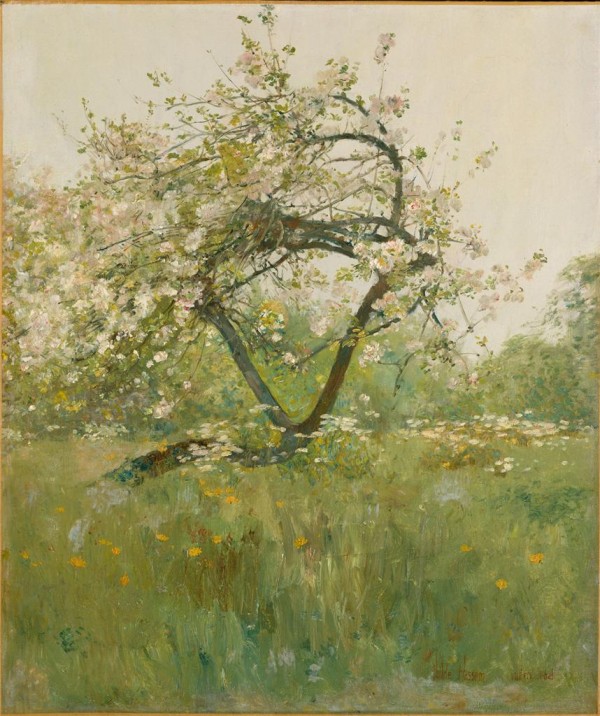
From top to bottom: The West Wind, The Isle of Sholas (1904), Ravine near Branchville (c. 1910-1919), At Sunset (1900), Peach Blossoms-Villiers-le-Bel (c. 1887-89)

“Childe Hassam (1859–1935), a pioneer of American Impressionism and perhaps its most devoted, prolific, and successful practitioner, was born in Dorchester, Massachusetts (now part of Boston), into a family descended from settlers of the Massachusetts Bay Colony. Equally adept at capturing the excitement of modern cities and the charms of country retreats, Hassam (properly pronounced HASS-am) became the foremost chronicler of New York City at the turn of the century. In our day, he is perhaps best known for his depictions of flag-draped Fifth Avenue during World War I. His finest works manifest his brilliant handling of color and light and reflect his credo (stated in 1892) that “the man who will go down to posterity is the man who paints his own time and the scenes of every-day life around him.”

After establishing his reputation in Boston between 1882 and 1886, Hassam studied from 1886 to 1889 in Paris. There he was unusual among his American contemporaries in his attraction to French Impressionism, which was just beginning to find favor with American collectors. Hassam returned to the United States late in 1889 and took up lifelong residence in New York. His signature images include views of Boston, Paris, and New York, three urban centers whose places and pleasures he captured with affection and originality. Examples include Winter in Union Square and Spring Morning in the Heart of the City, both of which record lively sections of New York during the first decade of Hassam’s activity there.

While Hassam was unusual among the American Impressionists for his frequent depictions of burgeoning cities, he spent long periods in the countryside. There he found respite from urban pressures and inspiration for numerous important works of art. Hassam’s many portrayals of the old-fashioned gardens, rocky coast, and radiant sunlight of the Isles of Shoals, Maine, are among his most cherished works. Among them is the 1901 view Coast Scene, Isles of Shoals, the first canvas by the artist to enter the collection of the Metropolitan Museum. Hassam’s images of Newport, Portsmouth, Old Lyme, Gloucester, and other New England locales also exemplify the late nineteenth-century appreciation of the picturesque region redolent of early American settlement and colonial growth. In 1919, Hassam and his wife purchased a colonial-period house in East Hampton, on the south fork of Long Island, New York, and made it their summer headquarters.

Hassam created more than 2,000 oils, watercolors, pastels, and illustrations, and—after 1912—more than 400 etchings and other prints. With these works he achieved critical acclaim and commercial success, riding the great wave of enthusiasm for American Impressionism to fame and fortune.”

-H. Barbara Weinberg for The Metropolitan Museum of Art

Carmelo Arden Quin

CAQ_1 CAQ_2

CAQ_3

CAQ_4

Carmelo Arden Quin

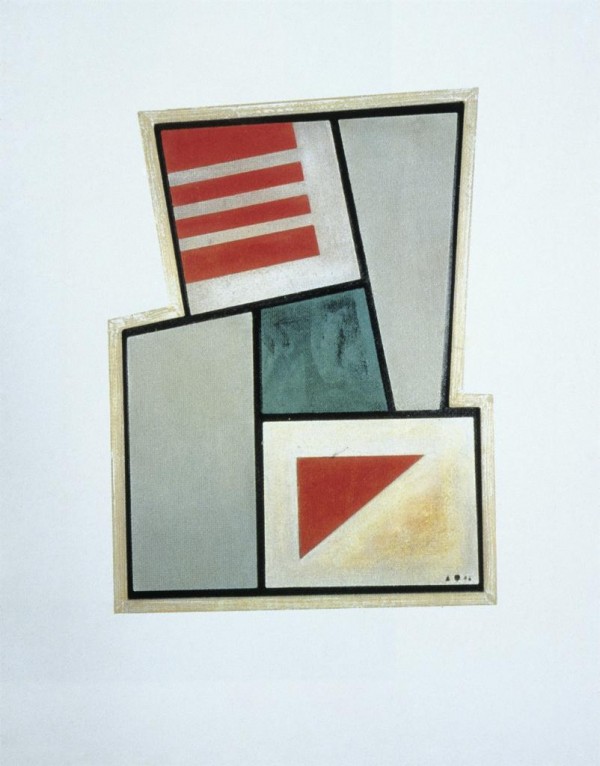
From Top: Murcurial (1945), Coplanal (1945), Négal (1946), Composition (1945-6)

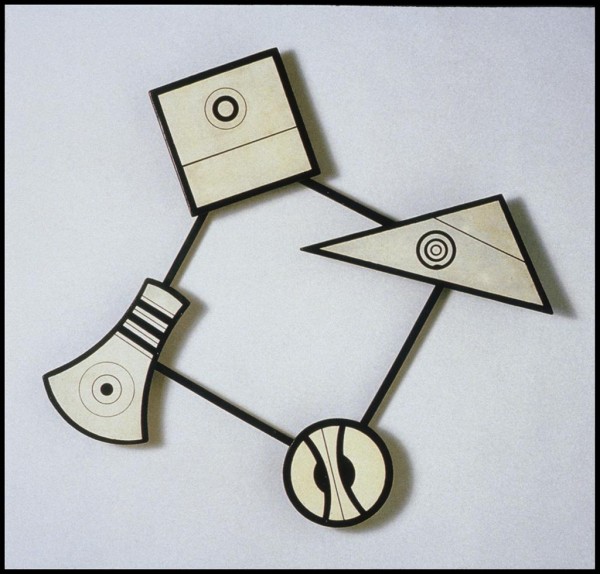
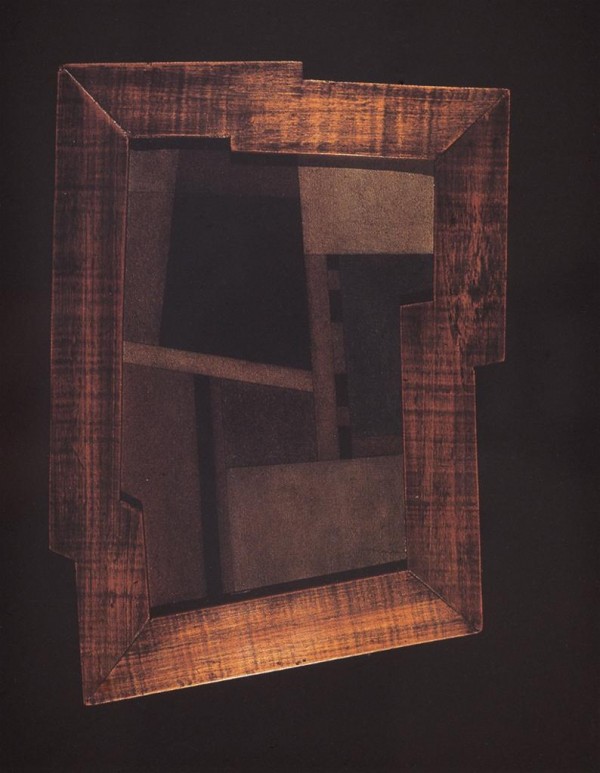
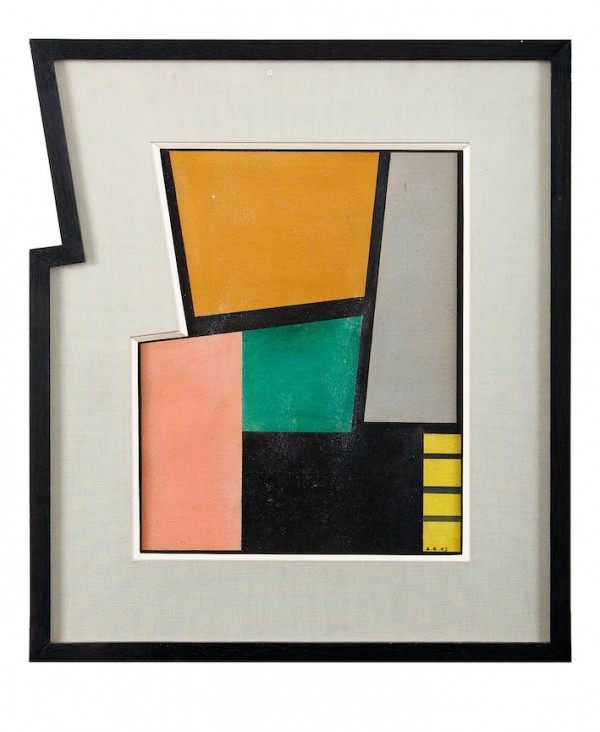
“Carmelo Arden Quin was born in 1913 in Rivera Uruguay, a town on the Brazilian border. He had an uncle who painted cubist paintings, and in 1934 in Rivera Arden Quin created his first surviving painting, “Naturel Morte Cubiste” or “Cubist Still Life.”

In Montevideo twenty-one year old Arden Quin met his mentor, the artist Joaquin Torres-Garcia, then in his sixties. Torres-Garcia had just returned from Europe where he had been influenced by Piet Mondrian and Michel Seufor: Torres-Garcia and Seufor formed the Cercle et Carre group, which included Mondrian and Vantongerloo and was dedicated to geometric and constructivist art. In Montevideo Arden Quin studied under Torres-Garcia and was influenced by his transformable and articulated sculpture pieces.

During the 1940’s Arden Quin joined intellectual writers and artists in Buenos Aires. In 1944, after working on it for several years, he brought out the literary and artistic journal Arturo, in which he applied dialectic materialism of art. He also contributed his prose proem Pegasus Eats Grass in Chaos, which refers (secretly due to censorship) to the horrors of World War II. In August of 1946 Arden Quin read to the public the MADI Manifesto, which he had written, and which launched the MADI movement.”

-Excerpt from the Museum of Geometric and MADI Art

Barbara Hepworth

BH_1 BH_2 BH_3 BH_4

Barbara Hepworth

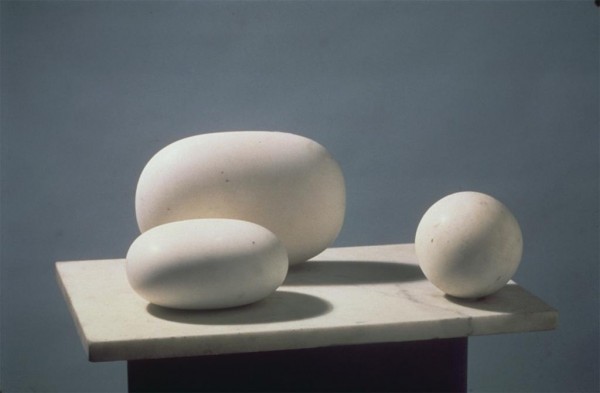
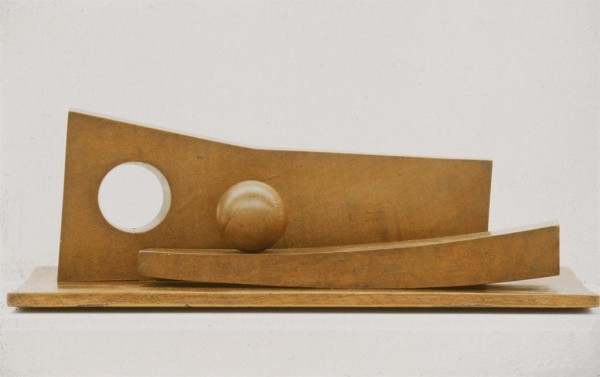
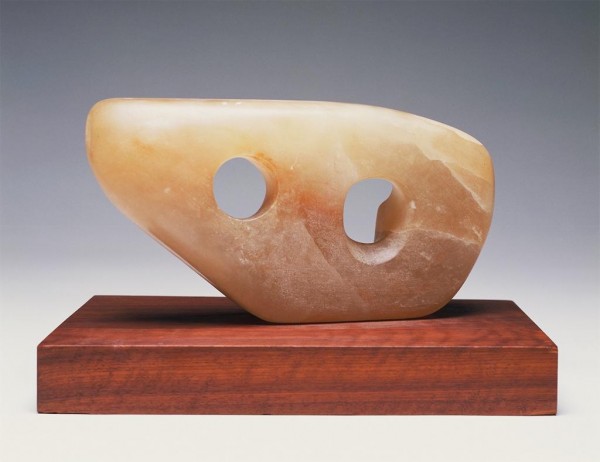
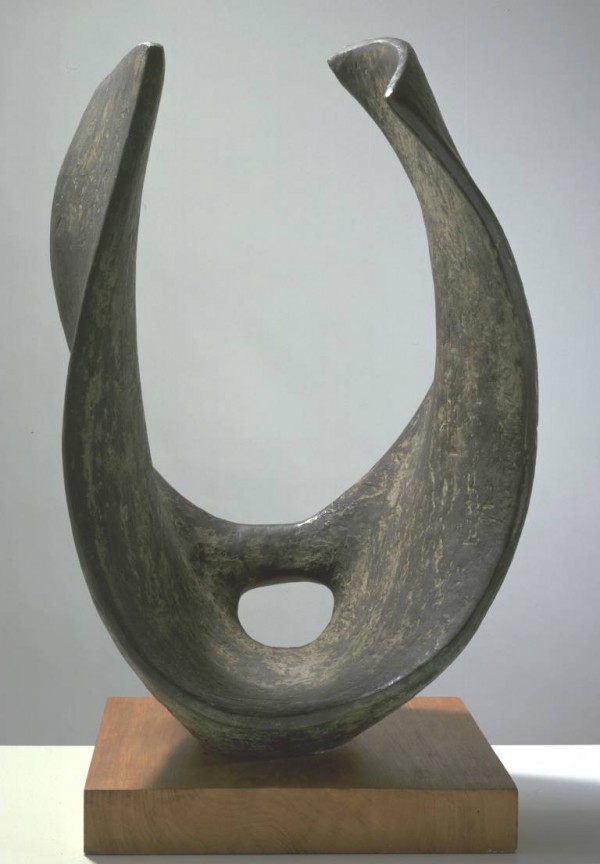
From top to bottom: Three Forms (1935), Ball Plane and Hole (1936), Figure in a Landscape (1951-51), Curved Form (Trevalgan) (1956)

“I have always been interested in oval or ovoid shapes. The first carvings were simple realistic oval forms of the human head or of a bird. Gradually my interest grew in more abstract values – the weight, poise, and curvature of the ovoid as a basic form. The carving and piercing of such a form seems to open up an infinite variety of continuous curves in the third dimension, changing in accordance with the contours of the original ovoid and with the degree of penetration of the material. Here is sufficient field for exploration to last a lifetime.

Before I can start carving the idea must be almost complete. I say ‘almost’ because the really important thing seems to be the sculptor’s ability to let his intuition guide him over the gap between conception and realization without compromising the integrity of the original idea; the point being that the material has vitality – it resists and makes demands.

I have gained very great inspiration from Cornish land- and sea-scape, the horizontal line of the sea and the quality of light and colour which reminds me of the Mediterranean light and colour which so excites one’s sense of form; and first and last there is the human figure which in the country becomes a free and moving part of a greater whole. This relationship between figure and landscape is vitally important to me. I cannot feel it in a city.”

-Excerpted from Approach to Sculpture by the artist

Theo van Doesburg

Theo_V_D_1

Theo_V_D_3

Theo_V_D_2

Theo_V_D_4


Theo van Doesburg

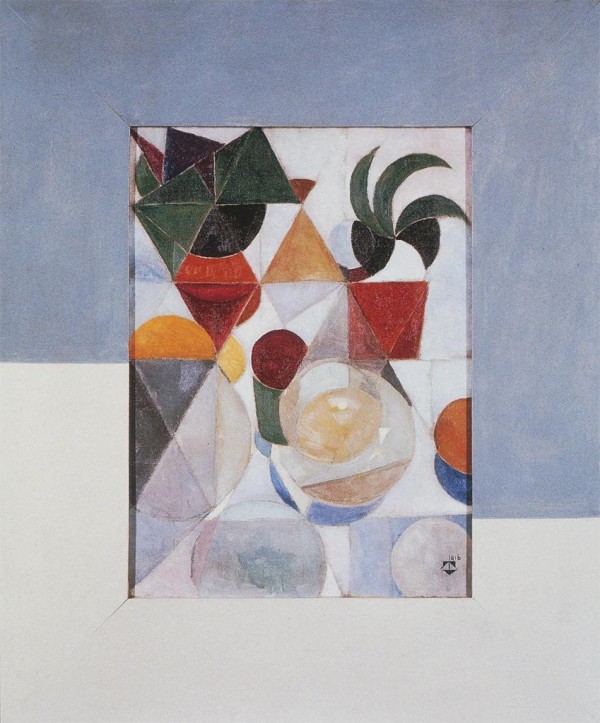
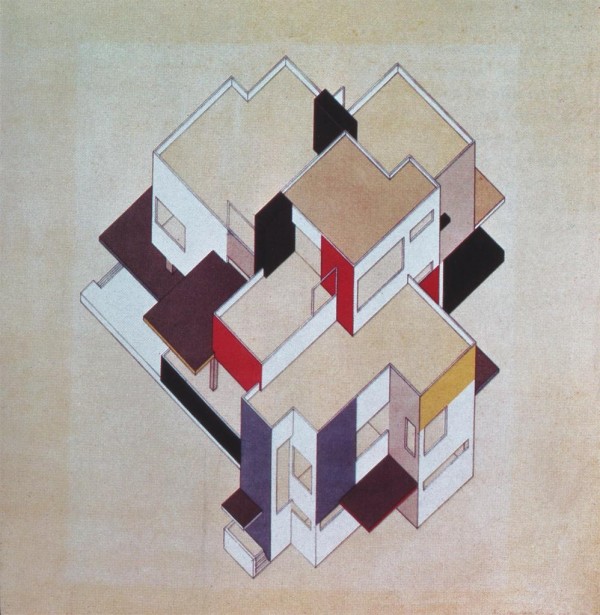
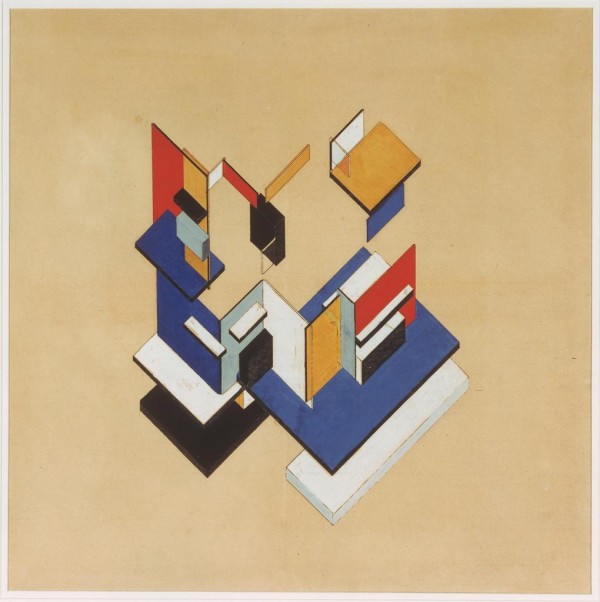
From top to bottom: Still Life (1913), Design for the Central Hall of a University (1923), Maison Particuliere: Axonometric Drawing (1923), and Contra-Construction Project Axonometric (1923)

“Born Christian Emil Küpper in 1883 into an artistic family in Utrecht, he only became “Theo Doesburg” when he started painting – his adopted name being borrowed from his stepfather. The “van” was added later, in much the same way that Ludwig Mies added “van der” when he merged his mother’s maiden name, Rohe, with his own paternal surname. One detects a similar feeling of social insecurity in the two men.

At the start of his career Van Doesburg was a competent figurative painter, his work reminiscent of Van Gogh in early, potato-eater mode; but he soon came in contact with non-figurative painting and in 1916 met Mondrian, newly returned from Paris. The devotion of both men to the creation of a purely abstract art led to the formation of the De Stijl group in 1917 and the publication of its magazine, De Stijl, which Van Doesburg edited and published from its foundation that year until its demise following his early death in 1931.

Van Doesburg’s life may have been short but it was energetic. Throughout the 20s his saturnine features, often topped with a homburg and usually accompanied by a cigarette – think Humphrey Bogart – appear in photographs of divers artistic groups from Paris to Weimar, from Berlin to Zurich and Milan. Neo-plasticism, constructivism, suprematism, dadaism, elementarism – the “isms” of the time are bewildering to anybody but a specialist, but Van Doesburg was involved in all of them. Indeed he invented some. He was both gregarious and eclectic, a centripetal element in a diverse and chaotic artistic world. He lectured and published, talked and theorised, attended conferences and congresses and exhibitions, many of which he organised himself.

Of all the arts that Van Doesburg touched perhaps his greatest influence lay in the area of architecture and design. Together with the architects JJ Oud and Gerrit Rietveld, it was he who took the flat, geometric painting of the De Stijl group and burst it out into the third dimension. Indeed he even tried to inform his work with a fourth dimension, although with what success is a matter of debate. Certainly he was fired with a thrilling spatial imagination. His axonometric projections of ideal houses, created in conjunction with the young architect Cornelis van Eesteren, are crucial in understanding this concept so it is a shame that they do not form part of this otherwise comprehensive exhibition. A plastic model of one of the proposed buildings (the “Maison Particulière”) gives some idea but a 3-D model is not as striking as the original drawings. A model is too literal. In the drawings perspective is ambiguous; walls are no longer supporting structures but floating, intersecting planes of primary colour; rooms are not static boxes but conceptual spaces hovering in the air. The volumes of the buildings seem to explode from an ­inner core, as though erupting into the third dimension and straining for that elusive fourth.”

-Simon Mawer for The Guardian

James Abbott McNeil Whistler

Whistler_1 Whistler_2 Whistler_3 Whistler_4

James Abbott McNeil Whistler

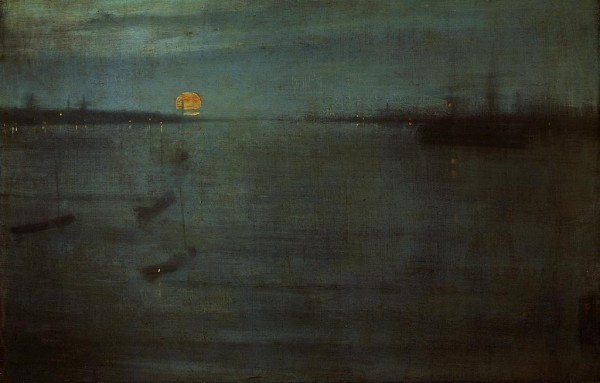
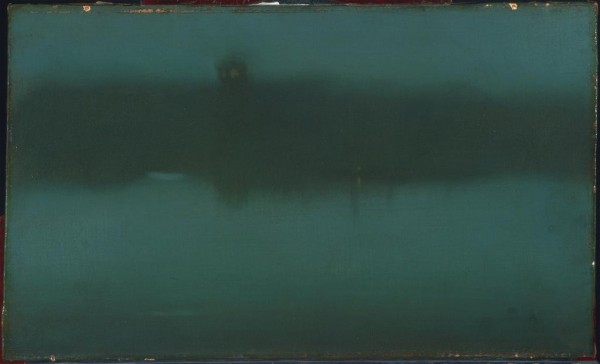
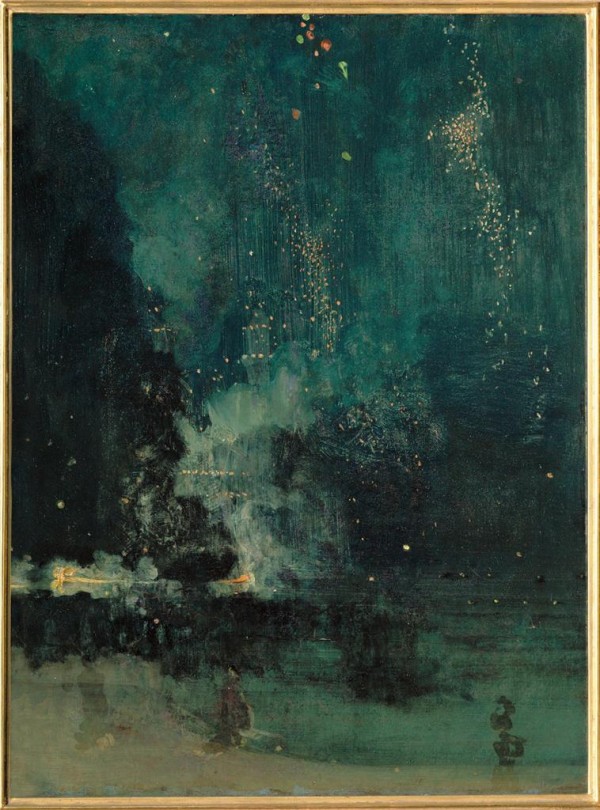
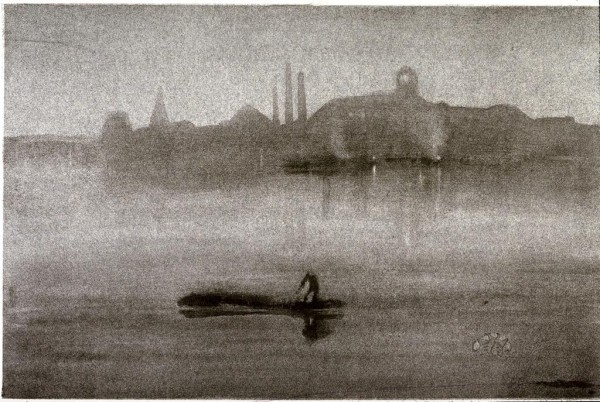
From Top to Bottom: Nocturne: Blue and Gold – Southampton Water (1872), Nocturne (1875-1880), Nocturn in Black and Gold, the Falling Rocket (1875), Nocturne (1878)

“Whistler’s aim in these works was to convey a sense of the beauty and tranquility of the Thames by night. It was Frederick Leyland who first used the name ‘nocturne’ to describe these moonlit scenes, suggesting the concept of evening, or night, but with musical associations. The expression was quickly adopted by Whistler, who later explained,

‘By using the word ‘nocturne’ I wished to indicate an artistic interest alone, divesting the picture of any outside anecdotal interest which might have been otherwise attached to it. A nocturne is an arrangement of line, form and colour first.’

Whistler preferred the calm of the river at night to the noise and bustle of the Thames by day. With the Greaves brothers as his oarsmen, he would set off at twilight and sometimes remain on the river all night, sketching and memorising the scene. He never painted his Nocturnes on the spot, but rather from memory in his studio, employing a special medium devised for painting swiftly in oils. He thinned his paint with copal, turpentine and linseed oil, creating what he called a ‘sauce’, which he applied in thin, transparent layers, wiping it away until he was satisfied.”

-Frances Fowle for The Tate Britain

Odilon Redon

OR_1

OR_3

OR_2  OR_4

Odilon Redon

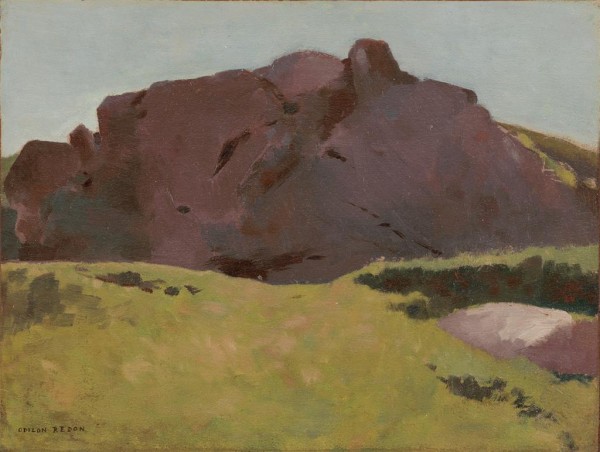
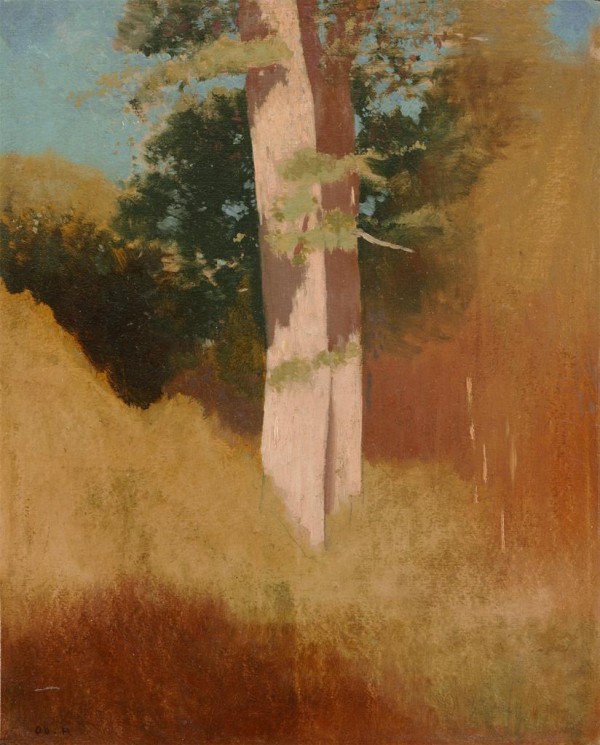
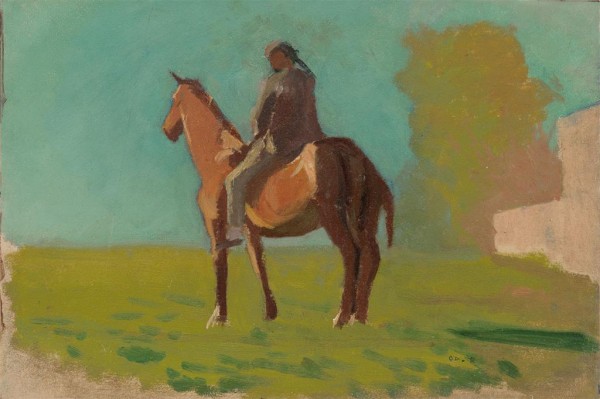
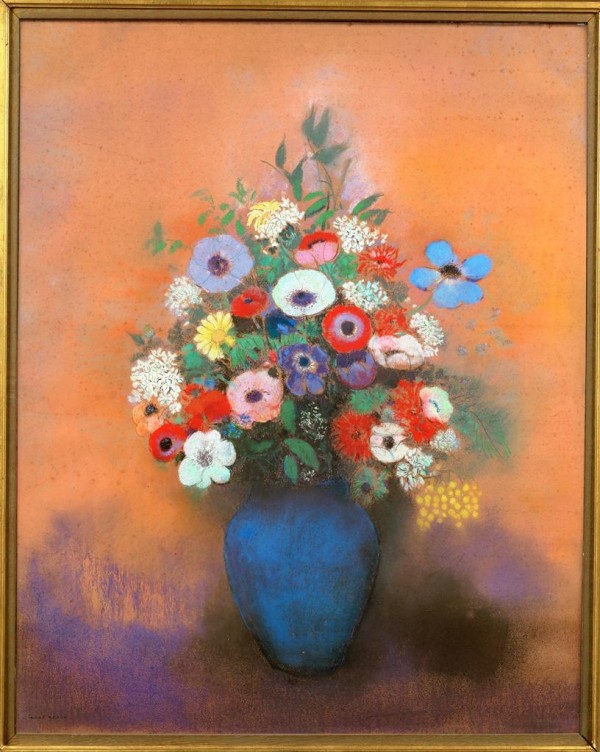
From Top: The Rocky Slope (c. 1875), Trees in the Blue Sky (c. 1883), Apache (Man on Horseback) (c. 1875), Large Bouquet in a Blue Vase (after 1912)

“Born Bertrand-Jean Redon, this French painter, printmaker, and draftsman spent his childhood at Peyrelebade, his father’s estate in the Médoc. Peyrelebade became a basic source of inspiration for all his art, providing him with both subjects from nature and a stimulus for his fantasies, and Redon returned there constantly until its enforced sale in 1897. He received his education in Bordeaux from 1851, rapidly showing talent in many art forms: he studied drawing with Stanislas Gorin (?1824–?1874) from 1855; in 1857 he attempted unsuccessfully to become an architect; and he also became an accomplished violinist. He developed a keen interest in contemporary literature, partly through the influence of Armand Clavaud, a botanist and thinker who became his friend and intellectual mentor.

Redon’s vocation was still undecided in 1864 when he studied painting briefly and disastrously at the studio of Jean-Léon Gérôme in Paris. He returned to Bordeaux, and his commitment to the visual arts was strengthened by his friendship with Rodolphe Bresdin, whose drawings and prints he much admired. He learnt from Bresdin’s skills as an engraver and made etchings under his guidance. In 1868 and 1869 Redon published his first writings: a review of the 1868 Paris Salon and an article on Bresdin, both in the Bordeaux newspaper La Gironde. His criticism looked back to the provincial artistic values of his background but also forward to an art of the future that would advocate imagination rather than pursuing realism. Such views reflected his wider loyalties: to Rembrandt and Corot, and especially to Delacroix. These early developments matured into an active artistic career only after the Franco-Prussian War, in which Redon served as a soldier. He regarded this experience as the catalyst that finally produced in him a firm sense of vocation. He settled in Paris for the first time, spending only his summers at Peyrelebade, and he began to participate in Parisian artistic and intellectual life. He was by then producing large numbers of highly original charcoal drawings, which he called his Noirs. They evoke a mysterious world of subjective, often melancholic fantasy. In 1879, partly at the suggestion of Fantin-Latour, he published his first album of lithographs, Dans le rêve.

Redon’s reputation until 1890 rested entirely on work in black and white, but he had been using colour in unexhibited landscape studies. From about 1890 he began to extend his use of colour to works that repeat or develop the subject-matter of the Noirs. Many of these were oils, such as Closed Eyes (1890; Paris, Mus. d’Orsay), but pastels also became frequent (e.g. Christ in Silencec. 1895; Paris, Petit Pal.). During the 1890s he used colour alongside monochrome, colour gradually becoming dominant, and after 1900 he abandoned the Noirs. Earlier subject-matter recurred, but new motifs also appeared, flowers, especially, becoming a central preoccupation. The increasingly decorative tone of these works led to commissions for screens and murals, an outstanding example being the paintings (1910–11) on the walls of the library at Fontfroide Abbey near Narbonne. The serene lyricism of these late colour works contrasts with the prevailing melancholy of the Noirs, but Redon’s fundamental aesthetic had not altered. The transformation of nature into dream-like images, suggesting indefinite states of mind and expressed in sumptuous textures, remained his central concern, and the exploratory freedom with which he investigated the suggestive potential of colour contributed considerably to Post-Impressionist art. His innovations were admired by the Nabis and by some of the Fauves, including Matisse.”

-Richard Hobbs for Oxford University Press, Grove Art Online

John Henry Twachtman

JHT_1

JHT_2

JHT_3

JHT_4

John Henry Twachtman

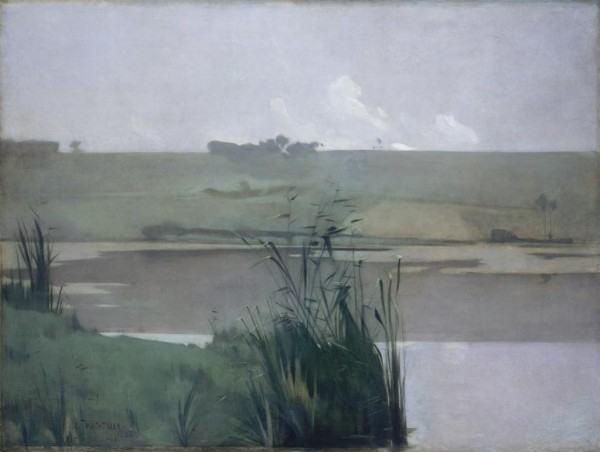
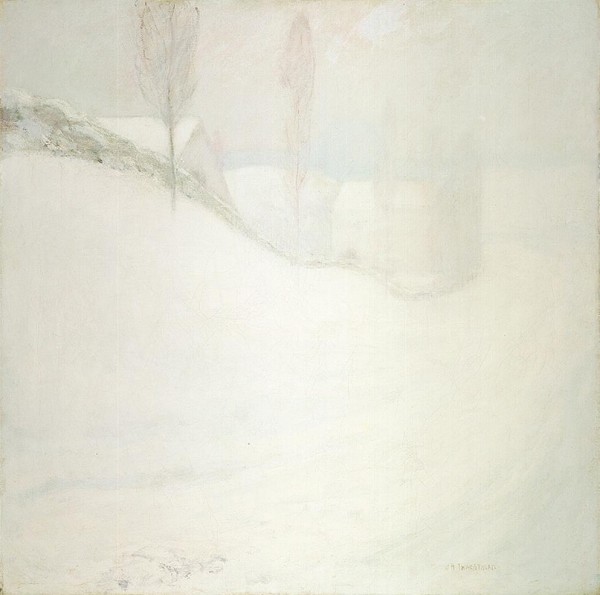
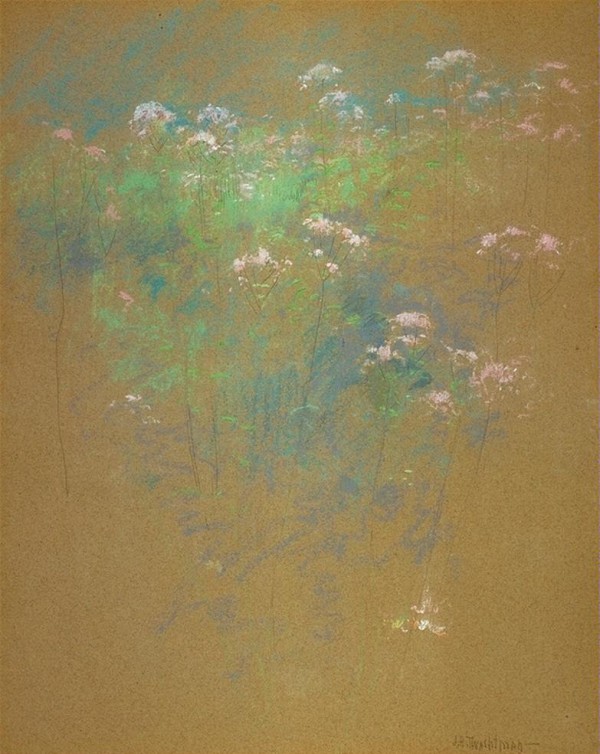
From Top to Bottom: Arques-la-Bataille (1885), Round Hill Road (ca. 1890-1900), Flowers (ca. 1900), and Along the River, Winter (1889)

“Born in Cincinnati, John Henry Twachtman worked as a decorator of window shades, as had his father. At the same time he took night classes at the Ohio Mechanics Institute and then enrolled at the McMicken School of Design (which later became the Art Academy of Cincinnati), where Twachtman studied with Frank Duveneck. Duveneck was a recognized painter who had recently returned from Munich, and he urged Twachtman to go to Munich to attend the Royal Academy of Fine Arts. In 1875 Twachtman went to Munich, and during his European stay he accompanied Duveneck and his fellow Munich colleague, William M. Chase, on a painting trip to Venice. Returning to the United States in 1878, Twachtman exhibited with the newly formed Society of American Artists in New York; he was elected a member the following year. In 1879 Twachtman met and began a lifelong friendship with J. Alden Weir. In 1881, he made a wedding trip to Europe, joining Weir and his brother John on a painting expedition to Holland and Belgium.

Between 1883 and 1885 Twachtman studied, traveled, and worked in France, meeting other American Impressionists Childe Hassam, Willard Metcalf, andTheodore Robinson in Paris. In 1889 Twachtman began teaching at the Art Students League, and, with the profits from a cyclorama he had painted withArthur B. Davies in Chicago, he purchased a home in Connecticut near Weir’s farm.

Twachtman’s naturalism combines the earth tones and the fluid brushwork of Duveneck and the Munich school, the muted harmonies and abstract patterning of Whistler, and, the atmospheric effects of Claude Monet. Writing in A Collection in the Making, Duncan Phillips noted that ‘Twachtman’s was perhaps the finest sensibility in American art.’

Among his many awards, Twachtman received a silver medal at the World’s Columbian Exposition in Chicago in 1893, and a gold medal at the 1894 Buffalo Academy of Fine Arts annual exhibition. In 1897 he and Weir withdrew from the Society of American Artists and formed The Ten American Painters. Estranged from his family, Twachtman spent the summers of 1900 and 1901 in Gloucester, where he died suddenly on August 8, 1902.”

-American Art at The Phillips Collection

Nicholas O’Brien


Nicholas O’Brien

Work from his oeuvre.

Short texts for each project follow – but the projects presented here are three of O’Brien’s interpretations on the function and legacy of the landscape.

“Farms at the End of Winter – This short animation is inspired by looking out the window during lengthy bus trips I made between Cincinnati and Chicago.

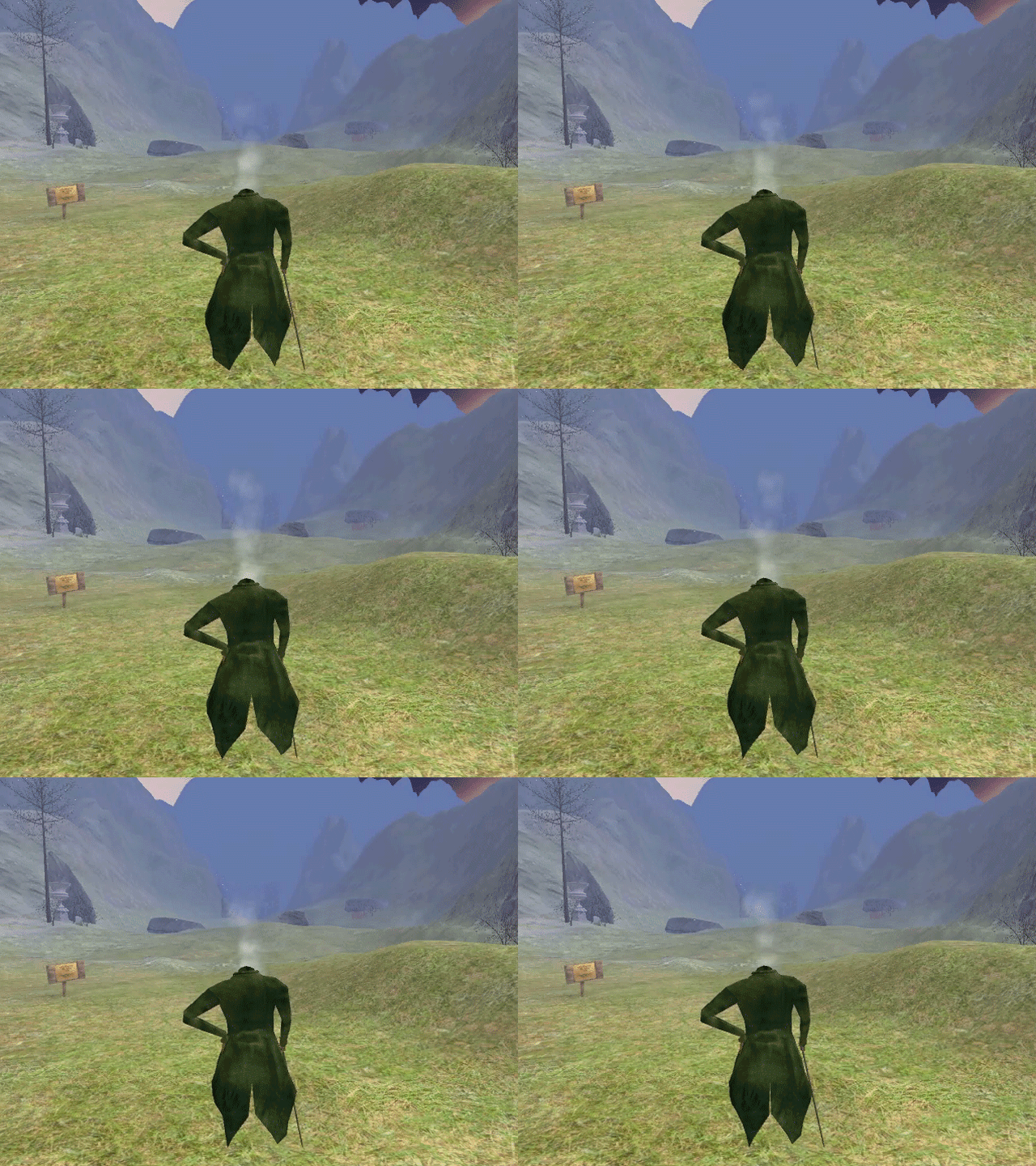
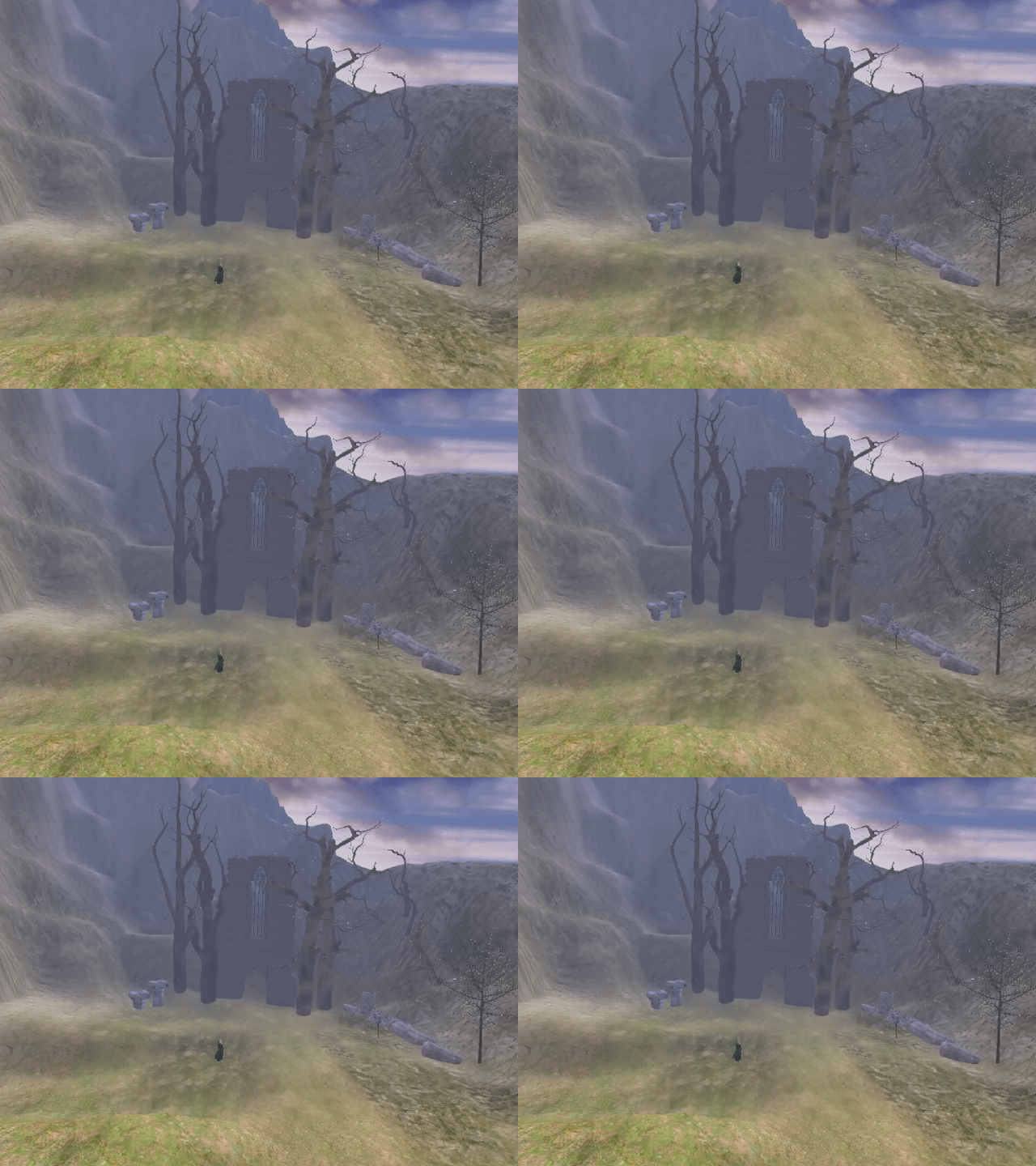
The Wanderer – This video game work explores the relationship between Romanticism and contemporary digital art. You play as the ghost of Romanticism’s past, drifting through a purgatory built from notable paintings by Caspar David Friedrick.

Three Ways of Evaluating Landscape as a Work of Art – This video looks at landscape in three different ways: silently, narrated, and loudly.” – Nicholas O’Brien

Kim Laughton

KIML7 KIML6 KIML9 KIML10 KIML11

Kim Laughton

Work from his oeuvre 

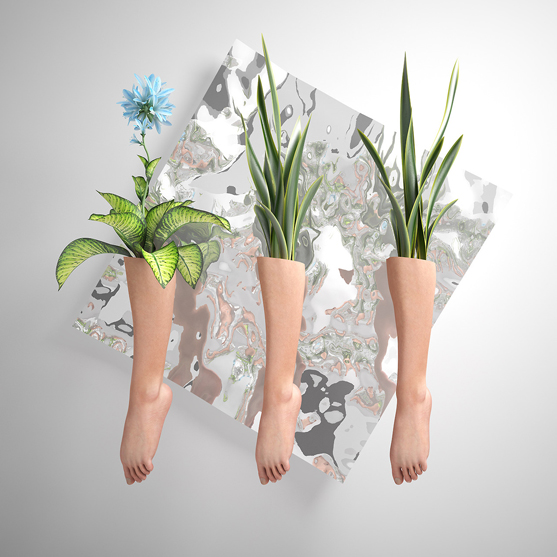
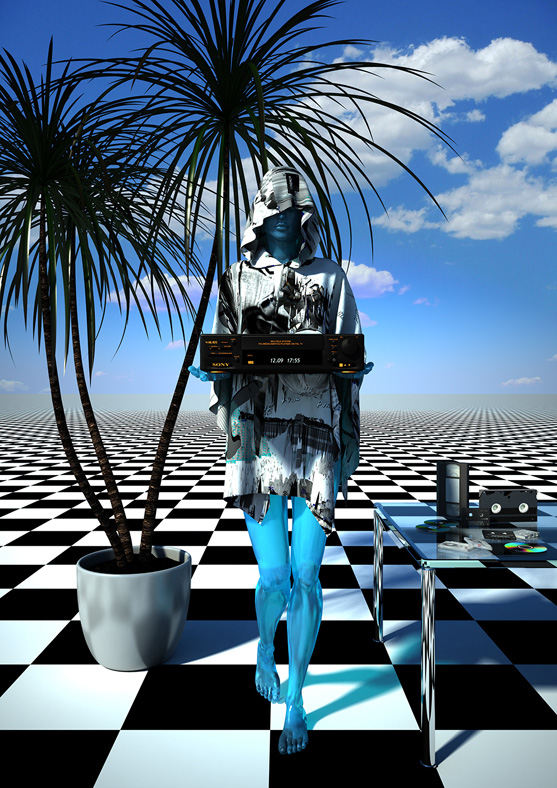
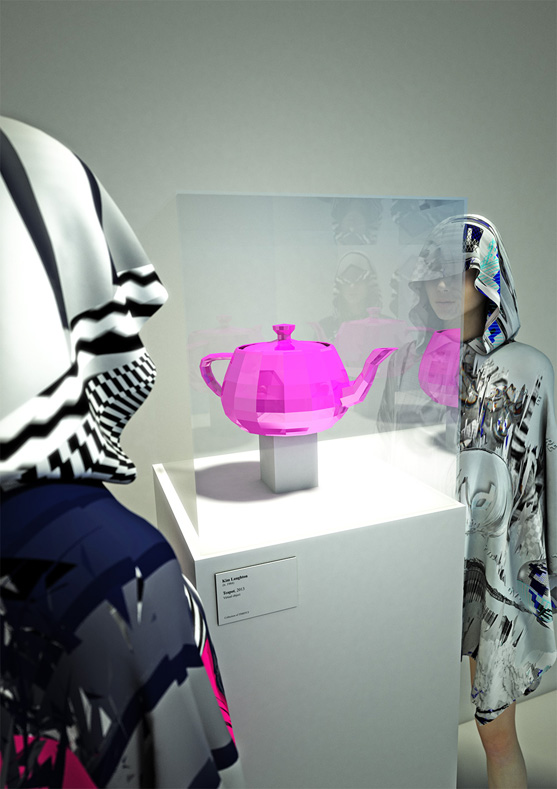
“Some extraordinary 3D design here from Shanghai-based artist Kim Laughton. Kim consider himself a little impatient because he usually don’t like anything that isn’t finished in a day or two. You may recognize his work from some of Kingdom‘s visuals or from TIMEFLY(his personal clothing label). TIMEFLY is where Kim puts most of his energy, where he can enjoy the sense of collaborating with the artists who produce designs to go on the clothes through the renders, even if the collaboration is very one sided. There are some exciting new artists lined up for TIMEFLY, giving a lot of potential to play with the whole thing.” – O Fluxo