Žilvinas Kempinas

Žilvinas Kempinas

Work from his oeuvre.

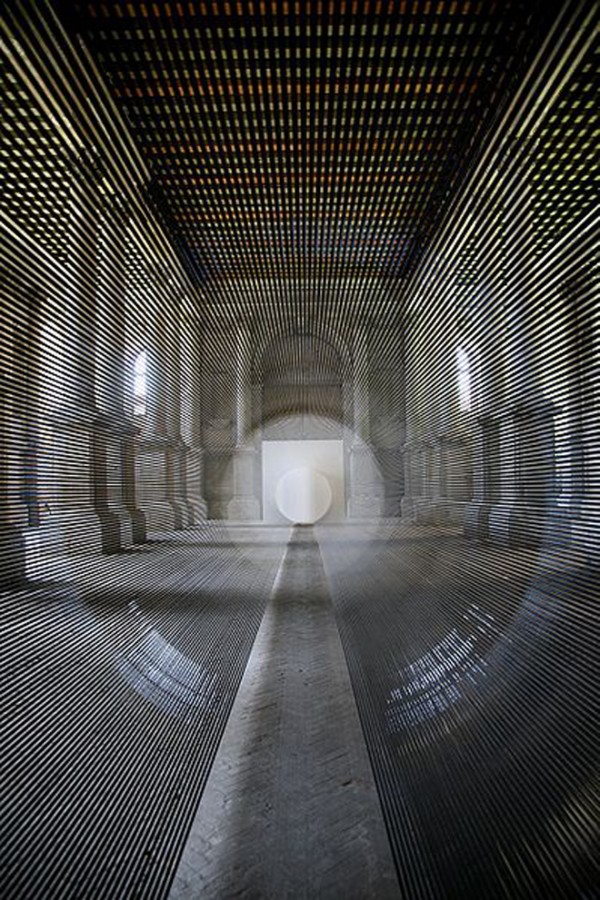
“I am attracted to things that are capable of transcending their own banality and materiality to become something else, something more. I like the way that videotape is simultaneously delicate and durable, since it’s meant to last. I can rip it easily with my hands because it’s so thin, but I can also stretch it. Videotape is made to present the world in color, but it appears purely black. It’s supposed to be this safe container of the past, but it is destined to vanish like a dinosaur, to become obsolete, pushed away by new technologies. It’s a familiar mass-produced commodity, but it can be surprisingly sensual and can look almost alive if set in motion. It can be seen as a solid, thick, black line, but it can also disappear right in front of your eyes if it’s turned on its side” – Žilvinas Kempinas

via Triangulation Blog

Joe Grimm

Joe Grimm

Work from his oeuvre.

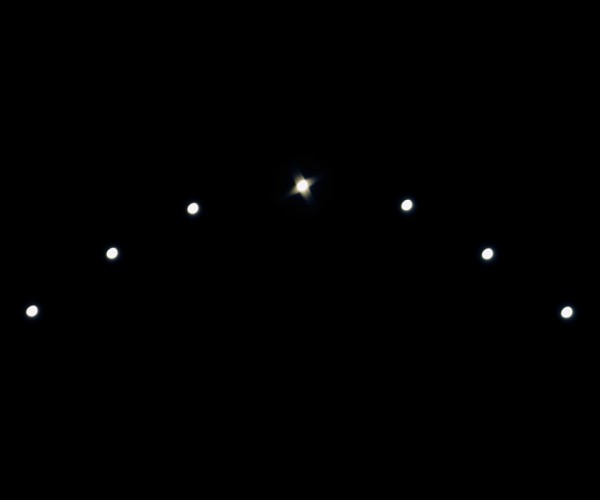
“My medium, properly understood, is not objects in space; nor is it light and sound. Instead I interrogate the human body’s psycho-sensory apparatus, exposing its blind spots, glitches, errors. Taking sense experience as my canvas, I make work that exposes the support; I show where the canvas ends.

In my recent performance and installation work, I use modified 16mm projectors, sans film. Micro-controllers algorithmically vary the speed of the projectors’ motors. At slow speeds, the shutter’s passing before the bulb generates intense flickering patterns. But as motors accelerate, flickers become so fast that they disappear to the human eye. At this threshold, ephemeral forms with unexpected color and movement are generated by the viewer’s body.

In certain pieces, I use handmade electronics to translate these shifting light patterns into sound waves which are at times audible, but at other times ultrasonic or infrasonic.

Projecting into corners and onto domestic fan blades, I create illusions of dimension and motion that paradoxically negate illusion, prompting the viewer to negotiate a direct, problematized confrontation with space, matter, and time: what you see is not what there is.

To encounter an artwork that exists partially beyond sensory thresholds is to face the limits of one’s ability to apprehend the ontologically real. When a phenomenon like sound vibration or flickering light moves back and forth across the border between the perceptible and the imperceptible, the fragility of the body is exposed in its limited ability to know its physical surroundings. Through this experience, I hope viewers will obliquely access the ultimately inaccessible world of things in themselves. I make art that, in Jean-Francois Lyotard’s words, “bears witness to the incommensurability between thought and the real world.” – Joe Grimm

via Piet Mondriaan.

Russell Hill


Russell Hill

Work from his oeuvre.

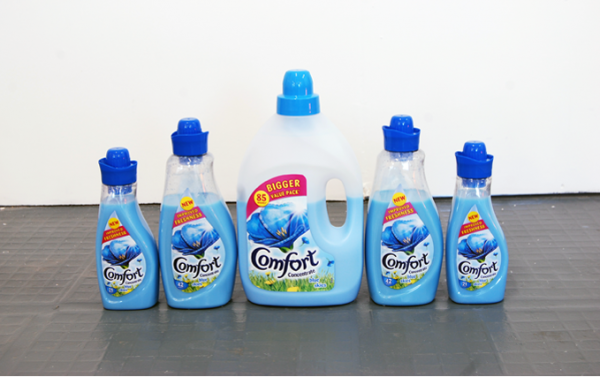
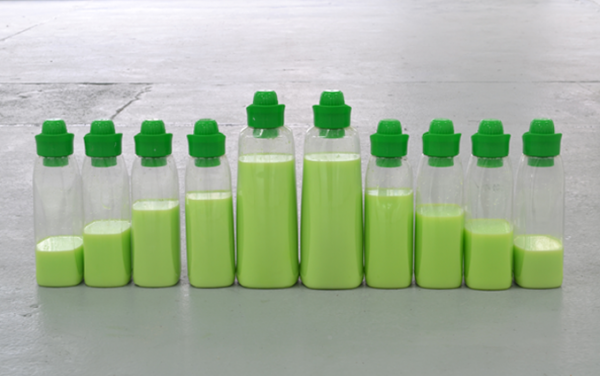
“The work of Russell Hill engaged in a playful and ironic way, with themes such as consumerism, mass merchandise and the throwaway society. He uses objects that we use every day and around us as if they belong to us. Hill arranged these items in an aesthetically pleasing manner, and they can work together.

Sun and deprived of their function in the presence of an unusual move everyday objects into new awareness and you sometimes questioned the purpose and benefit. Currently the artist is concerned with the effect of innovation on the object as art object. He examines, for example, as the choice of color and form of consumer objects to act as human as a buyer.” – IGNANT (Translated by Google Translate)

Bean Gilsdorf


Bean Gilsdorf

Work from her oeuvre.

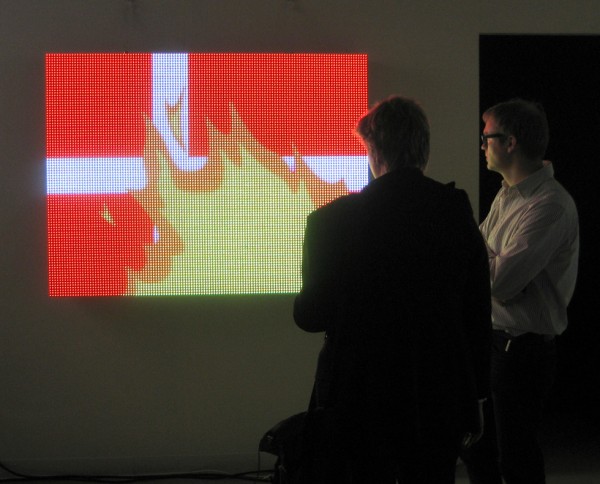
“My practice mines the ideology of images. I appropriate pictures of historical and cultural moments to make collages, flags, installations, and videos. By reshaping images from mass-market books and popular films, I explore the legacy of an archived, public narrative. Using popular and accessible images that transmit a codified and stereotyped view of American values, my work relies on recognition of the original form but establishes an unorthodox version. Translation of the source material from one medium to another creates a new and often re-gendered narrative, one that is modified by my own views and which supplies an account beyond the existing record.”- Bean Gilsdorf

Bernard Voïta

Bernard Voïta

Work from his oeuvre.

“…Over the past years Bernard Voïta has worked almost exclusively in the medium of photography, although the way he does so is often compared to sculpture. In his work he challenges the medium’s boundaries and its imputations and sounds out its potential as well as questions of perception. Out of simple found objects, Voïta constructs three-dimensional models in his atelier, which he, in a second step, records with his camera. His works do not picture an out-there reality, but an arranged-by-the-artist, complex sculptural design that finds culmination in its photographic depiction. Thus images arise that allude to modernist architecture and city landscapes, or to arrangements and patterns that border on abstraction.These, via the composition, utilize the medium’s own effects, such as depth of field and the loss of real dimensions. The perspectivally arranged objects together conform to one plane.Which objects and arrangements are represented behind the images is no longer discernible to the eyes of the beholder. It is in the photograph itself that a meaningful dimension of the installation first gets composed into something new…” – Gallery Bob Van Orsouw

Anselm Stalder

Anselm Stalder

Work from Vermutete Mitte (Supposed Center).

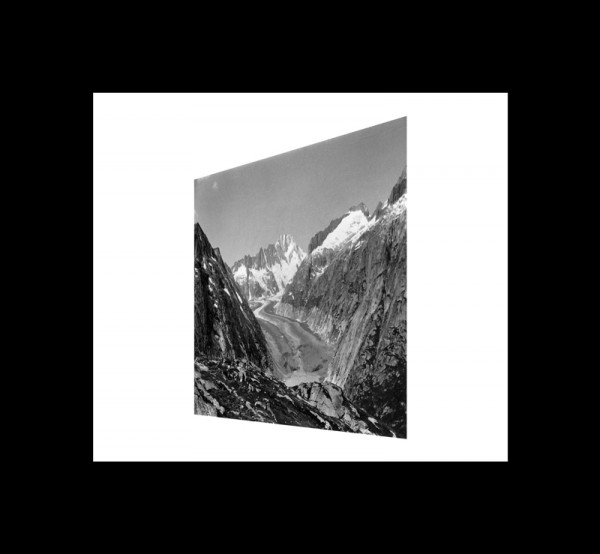
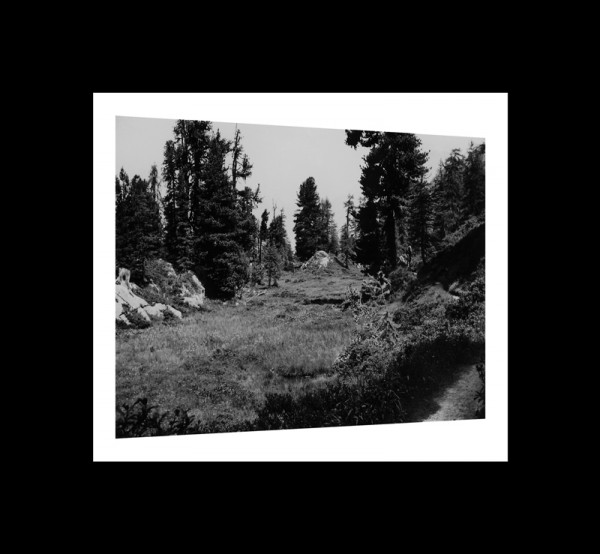
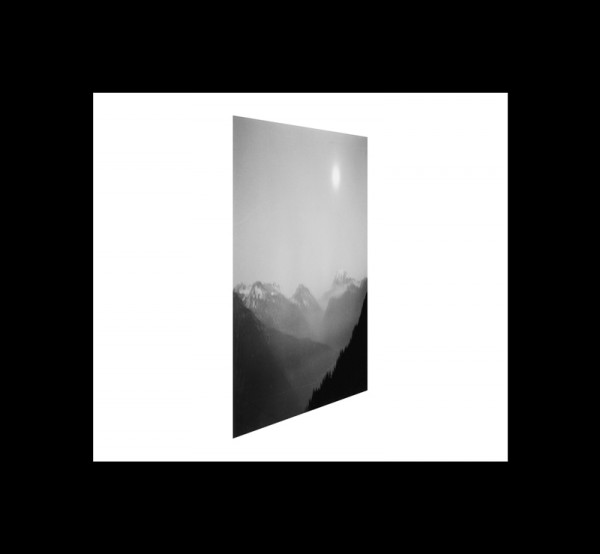
Mirrored in reflective glass, we see ourselves in front of Alpine landscapes from a time of black and white, back when craggy glaciers still filled the valleys and clefts of erosion hew openings into our view. “SEINEBILDER”, “his pictures”, reads the title. But whose, if not those by Anselm Stalder? Or has “he” already become another to himself; he whose art has taken definitive leave of the individual gesture through fractions and projections? In “SEINEBILDER”, the son of virtual image generations encounters his father’s analog photo archive. “He” is the father of the artist, who took these pictures during his hikes in the mountains. And “he” is the artist himself, who chose them, worked on them, and placed them within a new context. Regarding these photos, which are slanted and turned into the depth of the image, we realize that the indicated projection space could also be the space of our own perception. “His pictures” become our pictures.

“Glimmende Peripherie”, “smoldering periphery”, the Stalder exhibition currently taking place at Kunstmuseum Solothurn, constitutes a continuum of cuts and layering in all kinds of different media. The viewer’s gaze focuses on single points, especially when looking from above down onto images laid flat and presented horizontally. In Zurich, such a viewing table is also encountered, created by two diagonally joined rectangular panels and a desktop of reflecting dull aluminum. The drawing lying on top of this counter under a pane of glass can be read as a colorfully fractured antique floor mosaic. In “disegno topografico“, fragments of hands, a rope, and an open cardboard box whirl wildly about each other, as if we were regarding pieces of a puzzle that has lost the memory of its archetype. Five watercolors were in fact cut up and joined together anew.

“He” is also “Der Spiegelmann”, “the mirror man”. A man mirrored into himself, who searches with questing strokes orbiting his corporal symmetry for his own image in the looking-glass. “Vermutete Mitte”, “supposed center”, denotes the black hole of sensed possibilities to which art has eternally had the courage to gravitate. Always, “the mirror man” has developed his work along its edges. Anselm Stalder is a thinker of images in spaces. While the three-dimensional form of images creates a reflexive distance, the mediated motives stay enigmatic. It is probably because of this that they never let us go.” – Hans Rudolf Reust for Schau Ort
(translated from German)

Akihiko Miyoshi

Akihiko Miyoshi

Work from his oeuvre.

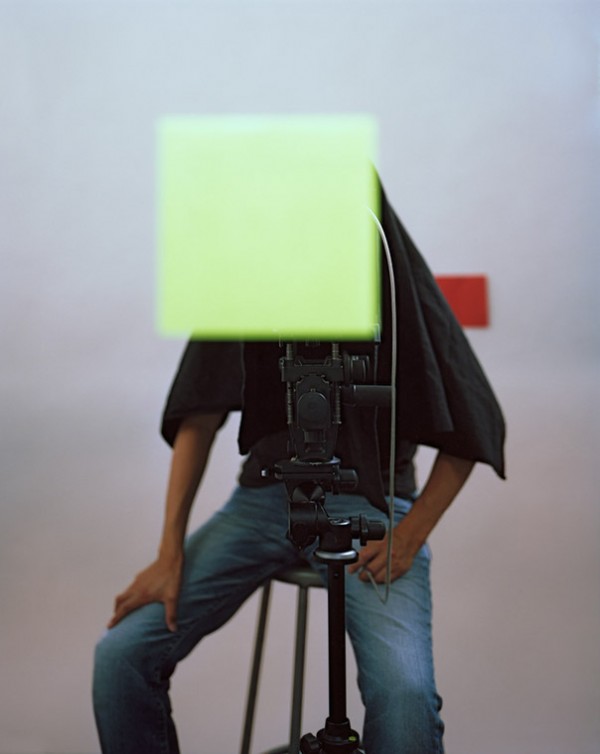
“Throughout my career I have been exploring the intersection between art and technology most frequently dealing with issues surrounding photographic representation. My works often reveal the conventions of perception and representation through tensions created by the use of computers and traditional photographic techniques.

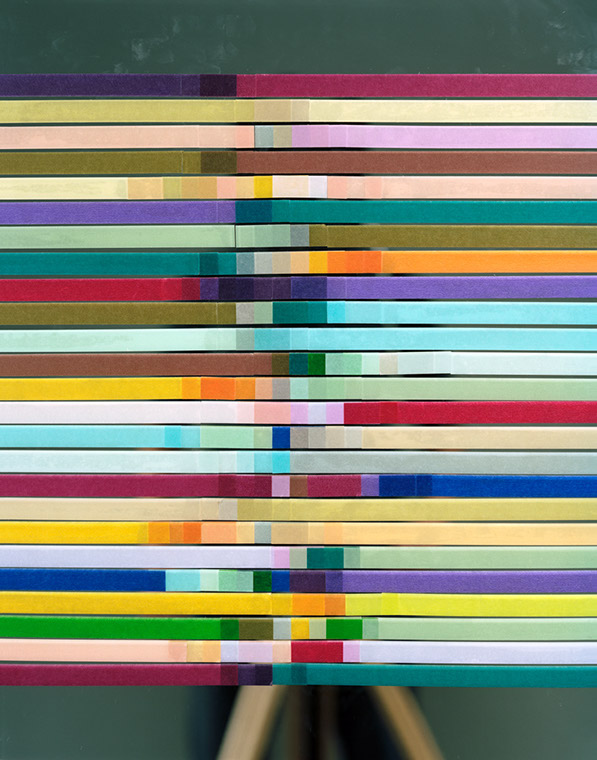
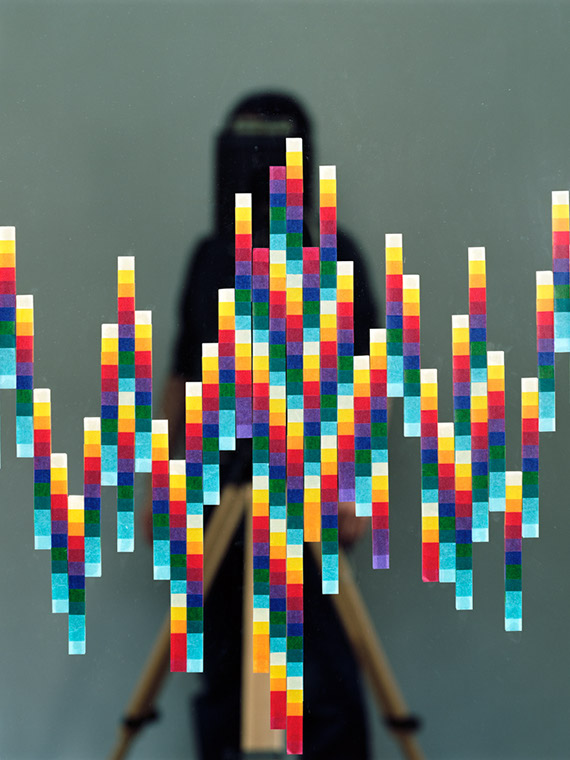
The photographs included here are of mirrors, paper, and tape taken with a large format camera as they attempt to unpack the structural mechanics of photographic representation by creating formally abstract pictures that are undeniably photographically real. While the images allude to abstraction the photographic nature of the images are emphasized as the image plane is selectively focused and blurred through the use of depth of field. The usually referencelessness nature of abstraction is contradicted by the presence of minute details captured by the use of a large format camera such as dust and scratch marks found on the surface of the mirror which makes the images very ‘real’ and photographic.

In other words these images have a duality (and tension) of being simultaneously abstract and extremely photographic.

Further, as with many of my other works the photographs also expresses my interest in the role of digital technology in photography and its aesthetic. The choice of red, green, and blue tape is based on the three primary colors that constitute a pixel. From a far the tapes can be seen as the pixels glowing on the computer screen. While they are made using primarily traditional photographic methods, they reference the new aesthetic that seems to be emerging as a result of the use of digital tools and technologies. The photographs always depict a silhouette of the hidden artist affirming the complex nature of authorship in the digital world.” – Akihiko Miyoshi

Superflex


Superflex

Work from their oeuvre.

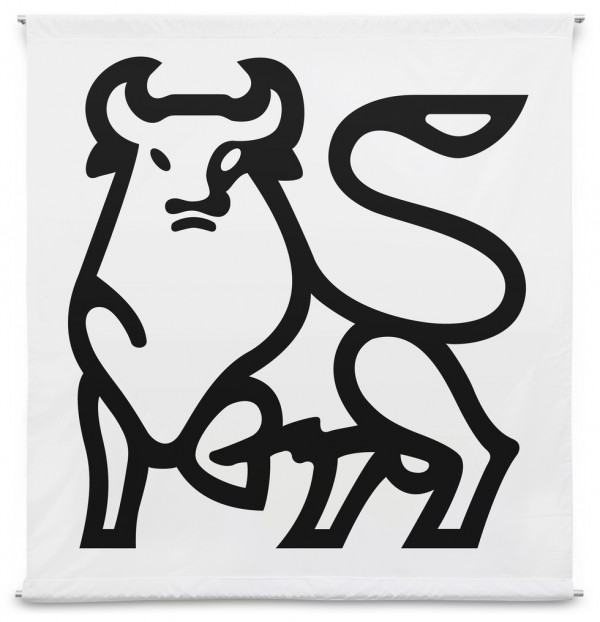
“Banks, of course, have rarely been so topical. Names like Northern Rock — the commercial bank that suffered a devastating run as the subprime mortgage crisis emerged in 2007 — and Bear Stearns — the investment bank that collapsed in 2008 — have been prominent in the news. Reportage and op-ed have repeatedly explained economic terms and banking practices that until recently were things I’d barely considered. Nothing in the Karangahape Road branch of the ANZ on the day of Today We Don’t Use The Word Dollars invoked the technicalities of the recent international financial turmoil directly, but they were evoked nonetheless. Simply through bringing the frame of contemporary art into the bank, SUPERFLEX drew special attention to the institution in general, for both staff and art audience.
The effects of SUPERFLEX’s specific intervention are known first and foremost by the ANZ branch’s employees. What is going on is all the less available to an onlooker for the fact that it is something not being done: A contract has been established between the artists and the bank that requires any staff member to pay one dollar to their social fund if she or he uses the word “dollar” during trading hours, 9:00am to 4:30pm today, Wednesday, May 27 2009. The deviation from routine is visually marked — by some crêpe paper streamers, balloons and the tellers’ matching sports shirts — but even this is hard to see from the outside, as it is only on their own initiative that the workers have repurposed these things from their usual significance, celebrating the ANZ’s sponsorship of a national netball competition. The signed contract that establishes the conditions for the day and the tally of forfeits are kept behind the scenes.
The agreeable-sounding “we” in the artwork’s title helps the rules of the temporary ban resemble a party game. To avoid a certain word, though, is often a serious business: to recognise a politics of language. Anti-racist, anticolonial and feminist movements have raised awareness of the significance of what and who gets referred to how in recent decades. Their efforts have shifted our diction, in a process of self-censorship now widely recognised by the pejorative term “political correctness”. For this reason, today’s scenario might suggest the possibility that “dollar” is a dirty word; the fine operating something like a swear jar.
“Dollar” — from Spanish and Dutch uses of the German Thaler — names many currencies including the New Zealand dollar, but is overwhelmingly associated with the United States and its history, and thus with American mythologies of wealth and success. To highlight it in this way points up connections and disconnections between the local here and the USA, that country’s influence on the world’s markets, and the global role of their currency’s aura of capitalist promise and power. It is clear that — along the lines of the possible politics of language — as a unit of value, the dollar has more than a literal weight. By sad coincidence the week before the work, for example, a young, upcoming Atlanta hip hop star had been shot and killed. His name, worn like verbal gold jewellery, was Dolla. On the Wall Street Journal blog ‘Real Time Economics’ (November 6, 2007), Kelly Evans picked up on another journalist, Mark Olson’s observation in The Minnesota Chaska Herald that — right at the beginning of the financial crisis — hip hop maven Jay-Z appeared especially sensitive to the shifting real and status-symbolic value of the US dollar. Seeing the newly released video for his single Blue Magic (featured in the movie American Gangster, starring Denzel Washington (and coincidentally New Zealand-born Russell Crowe)) Olson was quoted as lamenting:
It’s sad that rap stars can no longer show their style with a good old $500 bills (featuring President McKinley) and now need to flash 500 euros (featuring some sort of suspension bridge). I don’t need the chairman of the Federal Reserve to tell me about the state of our economy. I just need Jay-Z, the new Alan Greenspan. I don’t blame Jay-Z. A stack of $50,000 in euros would equal $72,000 in US currency. And you’d need 144 $500 bills to equal a stack of 100 500 euros. I don’t know if even Jay-Z has that large a money clip.
At the same time, hip hoppers joked that “euro” wouldn’t scan as well in lines like the refrain from the Wu Tang Clan’s biggest single, “dolla dolla bill y’all” (C.R.E.A.M., 1993). Despite the fact that there might be many reasons to question the cultural loading of the term “dollar”, the suggestion of irony in SUPERFLEX’s gesture of disciplining a bank’s use of such a central concept is never paid out. The sophistication of the work, perhaps, is that the agreement between the artists and the bank does not result in the sceptical artists having one over the uncritical institution. For one thing, the Branch Manager Lisa Burns can clearly account for the value of the undertaking in her own terms.
Apart from showing neighbourly goodwill to Emma Bugden, the Director of Artspace next door, who is facilitating the work, the break from routine offered some morale-building fun for her team, who also found it interesting to be made aware of what they take for granted in their own behaviour. Although she doesn’t resort to jargon, the undertaking contributes to total quality management.
Being in a bank where I don’t hold an account is slightly awkward. Security have been briefed, and are expecting those of us without obvious business here to drop by the scene of the artwork, but I am reminded nonetheless of waiting outside a queue once in California for my friend and host to make a withdrawal and the twitchiness of the conspicuously armed guard. Being here makes me aware that my sense of other banks comes largely from advertising, and — along with all the smiling couples unpacking boxes in new homes and laughing into cellphones — brings to mind a campaign by another New Zealand bank that made a show of replacing intangible banking clichés with concrete aspirations, another sign that for their own reasons banks are more than up for watching their words.
SUPERFLEX have been extremely formal, though, in establishing a legal contract, differentiating the experience from a training exercise or workshop. The instrument of the contract has a political history. Tracing the structural and cultural connections between capitalism and democracy, Ronald Glassman notes the defining features of trade-capitalism that are conducive to the establishment of democratic rule, including the establishment of contract law as a feature of business transactions, and the extension of it from business law to criminal and eventually constitutional law. 2
A variation on a month-long work, Contract, made with the Royal Danish Theatre in 2007, the work is emblematic of SUPERFLEX’s practice as intermediaries, operating as a business as well as artists, and creating value by circulating ideas and products both within the art system and in other contexts. Sometimes, in this series of contract works, value is created simply through such a translation. The work, then, ultimately gives us pause to consider value, how it is created and described, in art as much as in the world of finance. The artists emphasise in their statement their interest in real relations and concrete effects. In the terms of Brazilian artist Cildo Meireles, they have made an “insertion into an ideological circuit”.3


It is reminiscent of his defacement of actual legal tender, Insertions into Ideological Circuits 2:


Banknote Project, 1970, and perhaps more so his production of a nil currency, Zero Dollar, 1978—1984), that materialises precisely those things in a dollar that exceed its purchasing power. However, if the value of the dollar is unstable in so many ways —between credit and cash, say, between currencies, and between exchange value, cultural capital— the case of art is no less complex. SUPERFLEX’s artwork does nothing if not highlight the blur between real and symbolic effects. Alongside the Rolls Royce and the noteworthy wad of euros in in Jay-Z’s Blue Magic video appear Damien Hirst-like spin paintings and a recognisable recent Takashi Murakami painting, as illustration of the idea that, as Pharrel sings in the chorus, “I ain’t talkin’ about it, I’m livin’ it”.””  –Jon Bywater

Robert Canali

Robert Canali

Work from his oeuvre.

“Abstractions of refracted light, visible only “in dust”, emphasize the physical and chemical aspects of photography through the unique character of the negative. This work was inspired by phenomenons of light and rendered by means of large format photography. Comprised of both colour and black and white photographs, this body of work is an exercise in ‘seeing’ and photographic looking. Activated by its illusion, the black and white photograph in this series functions as an index from which to be referenced when considering the body of work. The crystal-like texture in this photograph reads as ‘something’, yet describes nothing but its subject ― illumination. These same devises exist in the colour photographs, however, the texture of the black and white photo is replaced by soft pastel hues that at once can reference the cosmic, the psychedelic, and the nostalgic. While they do invoke planets, sunsets, and even hard-edge painting, these semi-representational large-scale reproductions of the effects of light serve as opportunity to experience this spectrum in a way that can only be achieved through a series of lenses and mirrors.” – Circuit Gallery

Walead Beshty

Walead Beshty

Work from his oeuvre.

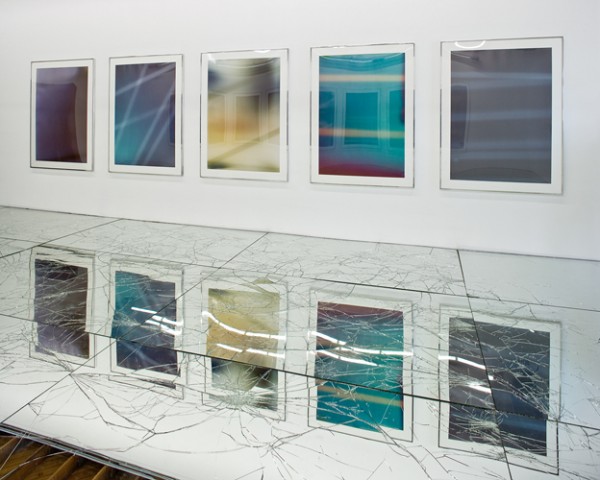
“With both a sharp and laconic aesthetic sensibility
Beshty creates a photography of uncertainty

Cutting across several media, including photograms
a representative example of the range of Beshty’s program

Clever if somewhat vague referents
presented as a subtly posed but effective arguments

Beshty inserts himself into the historical flow
But beware of the theoretical undertow

Photographs are created with very clear prescriptions
read as luminous abstract compositions

But have a roughed up texture that says all you need to know
One can make much, perhaps too much, of Walead Beshty’s show

Beshty has included within the exhibition
an assistant who toils like an art-world Rumpelstiltskin

This piece by Walead Beshty is briefly amusing
An accident that suggested the idea of deliberately using

A revised concept of site specificity, now proposed as a function
Investigating systems of dispersal and production

Whatever Marxist schadenfreude might be gleaned from black-and-white
Effectively reclaims the found object as a multivalent political site

Of the show’s relaxed attitude toward lines of demarcation
which, sexy as it sounded, felt like little more than rhetorical lubrication

Among the most special is Walead Beshty’s photo-slide meditation
Here flashy surface need not come at the cost of art historical, conceptual, and
socio-political elaboration.” – text via WALLSPACE