Friday, 16 March 2012
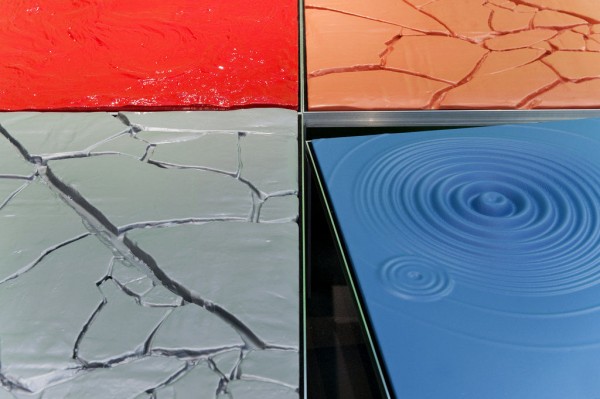
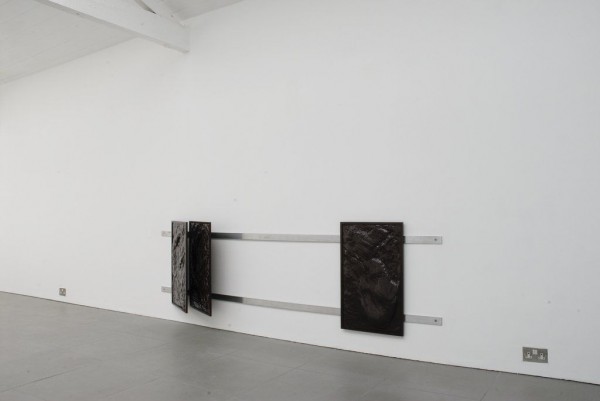
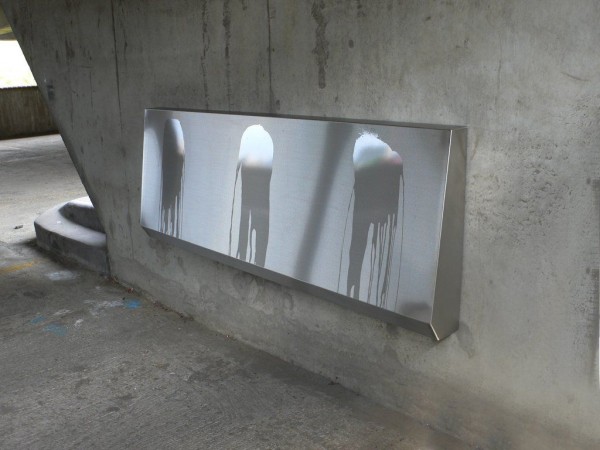
Nicolas Deshayes
Work from his oeuvre.
“Nicolas Deshayes’ sculptural installations use materials such as stainless steel and PVC to embrace the glossy aesthetics of 21st century design. Despite such fascinations, his works maintain a human presence in the forms of glutinously rich, bodily allusions, which engage with materials in ways that distort the ordinary. Deshayes states, “I create hybrid sculptures that gather multiple familiar cultural and stylistic references in a way that leads to a strange sense of hyper-materiality.””- Jonathan Viner Gallery
Tags: glossy, neo-materialism, sculpture
Posted in Uncategorized | Comments Off on Nicolas Deshayes
Thursday, 15 March 2012
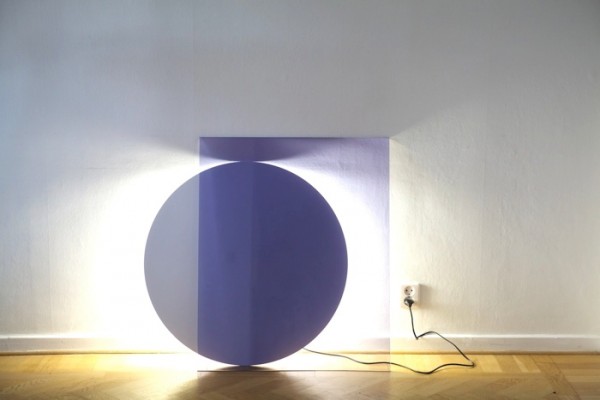
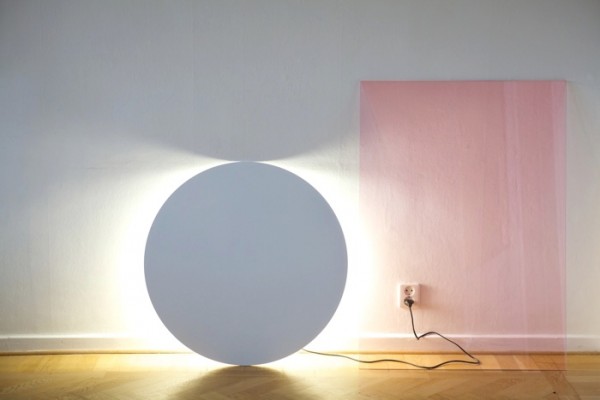

Daniel Rybakken and Andreas Engesvik
Work from Colour.
“Using sheets of coloured glass placed freely in front of a light source, Colour invites the user to mix various hues. I was also intrigued here by the exploded concept of a lamp, formed not only of multiple components, but by multiple objects too.” – Daniel Rybakken
via Zero 1.
Tags: collaboration, color, glass, interactive, norwegian
Posted in Uncategorized | Comments Off on Daniel Rybakken and Andreas Engesvik
Wednesday, 14 March 2012


Harm van den Dorpel
Work from About at Wilkinson Gallery
“…He is not aware that a gallery system exists. All his work exists in the virtual sphere, which to him is more real than the reality we all supposedly inhabit in the day-to-day. That was then. Even now, it doesn’t matter to him so much which of his works are realized, in the physical, and which remain virtual. Both, to him, are objects, completed works. They are just said in different ways, enunciated using two separate. Even language has its defaults. “Destabilized in Photoshop.” The eventual necessity to enter the gallery system, infiltrate the physical with his virtual systems, is read as a sort of betrayal by those adherents of his early efforts. In doing so, their misunderstanding of his intentions is revealed. For him, the virtual never a critique or evasion of the actual. Virtual and actual were always one and the same. Just as mind is but an extension of body. The work is always about process, no matter the form it takes. (By necessity, the forms must shift constantly. This is one of the rules of the system. As such, it is also broken; hence, the emergence of interrelations, series.) Conjure a body-mind machine, mattering itself into objects. The art object is a thing that is permitted to simultaneously be something else. Many things at once, that thing. Can we keep track of it, its vehicular motions, through our established. Should we allow those categories some slippage. Perhaps apply some slippage: lube them up, recognize their mutability, their indifference to our yearnings for stabilized meaning…” – excerpt from “Revenge of the Spheres” by Travis Jeppesen for Wilkinson Gallery
Tags: dutch, internet aware, sculpture, spheres
Posted in Uncategorized | Comments Off on Harm van den Dorpel
Tuesday, 13 March 2012


Carlo Bernardini
Work from his oeuvre.
“Paper is simply paper as long as it is white, but once you draw on it, it becomes ‘a drawing’. A design in light is a mental drawing that uses dark space.
Fibre optic drawings are in harmony with the place itself, the light creating an interrelation by overcoming the physical walls and transforming the environment in a deceptive way, pushing it to the limits of an illusionary dimension. An imaginary drawing, executed with the light of optical fibre, can go beyond the walls, where the wholeness can only be reconstructed as a puzzle in the viewer’s mind. The installation takes over the space and incorporates it.
Spatial forms develop a challenging relationship within the space as the optical fibre line passes from room to room piercing the walls and the floors, combining the external environment with the internal one: ‘Permeable space’, the place where light generates space.” – Carlo Bernardini
via Triangulation Blog
Tags: awesome, fiber optic, installation, lasers, light, magic, rad, triangulation
Posted in Uncategorized | Comments Off on Carlo Bernardini
Monday, 12 March 2012


Samson Young
Work from Signal Path II: Sinister Resonance.
“Signal Path II: Sinister Resonance is a site-specific sound installation. I meditated at various locations within/around/outside of the installation site while wearing a sensor that turns my brainwaves into sound. Sensors monitor eight sets of electroencephalographic signals while I attempt to focus my attention. Each signal generates one sinetone or squarewave. Each tone occupies a specific frequency range. When attention level is above a certain threshold, tones will be redistributed to approximate the harmonic series, producing a “fat,” “harmonious” sound field. Paradoxically, as soon as I became aware of the alignment of tones, I am distracted. This constant focus-distraction constitutes a perpetual signal feedback loop that “short-circuits” the sense of hearing. The sound of my meditation was recorded and played back via small media players, which were installed at the same spots where I meditated. I invite listeners to stand at the same spot where I meditated and listen to the continuous drones that were generated by my brain activities, while watching a video of my full shot from the back. Like the listeners, in the video I am shown standing still, listening.” – Samson Young
Tags: brainwaves, eeg, meditated, site-specific, sound
Posted in Uncategorized | Comments Off on Samson Young
Sunday, 11 March 2012
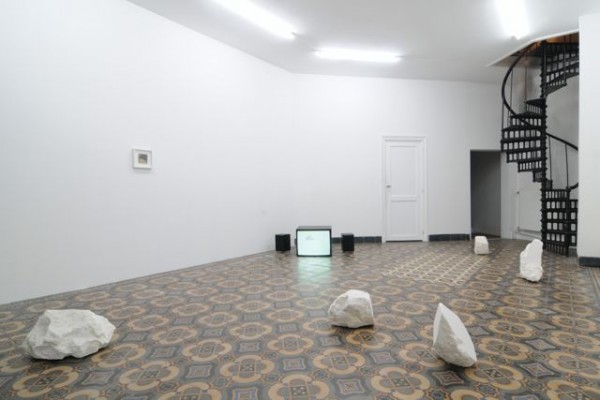


Jesse Ash
Work from The Sculptor’s Nightmare.
“…The ‘somewhere else’ you describe, could be thought of materially. I mean there are rules when you use a material like chalk, or editing software like Final Cut Pro and essentially you’re doing the same thing. Cutting away, re-modeling. And these rules and structures then impose their own restrictions to the content that may be taken from the ‘big outside’. In a sense, by materializing this information, I exert another filtering mechanism which abstracts it, and this abstraction is caused and affected by the processes which allow me—the author, but also just an individual in the world trying to closer to the already abstracted rhetoric of politics. It’s a document of proximity in a way.
…I use the context of the gallery space very particularly to stimulate tools that the audience already holds and that are necessary to uncover elements of the work—Scrutiny for example, and… as you say… time (although these are very much related). But also, I play with the sequential experience of works that might relate to each other. These could be seen as acts in a play or chapters in a book or something like that (to continue the use of heavy handed metaphors). Also, a viewer is often alone, and they have a shifting spatial relation to objects and images—i.e. as the feet move a sculpture changes shape, its image flipping from three dimensions to the effect of two—depending on the visual plane the spectator shares with the object. And while this is happening, the image on the wall becomes clearer, sharper as your proximity to it shifts. And then, the object is up close by the feet and you can look over it like a giant and simultaneously you can begin to see the construction of the image over there and the space within the image is opening up and out, so then we begin to have this very particular spatial, dimensional and temporal context with in which to show something to some one. A process of uncovering, which I think, resembles how we access the events, speeches, politics, conflicts that shape the world around us…
…The concept is made in a similar way to the chalk sculptures I’m working on now. An idea is a starting point where many questions are imposed upon it over a period of time… each question imposed on an idea is a test, and each test has an imagined outcome, which may work or fail as a result of that conceptual test. Like chipping away at something (this happens when anything continues to occupy the mind, I suppose). The ‘mental sculpture’ continues until there is a material starting point—when there is somewhere or something to start with. This might be an image for example, or a technique to impose upon a material, a sound to overlay with a colour or a model to be made. At this point the hand joins in. Both the mind and the hand impose new possibilities and problems upon each other and the variables and possibilities can often increase. This is the point when the work comes alive for me—when the hand, mind and material are working in relation to one another and something unpredictable is happening which I am beginning to loose control of despite my best efforts. I’m catching up, or running after the work…” – Jesse Ash
Tags: action, change, defense, material, new media, object
Posted in Uncategorized | Comments Off on Jesse Ash
Sunday, 11 March 2012


Viktoria Binschtok
Work from her oeuvre.
“In her image cycles Viktoria Binschtok traces the paradoxes of daily life – sometimes she observes the accumulation of the trade mark LVNY in our urban street setting, sometimes she reveals the traces of an ever increasing need based community at the job center or points to the separation of humans within our communication society. Her scope of precisely set visual means reaches from intensification and concentration of street scenes up to almost painting-like abstraction in ‘Die Abwesenheit der Antragsteller’. Thus, her photographs always refer beyond of what is in effect depicted.” – Klemm’s
Tags: crop, fragment, german, photograph, photograph as object, refresh
Posted in Uncategorized | Comments Off on Viktoria Binschtok
Friday, 9 March 2012

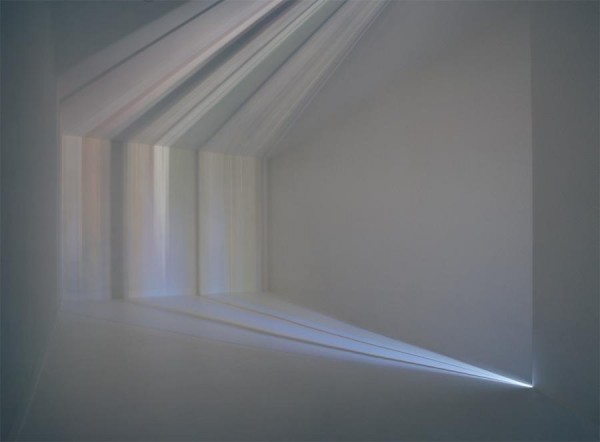


Chris Fraser
Work from his oeuvre.
“My light installations use the ‘camera obscura’ as a point of departure. They are immersive optical environments, idealized spaces with discreet openings. In translating the outside world into moving fields of light and color, the projections make an argument for unfixed notion of sight.” – Chris Fraser.
via Triangulation Blog.
Tags: installation, light, optics, sculpture
Posted in Uncategorized | Comments Off on Chris Fraser
Thursday, 8 March 2012


Matthias Ballestrem and Anton Burdakov
Work from Built on Promises.
“The promise of the photograph is the experience of the represented. But it goes beyond that; Through our eyes, images point past their ability to represent reality. Often exceeding the objects they capture in ability to hold our attention, photographs become the object of desire. Henry Cartier-Bresson ascribed his epiphany that turned him to photography to a single picture. “When I saw Munkacsi’s photograph of the black kids running in a wave I couldn’t believe such a thing could be caught with the camera. I said ‘damn it,’ I took my camera and went out into the street.” Cartier-Bresson didn’t go in search of experience. He went in search of images.
Built on Promises, the first collaborative project between architect Matthias Ballestrem and artist Anton Burdakov, seeks to question the intimate relationship between experience and image. How does the world of the sensible transmute into the second dimension? Spatial perception and the imagination this gives rise to are questioned in a series of photographic installations developed in and for PROGRAM’s exhibition space. As visitors move about in the exhibition, so too will their frames of perception shift. What exists, what had existed and what might exist become blurred and challenged.” – Program
Tags: architecture, berlin, collaboration, installation, photography
Posted in Uncategorized | Comments Off on Matthias Ballestrem and Anton Burdakov
Wednesday, 7 March 2012


Alexandros Tsolakis, Bastian Wibranek and Sebastian Kriegsmann
Documentation of “Disconnect“.
“Disconnect, a full-scale installation by Alexandros Tsolakis, Bastian Wibranek and Sebastian Kriegsmann, starts from a simple proposition: more often than not, public space is communally occupied. Despite the immutable forms of architecture, space transforms the moment it’s inhabited; what we do, and what we don’t is spatially inscribed by the simple fact of our engagement. By installing a stretchable membrane across the gallery floor, Disconnect allows visitors to physically register the movements of their co-habitants. As people move over and under the surface, the fabric’s stretch manifests the influence of other bodies as a sensible force. Projected beams of light mark contour lines on the fabric as shifts with movement. Continuing a line of projects initiated by PROGRAM that aim to instill spatial sensitivity, Disconnect similarly seeks to address a wider range of visitors, including the youngest ones.” – Program Initiative for Art and Architecture Collaborations
Tags: architecture, installation, interactive, performance
Posted in Uncategorized | Comments Off on Disconnect