Natasha Caruana

Natasha Caruana

Work from The Married Man.

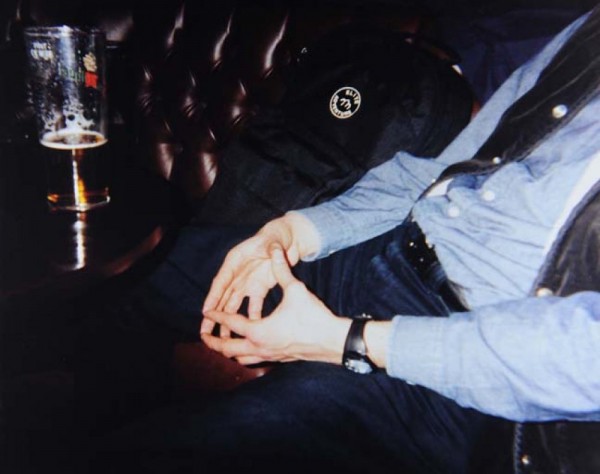
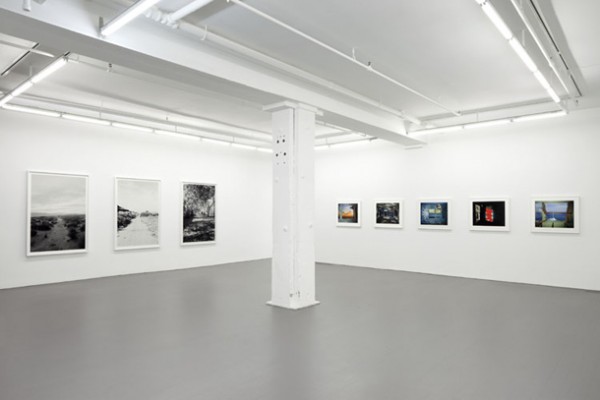
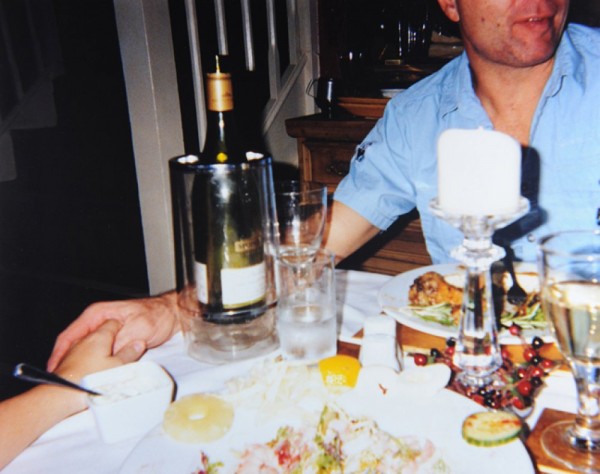
“Natasha Caruana’s series of photographs, ‘Married Man’ documents occasions when the artist arranged ‘dates’ through dating websites designed for married men to conduct affairs. She photographed each man, concealing their identity, but also recorded them secretly using a digital recorder hidden in a red purse seen in several of the pictures. Caruana asks why the ‘dates’ are willing to put their legally binding relationships at risk, as well as what an artist’s ethical responsibilities should be.

Like Phil Collins, Caruana’s work also asks what the ethics and politics of a ‘documentary’ mode of working are assumed to be. ‘Married Man’ might be thought of as almost a thematic negative of Cindy Sherman’s work: the desiring male subjects’ expectations and fantasies of womanhood are exposed, rather than the range of roles which women are asked to adopt.

The artist asks us to behave like a detective when looking at each photograph, searching for clues about the situations. In one, a man pays for a meal in cash- so that no evidence is left for his wife to discover, an old battered table in a tired pub suggests the ‘date’ has little concept of romance. In a third, which looks like a domestic setting, 1970’s style pineapple rings adorn the artist’s plate of food. The photographs were taken on a cheap disposable camera rather than professional equipment, so all the images are intentionally grainy and loosely composed, but each has been carefully printed by hand.” – Alistair Robinson, Curator. The Northern Gallery for Contemporary Art

Carrick Bell


Carrick Bell

Work from his oeuvre – specifically Get to the Chopper, Furniture for a New Community and Backwards, With no Mistakes.

“My video work negotiates between narrative and abstraction in depictions of human interactions with natural landscapes. I use appropriated video to investigate nature as a site for man-on-man violence, as a site for abandonment (of self, social constraint, good taste, futures, etc) and as a site for the production of political narrative. Using scenes from everything to trashy B-movies and viral videos to Hollywood blockbusters and disaster footage, I extract micro-narratives from existing cinematic, art historical, and pop cultural representation of the relationship between subject, landscape, and sovereign power. I have lately started to focus on the means by which I have always accessed my found footage, namely the Internet. Maintaining my focus on representations of disasters (both social and natural) within nature, I am interested in investigating the rhetorical overlap between Nature and the Internet (to whit, ideas of the internet as a ‘digital commons,’ and as a space for the experience of radical democracy outside the constraints of actually-existing democracy). The rhetoric surrounding the internet has, since it’s inception, reinvigorated the stale language of nature as a locus of unimpeded freedom, a medium through which subjects can escape their status as citizens and bodies, toward decidedly uncertain ends. Whether the internet is a technological development on track to cure all that ails us, or simply a territory so unchecked it functions as an outlaw-ridden frontier state, the language surrounding the Internet is inextricably linked to a dated, Manichean determination of nature as a stage for both the sublime and inhuman.

From horror movies set in foreboding landscapes, to documents of the aftermath of natural disaster, social conflicts continue to be mapped onto, and made legible by, landscape. The relationship between citizens and landscape is fleshed out in the specificities of narrative, particularly in narratives of vengeance, war, and solitude—extreme reactions of the individual to the social bond. The state of nature as an ever present threat to the human bond can no longer be understood as Nature itself; instead, being left to a state of nature (left to suffer natural disaster, the destruction of one’s land, being left stateless and paperless, etc) is a pre¬eminently political, and human, threat. It is the threat that, having been left to the disaster of nature, you will not be brought back from it. I work to make the links between narrative, natural landscape, and political power simultaneously transparent, seductive, and ultimately dysfunctional.” – Carrick Bell

via Culturehall

Adam Broomberg & Oliver Chanarin

Adam Broomberg & Oliver Chanarin

Work from People in Trouble.

“People in trouble laughing pushed to the ground. Soldiers leaning, pointing, reaching. Woman sweeping. Balloons escaping. Coffin descending. Boys standing. Grieving. Chair balancing. Children smoking. Embracing. Creatures barking. Cars burning. Helicopters hovering. Faces. Human figures. Shapes. Birds. Structures left standing and falling…

The Belfast Exposed Archive occupies a small room on the first floor at 23 Donegal Street and contains over 14,000 black-and-white contact sheets, documenting the Troubles in Northern Ireland. These are photographs taken by professional photo-journalists and ‘civilian’ photographers, chronicling protests, funerals and acts of terrorism as well as the more ordinary stuff of life: drinking tea; kissing girls; watching trains.

Belfast Exposed was founded in 1983 as a response to concern over the careful control of images depicting British military activity during the Troubles. Whenever an image in this archive was chosen, approved or selected, a blue, red or yellow dot was placed on the surface of the contact sheet as a marker. The position of the dots provided us with a code; a set of instructions for how to frame the photographs in this book. Each of the circular photographs shown on the previous pages reveals the area beneath these circular stickers; the part of each image that has been obscured from view the moment it was selected. Each of these fragments – composed by the random gesture of the archivist – offers up a self-contained universe all of its own; a small moment of desire or frustration or thwarted communication that is re-animated here after many years in darkness.

The marks on the surface of the contact strips – across the image itself – allude to the presence of many visitors. These include successive archivists, who have ordered, catalogued and re-catalogued this jumble of images. For many years the archive was also made available to members of the public, and sometimes they would deface their own image with a marker pen, ink or scissors. So, in addition to the marks made by generations of archivists, photo editors, legal aides and activists, the traces of these very personal obliterations are also visible. They are the gestures of those who wished to remain anonymous.

We would like to acknowledge and thank the original photographers Mervyn Smith, Sean Mc Kernan, Gerry Casey, Seamus Loughran and all other contributing photographers to Belfast Exposed’s archive.” – Nik Aikens for Frieze.

via Raw Function

Angelo Plessas

Angelo Plessas

Work from his oeuvre. Specifically: http://1minuterevolution.com/, http://www.plagueoffantasy.com/, http://onceinathousandyears.com/, and http://www.electricitycomesfromanotherplanet.com/.

Plesas has an opening at The Future Gallery in Berlin on Wednesday. Check it out.

“The last time I went to New York my hotel window was facing the Hudson. It would have been an amazing sight if, far away, off to the right bank, standing on its little Island, the Statue of Liberty wouldn’t have been there. There it was with its ghostly presence – nothing to do with its innocuous tourist reproductions. Luckily a dense mist fell on the river. Otherwise I would have closed the curtains. The statue is almost an unbearable sight for me, especially due to its movie depictions, such as the final one in the Planet of the Apes (1968) where the humans find the iconic monument’s head and other fragments on a beach, all signs of a self destructive, extinct civilization. The same symbolism is the Statue of Liberty’s broken head which appears on the poster of another cult science fiction movie 1997 Escape from New York (1981). The image of a broken monument is one of the strongest dystopic images existing, especially the anthropomorphic one. A monument, for better or for worse, embodies a collective ideal and utopian imagery. Sequences of the destruction of Saddam Hussein’s statues, as well as Ceausescu’s, just to name a couple of a long series, gave us testimony of a sudden power change, as well as a different self-representation of a society. Luckily, we don’t have to free ourselves from such an oppressive power (and it seems we are far away, but not far enough, from self-destruction) and we nourish a double feeling towards urban monuments, and their traditional embodiment of shared values both political and aesthetic. We are hyper-individualists and it is hardly possible for us to find unanimous agreement under a monuments shadow. Paradoxically, there’s a unifying moment where we debate on public art. They are ugly and/or questionable (therefore removable) even if they are signed by prestigious names. For example, lets refer to the monument to Pertini by Aldo Rossi and, most recently, L.O.V.E. by Maurizio Cattelan. Both monuments are installed in Milan, and both, quite remarkably, are in transit. The first one, after twenty two years of disputed presence close to Via Manzoni, is about to be moved, with not yet a specific destination, most likely to make space to a commercial activity. And only now, while a loose red and white tape surrounds its huge cubical frame, many people are fighting for it. The second one – intentionally controversial – should have been left in the middle of Piazza Affari from where it mocked the ambiguous exchange only for a month (i.e. until last October 24th). But it is still there while I write these thoughts, waiting to be assigned its final destination; while the artist, who is corroborated by Internet polls, wants to donate it to the city, only if it could stay in that very Piazza. Public art is a hot topic. It is also a thorny issue because of its intrinsic public nature: as a matter of fact, it’s one thing to look for art in galleries and museums (where it’s customary to discuss around the concept of anti-monumentality, or more precisely, a-monumentality, which is a quite vague notion attempting to represent our present time and its multidirectional desires), quite another to bump into art while walking on a public street. But they are somehow stimulating. They help us to understand that in our consumerist and perpetual present – where the preservation of memory and the planning of the future are both reduced to goods or marketing strategies- we still long for public art work that represents the society that produces and exhibits them. Amongst such projects experimented with in the last few years, there are two revealing trends. The first one is related to the transitory nature of the are, such as the Fourth Plinth at Trafalgar Square in London: a long time empty plinth is now adorned with works commissioned to famous artists in rotation. This is a Solomonic choice which makes temporariness an effective trigger for/of public debate. The other trend is related to virtuality, which is masterly investigated by artist Angelo Plessas. After a dip dive in the Internet, which represents for Angelo a “real” environment such as a gallery (with the advantage of a disproportioned visibility), the artist presents a physical and tangible translation of some of his websites that have been realized in the last ten years; diverse works that we could define as poetic interactive animations, embellished with titles that emphasize the deep humanistic intention of the project. Each of those websites is already a monument, in the most contemporary sense, because it is a work of art that stands in a new public field, the Internet, without imposing meanings from above, but actually proposing itself as a recipient of diverse stances, even opposite ones. In order to make his reasoning even more layered, playing with the ambiguity between reality and virtuality, (which is nowadays typical of the life of millions of people, who not only shop online but also establish diverse relationships through the web), Angelo has created these “offline monuments”:MeLookingAtYou.com, DoubleFaced.com, ZigZagPhilosophy.com taken directly from the websites, becoming urban and three-dimensional. They are participatory and playful sculptures, as the “originals” from which they are derived. They are to be installed in the streets of Milan, in places that have been coherently chosen with Google Street View. The “offline monuments” are projects that have two levels of users (local and global) and usage (real and virtual) that often get interconnected and generate interesting questions on the nature of contemporary monument. Muddling it up even more, Angelo Plessas increases the exhibition structure with some signs that “advertise” the actual realization of those monuments, works of art where real and illusionary elements synchronize to form a new aesthetic dimension. Moreover, the only real monument physically present in the exhibition, “The Monument to An Online Persona”, is two-dimensional like an online icon. Plesas describes this as such: «I borrowed the “face” of this imaginary person I call Leo Sky which I devised as a board member of the Angelo Foundation – my imaginary foundation.  The star “represents” that everybody with the internet now can become famous and a star. For example you create an interesting blog and you become famous in the most convenient way even if you are in the most remote place in the world. There are more connotations in this monument like the crown/mouth can be seen as the  “www”, and that can be seen as representing the internet way of doing things which makes everybody a “king” of his castle. I also chose this because a star is the national symbol of Italy». Has Angelo realized that his star shaped Leo resembles the silhouette of the Statue of Liberty’s head? I really believe so, as he declares to be interested in exploring a new genre of monumentality, where the classic notions of time and space are questioned.” – Caroline Corbetta

Zachary Davis


Zachary Davis

Work from Tropical Depression.

Zachary has an opening Friday @ extra extra in Philadelphia, extra extra shows solid work, check it out.

“A low pressure system. The artists, as my friend Andre St. James says, “Keep it on simmer.” I don’t know how much consideration went into titling Tropical Depression, the current group exhibition at New American Art Union (922 SE Ankeny) by the Appendix Collective, but bearing Andre’s words in mind, it’s apt. The Appendix artists—Maggie Casey, Zachary Davis, Josh Pavlacky, Benjamin Young—like a tropical depression, have a low-key way of making weather happen.

Like a force of nature.

…which is what the works in Tropical Depression address: earth, water, sky…and man’s forays into the great out of doors. These are works of modest scale in a mix of media that ranges from the common to the oddball (agar agar, anyone?) that are individually strong and collectively if not hurricane force, then close. The works inform and comment on one another, complete or contradict one another in intriguing and rewarding ways…” – ultrapdx

Sonja Vordermaier


Sonja Vordermaier

Work from her oeuvre.

“Sonja Vordermaier’s sculptures and installations are “conditional forms” a clash of opposites, are attempts to explore, the tension force, resistance and irritation potential.Conditions in space are reversed. A shadow takes on three-dimensional shape, is able to float heavy, man-made materials grow by natural principles.” – Stephanie Müller

John Divola

John Divola

Work from the exhibition Trees for the Forest.

““The works on view span the last four decades, and provide an expansive yet necessarily incomplete picture of John Divola’s practice – a canny yet understated  blend of documentary photography, conceptual art, performance and installation. The collection of works begins in 1971 with Divola’s images of women watering their lawns in the San Fernando Valley, and includes his landmark Vandalism and Zuma series from the same decade. While the San Fernando Valley work assumes a more deadpan, observational approach to image making, Divola’s Vandalism and Zuma Series invoke a theatrical tension that blurs the lines between authorship and documentation, sharing “a tradition with artists such as Bruce Nauman, whose photographs are considered to be performance or sculpture, and Robert Smithson, who used photography to investigate the built environment.”1 In these images, vacant, vandalized sites become the stage for Divola’s own observation, documentation, and artistic interventions: walls are spray painted, found piles of detritus become sculptures, and the site itself is a work in situ.

The sway between a structured, observational approach to image making and the free-form, improvisational gestures of his interventions is very much at the crux of Divola’s practice and can be traced from his earliest foundational work of the 1970’s to more recent bodies of work such as Dogs Chasing My Car in the Desert (1996-2001), where Divola documents the dogs that chased his car while working in the Southern California desert; As Far as I Could Get (1996/1997), where Divola sets up a camera and runs away from it during a given exposure; and Dark Star (2008), where his melding of intervention and observation continues to be in the foreground in large-format, color work made during the last decade.” – Wallspace Gallery

via Zero 1

Ricardo Cases


Ricardo Cases

Work from Paloma Al Aire.

You can buy the book here.

“Ricardo Cases’ third photobook deals with an unusual subject: the practice of pigeon racing in the Spanish regions of Valencia and Murcia, a game consisting of releasing one female pigeon and dozens of male pigeons that chase her trying to get her attention. None of them ever gets too intimate, but the winner is the one that spends the most time close to her. The winner is not the most athletic, the toughest or the purest in breed but the more courteous, the one showing more constancy and having the strongest reproductive instinct. The macho.

Raising a male champion entails prestige and profits. Painted in a combination of primary colours, like a flag or a soccer kit, the male pigeon raised and trained to mate becomes a projection of the pigeon-keeper, who embodies its sportive, economic and sexual success or failure in the community. Far from the harsh reality of his daily life, the colombaire has a second life where he can get to the top. He just needs a champion pigeon. The pigeon-keeper stays on the ground, while his projection is able to fly.
The present series examines the game as a symbolic act, a projection and a way of relating to the world. A group of men running through the countryside behind their male pigeons, observing their mating performances, discussing the rules and arbitrations… It refers to the ethnographic documentation of remote tribes rituals or to the group of children who invent a game while discovering the world.” – Dalpine Publishing
via Conscientious

Matt Hilger

Matt Hilger

Work from his oeuvre.

“the statement (above) like the work is meant to clumsily with what it is and what is isn’t and what can be built by those productive communications, most notably at a level with how a this ‘otherthing’ translates the ‘thing’ it index’s. Taking place with in a practice that continually finds itself being made than making itself before hand, so the level of accumulation in a wry sense of documentation that strips on the surface.

Im Interested in following a logic that loses the logic it started with, or something that tries too hard at being honest about its self that it faults itself, or more shortly the absurd thats inactive, or latent within the thing.” – Matt Hilger

Jana Papenbroock

Jana Papenbrook

Work from My Mystical Self.

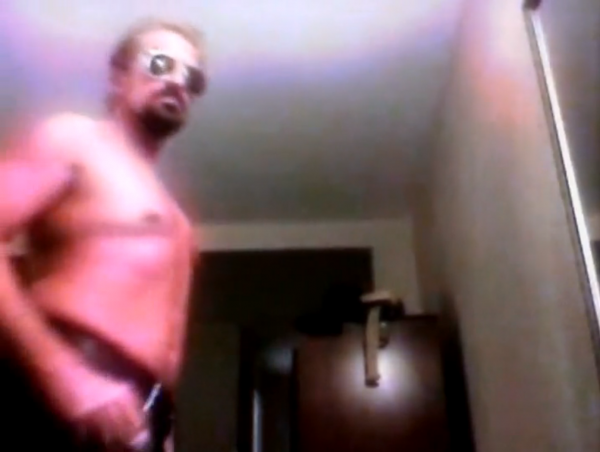
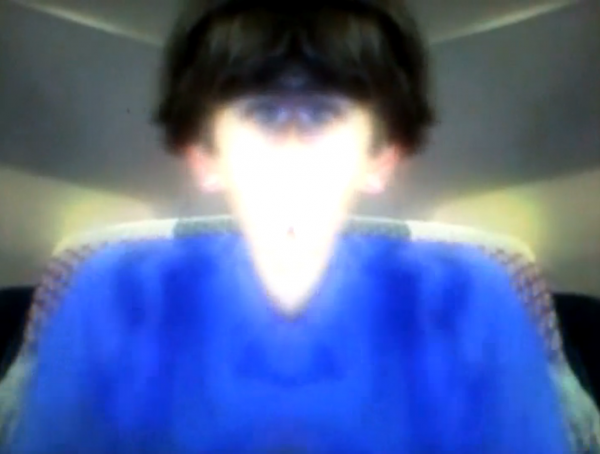
“My Mystical Self is a found footage video installation consisting of digital self-portraits. The omnipresence of self-monitoring, social performance and staged soliloquy illustrates the internalized public prospect, which is represented by the camera’s eye. In a confessional manner, the private body is inspected, measured, commented on and exhibited to the eyes of an anonymous audience.

The gaze on the self is deflected by the camera and mirror so that eventually the subject looks itself in the eyes as a stranger to itself, like in a schizoid soliloquy.

This narcissistic autism becomes particularly evident in the image of the subject kissing it’s own reflection. Sexual attraction is less and less correlated to the other and evermore directed to a reproduced image of an idealised and disowned self..” – Jana Papenbroock

via Rhizome Art Base.