Tuesday, 1 March 2011
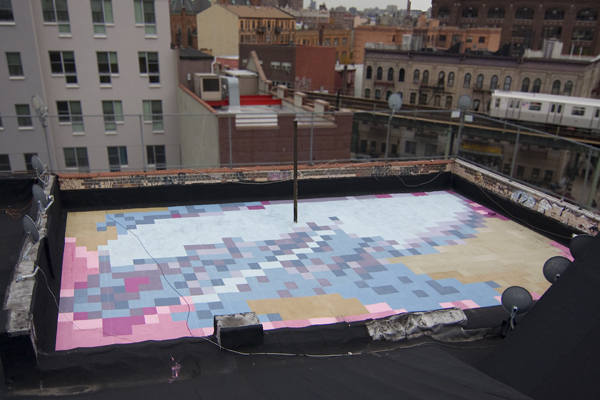


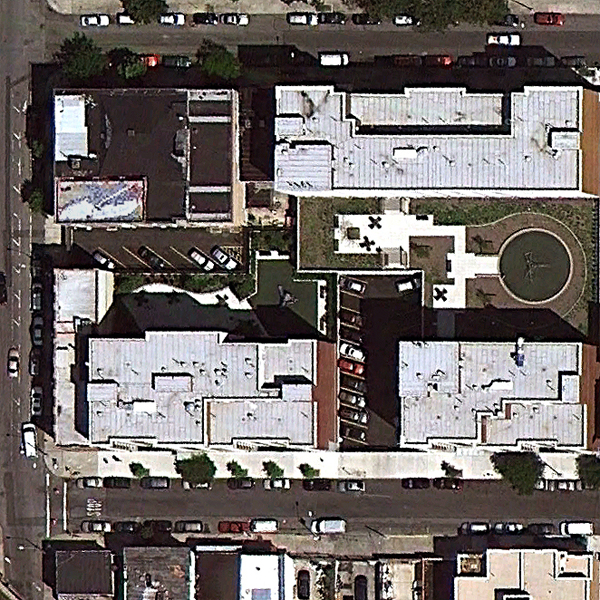
Molly Dilworth
Work from Paintings for Satellites
“I have an inclination to work with materials that have had an obvious life before I use them; it’s a challenge and a pleasure to make something from nothing.
In the last year my practice has grown out of the studio in the form of large-scale rooftop paintings for Google Earth. This project uses materials from the waste stream (discarded house paint) to mark a physical presence in digital space.
My work is generally concerned with human perception of current conditions; the Paintings for Satellites are specifically concerned with the effects of the digital on our physical bodies.
All my work begins a series of rules derived from existing conditions. For example, the color palette for the rooftop paintings is made from the discarded paint available on a given day; the physical surface of the roof determines the shape of the painting.
As this project proliferates, it will take two forms – a community model, using local volunteers and paint from the waste stream and a design/build model, using solar-reflective paint, solar panels and green roofing contractors.” –
Molly Dilworth
Tags: google, google earth, new york, painting, rooftop, satellite
Posted in Uncategorized | Comments Off on Molly Dilworth
Monday, 28 February 2011


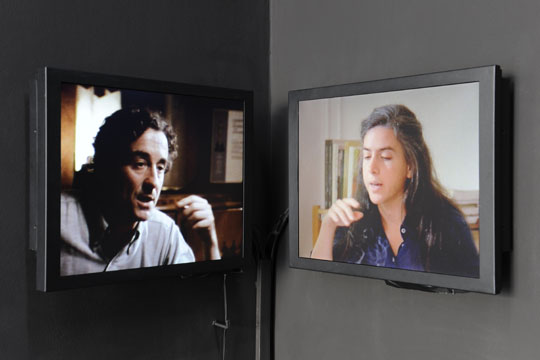
Amie Siegel
Work from Black Moon.
“The centerpiece of this three-part work is “Black Moon,” a partial remaking of Louis Malle’s 1975 film of the same title. A present-day science-fiction without dialogue, Siegel’s “Black Moon” traverses multiple film tropes – action, guns, lonely campfires, the end of the world – and, like its band of armed female revolutionaries, resists taking up residence in a fixed genre or narrative. Set in the post-apocalyptic landscape of foreclosed housing developments in Florida and California, the houses and empty streets become protagonists of a silent narrative, a documentary of the recent past. A highly stylized troop of female soldiers wanders through the abandoned environments, pushed on by gunfire and the bloody aftermath of battles. “Black Moon” conjures references to wars ‘here and elsewhere,’ suggesting alternate endings to the mythical domestic return of US troops from campaigns abroad, pondering the places soldiers protect, and the parallel economies of gender, images, and warfare. The film’s deliberate pacing, juxtaposing scenes of the armed women with fixed camera tableaux and tracking shots of the empty architecture of financial speculation, ponders the uncannily recent ruins of a future that never was.
The second element is a series of photographs, “Black Moon / Hole Punches”, derived from the hole punches, or black moons, typically cut by the motion picture laboratory into the first frame of action in film negative. Always left out of the final edited film, these hole punches appear in Siegel’s prints as imperfect black disks or voids cut out of film frames. They are evocative of lunar phases, yet strangely violent in their intercession into the otherwise smooth picture plane. As metaphors of the filmic endeavor itself, the set of images expose the film’s own production in a fragmentary manner, while re-capitulating its latent violence and re-use of aesthetic ruins.
The third element is “Black Moon / Mirrored Malle,” a 2-channel video installation that places an original 1975 interview with Louis Malle about his film “Black Moon” against a shot-for-shot version in which the artist herself plays Malle. This shift of roles introduces a transposition of gender and language, enacting a battle of authorship and doubled future within the present.” – Amie Siegel
Tags: circle, destruction, film, german, hole, hole punch, installation, photography, video
Posted in Uncategorized | Comments Off on Amie Siegel
Sunday, 27 February 2011
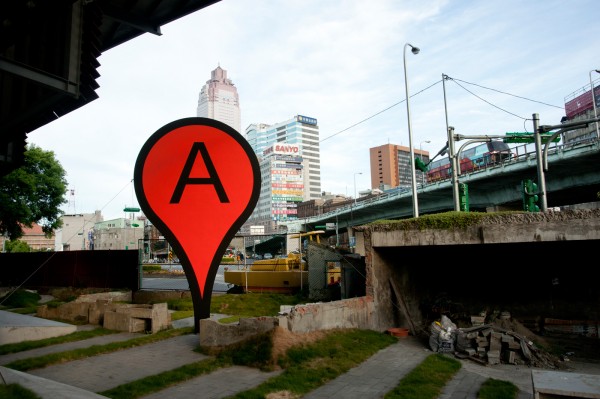
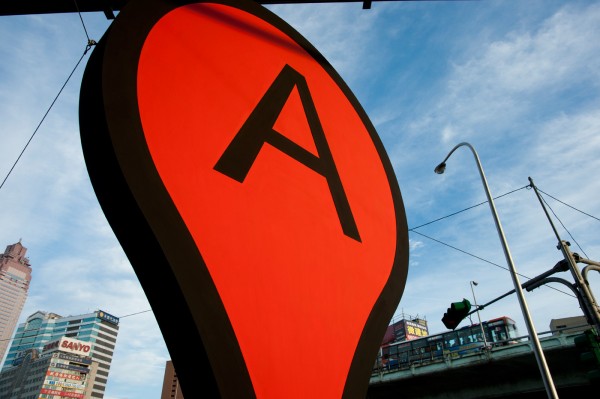


Aram Bartholl
Work from Map
“The project ‘Map’ is a public space installation questioning the red map marker of the location based search engine Google Maps. “Find local businesses, view maps and get driving directions in Google Maps.” With a small graphic icon Google marks search results in the map interface. The design of the virtual map pin seems to be derived from a physical map needle. On one hand the marker and information speech bubble next to it cast a shadow on the digital map as if they were physical objects. When the map is switched to satellite mode it seems that they become part of the city. On the other hand it is a simple 20 px graphic icon which stays always at the same size on the computer screen. The size of the life size red marker in physical space corresponds to the size of a marker in the web interface in maximal zoom factor of the map. Where is the center of a city?
In the city center series ‘Map’ is set up at the exact spot where Google Maps assumes to be the city center of the city. Transferred to physical space the map marker questions the relation of the digital information space to every day life public city space. The perception of the city is increasingly influenced by geolocation services.” – Aram Bartholl
Tags: berlin, digital information space, google, installation, maps
Posted in Uncategorized | Comments Off on Aram Bartholl
Saturday, 26 February 2011


Stefan Panhans
Work from Items for Possible Videosets.
“Stefan Panhans also concentrates in his works on everyday phenomena, even though, with another emphasize: His videos and photographs analyse the spectacle of increasing commercialisation and staging of urban spaces and reflects on the people’s searching for role models within these situations. In his photographic work, Panhans uses different strategies in parallel. Ranging from spontaneous photographs to the addition of objects in found situations to entirely composed pictures, he creates new compositions related to the context.” – Kunstverein Hargurger Bahnhof.
Tags: bright, color, german, kitsch, stills, video
Posted in Uncategorized | Comments Off on Stefan Panhans
Friday, 25 February 2011


Zach Gage
Work from Data.
“With my installation, Data, I explore a number of discrepancies surrounding our use of data, and how that use is, or could be, shaping our lives for the better or worse.
As a society, we are in a transitional time where we are no longer packing our memories into cardboard boxes, instead putting all of that content into digital “boxes”. We do this despite having a limited understanding of how these new “boxes” work. This makes it difficult to keep track of such previously simple concepts as where our things are going, how we can use them, or even how long they will exist.
We are thrilled to have digital photos, digital music, and correspondence through email, but we don’t usually realize the value of these pieces of data until they are lost to us. In the physical world we take steps to protect this kind of information, putting it in photo albums or treasure boxes and treating those containers carefully. In the virtual space however, we often don’t take any steps to protect these most valued possessions.
We are so excited to have infinite access to information, that we often choose to search for something over and over again, assuming it will always be there online, rather than save, or even bookmark it.
We love sharing our information with others publicly, yet when it comes back to haunt us weeks or years later we are upset and surprised.
We lament how the popular gain power, and then choose to make popularity the strongest metric of success in a new environment.
And most importantly, we store our collective memory online, and reference it often, without asking how it can enrich our lives beyond convenience.” – Zach Gage
Tags: computer, conceptual, hit counter, interaction, new media, parsons, smart, status, technology, twitter
Posted in Uncategorized | Comments Off on Zach Gage
Thursday, 24 February 2011
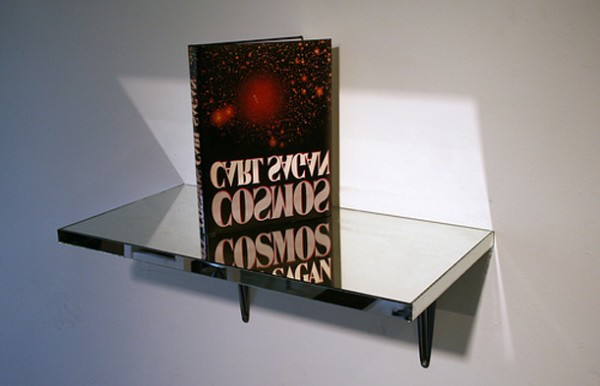


Gareth Spor
Work from his oeuvre.
“Often fixating on the physics of light, the cosmos, and the geometries of space and time, I work across a diverse range of media to explore the states of wonderment achieved when people contemplate things larger than themselves. My work is a means to feed my own curiosity and to share some of the wonderment I feel with others.” – Gareth Spor
via Zero 1
Tags: carl sagan, cosmos, intersection, perception, photo sculpture, pun, sculpture
Posted in Uncategorized | Comments Off on Gareth Spor
Wednesday, 23 February 2011
Tags: animated gif, chicago, net-art, new media, nicholas o'brien, rad, saic, sound, video
Posted in Uncategorized | Comments Off on Sara Ludy
Tuesday, 22 February 2011

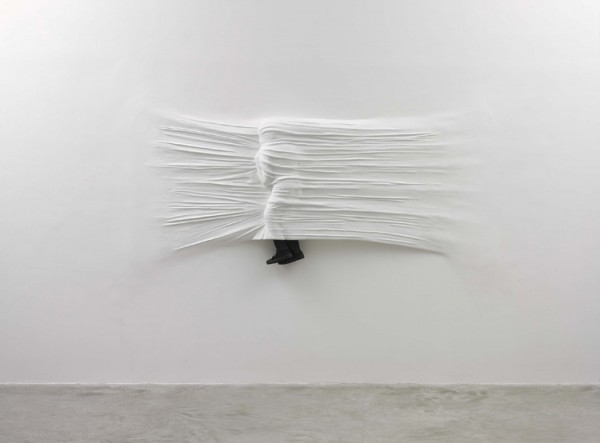

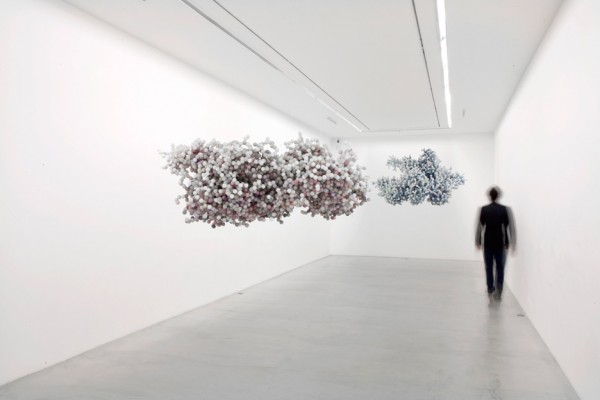

Daniel Arsham
Work from Three Dimension
“Straddling the line between art, architecture and performance, Daniel Arsham has worked with Merce Cunningham, Hedi Slimane, Bob Wilson and Jonah Bokaer. He makes architecture do things it’s not supposed to do, mining everyday experience for opportunities to confuse and confound our expectations of space and form. Simple yet paradoxical gestures dominate his sculptural work: a façade that appears to billow in the wind, a white cube eroded on all sides like a glacier, a figure wrapped up in the surface of a wall. Structural experiment, historical inquiry, and satirical wit all combine with consummate technical skill in Arsham’s ongoing interrogation of the real and the imagined.” – Galerie Emmanuel Perrotin
Tags: architecture, blurring of disciplines, confuse expectations, installation, minimal, sculpture
Posted in Uncategorized | Comments Off on Daniel Arsham
Monday, 21 February 2011
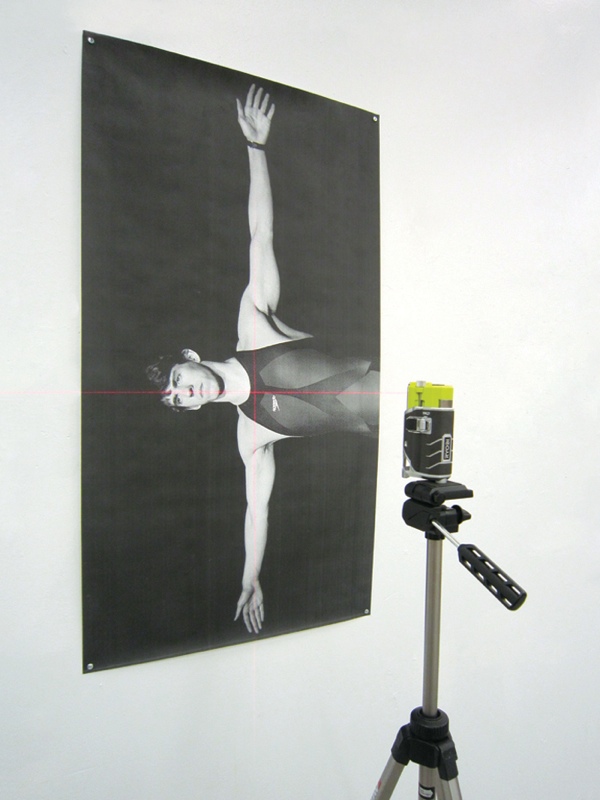
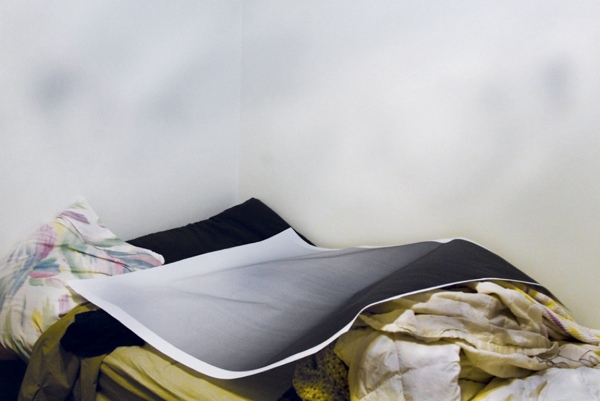

Brian Khek
Work from his oeuvre.
“Interpreting our relationship with information as a visual spectrum of didactic signifiers, the images in my work subjugate and expand physical experiences simultaneously. The fixed image inherently rephrases an experience. Documentation of this work is not interchangeable with the original object. It instead behaves as a different language through the physical displacement of the viewer as a result of the apparatus.” – via i heart photograph
Tags: hip, meta, photography, process, superdutch, video
Posted in Uncategorized | Comments Off on Brian Khek
Sunday, 20 February 2011


Ishac Bertran
Work from Generative Photography.
“The picture above (top) has been generated projecting white vertical rectangles, from left to right, at 25fps, to a projection screen. A camera, set to long exposure, captured the projection in 5 seconds. The rectangles aren’t homogeneous due to the rendering and the asynchrony between the frame rate of the video signal and the refresh rate of the projector.
The light grey rectangles have been in projected (and thus, exposed) double time than the dark grey ones. The brightest stripe has probably been projected three times the dark grey ones, and there is a rectangle that hasn’t been projected.
I’ve been doing some experiments using Processing to generate different patterns and sequences, a projector, and a camera pointing to the projection screen. Some of them are using a technique called procedural light painting, some other combining slit-scan with projected patterns. I’m also very interested in the low repeatability of some of these experiments, like the picture above, due to the noise introduced by the asynchrony of generation, communication and output means. Maybe we can call it Generative Photography.
The following pictures are generated projecting a vertical lines, one after the other, and then the same with horizontal lines (25 fps). Lines have 3-pixel stroke, and move 4 pixels each time, creating a double exposure every two lines. Plus the error introduced by the asynchrony.” – Ishac Bertran
Tags: computer, error, generative, processing, programming, radical, synchronicity, technology, timing
Posted in Uncategorized | Comments Off on Ishac Bertran