Andrew B. Myers


Andrew B. Myers

Work from his oeuvre.

“Tell me about your influences and where you go for inspiration.

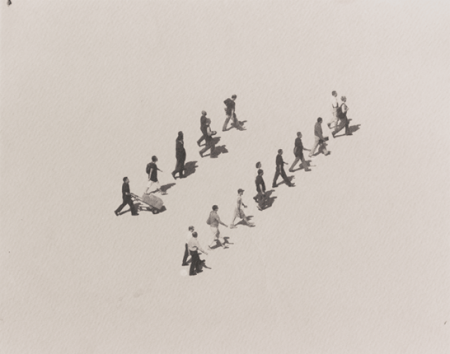
I’m very interested in contemporary art and design, almost exclusively, so most of my inspiration comes from what I see going on in recent years. Painting to me is an exciting world, especially the work I see coming out of it now. I admire (and am jealous to an effect) of the sheer control painters have over the imagery they produce, lacking a lot of the external variables that photographers deal with all the time. I guess I like taking this sensibility to my work, using these variables that photography has to offer but bringing a very tight element of control in terms of colour and composition. I’m not quite sure where I became so obsessed with washed out colours, sunlit shadows and negative space, but it must have something to do with how much I fetishized warm weather, the beach, and open areas during the summer in the remote area I come from, which I mostly remember as freezing and covered in several feet of snow.” – excerpt from an interview with Heather Morton

Vanessa Billy


Vanessa Billy

Work from her oeuvre.

Also, there is a review of a recent show at This is Tomorrow.

“To misquote Ecclesiastes, ‘The sun also rises, the sun goes down […] All art is meaningless and a striving after wind.’ Vanessa Billy’s Suns Neither Rise Nor Set (2008) comprises two convex glass discs that looked over her small exhibition ‘Flexible Values’, creating a new horizon on which these twin celestial bodies were halted. Glow (2008) was simply a layer of yellow pastel dusted over a section of the gallery’s white windowsill, but it radiated with the light of these new suns and bathed the show with subdued rays.

The spirit of Arte Povera has lately been reinvigorated, and Billy’s transient, mute poetry displayed, with its simple materials, an affinity with the earlier movement but also a further sense of dramatic irony. The two-part Fluids (2008) was a diminutive fountain-like entrance to what seemed to be a faded carnival; a thin stream of clear plastic arched between two steel green bases, set askew from its accompanying poster, which showed a spectrum of blue, purple and pink merged and diffused like colours refracted underwater. The sand from Dry Stamina (2008) was spread underneath, a wedge of sand that filled the step between the gallery’s two levels but had dispersed with time. At the rear the dozen red plastic misshapen arches of Support Brackets (2008) acted like a two-dimensional theatrical backdrop to a distant flock of seagulls. ‘Flexible Values’ set the spirit of Arte Povera loose in the faded grandiosity and elusive romanticism of a desolate seaside town, as though the artist’s collection of objects were the shorthand sketches of an abandoned proposal for Robert Smithson to design a Butlins holiday resort.

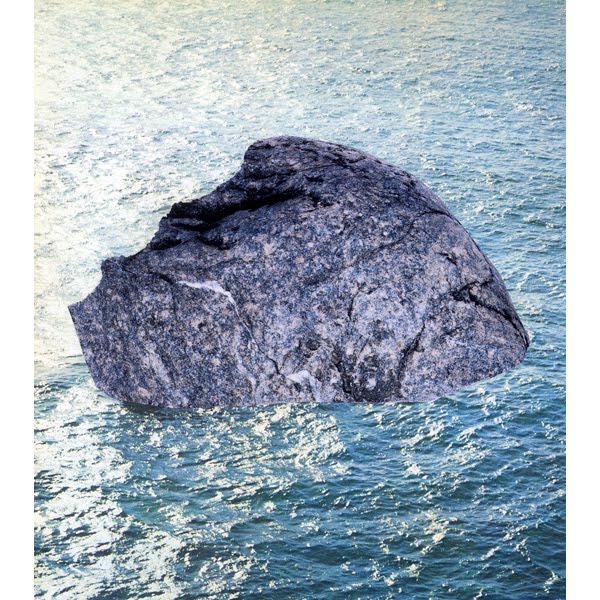
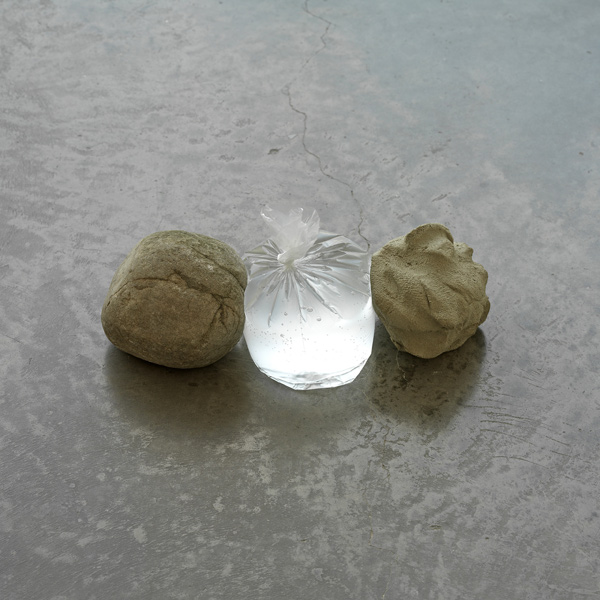
Similar in tone to the work of the Mexican artist Gabriel Kuri, each of Billy’s works casually maintains a discrete presence with a self-conscious sense of weight. As though they were theatrical props, Billy is fully aware of their temporary metaphorical value, setting us the task of casting about for connections before they are flung into the bin or washed into the sea. Hints of transformation began to emerge from the balance of materials used that suggested traditional methods of industrial conversion: sand and glass, paper and wood. In Supporters (2007), a low plywood plinth held up a sanded piece of cedar that resembled a smooth, sea-worn pebble, the wood’s age rings transformed into geological stripes. Billy quietly proposes a new elemental ecology in the weathered progression that flowed from the larger stone of Supporters to the smaller particles of Dry Stamina and on to the melted sand of Suns Neither Rise …. A similar metamorphosis took place in Four Times Weathered (2007), two square concrete blocks topped by a slight pyramid, each face holding a small, bunched-up tissue. The withered tissues seemed to bear marks of the pastels used in Fluids, ritually laid like seashells set out to dry, taking on evocative shapes in their cast-off abstraction; one of them even resembled a seahorse.

Billy set the gallery as a frontier for an encounter that shapes our environment, like the seafront. And like holiday resorts, galleries gather around this frontier, imbued with idealism and decorated with promises of escape. ‘Flexible Values’ set out a new stall along this coast, the ‘land’ of the exhibition shaped and transformed by a visual erosion, the artist’s deftly curated negative spaces between the works evoking an invisible sea of meanings in which the artist is happy to let us swim. But don’t expect a lifesaver: Billy’s seafront shares an escapism that can only lead back to ourselves. She readily acknowledges the futility of this striving after wind and revels in its physical sensations, letting explicit answers dance elusively on the constantly receding horizon.” – Chris Fite-Wassilak for Frieze.

Christy Matson


Christy Matson

Work from Soundw(e)ave.

“A number of artists have started using textiles and needlework to explore the relationship between computer culture and craft. Here on Rhizome, we’ve recently covered Ben Fino-Radin, Sabrina Gschwandtner, Cat Mazza, and Cody Trepte, among others employing “traditional media” in the service of a technological critique. Not to be left out of this group is Christy Matson, a Chicago-based artist who takes this investigation to even more self-reflexive heights. Matson’s work may not look high tech, but it responds directly to media culture and is often made using a Jacquard Loom, a mechanical device that is important in the proto-history of computing. Many of the artist’s projects involve building feedback loops between the sonic experiences of making and viewing her work. Recordings of the weaving process are algorithmically translated into binary yes/no, on/off, or true/false patterns and translated into images in the form of thread color choice, needle behavior, and other factors. The artist includes copper wires in these weavings to act as amplifiers or antennae for further sonic transmissions. See, for example, Movements, in which the viewer’s hand is meant to rove as a sort of playhead on what is posited as a 4-channel audio installation. The same questions are raised in her work, Digital Synesthesia, which looks at similarities in the abilities (one might even say tendencies) of both the human brain and the computer to conflate sound and image. To her credit as a dedicated artist, these are issues Matson works to flesh out again and again, even exploiting the repetition of the line-by-line weaving process as an ironic take on the re-spinning of these narratives. When she explored synaesthesia in Soundw(e)ave (a piece whose title conveys her obvious love of word play), she wrote that “This transmutability [between images and sounds] of information in the digital world initially seems to be in opposition to the ways that humans experience the physical world,” but is, in fact, quite natural. Speaking of the physical world, her weaving-together of cotton and rayon (or natural and artificial fibers) in Loomscapes seems perhaps her most visually compelling argument of the relationship between traditional media and digital production. Following from the long tradition of tapestries that depict battle scenes and other historical culture clashes, Matson’s wall hangings pull landscape imagery from LucasArts’ early-90s computer game, LOOM, to collage together images absent of figures, but instead foregrounding the game’s beautiful backdrops. In a sense, the beauty and conceptual quandaries that make Matson’s work so compelling are nicely summed up in her own words, written about her work, Either/Or: “[This] is a series of work that explores the grey areas that technically should not exist, but often do, in absolute systems.” The piece creates what looks to the human eye like a band of grey, where thousands of black and white strings are loosely knotted together. Here, the seemingly hard differences between bodily and machine perception are made messy, but prove worth unraveling. – Marisa Olson for Rhizome.

Katie Shapiro


Katie Shapiro

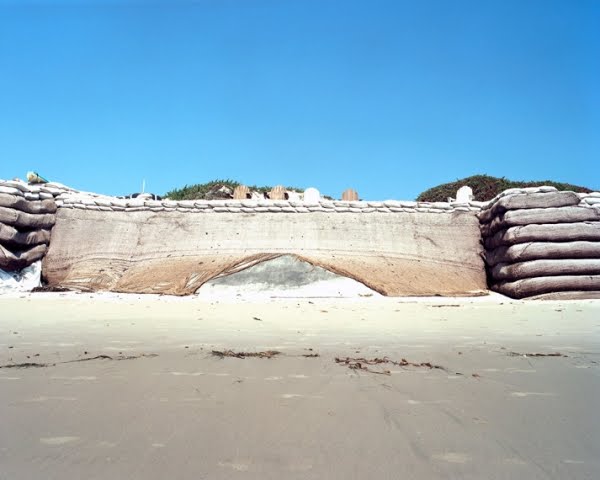
Work from Malibu Sandbags.

““Public Access: extending 25 feet inland from daily high water line.” -California Coastal Commission

In Malibu Sandbags I am exploring the cohabitation of nature and man. The sea level is rising and shortening our beaches. Beachfront houses are no exception. In their attempt to battle the inevitable, the wealthy homeowners of Malibu’s Broad Beach have erected sandbags to act as a barricade for their homes, a last chance to save their property. The sandbags serve as both protection and privatization of the homes from the public eye. This project is looking at how we divide ourselves into social classes as well as the natural evolution of our environment.” – Katie Shapiro

Ron Jude


Ron Jude

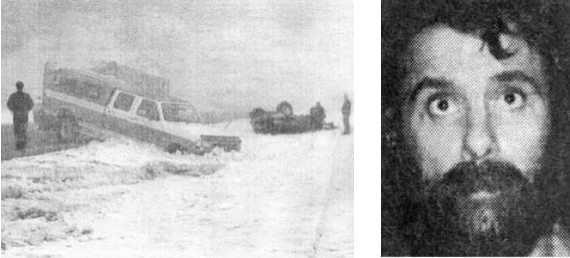
Work from Alpine Star.

“Photographer Ron Jude selected images from The Star News, a local newspaper in McCall, Idaho to sequence without text for this book. The images are reprinted using stochastic screening, a frequency modulation technique similar to conventional halftone printing that uses mathematical values to generate random density patterns. The printing method heightens awareness of the original source of the images, yet the visual language of notable people and events takes on a cryptic semiotic system when plucked from their news-worthy contexts. Blond twin toddlers in neck braces, a black bear’s domestic appearance, and flooded riverbanks become signifiers of attention-worthy moments and together assemble to capture a micro-cultural survey pregnant with meaning.” – via Printed Matter Books.

Alex Artz


Alex Artz

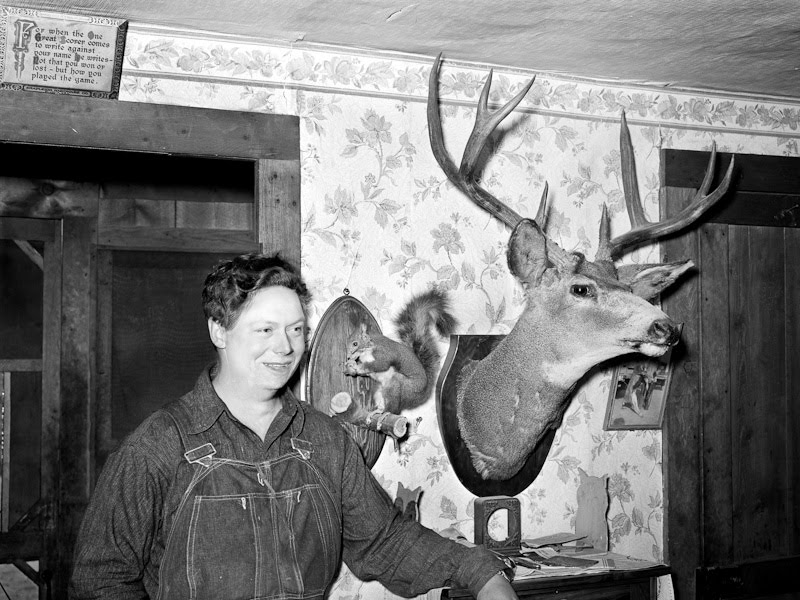
Work from Ailurophilia.

While the statement is from her project Human-Animal, I find it applicable to the images above as well.

“I continually wondered how adaptable the human home is for other species, whether that species lives in its own bedroom or in a cage in the backyard. The animals in these pictures often occupy the home space as fixtures much like the trinkets and framed pictures that display the animal lover’s identity. Various objects, including empty grocery store food packets, tchotchkes, stuffed animals, animal clothes, car decals, drawings, memorialized gravesites and photographs identify the human owners as animal-lovers, even when the object of their affection is not captured in the frame. As many of my photographs make clear, some human identities are carved through the creation of a familiar human-pet dynamic involving both affection and dominance, captivity and care. My photographs record this man-made symbiosis as it occurs in and around the American home.” – Alex Artz

Judith Baumann


Judith Baumann

Work from Travels with John.

“Travels with John delves into my fantasy life in which I travel across the country with John Baldessari, imagining our conversations on life, love and landscape. In addition to recreating myriad conversations between John and I, I have collected and reinterpreted snapshots of our travels together ranging from White Sands, New Mexico to Ruby Beach in Washington to Niagara Falls, Ontario. This series is the second in what I have dubbed “Art-Fan-Art,” my homage to those figures in contemporary art that have inevitably influenced the way I approach art-making.”

Debbie Grossman


Debbie Grossman

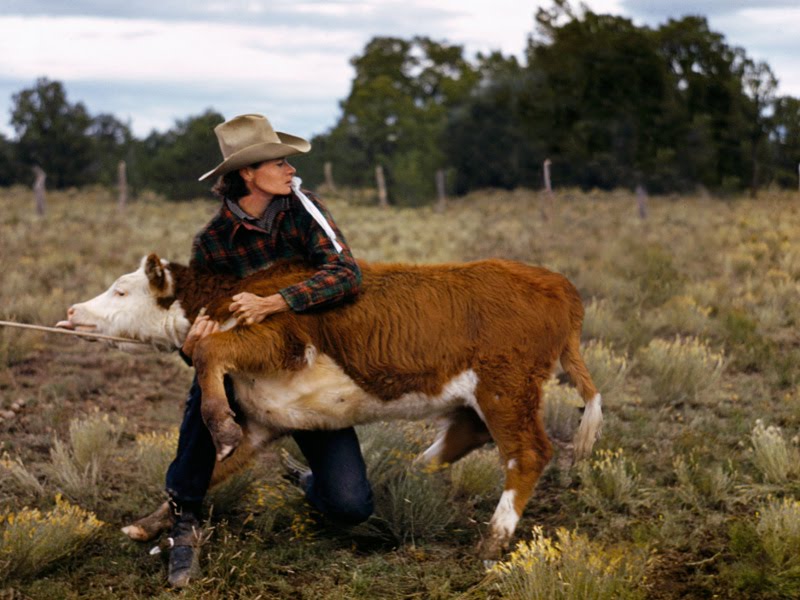
Work from My Pie Town.

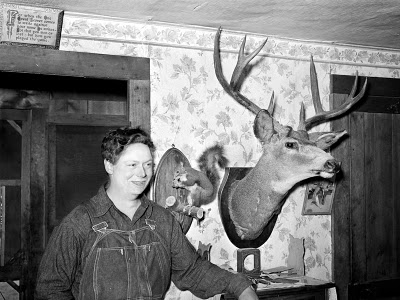
“In the spring of 1940, Russell Lee wrote to his boss at the Farm Security Administration, Roy Stryker, proposing to spend several weeks shooting Pie Town, New Mexico, a small settlement of homesteaders near the western edge of the state. Lee wanted to photograph there because he felt Pie Town represented a kind of hardy, small town community that was disappearing in America. His pictures of the town are tinged with his mythologizing of a difficult way of life and the land-conquering kind of patriotism that’s a foundation of the American story. I share Lee’s nostalgia. Seventy years later, I am drawn to a similar utopian ideal. I’m filled with a longing to connect with that time and the people in Lee’s images – I’ve had a lifelong obsession with frontier life. I fantasize about locating myself within those pictures and that time. So in an attempt to make the history I wish was real, I have made over Pie Town to mirror my fantasy.

In this work, I take a selection of Lee’s beautifully-photographed body of images and re-imagine, revise, and reconstruct them using Photoshop. The archive I have created resembles Lee’s with an important difference – in My Pie Town, the rag-tag community of homesteaders is populated exclusively by women.

In some of my revisions, I have taken male bodies and rendered them to look like masculine women; in others, I have taken pairs of women, shifted their distance and body language, and brought them closer to create a sense of intimacy. In some of the pictures I have created women so masculine, or so ambiguously gendered, that they may not, for some viewers, clearly read as one gender or the other. I’ve also left a few images untouched, allowing for another dimension of re-reading Lee’s work.

Though the Pie Town pictures were never widely published as a group, the images have a sort of a cult following. Posted by the Library of Congress on the photo-sharing website Flickr, they attract endless notes and commentary. Paul Hendrickson wrote an article in 2005 for Smithsonian Magazine about returning to Pie Town; David Margolick wrote a similar piece in the New York Times in 1994. And in 2001, Joan Myers wrote a fascinating biography of Doris Caudill, called Pie Town Woman. I believe that part of what makes the pictures so seductive for contemporary viewers is their extreme level of detail. Lee was a very careful chronicler of the details of everyday life. There’s also a casualness and an immediacy to Lee’s style.

My/Lee’s pictures also have the appeal as a body of work that slipped through history’s cracks. Because they work so much better as a group or a picture story, and perhaps also because they were made at the tail end of the Depression, Lee’s Pie Town images never become iconic symbols of the Depression itself the way that, say, certain images by Walker Evans or Dorothea Lange did. I, like Joan Myers, find Lee’s Pie Town pictures particularly compelling because they seem so respectful of his female subjects. Of course, gender roles in Lee’s original pictures are fairly traditionally divided, and any hint of sexuality is sublimated, but I could not have made my female version of Pie Town if there hadn’t been space and flexibility for my re-reading in Lee’s nuanced photographs.

Because the images of Lee’s time in Pie Town are available in high resolution form from the Library of Congress, I was able to get close to Lee’s images on a pixel level. For me, working with photographs and editing them so closely in Photoshop is a kind of an intimate act. Zooming in and carving a feminine jaw out of a masculine one, or manipulating the touch of one woman’s hand on another’s shoulder is a way for me to access and merge my desire with figures which would have otherwise remained frozen in time. I’ve begun to think of Photoshop itself as my medium – I’m fascinated by the fact that it shares qualities with both photography and drawing. This work creates something that reads as a photograph, and is infinitely reproducible like a photograph, but at the same time depends heavily upon the intervention of my hand.

Particularly because my work takes as its starting point a body of images that is Americana, that was made to be a political tool to encourage pride in this country and its homesteading, agrarian roots, I enjoy imagining My Pie Town working as its own kind of (lighthearted) propaganda.” – Debbie Grossman

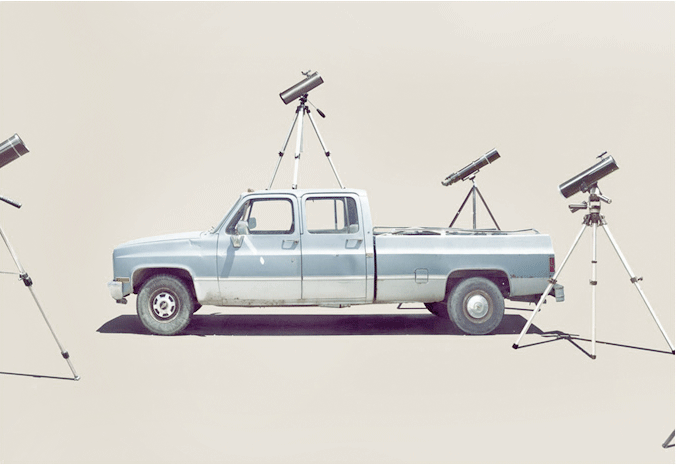
Toril Johannessen


Toril Johannessen

Work from Transcendental Physics.

“Toril Johannessen opens the spring season in NO.5. In her fascination with nature and the history of science she creates her visual works by way of methodical testing and an analytical attitude to the empirical and theoretical. The aesthetic grows up in a personal interpretation of the documentary where she also draws on metaphorical and mytholo¬gizing elements that are latent in the source material.

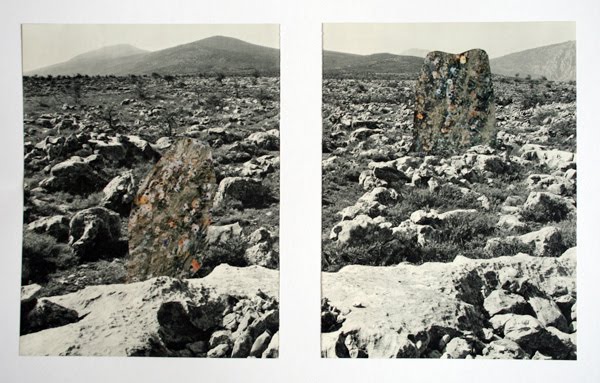
The exhibition in NO.5 consists of two works. One is a sculpture, which is absolutely the largest object one can possibly get into the gallery space in one piece, and thus circumscribes the volume and architectural framework of the exhibition. Unlike a ship in a bottle it is not hidden tricks that make the arrangement possible, but primarily a mapping of the physical conditions.

The second work is concerned with hypothetical points of contact between the German scientist Johann Zöllner (1834-1882) and the Canadian/US visual artist Agnes Martin (1912-2004). Inspired by the latter’s geometrical motifs, Johannessen plays on Zöllner’s discovery that parallel lines appear to be tilted when they are intersected by shorter lines at a particular angle (“Zöllner’s illusion”). A further meaning of the work can be read out of the fact that both Zöllner and Martin, through their methodical, scientific investigations, have explored various spiritual dimensions.” – Bergen Kunsthall

Alessandro Ludovico and Paolo Cirio


Alessandro Ludovico and Paolo Cirio

Work from Google Will Eat Itself.

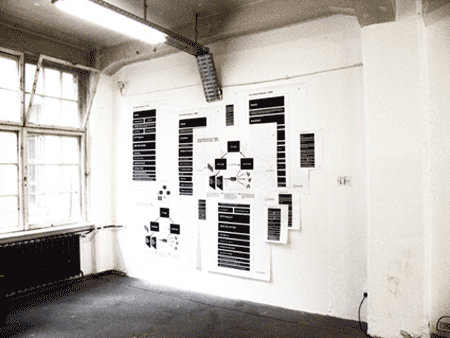
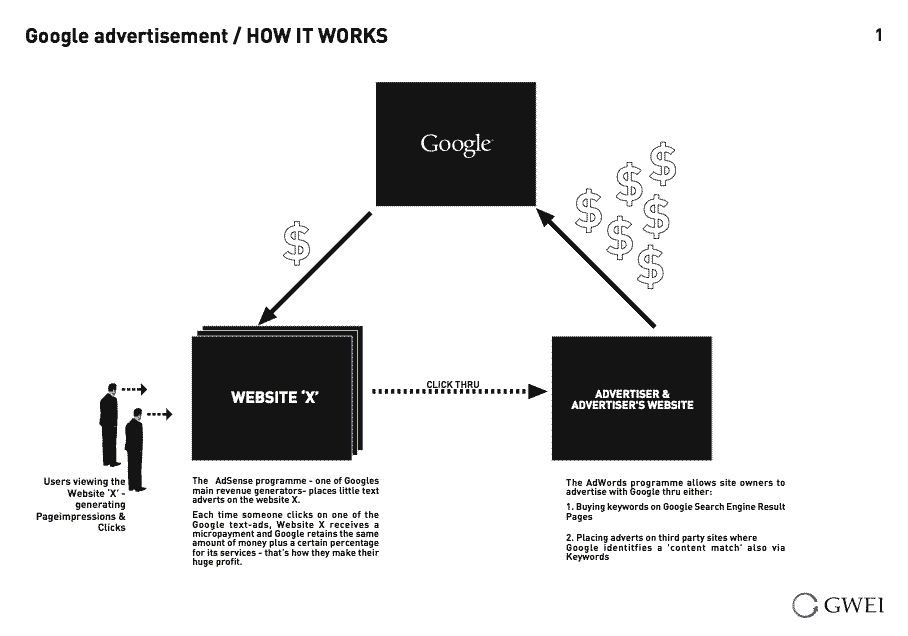
“One of Google’s main revenue generators is the “Adsense”* program: It places hundreds of thousands of little Google text-ads on websites around the world.

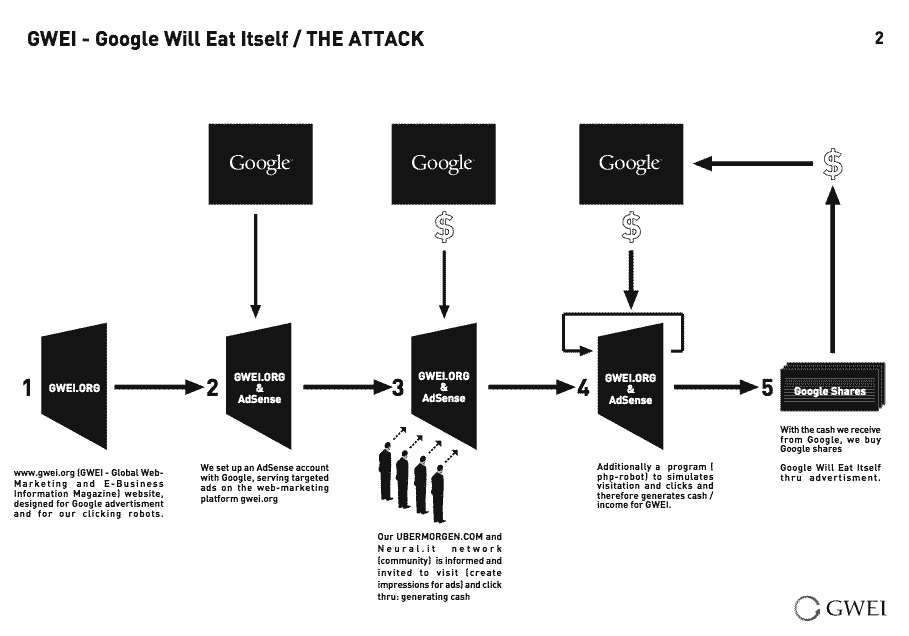
Now we have set up a vast amount of such Adsense-Accounts for our hidden Web-Sites. For each click we receive a micropaiment from Google. Google pays us monthly by cheque or bank-transfer to our Swiss e-banking account. Each time we collected enough money, we automatically buy the next Google share [NASDAQ: GOOG, todays value ~430.- USD] – we currently own 40/forty Google Shares.

Important: Google Will Eat Itself works by using a social phenomenon rather than depending on a purely technical method (for example a simple click-farm). Because of this social dimension empowered by technology, Google is not able to fight GWEI and it`s franchises by using their regular counter-fraud methods.

GWEI – Google Will Eat Itself is to show-case and unveil a total monopoly of information , a weakness of the new global advertisment system and the renaissance of the “new economic bubble” – reality is, Google is currently valued more than all Swiss Banks together (sic!).” – via  gwei.org