Friday, 5 June 2009


Glue Society
Work from their oeuvre, but not from a titled body of work.
The Glue Society has no sweeping statement I could find, nor any statement at all. The only information I could dig up was a few names, and the fact that they are an creative collective based in Sydney and New York. The pieces I chose are from their website, which I can only assume is intended to reframe the way we browse the internet with its (seemingly) pre-programmed wait times, java script errors, and huge Macintosh browsing icons from the days before OSX (or I went too far and it is just an error).
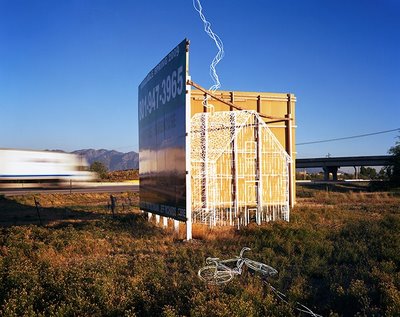
The pieces, as listed in order: God’s Eye View [Titles are: Moses, Cross, Eden, Ark], Digger (It wasn’t meant to end like this), and Pigeon.
There is obviously a disarming use of humor here, and a playful approach to art that in some ways reflects their advertising background, but I see a remarkably clever appropriation of culture as a material. With another of their pieces Relic (not shown here), artifacts of our daily existence are encased in small balls of amber like anthropological artifacts of the now extinct human race.
If you bump across a statement anywhere, please let me know.
Tags: artifact, humor, installation, pseudo science, sculpture
Posted in artifact, humor, installation, pseudo science, sculpture, truth | No Comments »
Thursday, 4 June 2009


Anu Vahtra
Work from Installations.
There is a great animated gif/video of one of her installations here.
I couldn’t find a statement or review for Vahtra’s work, but I did not want that to stop me from posting it. Vahtra uses Xerox prints to create a false wall in the gallery and imply the space beyond the piece, even if none exists. Installations is a body of work that examines the relationship of viewing context to the piece in a more literal way than your average site-specific work by completing (both literally and conceptually) the reletionship between the piece and the gallery.
Tags: conceptual, installation, sculpture, self-reflexive
Posted in conceptual, installation, sculpture, self-reflexive | No Comments »
Wednesday, 3 June 2009


Virginia Otth
Work from Petites Définitions.
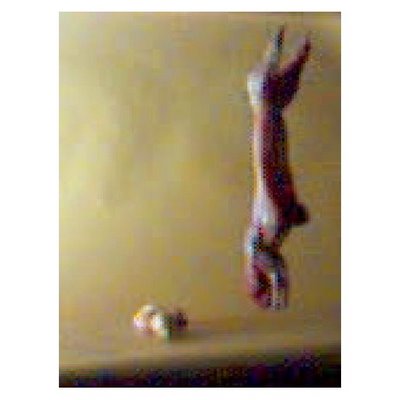
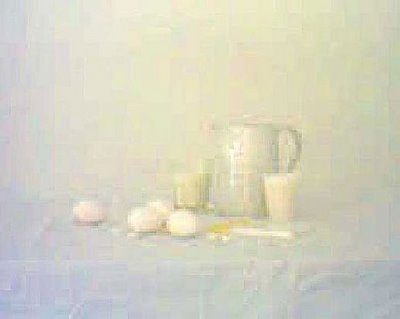
Otth’s work addresses the technical aspects of photography in the digital age. After visiting her site I wished that I spoke French, or at least the Google Translate was a little more perfect. Either way, you must go to look at her work. Her work ranges from a scientific and precise examination of digital color and reproducibility to low end digital pixelations of classic Dutch still lives. Please, please, please go to her site.
“Photographic images are defined today by their pixels. Although the medium seeks its definition from a technical basis, I prefer to work from a semiological perspective. This series, comprised of “small (‘low’) definitions”, uses “low quality” images from first generation mobile phones in relation to the tradition of representation in painting. The models and the stills (lives) are “illuminated” by the light a computer screen and make reference to portraits of the Renaissance period through the posture of the subjects and the strong directional lighting. The enlarged pixel, retained as a square of solid color, also resembles a “touch” of paint, and is inherent in this reference. “Unseeable” at close distances, the subject resolves from afar. The disruption of the signal, the image noise, and JPEG compression artifacts decrease the readability of the subject and refers directly to the medium. This is of particular interest to me, and is the basis of the work. This rudimentary high-technology, destined for mass production and consumption, presents a distorted vision of the world through this degradation and, paradoxically, refers to an image of the world much more abstract than expected. The aesthetics of this “bad” quality offers me an excellent opportunity to question the medium and our relationship to the realism of images. Though the camera-phone’s purpose is to give us the opportunity to easily record both the small instants and the great moments of history (if by chance we are there), it actually gives us an altered, or ‘other’ vision. I appreciate this pictorialist aesthetic, and I use it to sublimate my subjects, and the lack of definition is filled in by the imagination and by the references to the history of representation. This work is immediately dated by a ‘new’ technology which the market has already rendered obsolete The current generation of mobile phones – even at the low-end – is of much higher quality, the representation of the world is much more ‘accurate’, and unaffected by the severe JPEG compression of the first generation. This work conserves a trace of this stage of technology as a relic, of the beautiful noise which was the default..:. ” – Virginia Otth
via Conscientious.
Tags: awesome, conceptual, french, photography, process, self-reflexive
Posted in awesome, conceptual, french, photography, process, self-reflexive | No Comments »
Tuesday, 2 June 2009


AnnieLaurie Erickson and Everett Lawson.
Work from A Slip of Memory.
My first thoughts about this work were “badass”. A Slip of Memory is a phenomonal integration of science, optics, and art which explores how the eye functions and how it affects our perception (something I am working on from a vastly different perspective).
“Colors, shapes, and forms are collected on the inner surface of the eye before they can be directed by memory and one can ‘see’. This action is often hidden from view although physically present. This project uncovers latent images remaining on the retina often unperceived by the conscious. Retinal staining puzzles the eye; the strongest impression is filtered from the rest leaving subdued forms and colors to play out in inversions, fading and lessoning into darkness before finally digressing into the unconscious.”
______________________________
Process information – “An early example of a camera we created to photograph retinal decay can be seen on the right. In order to do this we mapped our retinas and used the information to make artificial retinal membranes from hydro-polymer material imbedded with particles of red, white, and aqua strontium aluminate. These particles store and convert the visible and ultra-violet spectrum into low transmissions of electrical output and resonate release of light. The lenses focus images onto the phosphorus membrane creating the corresponding crystal particles of strontium to activate and retain the optical information, which in turn, inverts and decays before it is exposed onto film.
From compressed and circulated chlorodifluoro-methane gas to electro magnetic cowling, our early cameras were constructed from found materials salvaged from disgarded consumer waste such as broken televisions, refriderators, and glass which was ground into lenses. This camera is both digital and manual; It interfaces with a computer and has a modified homemade lenticular photosensitive cell. We now have a number of retinal imaging cameras, both film and digital, each unique in construction. The lenses are hand ground and specifically de-signed to address the defects of our own eyes, conceptualizing the different modes of our
vision through their imperfections.” – Annie Laurie Erickson and Everett Lawson
via Invisible City
Tags: camera, obscured, perception, photography, science, sculpture
Posted in camera, obscured, perception, photography, science, sculpture, vision | No Comments »
Monday, 1 June 2009


Lee Gainer
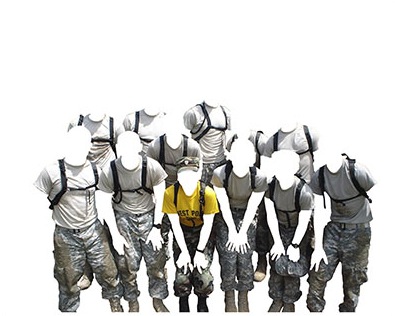
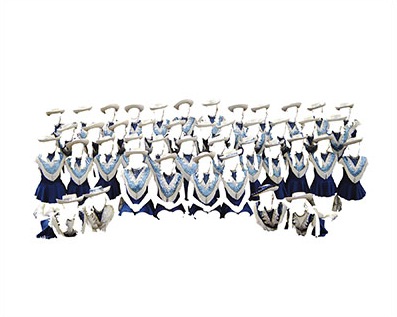
Work from Group Therapy.
“We have a tendency to seek out others with similar interests and ideas. Within these found groups, we can discover a place to belong, to be ourselves. When these ideas or interests require a certain uniform, whether for safety reasons or a consistent visual appearance, it serves to underscore our sense of belonging and our perceived acceptance within the group.”
______________________________
General statement:
“My art explores culturally accepted and media supported perceptions.
Using found and created imagery, I visually analyze social rules, hidden messages, the psychology behind these ideas and beliefs, and how they alter our behavior. I collect thousands of images from my own photographs, catalogs, magazines, newspapers, the internet and other media and regard them as raw data to be examined. From this archive, I will select imagery based on the perception I wish to explore and use them to initiate a visual experiment. By removing the image from its context and deconstructing its aspects, I can focus on a single characteristic of its message and evaluate it. While I begin each experiment with a result in mind, I have found that the data does not always produce what is expected. I find this work to be stimulating and rewarding. Every answer leads to a new question. My work is a response to a continuous challenge to decipher the bombardment of modern imagery. “
Tags: modification, obscured, photography
Posted in modification, obscured, photography | No Comments »
Sunday, 31 May 2009


Ethan Arro Jones
Work from In Water and Fish Story.
“As a young adult entering my twenties, I found myself full of questions and I began looking for answers in the photographs I was making of my peers. Still showing glimpses of their youthful innocence, these new adults are wading, beautiful and naked, in the chilly waters of Lake Ontario during cool, early fall mornings.
Photographing with my hands and camera resting on top of the water, I have brought the viewer into the situation as a witness to what I encountered with my peers. Each person walks into an aura of pure water and undergoes a transformation. This numbing bath causes social cover–ups and facades to be unveiled by the uneasiness of the water and the entire situation. This act makes the subjects vulnerable and exhausted, presenting a less comfortable yet more honest person.
The variety in physical and emotional responses among similar yet clearly different people defines the series. From statuesque arms to nervous fingers and goose–bump covered bodies, the subjects’ appearances display a powerful transition. This newfound tension causes some people to appear totally lost while others maintain their composure. Eventually, all of the subjects’ pretenses are left behind.
Through this singular experience everyone is similar. We are here together, not alone. The sense of trust and love, tension and anticipation, emergence and energy displayed in the portraits ultimately speak to the emotions involved for us all as we enter our twenties.”
____________________
“For several months, I ritualistically created photographs loosely based on my visual life. In order to make new, different, and exciting photographs I gave myself one specific limitation, a set working distance. The distance I chose was my awkwardly tall height of 79 inches. In one sense, every image is a portrayal of that height, but since the pictures are neither awkward nor representative of my tallness I no longer see them as such.
The photographs have become about living in a college house and then vacationing in Nantucket. There is a difference in the houses that is vast in style, size, cleanliness, location, and class. To me the photographs feel like they belong in the same story because the images are treated in the same manner visually by paying attention to light, color and composition all while trying to make the best photographs I could form the same distance over and over again. I also think that I was searching and looking for the same feeling in both places, a sense of home; I believe that I found it in parts of both places.
Now, the most interesting part of the photographic journey that I made with these images is that my height became insignificant. The vertical height was turned horizontal and it lost all emphasis when the context of my height was absent from the photographs. Due to this near lack of context, these photographs feel more embellished than the images I want to make. In a way the photographic story is my own little lie; the tall tale has been turned into a beautiful photograph.” – Ethan Arro Jones
Tags: color, photography, rit, series, straight
Posted in color, photography, rit, series, straight | No Comments »
Saturday, 30 May 2009



Josh Poehlein
Work from Borderlands.
“Pisces. For the week of April 3, 2008.
Astrophysicist Neil deGrasse Tyson told The Washington Post the following fun facts: “There are more molecules of water in a cup of water than cups of water in all the world’s oceans. This means that some molecules in every cup of water you drink passed through the kidneys of Genghis Khan, Napoleon, Abe Lincoln, or any other historical person of your choosing.” Your assignment this week, Pisces, is to choose three heroes you’d most like to be influenced and inspired by. Every time you drink water, be conscious of the fact that some of it was once inside the bodies of those exceptional people. Say a prayer that their mojo will become available to you.”
This project is still in progress so any feedback is much appreciated. The site will be updated periodically with new work.”
Tags: drawing, modification, photography
Posted in drawing, modification, photography | No Comments »
Friday, 29 May 2009


Krista Wortendyke
Work from (Re:) Media.
This is fascinating work about appropriation, photo history, media consumption, etc. It runs the gamut of critical analysis / critique about photography. I strongly recommend you look at Histortical Intervention as well.
“Although most of us have never experienced war, we are surrounded by its imagery. This project is an exploration of the way that imagery and information from movies, videogames, the newspaper, and the Internet come together to form our perception of what war is. Explosions are war’s most universal and most spectacular signifiers. We are never falling short of this imagery. I have made use of these magnetizing images to show not only how the lines between fiction and non-fiction blur, but also to show how a mediated experience can become indecipherable from a real experience. ”
____________________
” I have always been interested in the idea of the iconic image. Throughout the history of photography there are certain photographs that have gained a position of importance that surmount other photographs. It is claimed that this happens because of the power of the reaction it elicits from its audience. Once these images claim their authority, they are used over and over as a surrogate for that experience. As a culture, we tend to go back to photographs when we want to know about our history and our past. These iconic images become explanations for the “that has been,” where we gain our knowledge of who we are and where we came from. Through the inherent reproducibility and repetition of these images they become deeply imbedded in the fabric of our culture. They become instantly recognizable and familiar. My work has been the exploration of how recognizable these images really are. I am using the blur, a common photographic tool, to obscure these images and strip them of any detail. It is my conclusion that the viewer, given a minimal amount of information, will be able to fill in the details of the photograph through the recognition of their shapes. ” – Krista Wortendyke
________________________
“For several decades, photographers have been exploring the aesthetic values and virtues of scenes of environmental degradation; now some of them are doing the same with the contemporary battlefield, including Krista Wortendyke. In her brightly colored, graphic and digitally altered photo-collages of the killing fields, Wortendyke serves up great clouds of red, orange and yellow fire filled with shards of black metal, around which aircraft buzz and soar, and beneath which soldiers scurry in the midst of their doom machines. Neither glossy propaganda glorifying boys with their toys, heroism or bracing adventure; nor grim denunciations of willed destruction, Wortendyke’s photo-works are spectacles of grandeur to be contemplated with or without whatever moral judgments viewers happen to bring with them. By placing her scenes in backgrounds of elegantly interrelated rectangles of earth and sky tones, Wortendyke lets us know that she intends to sublimate warfare.” – Michael Weinstein
*images updated 31.7.09
Tags: appropriation, columbia college, found photographs, modification, obscured, photography, self-referential, self-reflexive
Posted in appropriation, columbia college, found photographs, modification, obscured, photography, self-referential, self-reflexive | No Comments »
Thursday, 28 May 2009
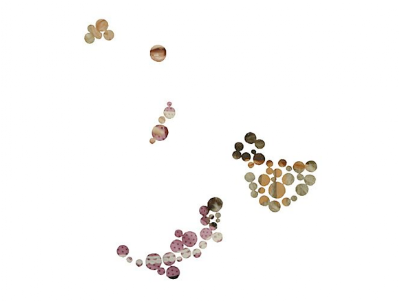
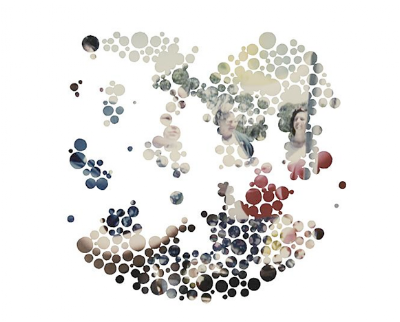
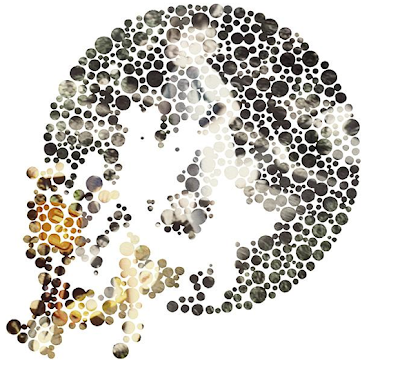
Odette England
Work from Attentional Landscapes.
“The Ishihara Colour Test is the most common clinical test for colour blindness in humans. But, like mirages and memories, the circles of randomised dots are just optical phenomena.
In this series, Odette England undertakes quasi-scientific experiments in manipulating the intended meaning and function of family photographs. Selectively and meticulously exposing personal snapshots through the Ishihara test plates, she explores how humans search, perceive and process imagery.
Inspired by the research of Professor Boris Velichkovsky et al ‘Attentional landscapes and phasic changes of fixation duration in picture perception’. Used with permission.”
Tags: cut print, family, holes, modification, nostalgia, obscured, portrait, science
Posted in cut print, family, holes, modification, nostalgia, obscured, portrait, science | No Comments »
Wednesday, 27 May 2009


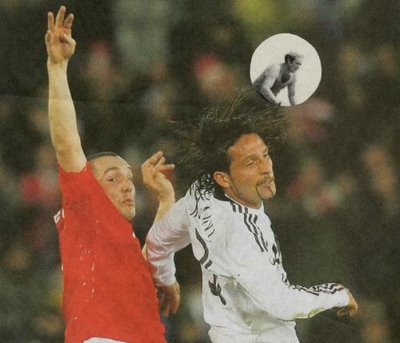
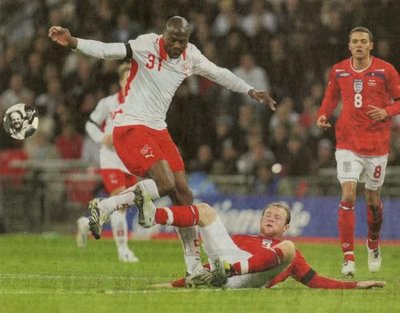
Veronika Spierenburg
Work from Newspaper no. 5 and Newspaper no. 4.
“Veronika Spierenburg’s Newspapers series no. 4 + 5 are a playful dissection of spectacle as it exists in sports photography, not in an overly analytic way but as one disassembles a machine out of curiosity – to inspect and marvel at its parts. Spierenburg approaches this spectacle first by disregarding the conventional way of viewing a football game “I am not a football fan…I don’t understand the rules of football…(but)…I am fascinated by the aesthetics of the football photos.” So we are no longer dealing with the football game as such but rather the body of material that is produced in photographing the game. In real time, while the ball is “in play” one is scarcely able to see the football as anything other than a blurry, circular mass flying through the air. It is only through photography that an object such as a football appears as a stationary orb, holding its position in mid-air while men are frozen in heroic poses of exertion, of concentration upon the fate of the ball, all at close range, as if we were joining them on the playing field. As Spierenburg notes “the football is more than a football, it is a magnet of gazes” and as in the eye of a storm, all eyes are on the struggle over the object yet there is a blankness, a sameness, a silence to the presence of the football itself. It is as in films when, in a decisive moment, all goes quiet as we brace for the outcome- the football photos are all infused with this sense of a dramatic, expectant pause -which has been amplified by Spierenburg’s treatment of the source material.
In series no. 4, the space in each photograph which would be occupied by the football is eclipsed by black & white photographic images, each one incidentally taken from “Freiämter Kalender” – a yearly publication of regional statistics and information which covered Freiamt, Switzerland the home of the Artist’s mother during the 1970s-80s. Each year all of the people who had died in this district were briefly memorialized in the Kalender, three of these obituary photographs are inserted here as one might have fitted them into an amulet – small, anonymous black & white micro-local print media which contrasts with the large color-saturated spectacle which could be taking place in any major stadium in the world, and then published in any newspaper worldwide. In newspapers no. 4 the blankness/ silence of the ball spoken of above is denied by this image which covers it, expecting to find silence we find instead a deep space, a circular window (as in a submarine) into another time/space – Spierenburg says she chose black & white images so that they register within our brain “as a time shift”, with the result that this object which is at one moment here, another moment there, at all times in the center of action, is again far removed from the commotion taking place around it. An unexpected formulation of the political also arises in these tiny worlds (of the anonymous and the dead) that are caught up in a spectacular power struggle between giants, who seem incognizant that these spheres that they are kicking around even contain life within them. Both the players and the figures within the contours of the balls seem detached- utterly apart from and unaware of one another- this is of course through the semiotic play of montage where bringing disparate materials close together materially invokes spatial and psychological distance.
The Newspapers no.5 series similarly uses images of football coverage found in newspapers as its source material but is not based around the ball at all, but on a very spare slicing of the picture plane which effectively leaves the limbs of the players cropped, becoming disembodied- ghost limbs, in motion with no center of gravity, sometimes no head – still flailing around after the ball like a chicken with its head cut off. This is both a disruption and a magnification of certain aspects of the sports spectacle. The lack of a centre, a spine, or a head tends to accentuate the dynamic and often precarious movements of the football player – accelerated movement is often represented by a breakdown or fragmentation of parts, as in many Cubist works. Here it is as if in the ecstatic movement of the limbs they become independent and autonomous- a body in themselves, continuing with the game. In the background, the bleachers are in soft focus, an unformed, soft and colorful mass watches intently the crystalline, balletic movements of well-defined knees, shins, outstretched wrists, and aerodynamic sportswear. It is as if the fetishisation of the power of the player’s body has reduced the body through selective focus and abrupt cropping to these isolated appendages, angling motionlessly in their moment of power. ” – Noah Angell
Tags: altered, appropriation, conceptual, newspaper, sport, swiss
Posted in altered, appropriation, conceptual, newspaper, sport, swiss | No Comments »


