Tuesday, 26 May 2009


Stuart Bailes
Work from [I couldn’t find a title for this body of work but I want to see more, and I hope it is coming soon] and Hidden (Forest).
“Hidden (Forest) was undertaken predominantly in Wales but some were made in the Forest of Dean and the New Forest. The geographical location was not critical, more important was the discovery of elements within the forest that would allow certain personal connections to emerge. Identifying sympathetic spaces proved to be incredibly difficult as the forest had to be at a certain point within its natural cycle to accommodate a sense of Bailes was looking for – however enigmatic and illusive. The preoccupation with the regenerative process of woodland flora is evident, a form of allegory to which Romanticism attached a sense of ones mortality.
Working in the dark is literally and metaphorically akin to existing in another realm, it heightens the senses, instils a sense of urgency, vulnerability, as the primacy of vision is diminished until the photographic event seeks to restore it. It is an adventure within a world that is generically known and in the depths of darkness becomes profoundly unfamiliar. Small pools of illumination through the use of flash reveal details of the forest floor; the flash of light brings with a perceptual shock that is literally the means to unlock the fantastical elements of the forest. Bailes pictures offer a theatrical space rich in narrative possibilities, a journey through darkness to a moment of illumination that suspends the forest interior in a liminal state of recognition and disbelief.
It was Roland Barthes in Camera Lucida who coined the term ‘punctum’ to define his often unfathomable and anxious preoccupation with certain details in photographs that triggered unexpected trains of thought. Bailes has identified an aspect of landscape that is bound up with the ‘punctum’ of place similarly rooted in memory and which, through the photographic act, moves a little closer to the possibility of knowing.” – Stuart Bailes
Tags: color, conceptual, landscape, lighting, night, photography
Posted in color, conceptual, landscape, lighting, night, photography, uk | No Comments »
Monday, 25 May 2009


Bill Jacobson
Jacobson was one of the earlier out-of-focus photographers, and for obvious reasons in my own work, I am a fan. There is something compelling about the denial of one of the fundamental characteristics of photography that draws me in. Currently showing at the Robert Klein Gallery.
“Bill Jacobson is well known for a body of work that negates (through the application of a diffusing lens) the specificity of photographic vision in favor of an immateriality of light and form. In the past his black and white pictures of isolated subjects suggested actions, moods, even narratives that were ethereal, haunting, and momentary. If his photographs were likened to poetry, Jacobson would be a symbolist rather than a realist.
His first series to feature soft-focus images was 1992-1993’s Interim Portraits. Interim Couples, Songs of Sentient Beings, and Thought Series followed, the last marking Jacobson’s first departure from the human subject. In the body of work that includes 2000’s Untitled, #3830, Jacobson took his camera to the streets of New York and, working in color, captured the prismatic effects of light washing over the active forms of the city. Untitled, #3830 immediately recalls the palette and compositions favored by Edward Hopper and, as a consequence, seems a messenger – or a memory – from an earlier time.” – thanks to the Museum of Contemporary Photography.
Tags: american, blur, blurry, conceptual, out of focus, photography
Posted in american, blur, blurry, conceptual, out of focus, photography | No Comments »
Sunday, 24 May 2009



Alison Jackson
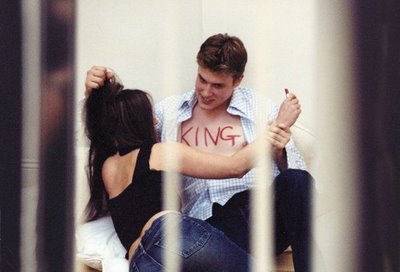
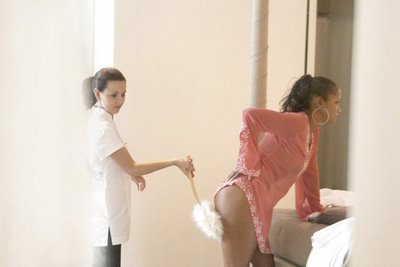
Work from Photographs. Here is a little celebrity magic for your Sunday browsing.
“Powerful images dominate the world. Pictures of celebrities who have reached the status of icons or demons. They are news—whether they are the Royal Family, Madonna, Posh and Becks or Britney Spears. This news becomes intrigue; it becomes difficult to differentiate between what is real and what is fantasy, what is important and what is not.
These celebrities are the icons of this contemporary folk religion. The pictures we have of them correspond to the religious pictures of the past. We find ourselves believing that what these pictures portray, really is the whole “truth” about the subject. For example, Marilyn Monroe is just a sex goddess; Britney Spears is white trash; Camilla is usually portrayed with a touch of the wicked old witch and so on.
The question is: How limited a picture do we receive of these icons? We suspect there is much more than we are told or read about. So our imaginations get to work to compensate for our lack of real information. Thus we are continually being seduced away from the “truth” into a world which has no “real” grounds of integrity and authenticity. At best, a photograph of a celebrity reproduces something authentic only at the very moment the shutter clicks. We have been teased and seduced into giving tiny fragments of “reality” an absolute authenticity. Images are by nature titillating and “of fantasy,” aiding this process. The photograph has become more real than the real.
This work is about simulation. Creating a clone or a copy of the “real” on paper. It is not a fake, it takes the place of the “real” for a moment, whilst looking at the image. The aim is to create likenesses of icons, where in the image, the simulations of icons, threatens the difference between “true” and “false,” between “real” and “imaginary”. The “real” subject becomes not necessary. The photographic image or the icon is more important and more seductive. It doesn’t matter to the viewer if the portrayal is not the “real”—as long as it looks like him or her—it creates a temporary confusion. This is the confusion the work searches to create. We think we are looking at something real, but we’re not. They are false images of look-alikes of the real thing.
Nevertheless, the photograph is authentic in one sense, Jane Smith and Jo Bloggs really exist as look-alikes within the image, but they portray a false picture of perception. The photographs reflect what really exists in the public imagination. They highlight the difference between what we see and what we imagine. This is bound up in our inherent greedy voyeurism and our need to believe.” – statement from M+B
Tags: authenticity, celebrity, fame, humor, photography
Posted in authenticity, celebrity, fame, humor, photography, trickery, truth | No Comments »
Saturday, 23 May 2009
Yogi Proctor
Work from Twenty Eight Portraits.
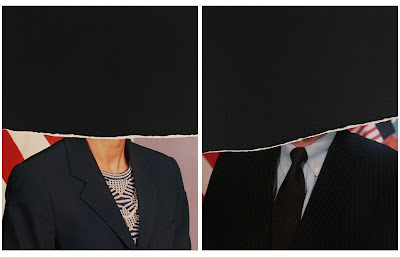
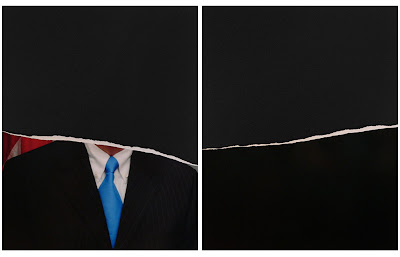
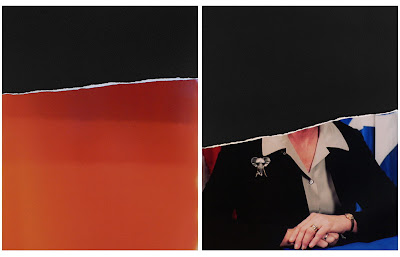
“Twenty Eight Portraits engages the materiality of a set of public-domain press photographs to intentionally expose the gamut of everyday photographic functionality.
Twenty Eight Portraits uses individual photographs of the entire presidential cabinet, which have been ripped roughly in half. The rip both figuratively and literally removes the focus of identity from each portrait. Where certain individual portraits were not available, previously discarded 35mm film leaders served to complete the set. When hung on the gallery wall, the rip connects across each 16″ x 20″ frame, forming a horizon line that unites the twenty-eight pieces into a single work.
In creating interrelation between abstract and political potential, Twenty Eight Portraits exposes the photographic picture as both mere paper object and essential component in the metaphysical space of everyday image relations.” – Yogi Proctor
via i heart photograph
Tags: appropriation, conceptual, medium, modification, obscured, photography, self-reflexive
Posted in appropriation, conceptual, medium, modification, obscured, photography, self-reflexive, tear | No Comments »
Friday, 22 May 2009


Miles Collyer
There was not enough space to post his other bodies of work as well, but you should go to his website to see the wide range of solid work.
____________________
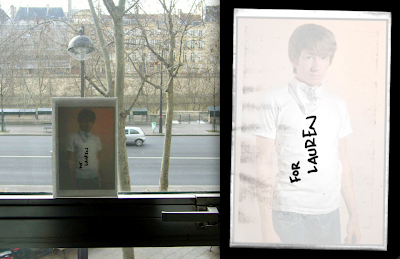
“For Lauren is a mail-art edition that was sent to 50 individuals in February, 2006. It is a reproduction of an original letter, which was never sent. The recipients were instructed to view the edition by placing the unopened envelope in the sill of a bright window.”
“Perhaps this explains the initial and contradictory mix of puzzlement and familiarity one feels when looking at it. Multicoloured balaclavas, felt flags with Islamic script, exploding blankets, neon colour wheels . . . His choice of materials and motifs disorient one’s conditioned aesthetic response to art. The “beautiful” or “emotive” signatures of the work exist at a remove, if at all. Maybe we’re being toyed with, for at first glance his choices seem arbitrary, random, even frivolous. Individual works exist in isolation from one another, and don’t seem to add up to anything like a consistent aesthetic vision. Initially it’s difficult to see the bigger picture. But the more you gaze at his work the more arresting and uncanny it becomes. One can’t deny its consistent visual power; the eye is drawn to it again and again. And though each piece seems to operate autonomously, what does become clear with repeated viewings is the presence of a witty (in its best sense, underscoring and informing every piece), risk-taking artist with an eye for images that sear themselves in the mind, and a tactile sensitivity and receptivity that seeks and permits composition with all manner of material.” – Robert Cook for The Art Gallery of Western Australia
Tags: Canadian, conceptual, installation, mail art, photography, portrait
Posted in Canadian, conceptual, installation, mail art, photography, portrait | No Comments »
Thursday, 21 May 2009


Gigi Gatewood
Work from Models, Representations & Self Contained Worlds and To Honest Seekers for Truth.
Sadly, I cannot tell you how I came across Gatewood’s work, but her approach to the peaceful yet tense still life drew me to it. Gatewood uses no text, only title, and has a fascinating habit of perching objects near table edges and corners that adds a particularly perilous quality to the seemingly placid still lives.
____________________________________
Models, Representations & Self Contained Worlds
“How is the human understanding of the world described and what can we learn from the way we represent nature? Models and Representations and Self Contained Worlds, two series of still-life photographs of replicas of natural subjects, investigates these objects’ purpose and history, and how we create worlds within our world. My subjects—objects depicting flora, fauna, and the human body—function in various ways: they teach, they sell, they decorate, they idealize. These objects are romanticized and sometimes absurd translations of reality, infused with our understandings of the world around us and with our desire to gain control over it, thus creating a space that exists somewhere between reality and the imaginary.”
____________________________________
To Honest Seekers for Truth (previously known as Knowing & Believing):
I photograph symbolic objects that bridge the gap between the universe and us to examine the different ways in which we search for answers about the unknown—from the scientific to the spiritual, from knowing to believing. The objects, whether a moon rock suspended in a transparent pyramid or a sheathed Newtonian telescope, fuse together the material and immaterial, the visible and invisible world. I use various strategies, including light and scale, to defamilarize the objects, reflecting the mystery in all belief systems. As this series reveals, I am, as one of my objects is inscribed, an “honest seeker for truth.”
Tags: color palette, documentary, photography, risd, still life
Posted in color palette, documentary, photography, risd, still life | No Comments »
Wednesday, 20 May 2009


Work from Remission. Go to Mater’s website and check out her other bodies of work as well, there is a phenomonal range of work addressing conceptual aspects of the medium of photography. The titles of these pieces are fantastic, make sure you follow the words that haven’t been redacted.
“Remission is something i have been working on in between projects. Whenever I need inspiration I go to the central library in Amsterdam, here i spend my time going through (science) books. The remission series are pages taken from these books where I pull the texts towards me, in for example the image: ‘hey, help me to make a landscape photograph’ i remission a text about something absolutely different to talk about photography again, either is a romantic or a technical way. ” – Katja Mater
Tags: conceptual, dutch, obscured, photography, redacted
Posted in conceptual, dutch, obscured, photography, redacted, text | No Comments »
Tuesday, 19 May 2009


Aaron Hegert
Work from The Money Makers and Every Day.
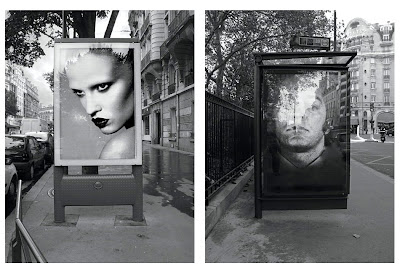
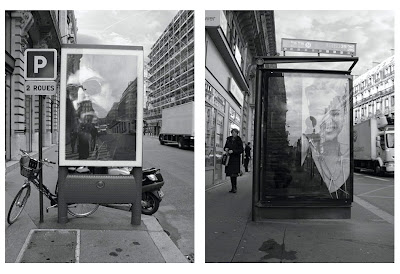
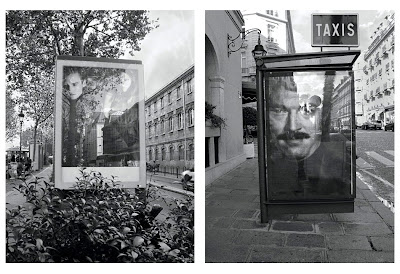
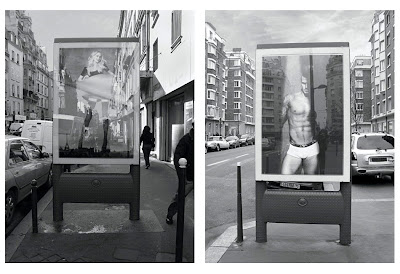
Hegert’s work is a fantastic example of observational photography well backed by a solid concept. I included one shot from Every Day because it reminds me so powerfully of a Cartier-Bresson in style, humor, and composition.
“Public places around the world are inundated with advertising images that represent the perceived and imagined cultural values of society, from idealized bodies or attitudes to exaggerated versions of our fears and desires. My current series of photographs, titled The Money Makers–a reference to the basic purpose of advertisements to sell products, as well as an uneasy reference to value placed on art as a commodity–is an examination of the placement, context, meaning, and function of photographic images as advertising in public places and the possibilities for investment of new meaning within these images through their reuse. The concept is based on the belief that the materials necessary to build an effective critique of society today are already present within the language of that society and that through simple processes of decontextualization and reorganization another meaningful ensemble can be found. To explore these possibilities I have created a series of photographs in which I erase the text and branding elements from outdoor advertisements in Paris, freeing the image from its commercial duty and at the same time enhancing the reflection of the urban milieu in which they stand. These images–originally citizens of a pseudo world apart, involved in a one-way conversation about themselves and promising us nothing less than an artificially produced mass ego–I now present as liberated images, no longer ignorant of their surroundings and open to interpretations and uses they were previously denied.” – Aaron Hegert
Tags: advertising, commercialism, conceptual, fulbright, paris, photography, SFAI, straight
Posted in advertising, commercialism, conceptual, fulbright, paris, photography, SFAI, straight | No Comments »
Monday, 18 May 2009


Ryan Thayer
Work from Ceiling Tile Wall, Untitled (Experience of Place), and IKEA Vattern variations.
“Ryan Thayer’s work ranges from architectural installations to photography and sound sculptures. He explores structures of power, and their often contradictory manifestations, in buildings and everyday objects. Through models of consumerism, anonymity, and boredom, he isolates these power structures as objects of contemplation.” – Ryan Thayer
“Despite the title of the current group show at Southern Exposure the work on view is, by turns, thoughtful, silly, absurd, self-effacing and sweet–none of the qualities that come to mind when I think of a smart ass. I count these as positive attributes because they keep the show Smart Ass, which is also sarcastic and irreverent at times, from being flip or arrogant. Instead the artists are premeditated, even sneaky, in their approaches…
…Before I get too far I should tell you that I personally know half of the artists in Smart Ass (I went to school with three of them). What’s more, I like their work. I also have ties to Southern Exposure. So you can take it with a grain of salt when I say that Smart Ass is amongst the most successful exhibitions Southern Exposure has presented.* Much of the credit belongs to curator Kelsey Nicholson who put together a show that does not simply hold together around the stated theme of sardonic humor but is bonded more tightly by a shared interest in coping with the paradoxes of contemporary life. Like the phrase “You gotta laugh to keep from crying” the works in Smart Ass, which span the gamut of artistic production, use humor as a coping mechanism–a way to stave off despair. This gives Smart Ass an overall feeling of compassion, or at least understanding toward the human condition.
There are other similarities. Most of the works stem from relatively simple ideas or observations–ideas that came suddenly in the midst of doing other things (not, it would seem, while “making art”): taking a walk, daydreaming at work, looking at snap shots, watching TV. This last activity was the impetus (perhaps the inspiration) for New York artist Shannon Plumb’s video Commercials, a collection of hilarious, manic spoofs of television advertisements shot in the style of Buster Keaton films. Amongst the physical comedy Plumb draws parallels between consumerism and Attention Deficit Disorder. In this way the work inSmart Ass is conceptual and personal. Here the ideas that are given form are nuanced and full of quirks. For me this allows the ideas to become visceral. Given this, it’s curious to me how each of the artist’s work in Smart Ass seems sealed off from the pieces that surround it. Imagine a sentence constructed entirely of parenthetical phrases.
I don’t doubt that the works benefit from being in the same room together, but usually I find more specific harmonies or greater dissonance between pieces in a group show. With Smart Ass these tensions are missing, replaced with an awareness of imminent dispersal. As I said this is more a curiosity than a criticism. The lack of tension may have something to do with Ben Riesman’sVisualize Sleeping Your Way to The Top, a believable self-help audioscape that satirizes the power of positive thinking to affect real changes in one’s life. The soothing voice of the narrator, his repetitive phrases, and the ambient sound track produce a truly relaxing if not hypnotic experience. So much so that if it weren’t for the gallery setting (which if you close your eyes as instructed you can block out) and Riesman’s idiosyncrasies, Visualize Sleeping Your Way to The Top could easily be taken in earnest.
More likely the encapsulated quality of the works in Smart Ass is due to the sense that all the artists are far more interested in what lies outside the gallery. Even the sculptural objects in the show point to everyday aesthetic encounters and have a kind of self-sufficiency that could survive less rarefied environments. I’m referring to Ryan Thayer’s large scale reworkings of homogenous office architecture (Ceiling Tile Wall, a modular acoustic ceiling, complete with fluorescent lighting fixtures and air conditioning vent, rotated 90º to become one entire wall of the gallery, or his claustrophobia-inducing office cube, Untitled (Experience of Place)….” – Shotgun Review by Scott Oliver
Tags: conceptual, humor, installation, sculpture, site-specific, space
Posted in conceptual, humor, installation, sculpture, site-specific, space | No Comments »
Sunday, 17 May 2009


Lilly McElroy
Work from I Throw Myself at Men.
“I throw myself at men.
The basis of the project is simple. I go to bars and approach men I don’t know. I ask if I can literally throw myself at them. Then I ask if I can take a picture of that moment. The men are picked based on their size; on the possibility that they can handle having 135 pounds come hurtling through the air. In other words, I pick men who I think can take a hit.
The resulting pictures show me in mid-air with my arms stretched towards the person who might catch me. I am, at that moment, part projectile and part foolish romantic. These images are documents of a hopeful and violent gesture, a demand that the possibility of a connection exist. The men often look terrified or at least slightly surprised. My role as aggressor is clear and I think of my leaps as feminist acts that acknowledge a basic desire for contact.
To date, there have been no major injuries.”
Tags: chicago, performance, photography, saic, self-portrait
Posted in chicago, performance, photography, saic, self-portrait | No Comments »


