“In the field of social semiotic theory (amongst other fields) the term modality (originally used in linguistics) is often used when referring to the truth-value or credibility of statements about the world. In Reading Images – The Grammar of Visual Design, by Gunther Kress and Theo van Leeuwen, the authors argues that modality should be conceived as interpersonal, meaning that information (of all sorts) doesn’t express absolute truths or falsehoods itself; it produces shared truths based on values and beliefs belonging to the specific social group that we live, work and/or interact within. Thus, by interpreting the modality markers (collectively developed out by each social group), we are able to decide whether the information is reliable and true or if it should be treated with circumspection.
As Holsanova and Nord suggests through the quotation on the previous page, the act of reading and interpreting information today is more characterized by multi-modality, rather than a singular modality. As the prefix implies, both information as such and the way we assimilates it has become more and more scattered and is highly dependent on recipients own models of reading and interpreting. The rapidly increased possibilities of access to information through the Internet via laptops, mobile phones and other media have dramatically changed the speed and the nature of how we consume information. Hence, the way in which we browse through different types of information has made the consumption of it a more individual activity, creating greater allowance and acceptance towards more subjective interpretations and opinions of it.” – Johan Eldrot
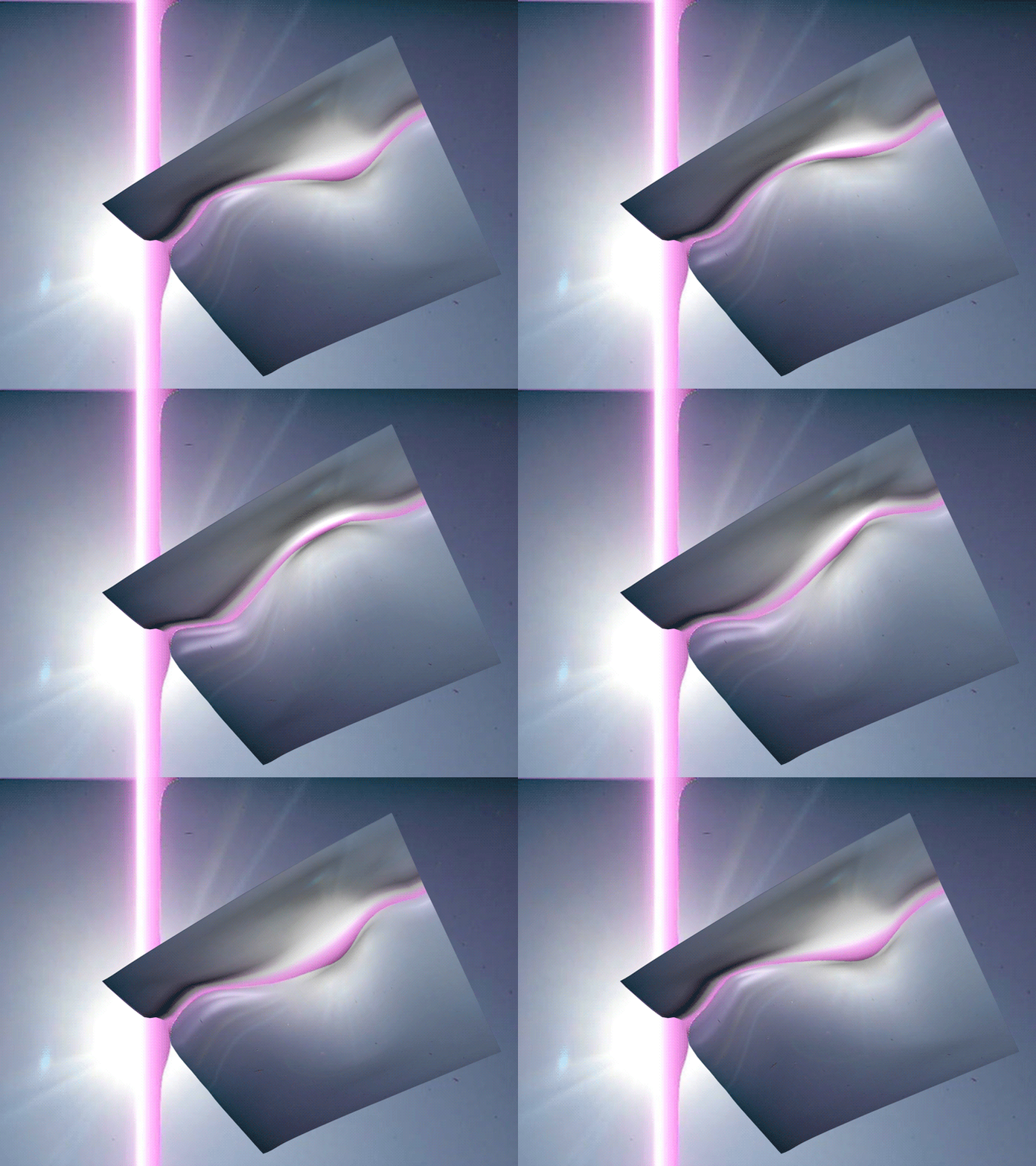
Their debut exhibition features the works of Emilio Gomariz and Andrey Yazev. While not in the exhibition, I have included one of Gomariz’s works that shares a process with his works in the show.
“The Internet, it is everywhere. It is here, it is there and it is where you actually are. It is so huge that nobody ever could print it. It is so deep that no one ever would dive to its end. There is peace and war in it, love and hate and all between. Once you have traveled trough it, you will never forget, and you will come back, asap, lol.
The Internet is a digital reflection of our real life world, but with much more freedom, with the option to be who ever you want, and this is really important, with an off-switch. It is a massive playground, a television with infinite channels and the greatest exhibition space.
In short, we love it.
And we, the Fach & Asendorf Gallery claims to be an important and interesting part of it.
The Internet makes it pretty easy and mobile for us to discover artworks from all over the world. Yes, and it seems that it had made it possible that some artworks get a behavioral like an autonomic creature. Sure, it is good if your work goes around the world, without any special effort beside putting a proper documentation on your website. The art and design blogosphere works as a neat filter if you frequently visit your favorite blogs.
But do you really want that? Do you just want to view the presorted stuff? That thought is pretty commercial, too commercial.
The Fach & Asendorf Gallery is the major online exhibition gallery for net.art, media art, digital madness and satisfaction.
We believe in electricity, bits, brains, glitch and curiosity. We are a seeder. — We don’t just reblog posts from other sites, we seed the freshest and latest works of a very fine selected group of exceptionally artists.” – Fach and Asendorf
“This work begins with the realization that photography now refers to and derives from both physical and virtual environments.
Consider deconstructing photography to its essential components, namely
1. the photographable
2. the photographer
3. the photograph
and re-applying them to the Internet “image-world” (as experienced via personal computer + monitor + screen shot).
Compressing environment, camera, and image into a singular apparatus and experience is an unconventional act.
Although I have increased accessibility and mobility to a variety of virtual locations, my body becomes increasingly isolated in a order to cope with the overwhelming desire to be simultaneously positioned here and elsewhere.
The achievement and disappointment of both photography and the Internet are due to the reliance upon the elsewhere.” – Jesse Morgan Barnett
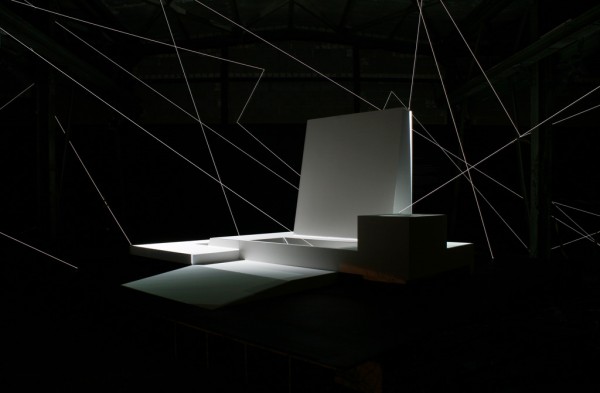
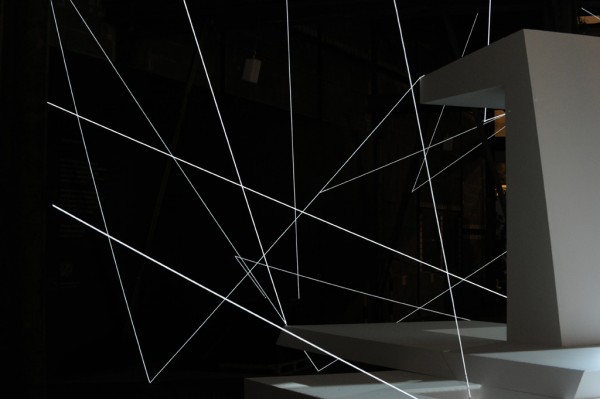
“Revolving Realities is an autoreactive installation, one that plays with our sense of reality by continually causing us to perceive and experience a place and an object in new ways. Its surfaces projected with different images, textures and animations, the object becomes a mirror of changing realities. As a result, a kind of real virtuality arises to confront virtual reality. A modular light installation issuing from the sculptural object reworks the space. Cords of light pass through the 600 m2 of surrounding space, intertwining the surrounding area with the centre. Ideas are seized upon and returned; the space is transformed into a sound box that enters into a reflexive dialogue with the sculpture. The object, the space and the beholder form a communicative unit.” –Martin Hesselmeier and Andreas Muxel
Fiercely emotive, de la Cruz’s work examines the language of painting and sculpture, challenging the established norms and testing the boundaries of both mediums. De la Cruz’s work is both unapologetically raw and darkly humorous, possessing a physicality that is as much influenced by the work of comics such as Jacques Tati, Charlie Chaplin and Harold Lloyd as it is by the visceral nature of Goya’s painting. Through violent interventions she anthropomorphises her work, manipulating and deconstructing her canvases and materials so that they appear broken, crumpled and collapsed. Twisted and deflated, her works lie as crushed or crumpled bodies on the gallery floor and wall. –Lisson Gallery
“…You do a lot of installation work as well as photography, installation work is often conceptual while photographers are often formalistic. Do you consider yourself a formalist or conceptualist?
I think installation is perceived as more conceptual and photography as more formal due to the overwhelming number of photographers in comparison to people who make installations. Taking pictures is such a huge part of western culture; it is truly difficult to avoid being a photographer now. This is of course tied to the current ease of making (with the proliferation of digital cameras) and displaying (through the internet) images. Why it is that most people prioritise formal issues is then the question. In contrast, creating an installation requires a great deal of specialized knowledge – or perhaps indoctrination – that most people don’t readily have access to and is administered in a community that prioritises the conceptual over the formal.
If forced to choose one I would say conceptualist, though formal issues are always considered when I am working. For instance, my installation October 11th, 2007 uses the idea of the mimetic projection but was laid out in the space based on formal decisions. I think the most successful pieces result in a balance between concept and form.
Your photographic series such as ‘mirrors’ and ‘portraits’ are self-reflective of their medium, and focus attention on the camera itself. Your video and installation work also appears to deal with this issue, so do you have a preferred medium to work in, or do you find them all equally relevant?
I wouldn’t say that I have a preferred medium. Currently, I am most interested in the power relationships that are present in representation, and so I find questioning a medium utilising aspects of that medium itself a productive strategy. I hope that while the initial focus appears to be on the medium, the viewer will eventually find themselves and their act of viewing implicated in the work.
On your website your photographs are in series or sets, do you feel this adds to the photographs individually, or would they convey the same message should they be displayed on their own?
With some series an accumulation of images is in a way built into the idea when I conceive of the project though it is not necessary when displaying the images. But in general, rather than thinking of images or projects individually I consider everything dependant or linked to the other work I have already completed. When beginning something new I am always considering what sort of dialogue it will have with the work already produced, or where it will lead my work next.
What are your plans for the future?
For the long-term, I don’t have any solid plans. When I finish my MFA I would like to move to a larger city where I can become active in the art community and ideally be able to teach in a college art program. I am considering cities throughout North America and Europe. Speaking in the short-term, this summer I am doing a lot of research, catching up on reading and developing new ideas for future projects.” – HUH Magazine.
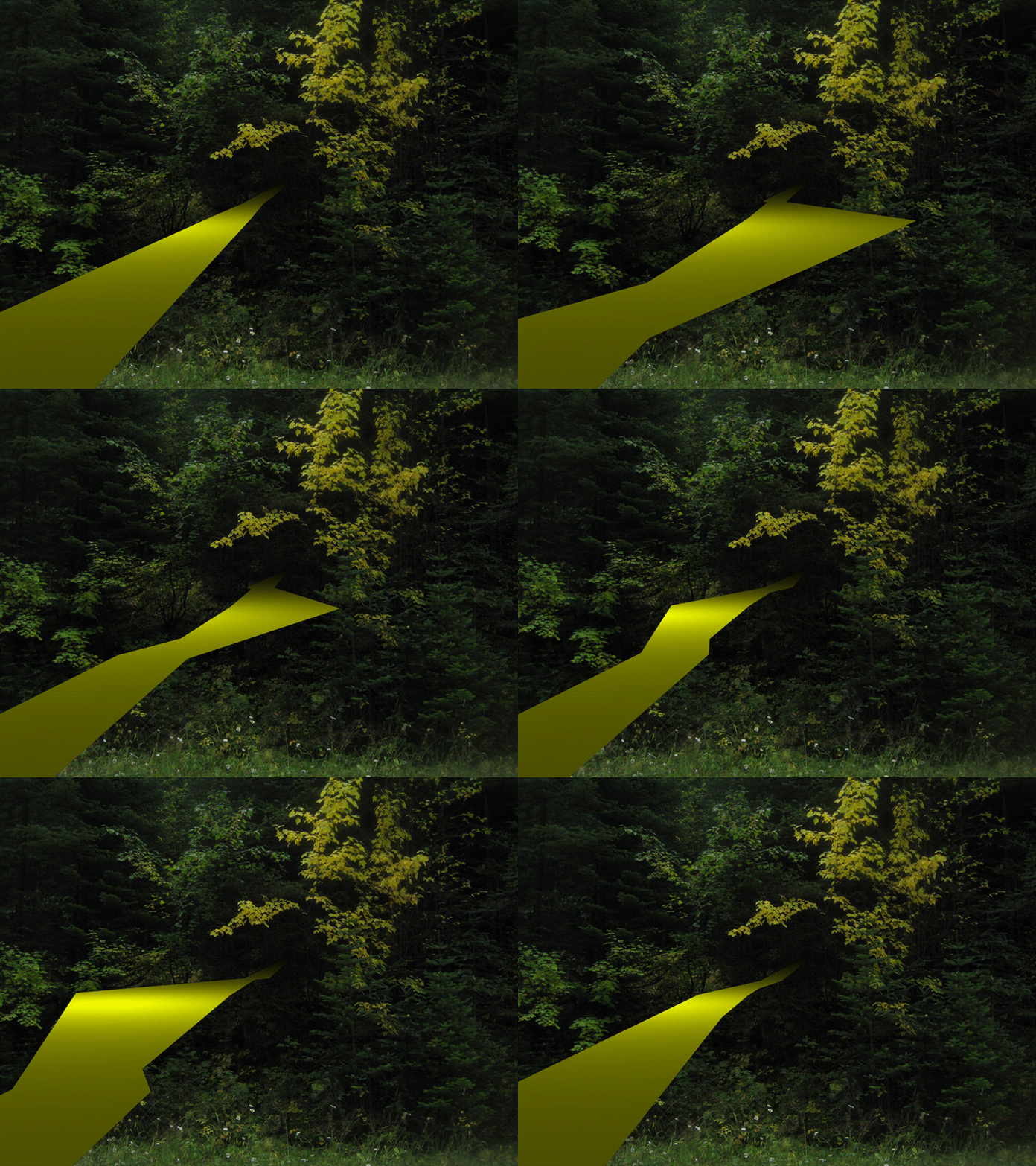
“I try not to follow the roads I am supposed to take, but try to seek out my own path within and outside the given boundaries of the game. I find joy in making use of a glitch/error which gives me the possibility to have a different look at the virtual world. Flying around and running through walls which I am not supposed to do gives me a sense of freedom and the ability to move in ways I can’t in the physical world. I want to look behind the curtain of the virtual facade and show it to the world.
I hope that my view of the virtual world will in the long run make us think about actually using the new possibilities that the virtual world offer us and try to create a more innovative and challenging virtual world.” – Robert Overweg (statement from Glitch, but appropriate for all of the presented works)
“Murata uses objects that already exist in the world, playing with their inherent narratives and associations. Murata’s still lifes are composed of arranged objects such as VHS cassette tapes, fruit, skulls, cracked iPhones, musical instruments, and beer bottles. He places these objects in a virtual space that appears eerily real, accentuating their strange relationships with each other as they rest in a timeless abstract space. With these prints, Murata moves in the opposite direction of time-based video, emphasizing stillness, tension and pictorial illusion.” –Ratio 3
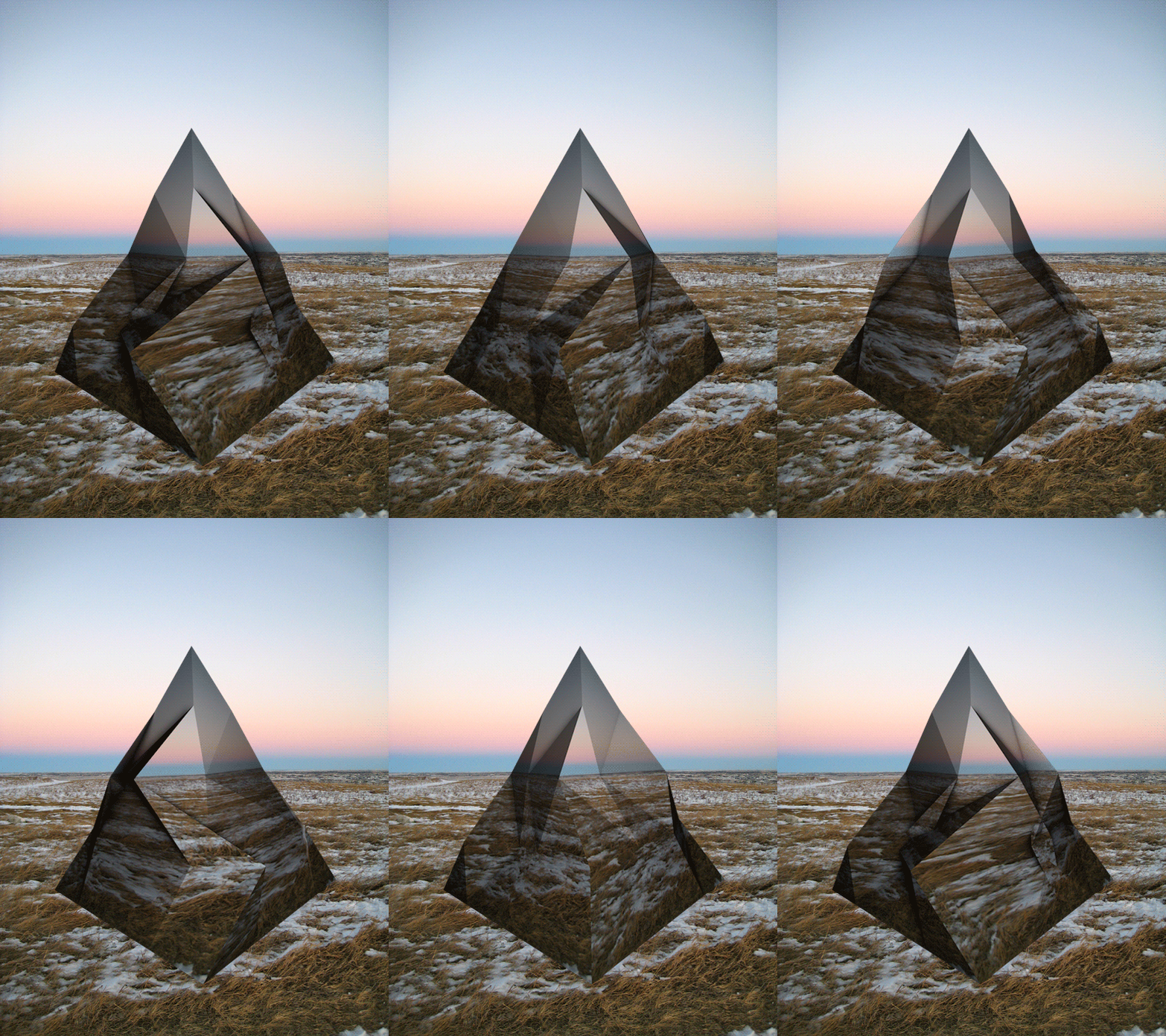
“Rick Silva’s ongoing project Antler’s Wifi depicts a series of animations that combine geometric glitch aesthetic with serene landscapes and natural iconography. The weekly updates to this blog project vary in complexity and density, but all the images share an acute aesthetic that Silva has been developing over the past several years. The visual elements that comprise the animations in Antler’s Wifi – a telling name – often juxtapose vistas of the icy surrounding of Silva’s current Calgary home with diagrams that appear to be algorithmic interpretations of geological structures found beneath the soil. These images not only appear to hold secret mathematical equations, but also appear to be pseudo-scientific data visualizations of some hidden incalculable source.
The crystalline patterns and undulating shapes that appear in the more recent iterations of this work – “an aesthetic that was rebooted” according to Silva at the beginning of 2011 – create a tranquil yet playful reinterpretation of the landscape image. It appears as though the line drawings and artificial peaks that mirror the mountain ranges and remote lakes hold resonant frequencies that generate their rhythms and patterns. The short gif cycles appear as though they contain sonic qualities that never actually manifest through playback. This lack of an aural link to the repetition and rhythm of the animations accentuates the remoteness of the imagery providing viewers with hypnotic and haunting micro-scenarios.
The directness of the pairings made by Silva throughout this work symbolize a need for understanding and contemplation of the visual world outside out windows and away from our screens. The meandering presence that dictates the visual paths and pace of the aesthetic that Silva captures within this work is akin to the wanderings of an amateur cartographer mapping the foothills of his backyard. In some images the false sense of simplicity that landscapes embody is paired with similar elementary geometric spaces for deviations and abnormalities to occur. Silva compares the hidden ecology of any environment to the abstract complexity of euclidian geometry throughout many iterations of the work. Observers of this project can see how the lo-fi superimposition of data-projection highlights the correlations that Silva wishes to explore in these diaristic and delicate renderings.” – Nicholas O’Brien
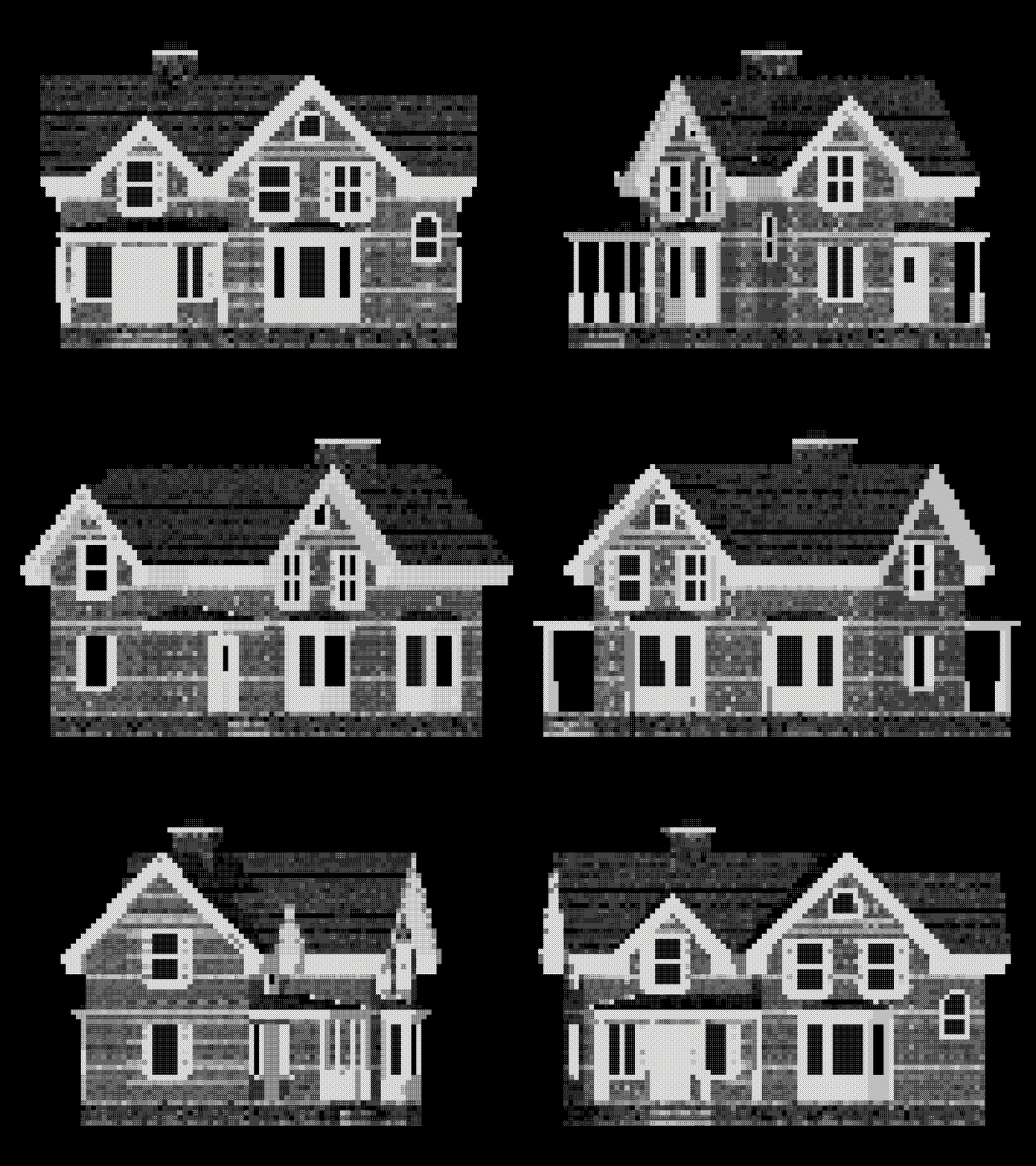
“I want to go back to the idea of modularity that has come across in the last model you sent me. Does the malleability and flexibility of these 3D environments inspire your process, or has your work always contained a element of repetition and combination?
I’ve always been excited to insert elements of repetition and combination into architectures, landscapes, human environments in general. When I started drawing architectural shapes, I realized that copy/ pasting a building was very easy. Any kind of architectural fantasy is stimulated in a 3D environment. It’s something scary and exciting at the same time, but I think it’s also something that we have a lot to learn from.
You’ve mentioned how observing and searching play a large role in the work. Are there areas of study and observance that you participate in that haven’t manifested in your work yet?
I like to observe how technology is integrated in my environment. That includes architecture, landscape, domestic interiors, industrial areas, etc. Most of these fields have already manifested in my work as digital drawings or animations, which is a starting point. A lot of my work is driven by the possibility of being translated physically.
In these sketches, and your other work, there seems to be a great demand for order and symmetry. Is this just a stylistic undertaking, or is there some other concern, like say form an architectural perspective?
When I draw architectural shapes, I find it exciting to think of a house as an abstract geometrical shape. Looking at architecture from its beginnings until today, it is something that really stands out to me.
I think I’m also interested in how the translation of the fantastic structures and landscapes you’ve made here are starting to manifest themselves in real space. Can you talk a little bit about how you are planning on realizing these virtual works into physical objects?
There is something very romantic about the potential of technology integrated in our daily environment and I would like to explore more that potential. I want to address domestic spaces and daily areas where we use technology. My work generally takes the shape of a building, a landscape or an object; these are 3 elements I’m working a lot with when it comes to physical objects.” – excerpted from an interview with Nicholas O’Brein for Bad at Sports.