Florian Hecker

Florian Hecker

Work from Event, Stream, Object.

”Event, Stream, Object” is a sound installation by German artist Florian Hecker (born in 1975, he currently lives in Vienna), produced by MMK with funds from the MMK’s partners, that has now been acquired for the museum’s collection. Presented in the current exhibition ”Radical Conceptual“ (February 19 – August 22, 2010), the work consists of a loudspeaker system suspended from the ceiling used to convey a computer-generated, eight-channel sound composition. Each individual loudspeaker plays a sequence of sounds allocated to it and, in itself complex, become a part of the acoustic whole with its differing frequencies and volumes.

“Florian Hecker is one of the most innovative artists of the present, because in his work, he combines the areas of fine art, music and performance in order to break down the barriers between them and open up new forms of expression and means of perception in space and time,” comments Dr. Susanne Gaensheimer, Director of MMK Museum für Moderne Kunst.

Over the last few months, the artist has used a special kind of software to elaborate synthetic sounds for the exhibition space at MMK. Here, the sounds offer museum visitors an unusual kind of experience – a space/sound experience. The further they progress into the installation, the more intense their constantly changing perceptions of space, the body and themselves become.

The bent reflectors in front of the loudspeakers illustrate the way that the sounds rebound and are diverted, thus heightening the complexity of the sound installation. ”The work dramatizes an uncoupling of sound sources in space and the locations from which we perceive them to come. Such an active process of hearing underscores the impossibility of uniformly describing what we hear, when, where and by whom it is heard,“ explains Florian Hecker, talking about his installation at MMK. The artist is equally interested in the history of concept art and in specific developments in the composition of post-War modern art, electro-acoustic music and non-musical disciplines. In ”Event, Stream, Object“ he is particularly concerned with Diana Deutsch’s Erkenntnisse der musikalischen Psychologie, the change of perspective associated with processing signals developed by Dennis Gábo and Albert Bregman’s psycho-acoustic research.

Attempts to describe Hecker’s acoustic work quickly highlight to what extent our language is based on visually coded formulations. The nature of his installation emphasizes an active and subjective experience, since the piece presents itself differently to every hearer, depending on his position in the room. Moreover, each time the sound installation is played is unique, because there is something known as a stochastic scheme built into the spatial composition that slightly various the sound signals, thus repeatedly making them sound surprising and unpredictably different.

Recording of “Event,Stream, Object”

via Museum für Moderne Kunst Frankfurt am Main.

Lenox-Lenox


Lenox-Lenox

Work from TMRRW(dot)net (and their oeuvre).

“TMRRW(dot)net combines predictable and unpredictable change in order to form a cubic time capsule of tomorrow’s relics. Predictions arise by mapping the course of natural disasters and desiccated resources, and non-predictions are postulated from science fiction and myth. The resulting guided tour of The Last Gallery presents attributes of artifactual design and nostalgia: we will remember impact events and Y2K12 hysteria; thirst, wetness, and all things glossy; sitting, leisurely commodities, and decoration. This piece intends to simulate future documentation of the past, while simultaneously proposing precursory relics.” – Lenox-Lenox

Niko Princen

Niko Princen

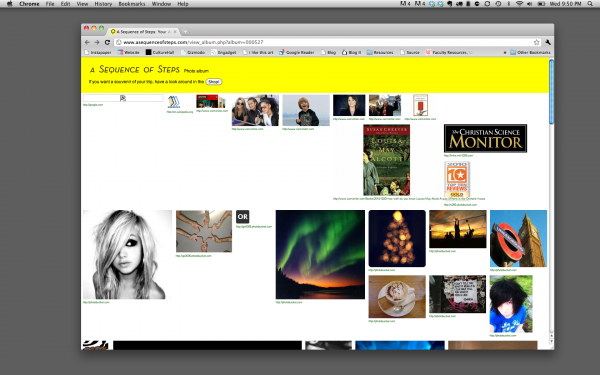
Work from A Sequence of Steps (and his oeuvre).

“A Sequence of Steps is an automatic web-browsing tool. It presents a new way of experiencing the Internet by creating different relations between websites. The trigger mechanism starts with a chosen point of departure but can lead you to the infinite space of the web without a conscious decision.

It is also a way to look at what happens when we turn technology on and let it be autonomous. Let it go for itself.

During the trip it takes random snapshots of where you went and collects these images in a photo album. There you can see all the images together next to each other creating new meaning derived from their original content.

Here you can travel the World Wide Web. Only the direction is not set.

Surf’s up!” – Niko Princen

Programming by Martin Pool

Stefano Calligaro

Stefano Calligaro

Work from his oeuvre.

“The nature of Stefano Calligaro’s practice can be seen as a minimal intent to describe the construction of an artwork through layers of gestures as collecting displacing and remodeling materials, images and meanings. The works and their subtle presence in the space are tracing a constellation of references in constant dialogue with each other. In their misterious but simple essence, they look like hermetic compositions meant to translate in forms an untouchable visual narration” – Stefano Calligaro

Phillip Schaerer

Phillip Schaerer

Work from Bildbauten. Also see Raummodelle, they are fantastic as well.

“The series of images with the title „Bildbauten“ deals with the effect and the claim to credibility of images of architecture that appear to be photographs. It further questions the medium “photograph” as a documentary piece of evidence depicting reality.

Frontal views of fictional architectures serve as an example. By means of their exaggerated and orchestrated way of representation, they model themselves on the object-like appearance and the formal language of contemporary architecture in a rather ironic way. All images try to reproduce a reality. They are not a photograph; instead, they were newly designed and constructed from scratch by means of image synthesis and digital image editing.” – Phillip Schaerer

Renata Lucas

Renata Lucas

Work from her oeuvre.

“Renata Lucas’s practice is a critical interpretation of how our built environment determines actions, behavior and social relationships, and by extension, society’s dependency on the preservation of prescribed definitions of space, property and order. By offering an alternative spatial imagination—one that brings into consideration malleability, manipulation and play—Lucas provokes the possibility of new subjective and collective engagement within our built environment.” – via REDCAT

Iman Issa

Iman Issa

Work from Triptychs (and others).

“Issa’s Triptych series (#1, #2, #3, #4, #5, #6) from 2009, is a group of six beautiful wall installations comprised of photography, video objects and texts. They are images of places she collected in New York and restaged; settings that occurred through a personal psychological process in order to reveal personal associations. As Issa says “At one point I realized that what might have attracted me to these spaces was that they reminded me of others…. In trying to be as precise as possible, I realized that the certainty with which I was able to construct and produce these images did not translate to my final photographs, that I no longer recognized my constructions.” – press release from Rodeo Gallery.

Amos Latteier

Amos Latteier

Work from Calculator Haikus (also check out N8R TXT if you live in Canada).

“I created two haikus using upside down calculators.

Illegible blob
Legless eggshell oozes oil
Elegize his loss

Hellish shoe is beige
I slosh soil, slog hill
Hobble, oh high heel

You can form words with a calculator by entering numbers and then turning the calculator upside down. Each number except nine corresponds to a letter.

1 2 3 4 5 6 7 8 9 0
I Z E h S g L B O

Figure out the word you want to spell using these letters and then key in the numbers in reverse order. For example, to spell HELL use the number 7734. To make a word that ends in O you must use a decimal. For example, to spell HELLO you use the number 0.7734.

The calculator vocabulary is rather limited. I have come up with 118 words. I wrote a program to search the dictionary and select words that can be spelled using the letters that can be formed on a calculator. Among these are such choice words as gigolobesiege, and ghee.” – Amos Latteier

Snijders & Teunisse

Bram Snijders & Carolien Teunisse

Work from RE:

“RE: is a 360 projection-mapping installation that uses mirrors to enable a projector to project on all sides of its own surface. In most art installations the projector is used as merely a tool; preferably even hidden away from view. Contrastingly, in Re: the projector is the central object of attention by making the device both the sender as well as the receiver of projected light.” – Snijders & Teunisse

via Today & Tomorrow

Internet Archaeology

Internet Archaeology

Work from their oeuvre (and Now Thats What I Call MIDI).

“Internet Archaeology seeks to explore, recover, archive and showcase the graphic artifacts found within earlier Internet Culture. Established in 2009, the chief purpose of Internet Archaeology is to preserve these artifacts and acknowledge their importance in understanding the beginnings and birth of an Internet Culture. We focus on graphic artifacts only, with the belief that images are most culturally revealing and immediate. Most of the files in our archive are in either JPG or GIF format and are categorized by either still or moving image, they are then arranged in various thematic subcategories. Currently, a major focus of Internet Archaeology is on the archiving and indexing of images found on Geocities websites, as their existence has been terminated by parent company Yahoo; who discontinued GeoCities operation on October 26, 2009. Internet Archaeology is an ongoing effort which puts preservation paramount. Unlike traditional archaeology, where physical artifacts are unearthed; Internet Archaeology’s artifacts are digital, thus more temporal and transient. Yet we believe that these artifacts are no less important than say the cave paintings of Lascaux. They reveal the origins of a now ubiquitous Internet Culture; showing where we have been and how far we have come.”