Jessica Pooch

Jessica Pooch

Work from her oeuvre.

INSIDE MONDRIAN

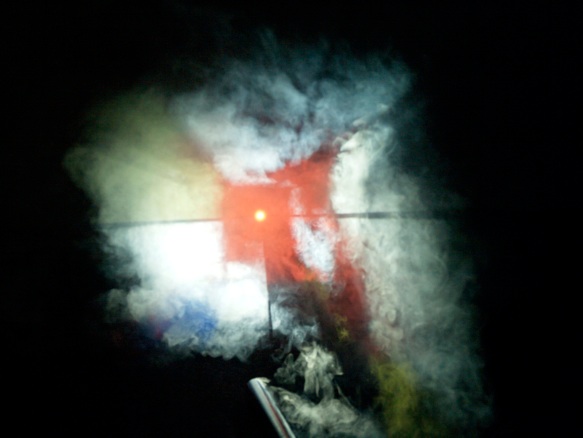
The work “inside Mondrian” is constituted in an installation consisting of a projector, a fog machine, a

Metal tube and a ventilator. Beamer and fog machine to face off in a line. The projector projects the image without interruption. The fog machine is equipped with a metal pipe through which the mist is focused and is expelled at a rate 5 sec fog, 20 sec break. Once the fog shoots toward projector, the projected image is visible. By the beam of the projector and the mist as base, “Composition with red, yellow, blue and black, shall be held in space.

The image is projected on the mist through the fan in motion and held. Again and again builds up that image put on new.


MULTI ASPECTS

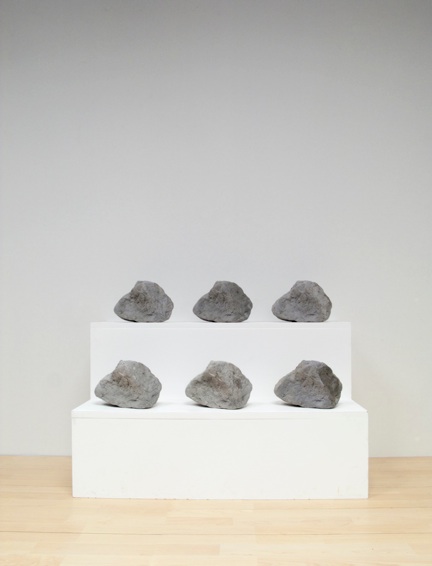
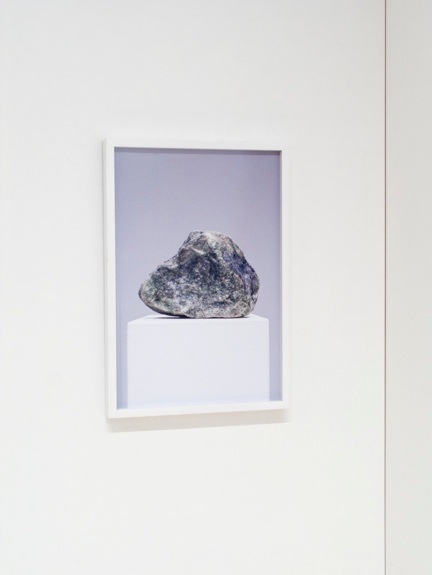
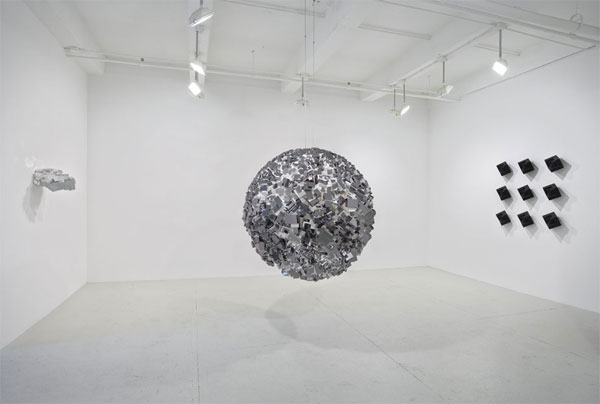
These are six silicone casts a stone and a framed photograph of the original.All stones are identical in shape and size. The casts are made of cast plaster.The pictured in the photograph stone was stolen from a landscaped garden.The original stone is visible only in the form of reproductions in the exhibition.

Geoffrey Pugen


Geoffrey Pugen

Work from his oeuvre.

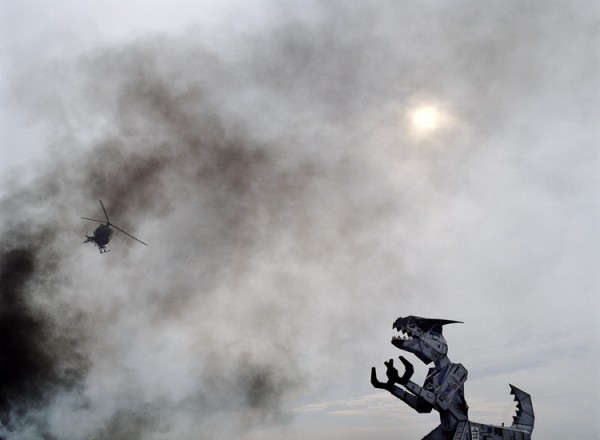
“With theatrical absurdity, Pugen explores relationships between real and staged performance, the natural and the artificial, and tensions of virtual identity, through altering and manipulating images. Working with video, film, and photography in the digital realm Pugen renders situations that examine our perceptions of how history, documentation, and simulation intersect.” – Geoffrey Pugen

Phil Toledano

Phil Toledano

Work from The United States of Entertainment.

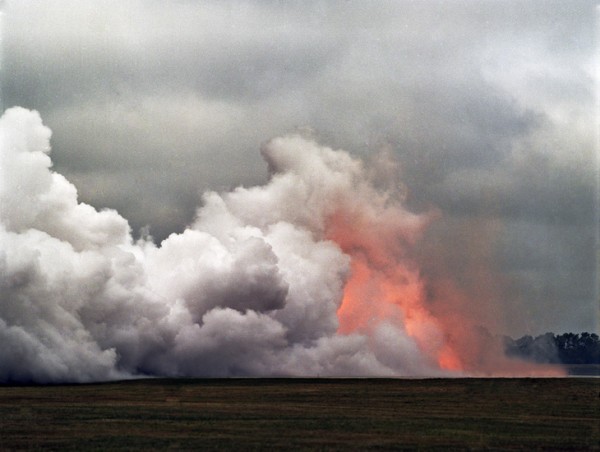
“I’ve always felt that the very soul of a country is reflected in the way in which it entertains itself. So how does America amuse itself? And what does it say about the very nature of the American soul? Spectacle. Destruction. Guns. Religion. And of course, scale, giant scale. All of it refracted through the prism of commerce.” – Phil Toledano

John Powers

John Powers

Work from Star Wars Modern (among others).

Below is a blog post Powers wrote regarding statements. The statement in question can be found here.

“I spent the morning working on a couple applications. One was for the Guggenheim’s YouTube show. I decided to submit the short test I did with the help of my digital animation friend Teddy Gage Spiral Jedi. I misread the instructions on the submission. I thought they wanted a thousand words – turns out they only allowed a thousand characters (spaces included). Rather than throw away 4,447 carefully arranged characters I thought I would use them as a post. but I have a reservation. I am always interested to read artist writing, but I very seldom enjoy reading artist statements. They tend to sound bloated and pretentious – my own included – it’s the nature of the beast.

There are a few I like. Jackson Pollocks Guggenheim Application is a a great one: “I intend to paint large movable pictures that will function between the easel and mural.” I like that he uses such plain language, that he says pictures. Mostly I like how short it is. The one Carl Andre wrote for Frank Stella’s black paintings, Preface to Stripe Painting is even shorter than Pollock’s:

Art excludes the unnecessary. Frank Stella has found it necessary to paint stripes. There is nothing else in his painting. Frank Stella is not interested in expression or sensitivity. He is interested in the necessities of painting. Symbols are counters passed among people. Frank Stella’s painting is not symbolic. His stripes are the paths of brush on canvas. These paths lead only into painting.
That’s the whole thing. It reminds me of the writing lesson in A River Runs Through It: “The art of writing lay in thrift.: I don’t at all subscribe to that notion myself, but I admire it in others.

My all time favorite artist statement belongs to the artist Tom Friedman, who, for a solo show he did in 2000, wrote a bullet point history of the future. It was a complete non sequitur – bonkers. I remember wishing I had done it myself. Friedmans’s inspired a long assemblage of quotes and images that I posted a while back on the subject of the Singularity. I also posted it in its original undiluted form because it was not available anywhere esle on the web. (I typed it in using the original xerox I got from the gallery – I keep it pinned to the wall above my desk.) Amy Sillman’s Some Problems in Philosophy is a great recent example of this same sort of left field triangulation.

Artist statements are easy to make fun of, but we are required by gallerists, institutions, grant giving bodies, residencies, etc. etc. to submit artist statements. And for an artist who not lucky enough to have had anyone else write about their work, it is there only opportunity to give the work context. In addition they sound the way they do because we are usually given a ration of shit if we try to submit something unconventional. But truly that is not the problem, the problem (especially for younger artists) is that most of us love to write them (artist who don’t out grow that impulse start blogs).

Something I realized after reading Friedman’s non-statement was that artist statements are traps – viral mindworms akin to earworms. My friends and I would spend days at a time writing and rewriting these things, passing them around, asking for input, editing sentences over and over in order to strike exactly the right tone, allude to the smartest theories, contextualize our work within the most compelling contemporary work – on and fucking on. All in an effort to make them sound like the ones we picked up in the galleries. The nightmare was that they all ended up sounding drearily the same.

I was already aware that I had caught the writing bug, but I was also aware that I was pouring that energy into writing and rewriting a single statement. I decided to write about and talk about my own art as little as possible. I did an artist lecture for the Brooklyn museum in the aftermath of Friedman’s essay were I never mention my own work – I talked about the conventions of sculpture as conventionalized expressions of authority as I toured a group through the museum’s Egyptian art collection (one of the best in the world).
I did my first text base show Indicator Spaces less than a year later. That text never mentions me, in fact I made a fetish of avoiding personal pronouns. All of the artist lectures I have given since have been about art, not my art, or at least not all about my art – you are expected to introduce your self and your work – but as much as possible I talk about art in general. And now I do this blog.

I understand that artist Statements are a required part of the gig, and I have a couple simple ones I keep on file. I usually ask that my artist statement be kept private. If that won’t do, I do my best to make them fun to read (and write). My best effort was an assemblage of quotes I made for a show a couple years ago. For those interested you can see it here.” – via Star Wars Modern

Pleix


Stills from
Sometimes video
E-BABY video

Pleix

What does Pleix mean and how long has it been around?
Leti: “PLEIX” doesn’t mean anything, we just liked the sound of it and the look of the letter combination. This name comes from one of us in the group who is very good at finding words that sound good, yet are ambiguous. Most of us are based in Paris, and have worked together since 2001.

Are you all from Paris?
Leti: No we are not all from Paris, but we are all based in Paris!

Who is “Chased by Cowboys?” Are they the one(s) responsible for all the 3D animation
Leti: “Chased by Cowboys” is a production company that represents us in Germany. We have other producers in the UK for advertising, such as Blink Production, and for music videos there is Colonel Blimp. In France, we are with Soixante Quinze.

Bleip is your music vehicle?
Leti: Bleip is part of the collective thing we do. Bleip, the person, is a musician and also an editor. He knows exactly what “rhythm” really is, both musically and visually, and we like that about him. The music he composes is very “visual”, in that it’s very easy to imagine his music with graphics. Because we all like his music, we work with him often but we also do video for other artists. Currently, he has a new EP out called “+1” and is now working on his second CD project.

Do you all work together to complete a single project or do you take on projects individually, under one group?
Leti: In fact, it depends on the project we’re doing, but most of the time a project will start first by name only, and if needed (technically or creatively) two or all of us come together and join the project. We all discuss the projects collectively and share ideas. At the end, we sign the project as PLEIX.

What are your individual roles in the projects?
Leti: Pleix is a real community of digital artists; graphic designers, 3D artists, musician, editor and a project manager. We really like mixing our different skills to gain greater freedom to do a verity of things. The roles depend on our skills, but also of each of our own desires, it’

I read somewhere that you all met at Kuntzel+Deygas Animation studio, is that correct? Can you talk about that some?
Leti: Yes, we all met there a few years ago. It has been a great experience for all of us to work for those very talented directors, Kuntzel and Deygas. During that time, we (the Pleix team) got along very well together and found we really liked and respected each other’s work and ideas. As I said, we were all complementing, technically and creatively each other, and it was ideal situation for us to be together. We wanted to do our own projects. I guess that’s a really good reason to come together!

When it comes to motion design, what are you most interested in accomplishing?
Leti: We like to work on limits– contradictions and accidents that show the fragility of the digital world and the world in general. We all like producing tension by joining together heterogeneous graphics, videos and sounds. By being a group of seven, it makes our inspiration source very large– meaning our inspiration comes from many different fields like cinema, art, TV, comic books, cartoons, etc. For us, we find it is always very exciting to start on a new project together.

What are your individual influences?
Leti: We all really like electronic music– some of us like Aphex Twin, Amon Tobin, Björk and many, many other good artists. Individually we’re inspired by a lot of our own things, but for music, we’re in agreement. We really like electronic music, but not only that.

I like the cynical tone and modern approach in your animations. How do you arrive with the concepts in your work?
Leti: We really like using what we see every day on TV, in our society and whatever happens in this world. In our films, we usually try to have double meanings, and people are free to see what they want in them. We like to use social commentary with a touch of dark humour, and that sort of mix is very important for us to keep a project on the “lighter” side. We all like to work it to the edge of things and make one think.

What are your thoughts before and during the creation period?
Leti: Once we find the right idea… we don’t “think” anymore, we work! [laughs]

Who is the force behind all of your photography?
Leti: Ah, don’t forget we are a collective and it’s not always the same person who does the photography! We simply get what we need, the force behind it is up to whomever is working on that part of the project at that time.

I love the style, cropping and perspective. Do you stage all your photography/videography and later edit it digitally?
Leti: It really depends on the project, we never use the same process.

Can you talk about your process in handling photography in your animation pieces?
Leti: We love using a mix of techniques, photography is a combination of all of them, it’s just a tool though!

Do you all see yourselves sticking to this style or mood, or do you ever feel the need to try other things?
Leti: We don’t think there *is* only one “style” in all our films. But there is an ambience– an atmosphere– a feeling of how we all work together to bring the project on edge of things. The Pleix “touch” could be a common task reset to more unique conditions, however it is done, we too want to be surprised!

With some of the imagery you use, I imagine it might spark a little protest. What sort of reactions do you get from the public?
Leti: We are always very surprised to see that many festivals, design schools, art museum and so on ask us to show our films. Most of the time we’ve received nice reactions, but of course some people hate what we do, which we find is nice too!

Are you trying to get under their skin? What’s the overriding agenda in your work?
Leti: We find our inspiration in our society, our world which is full of contradictions. We usually try to have more than one connotation in our films, somewhat like a subliminal message. You can watch our videos without thinking of it or noticing it, then maybe later you’ll find something more sensitive in it. People are free to see what they want, we don’t mind. We are not so different from other artists. We’ve got our own tastes, our own desires and our own sense of humour– we’re free to use it.

I know group collaborations are not always easy, how do you all get along?
Leti: As when we first met, we really liked and respected the work we each did. It’s still the same and will remain that way. I know it’s hard to explain but we all get along really well, and there is no leader, and no hierarchy in the group. We feel free to do and say what we want and without worrying about each other’s character, because we just like each other, like a big happy family.

How do you manage your time? You have done so much in such a small span, you’ve either figured out how to stop time, or you don’t sleep. What’s the secret?∞
Leti: We all love what we do, that’s the secret to stopping time. We also love to share what we do with the public, so that motivates us, too.

Laetitia, thanks for the time to speak with you.
Leti: You’re welcome. Pleasure speaking with you.

via Spunk
Thomas Traum


Stills from
Untitled Painting website
Outro & bye bye website

Thomas Traum

Likes
3D
Agile Manifesto
Ann Lee
Anti Gravity
Brutalism
Cars
Code
Death
Decadence
Digital
Drawing
Emotions
Football
Formula 1
House Music
Imagecollections
Internet
Landscapes
Liquids
Loops
Los Angeles
Loudness
Minimalism
Money
Music
Noise
Paintings
Particles
Porsche
Powder Snow
Randomness
Rap
Reduction
Rewinds
Satellite Images
Science Fiction
Sea
Sex
Slow Motion
Sneakers
Space
Stage Sets
Stroboscopes
Subways
Sun
Surface
Techno
Textmate
The Black Forest
The original Homepage Concept
Theories
Underground Resistance
Urbanism
violence
Webcams”

Jennifer Steinkamp


Stills from
Daisy Chain video installation
The Wreck of the Dumaru video installation
and Orbit, 2 video installation

Jennifer Steinkamp

“My artwork uses computer animation to craft immersive interactive projection installations. Three dimensional computer graphics are the basis of my animation; animations that take full advantage of the computer’s ability to create motion and points of view that are not available by any other means. Projectors are strategically placed in a space, and the projections of the animation are then fitted or remapped into architectural situations; the art can then be experienced physically in relationship to one’s movements through the space.

The first installation I executed was a multiple site work titled Gender Specific (1989), a piece created for my undergraduate thesis at Art Center College of Design. It began as an installation for a house in Pasadena that was an artist run alternative gallery space called Bliss; subsequently it was also exhibited in a storefront at the Santa Monica Museum of Art, California. Both pieces ran simultaneously in different parts of the city and viewers would have to drive across town to experience the entire installation. Issues surrounding the cultural specificity of gender in relation to domestic and consumer architecture were addressed by bifurcating the architecture and sites across town.

I use light to dematerialize space.
As my ideas and the work developed, I found I could dematerialize architecture by combining light, space and movement. I had always been fascinated with the light and space artists such as James Turrel; his perceptual light illusions transform our experience of architecture. Following this tradition, I investigated how light could create an illusionistic sense of space and dimension. Unlike the light space artists, I added the component of motion to my light projected illusions that made the architecture appear to dematerialize. I first came across this visual phenomenon when I created Untitled (1993), a floor projection piece. A colorful water animation was projected from the ceiling down across the floor. The inanimate floor seemed to breathe; the architecture was transformed by light. The viewers perceived the non-physical components of the imagery and light corporeally. People actually experienced the physical sensation of seasickness. Ever since creating Untitled, I set out to investigate illusions that transform the viewer’s perception of actual space in a synthesis of the real and virtual

Shifts and Decentering
I have used various methods to decenter or reconsider subjectivity; another installation titled, The TV Room, for the Santa Monica Museum of Art: the image formed a disorienting parallactic shift as the viewer moved through the room. Three wall strips stretched horizontally across a room in the museum; animated water streams were projected on each strip. The wall behind was filled with a multi-colored waterfall. The back surface and the wall strips interlaced to form the image, somewhat akin to the scan lines on a television set. Further shifting occurred as the animated imagery tilted, consequently, the architecture, virtually destabilized, it felt as if it were tilting as well.  The viewer, unable to decipher the half wall, found the experience disorienting.

Shadows
With many of the installations, the viewer’s shadow becomes part of the image as she passes through the projection, partially disrupting the image, breaking the illusion. The projectors are often placed low so the viewer has no choice but to become part of the work. Children immediately understand that they are expected to play in the projection. Humor and play are important aspects of the art; these are further ways of involving the viewer as part of the work. As the viewer internalizes the image in her mind, she also experiences it physically and narcissistically (though their shadow) in real space.

Some of the imagery I use tends to be more abstract, I am intrigued with abstraction because the point of view in abstraction is complex and perhaps not fixed. You could ask, where is the point of view in abstraction?  What is the viewer’s relationship to an abstract image? This thought has had a profound effect on my contemplation of abstraction and subjectivity.

My work has evolved out of a deep interest in issues of feminism. My site-specific installations set up complex relationships between the viewer and the viewed. With the environments I create, the relationship between viewing subject and art object is recast. My work engages with the spatial politics of vision. It breaks down standard — often male coded — modes of seeing to create a more open physical state of pleasure that includes all genders. My work is influenced by the pioneering feminist film theory of the seventies, especially Laura Mulvey. I am interested in investigating ideas such as the patriarchal gaze, point of view and objectification. With the help of virtual technology, my work sets out to de-center and reconstitute the viewing subject as we know it.

Collaboration
I have collaborated with three composers over the years. Their music is a very important part of the work: music creates the atmosphere, adds mood and emphasis to certain visual elements. The soundtrack creates a sonic dimension to the space; the physical space is transformed by the audio. For example, the interactive piece titled Phase=Time, exhibited at the Henry Art Gallery, Seattle: composer Jimmy Johnson and I placed 8 speakers around the perimeter of a large square room, the sound traveling across each speaker transformed the square gallery into the sensation of a circular space.

To date, I have collaborated on twenty-three pieces with Jimmy Johnson who had an electronic music group called Grain. I have also collaborated with Bryan Brown whose band is called Blue Bird, additionally, he is the drummer for surf guitarist Dick Dale; I have also collaborated with an experimental composer and artist named Andrew Bucksbarg. When collaborating, I come up with the structure, or space for the piece. I usually create a virtual scale model on the computer, and then discuss the ideas behind the work with the composer. We get together a few times testing the sound in relation to the space and image.

My first collaboration with Jimmy Johnson was part of an exhibition and symposium on photography. You might say our work was a far extreme of photography, especially since I never use imagery from the real world; everything is synthesized in the computer. On the other hand, Jimmy used highly manipulated sound samples of Helen Keller speaking to an audience, by the time he was finished the sound sample was unrecognizable. I conceptually linked the work for this exhibition to photography by utilizing three intersecting landscape topologies that moved in and out of focus on a grid. A “photographic” aerial view of my constructed landscape was remapped into the space.

Technology
As I mentioned, the imagery, synthesized is derived from software tools, not the world. I use Alias Maya Software, a 3D animation package used by the film industry for special effects; Adobe After Effects for compositing; and Macromedia Director for interactivity. As new virtual reality software tools develop, my work effectively changes; in a sense the software developers are collaborators. I often use particle dynamics and paint effects, a set software tools created to simulate natural phenomena. These are interesting because they are unpredictable; you can assign the particles a life span, tell them what color to be over their life, and attribute how they will respond to environmental variables such as gravity, turbulence and wind. You dial in these variables, and then run the simulation for a few hours. It can be a pretty random process and it can take a couple months to complete an animation. Because particles were created to simulate physics, they synthesize a very realistic quality of motion.  I have long since been interested in “life-like” motion. This is always the challenge for an animator or anyone who thinks about movement.

Over the past couple years, my collaborator, Jimmy Johnson and I have been adding the component of interactivity with sensors. We completed a large-scale piece titled Stiffs (2000). I knew almost immediately that I wanted to create large floor to ceiling monoliths, the forms would fill the space while referencing some of the existing proportions of the gallery. I imagined the monoliths as a forest of tall figures or trees. We further emphasized this by arcing the animation and sound around the viewer as they approached each monolith; the image would envelop the body. The viewer has always been an integral part of the artwork – their shadow disrupts the image, breaking the illusion of the projection. Their playfulness and movement though the space creates the experience. With Stiffs we explored spatial interactivity, using ultrasonic sensors to track the viewers relationship to each monolith. As the viewer approached the monolith, the animation would speed up. Another couple of sensors at the far ends of the gallery sent the image and sound into a chorus; all the monoliths sang together in unison. It is an interesting challenge to construct interactivity in a large space for many viewers without loosing the impact or experience of the work of art.

Genres and Influences
The question is often raised about what genre these art works can be said to inhabit. They obviously can be considered part of the new media art genre because of their origins in, and reliance upon, computer based technology. At the same time they are part of a long evolution in installation art. These are the two most overarching genres; but there are many other ways to categorize this work; and it has been included in many types of exhibitions, including: feminist, video, digital, interactive, photo, and abstract painting.

3D computer graphics, virtual reality if you will, is a new medium for artists. I find it extremely gratifying to work with these adept tools. Works of art can be created that have never been experienced before, although this can also be all too tempting. I feel a great responsibility to create artwork that engenders poetic resonance. Artwork should perform on many levels; it can be accessible and interesting to an untrained audience, as well the cultural vanguard. One of my greatest challenges is to create a work where complex ideas can be best experienced as works of art.”

From My Only Sunshine  [Installation Art; Experiments with Light, Space, Sound and Motion] Jennifer Steinkamp, Leonardo/MIT Press (San Francisco, CA: April 2001)

FIELD


FIELD (led by Marcus Wendt and Vera-Maria Glahn)

“FIELD is a design studio using generative strategies in graphic design and digital art.
We design custom software tools and processes to express an idea across a wide range of media: from print to animation, interactive installations and websites. Our goal is to merge code-based design with established digital content creation methods.
Inspired by modern art, nature, science and technology, we aim to create animate images with a life of its own. Generative Processes, Interactive Systems, and Artificial Life are the reference points from which we draw ideas, methods, and mindset into our design process. We believe this FIELD is still largely unexplored, and that there are exciting visual places yet to be discovered in this landscape.”

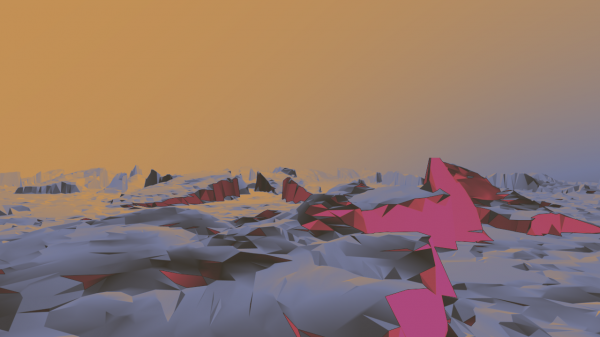
On Interim Camp:

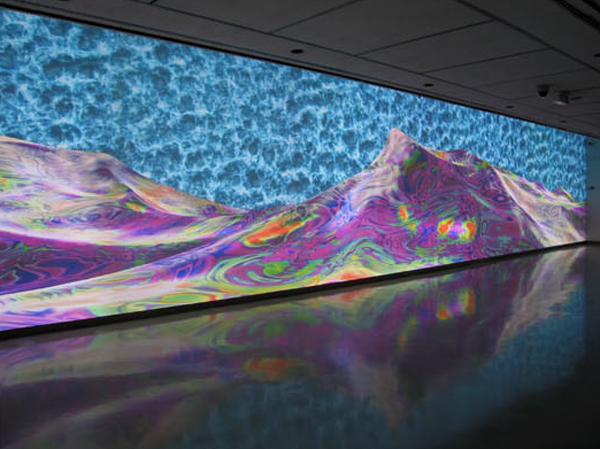
“The constant transformation of the landscape shapes and their surfaces is based on generated motion sequences of drifting and constantly transforming surface structures, which were created with a custom generative software tool.

A fascination for the beauty of mountain views and glaciers was at the starting point of Interim Camp.
 
The dynamics that shape the earth´s surface until today are fascinating and frightening at the same time. Regarded in time lapse, mountains, valleys and plains are folded, sharpened and grinded like paper structures.
 
Respectively insignificant the human being appears in the dimensions of these forces. Tectonics and weather forces, time and chance create these inimitable irregular patterns that we recognize as nature.

For our film, we wanted to gain control over these forces; create shapes and structures that are surreal and supernatural, yet so detailed that they might fool us for being real.”

Zeitguised


Zeitguised

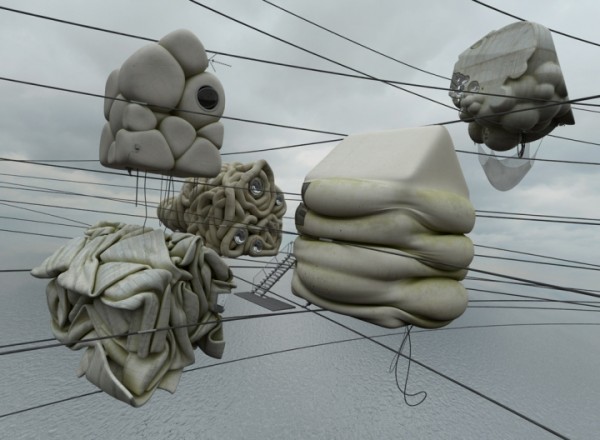
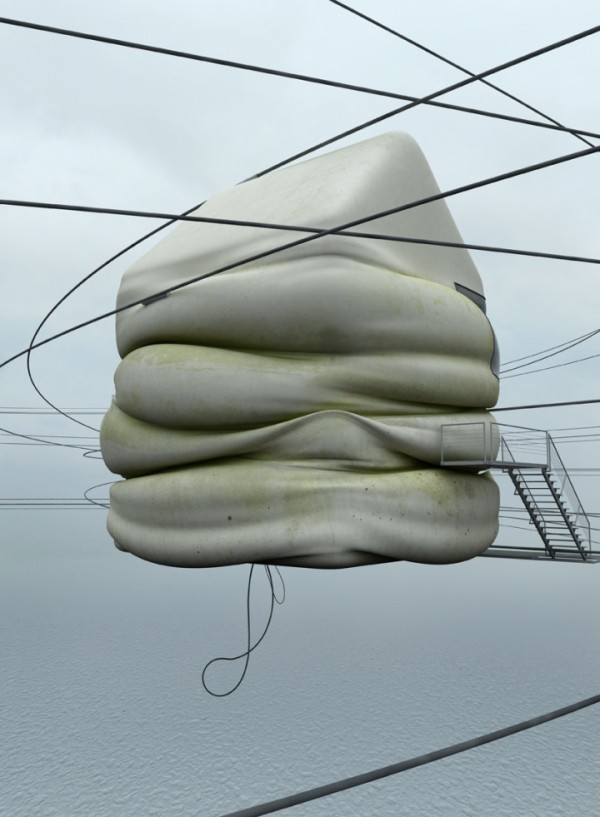
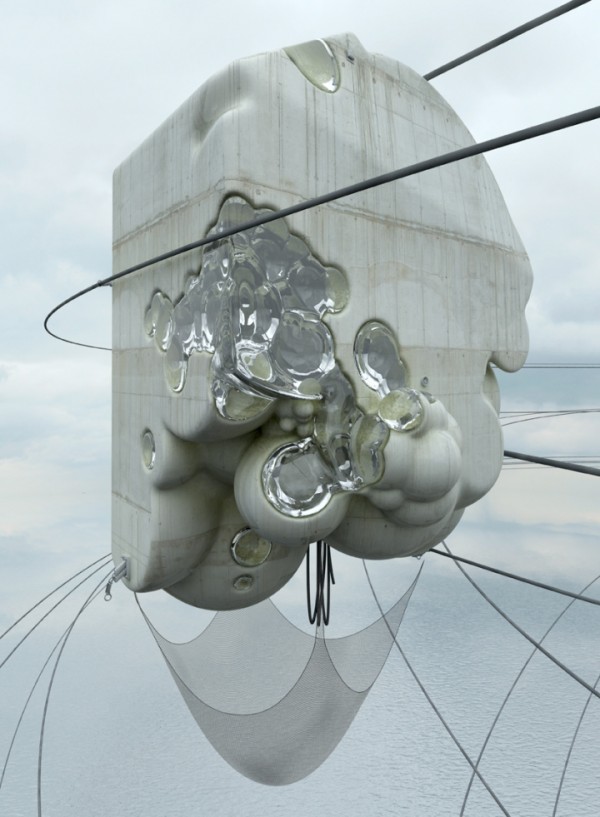
From the Concrete Misplots series:

“Featured in swiss architectural magazine Hochparterre’s “Raumtraum” section, these visualizations of future architectures search for the accidental in computer driven manufacturing processes.

Based on iconic housing shapes, these buildings were intended as prototypes for mass-customization. Yet, as things go with computerized manufacturing, there have been misplots. The cartridge was not loaded properly. The concrete was set to the wrong parameters or scale. The printer module falsely translated a data set…

These misprints are the rejects of this early process, and they are now being used as shared homes by elderly people from the former squatter scene.”

United Visual Artists


United Visual Artists

The Creators Project: How did UVA first begin its splendid attacks on our senses?
Matt Clark: We met in the world of designing for live performance. Working as individual freelancers, we worked on a couple of projects together and thought, “Why don’t we start up our own thing?” I guess our original vision was to create innovative live shows for touring bands, but we’ve diversified quite considerably since then.

How does everything transpire within the creative process?
When I first started working with them, it was different from working directly with other designers like I was used to. Ash [Nehru] is a software director and has experience in the games industry. Chris [Bird] deals more with production and technical skills. That kind of combination at the beginning of the creative process allowed us to do quite innovative things at the time, certainly in the live-performance industry. We’ve really expanded with that thought in mind. There are now 18 of us, and there are no two people with the same background or education. There’s a diversity and cross-pollination of skills.

How did your long-standing relationship with Massive Attack come about?
Originally we hooked up with those guys because Chris and myself worked on a show for a band called Leftfield, and the production director got a job working on a Massive Attack project. We got a meeting with the band and they had a really interesting idea to make their show new and fresh every day. The personality aspect has to be good, and then the technical elements come into play a bit later. They wanted us to go on tour with them and I guess a friendship was struck, which led to consecutive tours.

You’ve worked with lots of other big artists, like the Chemical Brothers in Trafalgar Square for the Institute of Contemporary Arts.
We created an interesting film for that. It was quite abstract, representing their sound through light. What was particularly scary about that project was that there were no rehearsals at all. It was quite technical getting your animation onto a big screen with lots of lights and stuff. We were standing in the audience just hoping it would work, and it did.

Is that part of the reason you started to develop your own software?
Yes, actually. Our software allows us to pre-visualize the environment in 3-D, and you get a sense of being there.

What’s the creative process like when you begin working with a musician?
It depends who you’re working with. We’re interested in a kind of sculptural approach, which creates a world for the performers to occupy. We prefer to meet the band and get an overriding concept for the show with what you’re trying to communicate.

You directed a music video for Battles. How did that come about?
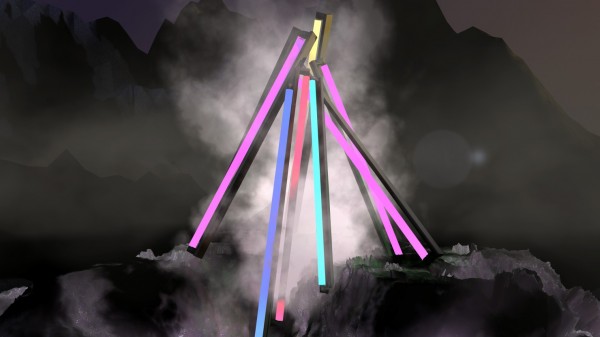
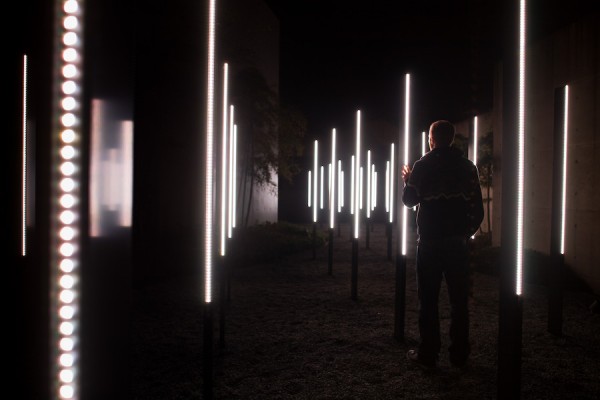
A phone call from Warp Records. The live aspect of them onstage is just really interesting to watch. We wanted to feature that. We chose a quarry in North Wales because it was very sculptural and created an installation for them to perform in. We used these linear digital strips of light and had this mad organic landscape. In an abstract kind of sense, it’s what their music represented to us in a way.

What was the transition like from directing to designing?
It was definitely a learning experience. We’ve had a lot of people wanting us to direct music videos, but for some reason that industry is crazy in terms of timeframe. It’s like, “Need to shoot a video in two weeks’ time, want to do it?” It’s never a right time for us here because we’ve got so much going on. It’s a shame, really, because I would like to do more of that. Maybe in the future.

via The Creators Project