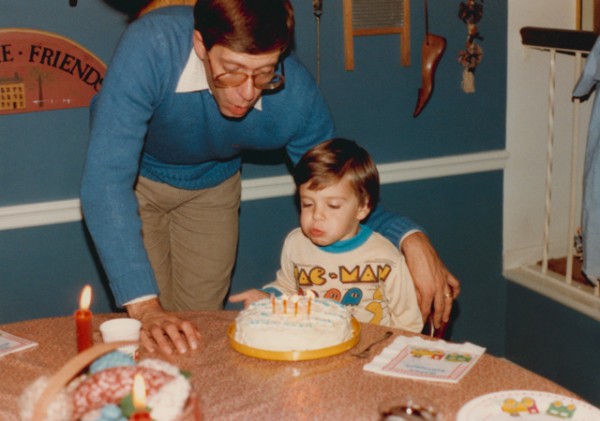
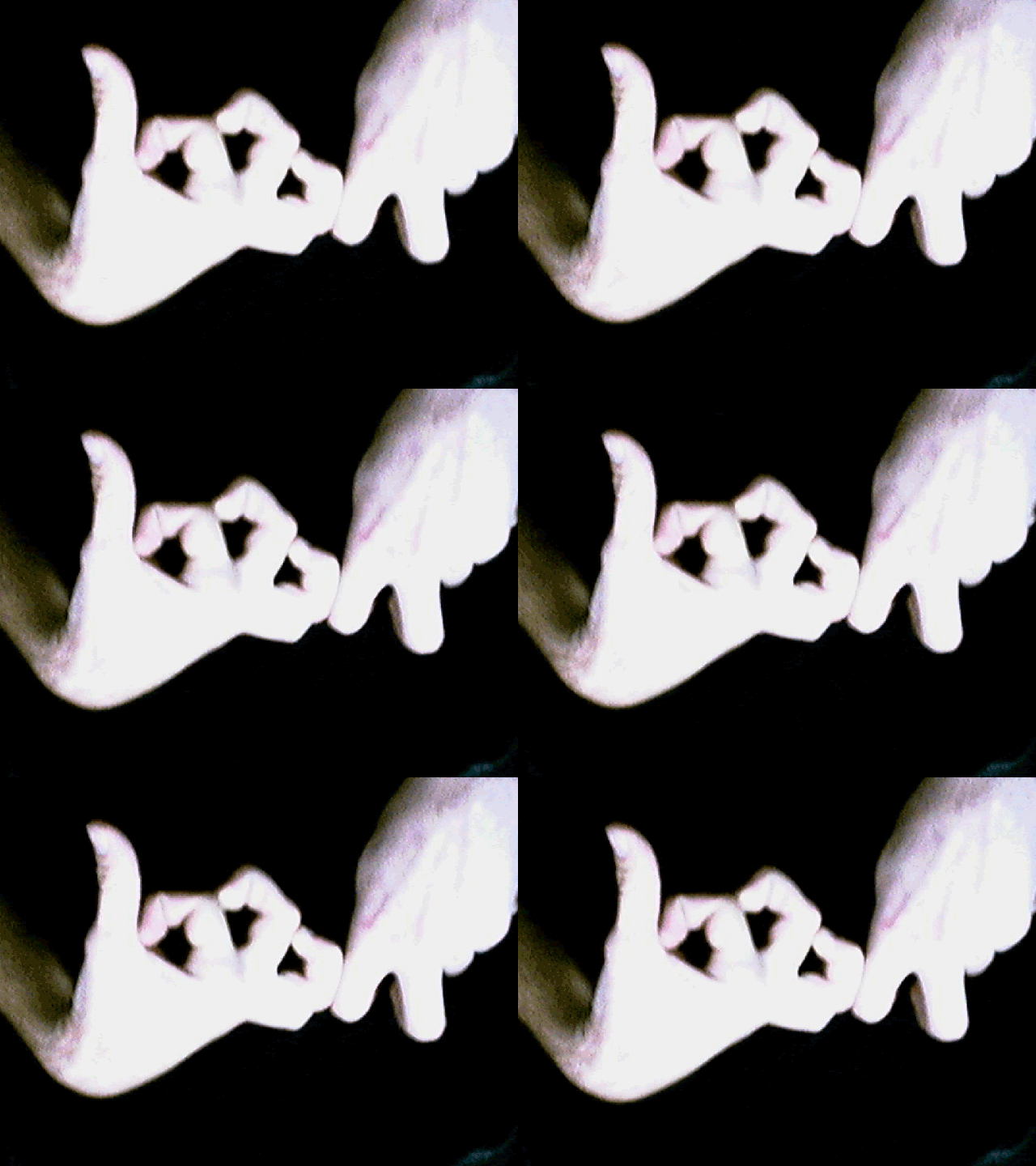
“I began collecting images for You’re Invited shortly after having found a Kodachrome slide showing the back of a man as he blew out birthday candles. I was thrilled by the funny confluence of elements-the yellow curtains, the man’s blue shirt, the boxy, old refrigerator, and a woman’s hand breaking into the edge of the frame holding a glass of water. All of this came together to create a vernacular Garry Winogrand, or one of Henri Cartier-Bresson’s decisive moments. Finding this slide also made plain the ubiquity of this type of image. I was curious to see how similar other pictures (of this type) were to this thrift store gem. I wanted the images to be solicited from people with whom I was close, so I wrote letters to my friends’ mothers asking them to send a similar picture of my friend. I also asked the mothers to write about the time when the picture was taken. After receiving the pictures and letters, I emailed the pictures to my friends asking that they also write about the photographs. I was interested in how the memories of the day and the reactions to the pictures would differ. When gathered together and exhibited alongside one another, the photographs and the texts of the mothers and the children allow for a story more complicated than expected from a seemingly sweet and charming subject.” – Michael Lease
Ceja and I have work in the upcoming shoe A Diamond is Forever at extra extra along with Alexander Skarlinski, Daniel G. Baird, and Dave Murray. The show opens October 1st @ 7:00.
“Extending the idealism granted to youth to the whole of humanity, this work acknowledges that our ability to conjure such grand ideas as the infinite – while awe inspiring – falls short of revelation. The denial isn’t cold-hearted. It isn’t cynical. The denial comes from a place of sincere reflection. While Ideas larger than life can rest in our mind – and can remain there, in a place of ever-present possibility- they remain out of reach, unable to be manifested except in part and by analogy.
With necessary thrift and detachment, this work is representative of the elusive desires and grandiose philosophies that lie outside of mortal human experience; ideals that are valued but unknown.
Attempting to immortalize some time, some thing – pointing at what is not measurable, trying to hold what is intangible-This work represents possibilities. To the idealistic, our philosophical and material gain is limitless. These ambitious ideals are a treasure, but like most treasure, the impossibility of attaining them always looms.” – extra extra
“”Beydler’s magical Hand Held Day is his most unabashedly beautiful film, but it’s no less complex than his other works. The filming approach is simple, yet incredibly rich with possibilities, as Beydler collapses the time and space of a full day in the Arizona desert via time-lapse photography and a carefully hand-held mirror reflecting the view behind his camera.
“Over the course of two Kodachrome camera rolls, we simultaneously witness eastward and westward views of the surrounding landscape as the skies, shadows, colors, and light change dramatically. Beydler’s hand, holding the mirror carefully in front of the camera, quivers and vibrates, suggesting the relatively miniscule scale of humanity in the face of a monumental landscape and its dramatic transformations. Yet the use of the mirror also projects an idealized human desire to frame and understand what we see around us, without destroying or changing any of its inherent fascination and beauty.” – Mark Toscano
“This indeterminate physicality with different physical planes–it is beautiful and confusing, everything starting and reversing.”– Robert Irwin
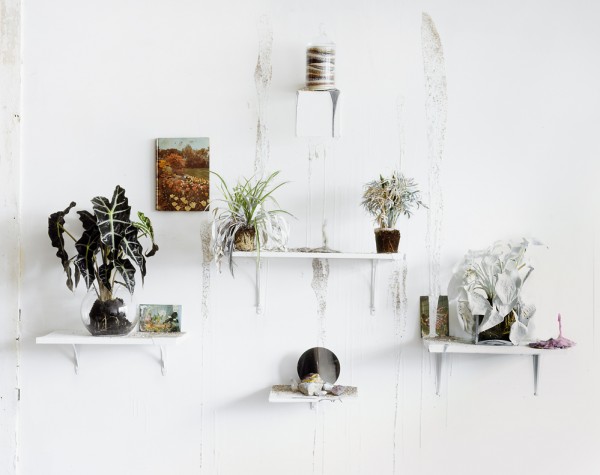
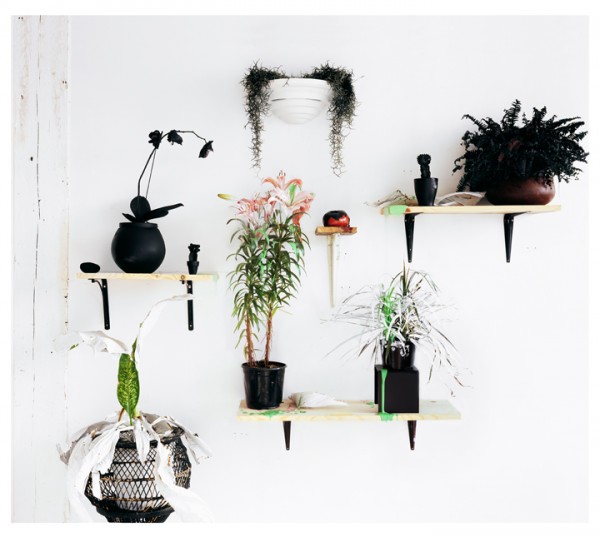
“New Age Still Life: Paint, Plants, Trash, and Formalism are studio constructs utilizing plexi and wood shelves, plants and other objects that are representational of my youth. They are things borrowed from my parent’s basement—animal horns, macramé, art, drum cymbals, old mirror, incense, candles—and represent a universal new age culture of the 60’s and 70’s. These works engage in a conversation between still life, photography, sculpture, and painting and are intended to stimulate an exchange that questions the ideals of Modernism, particularly notions of idyllic beauty.
The idea of simultaneously preserving and deconstructing idyllic beauty (represented by the plants and other organic objects) is accomplished through the application of paint to the objects. With Whitescape and Blackscape the still life is completely covered with paint and then photographed. The plants eventually grow out of the center and shed the acrylic paint digressing into the their natural forms, ie. Deconstructed (Rebirth). The paint encapsulates and preserves, but it also kills, forcing the plants to sit somewhere between life and death.” – Heidi Norton
“Clouds are important elements of our atmosphere, framing outdoor space and filtering sunlight. They are the visible part of the terrestrial water cycle, carrying water— the source of life—from the oceans to the land. Clouds find balance within stable equilibria and naturally sustain themselves, embodying and releasing solar energy. The ability to touch, feel, and walk through the clouds is a notion drawn from many of our fantasies. Gazing out of airplane windows, high above the earth, we often daydream of what it might be like to live in this ethereal world of fluffy vapor.
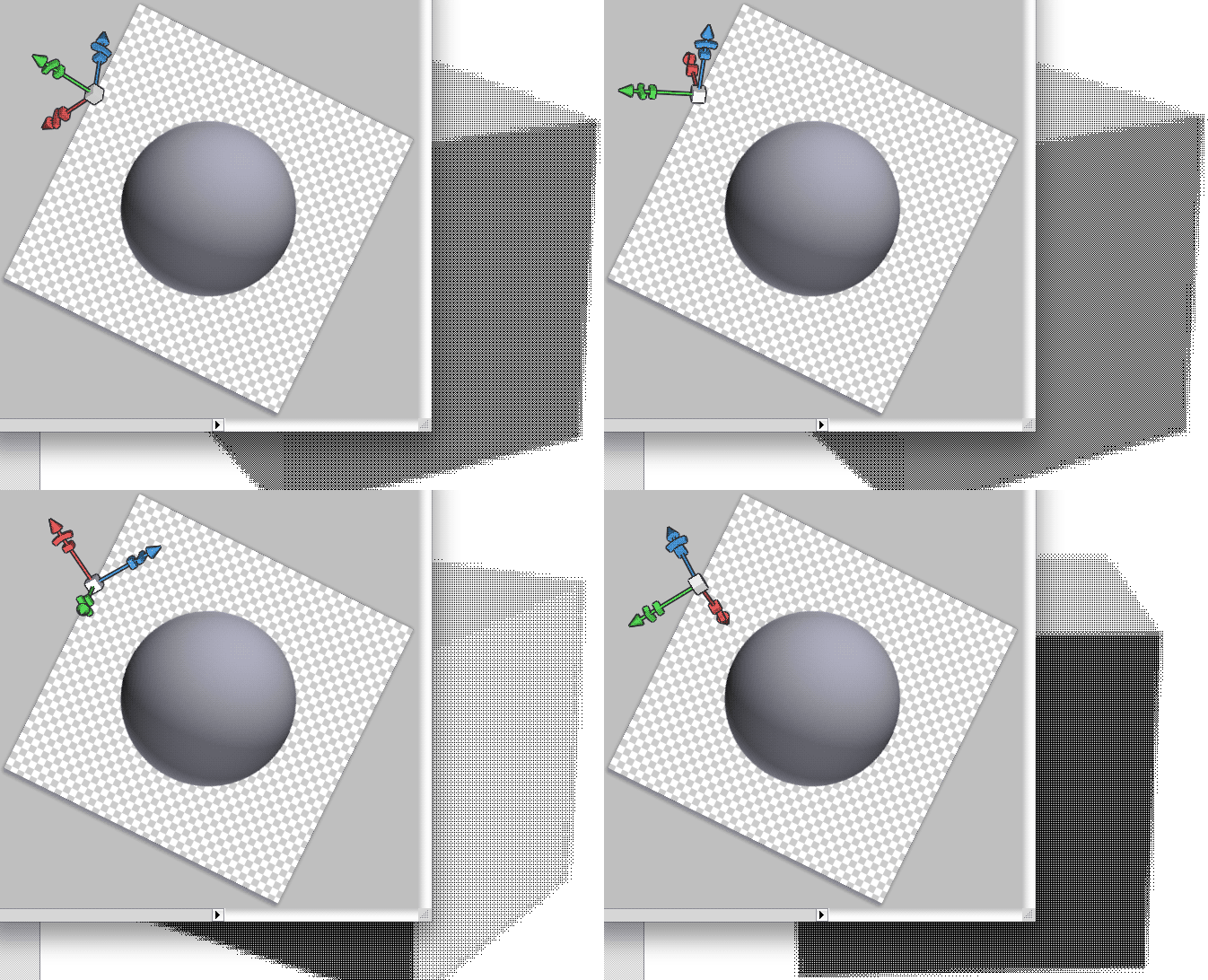
TRANSSOLAR & Tetsuo Kondo Architects create Cloudscapes where visitors can experience a real cloud from below, within, and above floating in the center of the Arsenale. Visitors find a path that is akin the normal experience of walking through a garden. The path winds throughCloudscapes appearing and disappearing. Sometimes people only see the other people across the cloud while the path is obscured. The structure consists of a 4.3 meter high ramp that allows visitors to sit above the cloud. Simply, the structure leans on the existing Arsenale columns. The cloud is always changing so the experience of the path is also dynamic.
The cloud is based on the physical phenomenon of saturated air, condensation droplets floating in the space and condensation seeds. The atmospheres above and below the cloud have different qualities of light, temperature, and humidity, separating the spaces by a filter effect. The cloud can be touched, and it can be felt as different microclimatic conditions coincide. The scene is set underneath an artificial sky where the cloud can be touched and felt as different micro-climatic conditions coincide and where people are changing the cloud and meeting each other.” – Tetsuo Kondo Architects
“I am easily blinded by the optimism embedded in a new process, as it first appears to be the universal solution. The euphoria quickly dissipates though, as it becomes clear that each new process also a regulating device. I believe that the techniques that promise utopian solutions, through totally malleable mediums, simultaneously produce total control environments. Through distortion of commercial processes involving sensory perception and theatrical gesture, my work explores an attraction to these zones of self dissolution. I am interested in systems of form making that have the potential to reduce my influence to an automatic response.
Sensory technologies are devices designed to enter the body, mimicking its evolved systems of perception to better control them. The Space Ball System and the other performance light devices came out of my research into commercial light therapy “mind machine” glasses that use LEDs to induce altered brain waves and intense visual illusions of form floating in a void space. The light performance devices extend this thrill of complete stimulation to a mass crowd, linking their entire nervous system to my computer drawing pad interface.
I am interested in the use of abstract gesture as a commercial penetrative device, a colonized pathway into a vulnerable self. The biomorphic forms in my work began as experiments with motion capture technology, a process typically used to program the actions of manufacturing robots and CG movie characters. Manipulating a force-feedback sensor records my hand movements as tubular clay extrusions within a virtual space. This process became a model for a type of auto body shop treatment of the production of space, a universal sculpture system employed in handmade form. Computer modeling processes remain important to me though, both as outsider art medium, and as encroaching universal visual process.
I am drawn to working in marginalized zones; science fiction, rock concert lighting, computer graphics, and commercialized abstraction. My work explores the mutated remains that could continue to survive, with continuous technological support, and evolve in the vacuum of these environments. In my practice there is a theatrical primitive self trying to communicate, dragging its appendages through these technologically constructed void spaces in endless repetition.” – Benjamin Phelan
“…In terms of how evolving software or technology affects my work, I’m constantly trying to learn programs (currently Blender, Google Sketchup, Brushes, Maya, PHP) but at the same time, learning new programs comes from a strong desire to extend and diversify my daily computer practice. I spend time in After Effects now than in Photoshop. There are definitely projects on my mind that I haven’t yet figured out how to bring into a material reality. Those projects become a kind of other practice that’s different from the drawings I make in a day or the Photoshop files I create at night.
Thinking about how to make these ideas exist, and the problems I run into, doesn’t necessarily result in them ever actually coming to completion or even a start; but thinking about it, and problemsolving, influences other projects and ideas that I do make. Monumental projects act as milemarkers or destinations, but usually on the way there I end up working on new projects and experiments that lead me in other directions.
Your work runs the gamut between serene abstractions and disorienting digital landscape collages. Do these different styles serve distinct purposes for you as far as self-expression and the impression you’re trying to convey or do you see it as all part of one continuous creative process?
The short answer is that I see it all as one clear and continuous process. In my practice there have been very few pieces of finished artwork, but instead are documents and moments along a path of structural tests, program explorations, art history lessons, and formal questions.
Is there ever such a thing as too much or not enough in your images? Is there a line where thing become too overwhelming or minimalist?
That’s something I always consider. I perpetually overkill. The computer helps that, though. I just keep saving states of things. I overkill drawings much more often than digital files. With the digital, I can undo and go back to earlier versions.
My friend and fellow artist Harm van den Dorpel has offered me one solution for this problem. He created a program called symbolicbehavior that allows me to take screen captures in the midst of working and they are directly uploaded to a private online portfolio to look through. So even if I “overkill” there is a chance that a state of the work is out there that I do like.” – from an interview with Dan Rosplock for Future Shipwreck.
“…People make crush art about you all the time, don’t they?” That’s the first question I asked Jon Rafman one month ago after he discovered I was embarking upon an ongoing multi-media performance inspired by his work. Our conversation provided my first hint into Rafman’s process. He wanted to know what I’d done between the time I left work and the time I arrived at home, the name of the office building, where my roommate was born, the details of my relationship to certain net artists, and a host of other very specific questions which I later saw as part of his process for, and reverence toward, the construction of one’s personal narrative. The truth, though he wouldn’t admit it, is that Jon Rafman is one of the net art community’s most respected and beloved figures. This prestige, it seems to me, relates to his ability to position himself in shamanistic roles, as director, storyteller, and tour guide, as the middle man exploring essential concepts of modernity/contemporary experience, and then processing and framing them into narratives. His work is concerned with virtual worlds, self-identity, and the collapse of high/low art. He is the artist/curator behind Googlestreetviews.com and the cartoonish internet flâneur directing tours through Second Life as Koolaidmaninsecondlife.com.
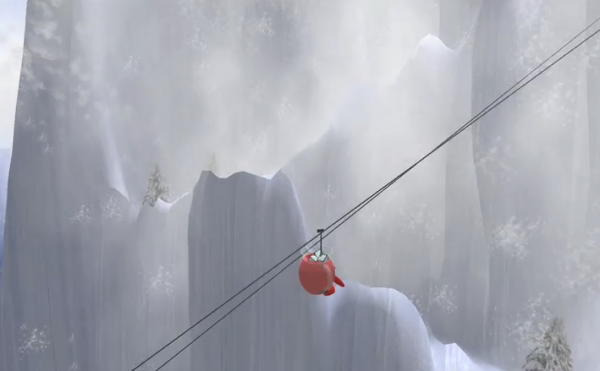
Rafman’s Kool-Aid Man avatar is one of his most primary characters, taking appointments and leading tours through Second Life worlds both utopian and fetishistic, as well as starring in a collection of stills and films directed by Rafman himself, which humorously contrast the avatar’s round red body against the super sexy alter egos much more commonly found in Second Life. The tours are primarily directed between virtual avatars, however Rafman also performs the tours live, inviting audience members to directly interact and inform the journey, as he subtly contextualizes and frames the experience. The Kool-Aid Man avatar, as it relates to Rafman’s body of work as a whole, is an externalized representation of Rafman’s honest and committed artistic struggle to construct and examine self in virtual culture….” – Lindsay Howard for BOMBLOG
The oracle told me that a surfer would snag the sister domain once it was cut loose, and that this surfer would be a chosen one. – Spirit Surfers
“My day of featuring fellow artists who go that extra mile by incorporating a third part to their name is coming to a close. This last post, while diverging from the theme, is nonetheless about a collective effort. Being part of POC has helped me to further appreciate the group mind and the profound impact it can have on its participants. Which brings me to Spirit Surfers.
It is hard to sum up an effort like Spirit Surfers but one word that comes instantly to mind is brilliant. The digital work of these “INFOmonks” is nothing short of cutting edge. While remaining anonymous, a very web-savvy thing to do indeed, much of the work featured here appears to be generated by the web, re-appropriated, only to be featured solely on the web once more, or as they put it, “Let the boon be the made, for the wake to unmake.” I am tempted to call them modern day Dadaists, though I wonder if they would take kindly to my rear view perspective. With the site being progressive to the utmost I imagine they are always forward leaning….” – Justin James Reed.
“To say that unicorns have an existence in heraldry, or in literature, or in imagination, is a most pitiful and paltry evasion. What exists in heraldry is not an animal, made of flesh and blood, moving and breathing of its own initiative. What exists is a picture, or a description in words. —Bertrand Russell
…
Barry Stone employs a wide variety of practices as a means of generating singular images. His approach includes “straight” photography, rephotographing, computer-rendering, and manually reworking, and does not value one method above another. Instead, Stone takes an egalitarian view of image-making. At a time when an explosion of photographic imagery can seem to dilute the medium to an infinite stream of information, Stone displays a considered selection which exemplifies his varied approaches. Through the seven photographs, he has slowed the eye to focus on points within his photographic practice.
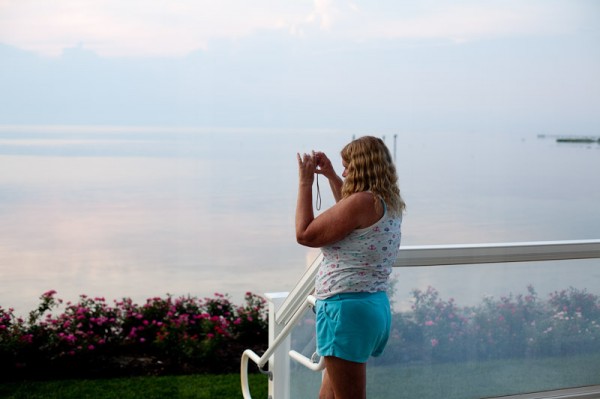
In two photographs—one of a “I Met a Unicorn” at a children’s party, the other of a woman pointing her digital camera at a sunset—the conceptual focus of the image is enclosed in the framing of a scene observed by Stone through the lens of his camera. Another work in the show is a rephotographed image of an oil painting, an image within an image. In a third piece, Stone employs the conceit of the self-referential image again by spray-painting an arc on a photograph of a corner space and rephotographing, collapsing the pictorial space back into abstract elements.
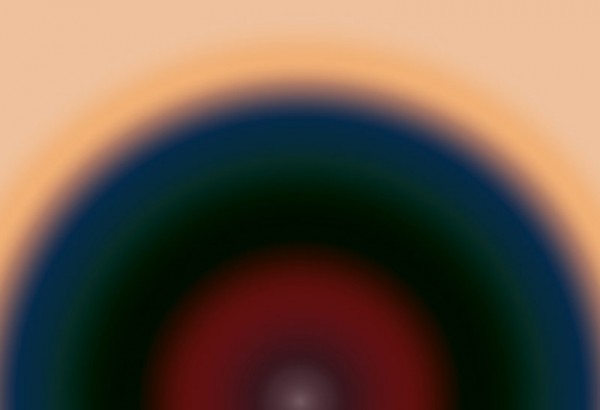
The image Alan Greenspan as a Rainbow in Washington D.C. on October 23, 2009, 12.20.2009 was created by sampling the colors of a Washington Post press photograph of Greenspan testifying in front of the House Oversight and Government Reform Committee and creating a gradient rainbow from those colors, a nod to the connection between photography and currency, neither of which is tied to a gold standard that delineates a definitive value.
Stone’s photographs deal with the problems of description in photography, and can reflect our perceptions of reality as we acknowledge the factors which inform their production and interpretation.His aesthetic in this regard is as indebted to the language of painting as it is to the language of advertising as it is to capitalist production.” – via the press release from Klaus Von Nichtssagend Gallery