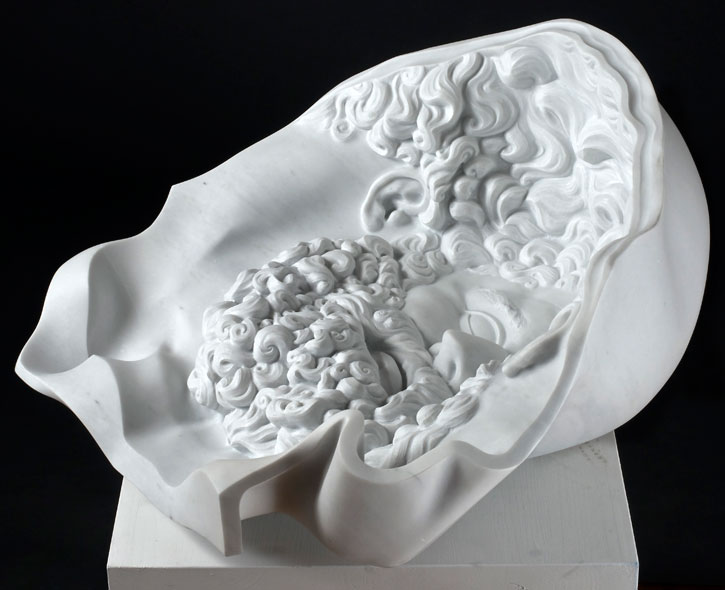
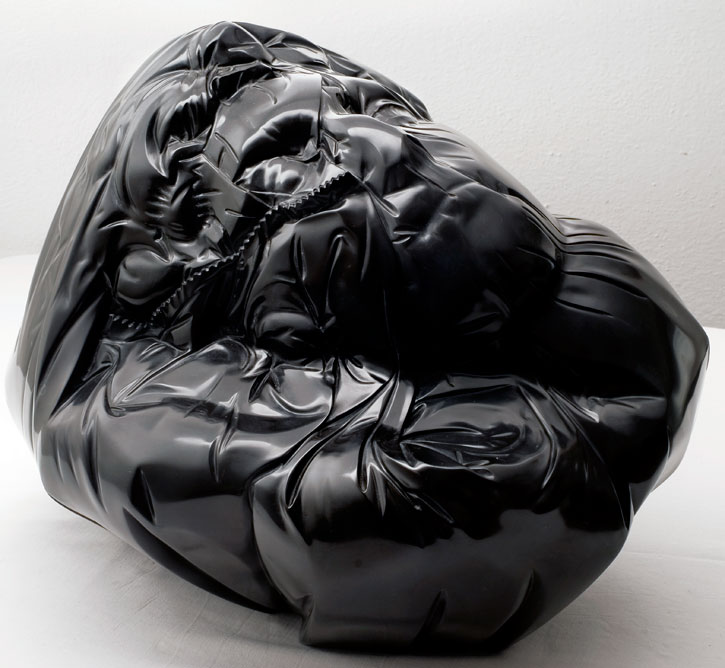
Work from their oeuvre. Their exhibition is on until the end of the month at Galleria Rubin in Milan.
I find it appropriate to include the press release from their current exhibition, translated via google translate as it mirrors translations of classical sculptures in their works. Ironically, many of these busts recall the ephemeral and incorporeal avatars of second life, among other transient and temporary media.
“Rubin presents the first solo artist Milan Affiliates corbels / Savini. Among young contemporary sculptors and ‘widespread use of poor materials or recycled. Corbels and Savini, on the contrary will be challenged with a noble and dignified as marble demonstrating technical knowledge and experience by virtuosos.
In relation to this choice on their path and ‘exemplary graduates at the Academy of Fine Arts in Carrara, where is’ done their meeting and is’ born artistic partnership, they could increase their production by working on important projects abroad completed in part in their great studio in Carrara and partly to the destination.
Their research work comes from the extraordinary familiarity with the material condition and irony with the forms of sculptural tradition that is normally experienced. Classical busts, holy figures or purely ornamental, portraits.
This iconography, from the great masterpieces until the items’ Run, is taken up and reworked with insight or humor to become a gallery of amazing improvisations on well-known themes: the Farnese Hercules in polystyrene, a pair of cherubs garden that seem wood burned up to more ‘daring distortions arising from handling of the tires with which they are traced. Recently, we have sent more decisively in this direction by creating portraits that combine and integrate different parts of sculptures.
It ‘s a job that many evidence from contemporary artists, among which there is not only inappropriate, the phenomenon of’ materials and forms, but also a certain satisfaction in hybridization and grotesque. However corbels and Savini demonstrate against classical iconography, a love and familiarity that prevents any cloying degeneration and suggests a free hand but respectful coexistence.” – Galleria Rubin via Google Translate
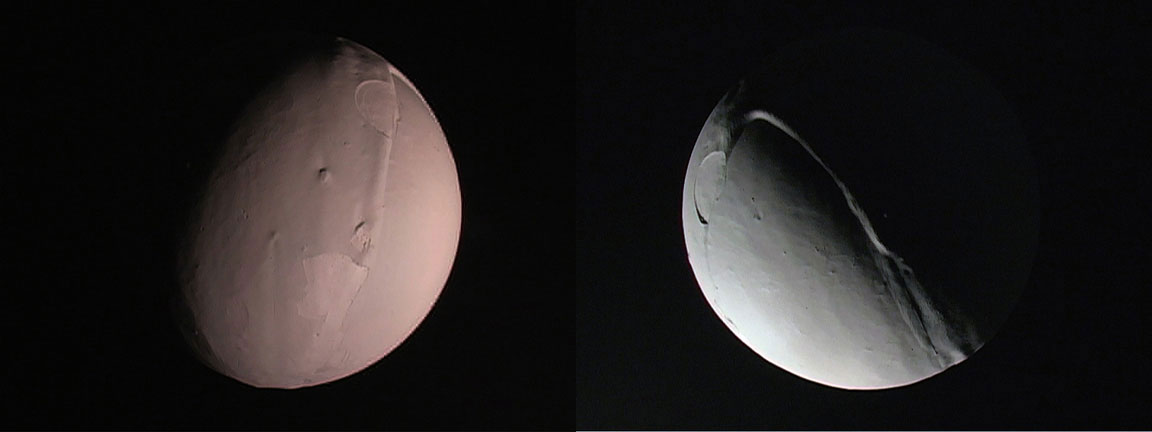
“We are dealing with replicas, but of what? For her first solo show ‘Landscapes, Heads, Drapery and Devils’ at Lisa Cooley Fine Art, Erin Shirreff presented an arrangement of cryptic objects, films and photographs that appeared to be mundane, but stubbornly managed to defy recognition.
The title of the show derived from the most common associations that people make when confronted with ambiguous forms – they are, perhaps, the most basic categories by which we generate meaning. In his unfinished essay ‘The Artist as Site-Seer’ (1966–7), Robert Smithson related the origin of the visual to language, or what he called the ‘enigma of blind order’, to reflect on the process of creating meaning through classification. A similar investigation can be found in Shirreff’s recent works, which employ the idiom of the all-too-familiar as a visual trap. They lure the viewer into familiar terrain by employing a visual language that mimics well-known things in the world, as well as the pseudo-scientific aesthetics established by Conceptual art. However, the familiar quickly becomes unfamiliar, and the viewer – unable to make sense of what he or she is seeing – has to rely on perception that is based less in recognition than in observation.
In Two Moons (2009), a moon-like sphere hovers in the middle of each of two adjacent monitors. Both spheres are lit from the side: while one slowly appears and disappears within the brightening and dimming lights, the other rotates on its own axis, gradually revealing its cratered surface. The changes are hardly detectable to the wandering eye, the slow pace turning the investigative gaze into a mesmerized stare.
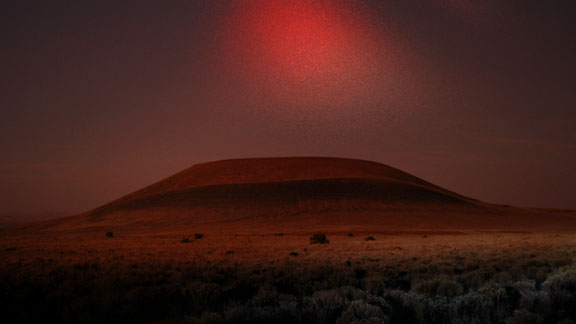
There is a similar effect in Roden Crater (2009), a single-channel video that was projected onto a large screen suspended in the back corner of the gallery. Shirreff took hundreds of photographs of a photograph of the dormant crater that houses James Turrell’s iconic, still-unfinished earthwork. She photographed the image repeatedly from the same distance and perspective, but under changing light conditions, then edited the pictures together to create a 15-minute film, mimicking a time-lapse shot of the actual terrain. The altering light environments create the impression of changing daylight and seasons while the flash reflection on the image’s surface is reminiscent of the travelling sunlight.
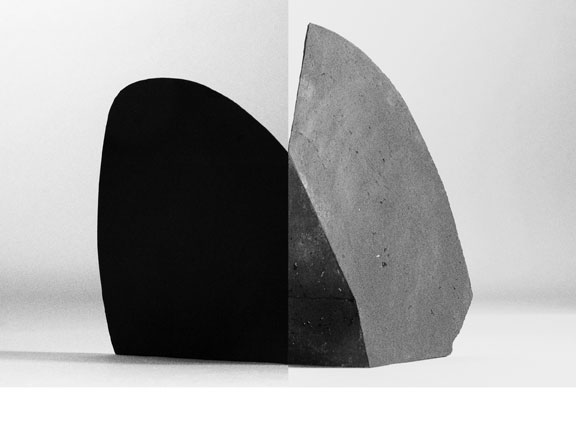
In Shirreff’s recent series ‘Untitled’ (2009), angular geometric forms made of compressed ash leant along the long gallery wall, their relatively thin surfaces suggesting veneer or casts rather than actual structural elements. With no immediately obvious function, these shells may evoke ancient temples as much as they might the papier-mâché architecture of Disneyland. It is difficult to find the right angle from which to examine their multiple surfaces, which encourage viewers to continually shift their body in relation to them; an erratic dance, examining them from all sides and angles. Shirreff’s work plays with the relationship between appearance and the actual object, collapsing the things that we think we see with the actuality of compressed ash, plaster casts and pictures of pictures. All the action occurs on the surface; it is where our knowledge and the objects’ inherent references meet. It is also where the artificial nature of the works is revealed. Once the sleight of hand is exposed, and the viewer realizes what he is actually looking at, the stand-in nature of the works becomes apparent. It is not about the reference to moons, craters or architecture but much more about the process of recognition, about how something may appear to be a landscape, a head, drapery or a devil.” – Anna Grits for Frieze Magazine.
“In 1936 Walker Evans photographed the Burroughs, a family of sharecroppers in Depression era Alabama. In 1979 in Sherrie Levine rephotographed Walker Evans’ photographs from the exhibition catalog “First and Last.” In 2001 Michael Mandiberg scanned these same photographs, and created AfterWalkerEvans.com and AfterSherrieLevine.com to facilitate their dissemination as a comment on how we come to know information in this burgeoning digital age.
Here on AfterSherrieLevine.com you will find a browsable selection of these images. Links to the high-resolution exhibition-quality images to download and print out. Along with a certificate of authenticity for each image, which you print out and sign yourself, as well as directions on how to frame the image so that it will fulfill the requirements of the certificate.
By building the image’s URL into the title – the image to the left is “Untitled (AfterSherrieLevine.com/2.jpg)” – the images are locatable and downloadable by anyone who sees or reads about the image. By distributing the images online with certificates of authenticity, the images are accessible by anyone. Unlike the work of the late Felix Gonzalez-Torres ‹ known for his spills of candy and stacks of paper from which the viewer can take a piece of, though the sculpture stays complete because the owner possesses the certificate of authenticity, the right to reproduce ‹ the certificates here are used to insure that each satellite image be considered with equal authenticity, not the opposite. This is an explicit strategy to create a physical object with cultural value, but little or no economic value.” – aftersherrielevine.com
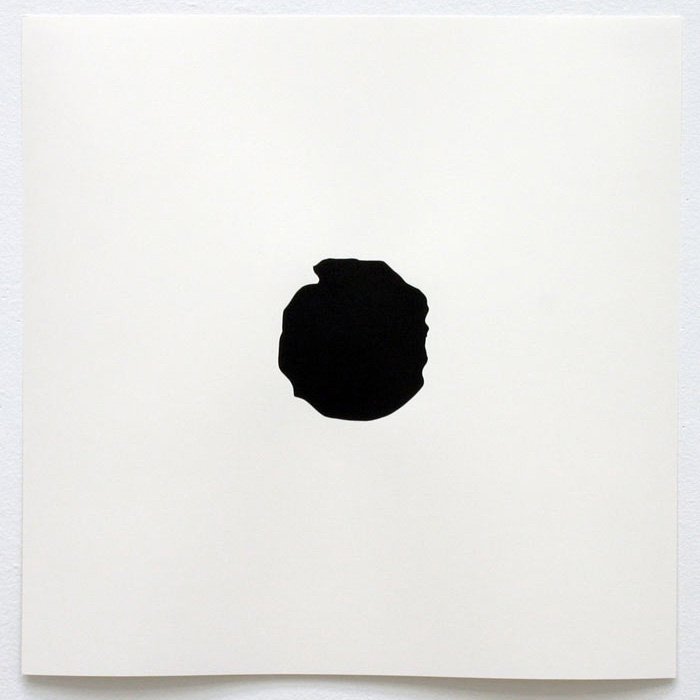
“‘Abstraction has been less a search for the ultimately meaningful… than a recurrent push for the temporarily meaningless.’*
Paintings that look like something are rubbish. Why not take a picture? Or just look at the real thing? Or if you really want to see something differently, just use your imagination. Or hang it upside down. Or take a pill. Or squint. Painting a painting that looks like something is a kind of arrogance. Rudeness, even. What do you suppose the aliens think about paintings that look like things? Rubbish, that’s what. The same goes for music. Songs are rubbish. Why would I want to hear you sing about your own shit? Sing about your own shit on your own time please. I’m having enough trouble dealing with my shit without having to listen you sing about yours. I’d much rather listen to some static, or some droning, or throbbing, or pulsing. How about a nice hum? Can all musicians just hum from now on please? For real, I’m trying to think.
Years ago Sam Songailo was asked to paint the inside of a tiny venue in town called Delacatessen. Among other things it played host to an event called the ‘Festival of Unpopular Music’. Minimalist noise-niks would once or twice a month subject seated crowds of turtlenecks to a variety of interesting humming sounds. I make it sound pretentious – and it probably was – but I liked it. It was very therapeutic. Your job was to sit there and pretend to listen to people extract sustained droning sounds out of an array of expensive effects pedals, hoping to God that you’d remembered to turn off your mobile phone. You think you were bored – which is what you’d afterwards tell your less pretentious friends at the pub – but as soon as the music stopped the ideas would tumble out in torrents, sure as birdsong after rain. We’re surrounded by meaning. Every object has to have a moral, a point, a purpose, an explanation – some figurative reflection of ourselves, or else a clever-clever whiff of humanity, as if to say ‘Oh, hello there fellow human, isn’t this nice? Isn’t it lovely that art – my art – can bring us together like this? Let’s all have a big phenomenology party, but only invite people who think they get Sinedoche.’ All this desperate yearning for significance. All this vanity. It makes me a bit sick sometimes. Sometimes I think the aliens are looking down – if they’re bothered enough to look down at all – saying ‘duh’. Rare is the work of art that doesn’t pretend to relate – that invites you to bring your own meaning to the object. Rarer still is art that invites nothing at all, only a frame of mind. When you look at Songailo’s work, you aren’t immediately struck by anything meaningful. Songailo is the first to admit that he wants to place a great deal of distance between his work and the banalities of everyday life. He wants his work to act as kind of circuit breaker – a means by which you can remove yourself from your life, from that which makes you human, in order to appreciate how strange the world really is. Like all truly abstract artists Songailo wants you to see the world the way the aliens see it – in all its weirdness, its beauty, its irreducible complexity. ‘Post-human’ is a misused phrase. In many ways, post-human is more human than human-human. That which truly makes us human has nothing to do with romance or humor or pathos, it has more to do with a cold appreciation of aesthetics, of geometry, of the overwhelming beauty of colours and shapes – unsullied by the petty trivialities of the so-called human condition.” – Stan Mahoney
*Varnedoe, K., Pictures of Nothing, Abstract Art since Pollock, Princeton University Press 2006
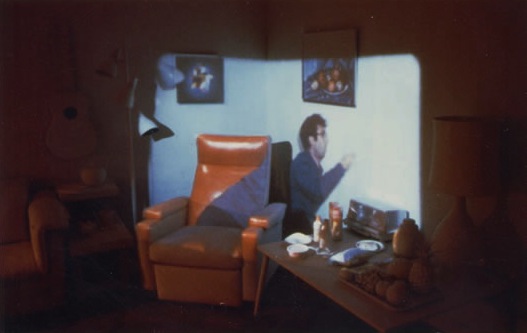
“Displacements is an immersive film installation. An archetypal Americana living room was installed in an exhibition space. Then two performers were filmed in the space using a 16mm motion picture camera on a slowly rotating turntable in the room’s center. After filming, the camera was replaced with a film loop projector and the entire contents of the room were spray-painted white. The reason was to make a projection screen the right shape for projecting everything back onto itself. The result was that everything appears strikingly 3D, except for the people, who of course weren’t spray-paint white, and consequently appeared very ghostlike and unreal.
Displacements was produced three times between 1980 and 1984. By the third time, at the San Francisco Museum of Modern Art in 1984, it was done.
Twenty-one years later, in 2005, my long-time friend and colleague Brenda Laurel cajoled me into a redux. The young couple in the original living room are now middle age with a teenage daughter. Mom is still pensive, Dad still watches TV, and the daugther is curious. Displacements 2005 was shot and projected in digital video rather than 16mm film, which, it turns out, was much more challenging.” – Michael Naimark
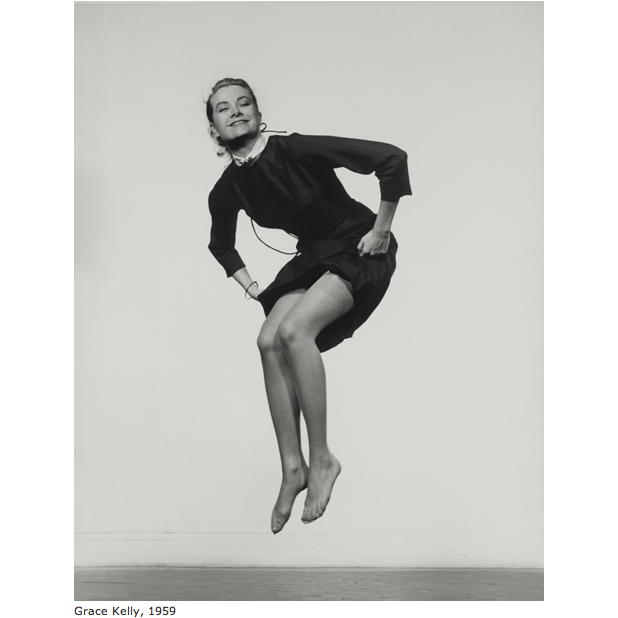
“Jump was born in 1952, Halsman said, after an arduous session photographing the Ford automobile family to celebrate the company’s 50th anniversary. As he relaxed with a drink offered by Mrs. Edsel Ford, the photographer was shocked to hear himself asking one of the grandest of Grosse Pointe’s grande dames if she would jump for his camera. “With my high heels?” she asked. But she gave it a try, unshod—after which her daughter-in-law, Mrs. Henry Ford II, wanted to jump too.
For the next six years, Halsman ended his portrait sessions by asking sitters to jump. It is a tribute to his powers of persuasion that Richard Nixon, the Duke and Duchess of Windsor, Judge Learned Hand (in his mid-80s at the time) and other figures not known for spontaneity could be talked into rising to the challenge of…well, rising to the challenge. He called the resulting pictures his hobby, and in Philippe Halsman’s Jump Book, a collection published in 1959, he claimed in the mock-academic text that they were studies in “jumpology.” Portraiture is one of the greatest challenges in photography, because the human face is elusive and often mask-like, with practiced expressions for the standard range of emotions. Some photographers accept these preset expressions—think of annual-report portraits of corporate officers—and others try to eliminate expression altogether, to get a picture as neutral as a wanted poster. Halsman was determined to show his sitters with their masks off but their true selves in place.” – text via the Smithsonian.
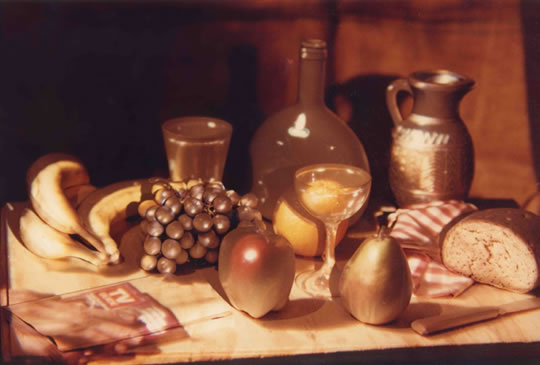
“Every period from Jorge Louis Borges’ “On Exactitude in Science” enlarged and then drawn from the third edition of Collected Fictions.
“… In that Empire, the Art of Cartography attained such Perfection that the map of a single Province occupied the entirety of a City, and the map of the Empire, the entirety of a Province. In time, those Unconscionable Maps no longer satisfied, and the Cartographers Guilds struck a Map of the Empire whose size was that of the Empire, and which coincided point for point with it. The following Generations, who were not so fond of the Study of Cartography as their Forebears had been, saw that that vast Map was Useless, and not without some Pitilessness was it, that they delivered it up to the Inclemencies of Sun and Winters. In the Deserts of the West, still today, there are Tattered Ruins of that Map, inhabited by Animals and Beggars; in all the Land there is no other Relic of the Disciplines of Geography.”” – Cody Trepte
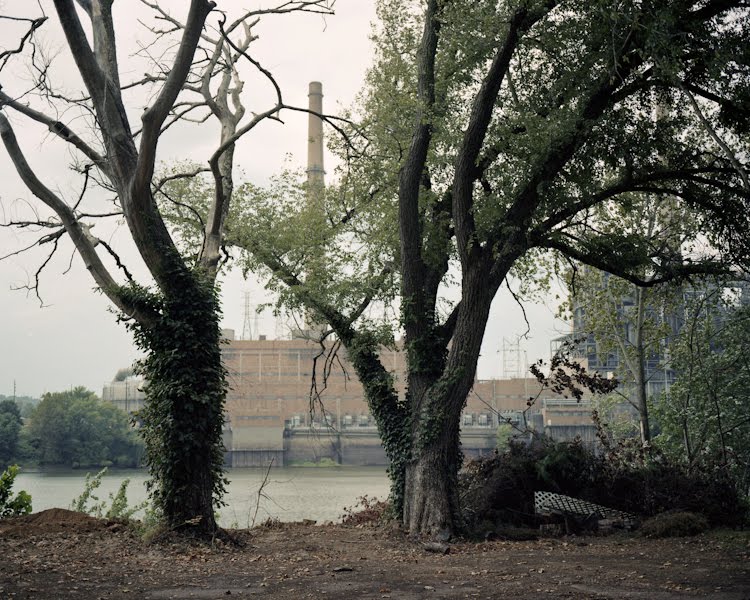
“Plume is a photographic exploration of Southeast Ohio and its unusually dense concentration of coal-fired power plants. The project serves as a follow-up to the work I made in 2007 in Appalachia, Removing Mountains, which focused on mountaintop removal, a particularly pervasive form of coal mining. Plume follows this coal up river to Ohio, where it is being burned to generate electricity.
Geographically rooted in two towns along the Ohio River, Plume focuses on Racine and Cheshire, who sit in close proximity to 4 power plant stations, all within a 15-mile radius. The landscape of these towns presents itself in distinct layers. The subdued palette of the river, with its plodding pace, carries not only coal, but a unique regional sentimentality. Off the banks of the river exist people and sparse economic growth, and above them sprawl small mountains and Appalachian biodiversity. The trees, reaching for the sky, are outpaced by their synthetic allies in upward ambition. These smoke stacks are as ubiquitous landscape accompaniment in contemporary life as any, and in this series they are presented in their social environment, separated from their industrial foundation. Their repetition in the landscape creates a stabilizing visual element throughout the series. I want the viewer to scan the horizon line, looking for the visual cue that connects subject to place, and ultimately, to narrative.
Southeast Ohio resonates a hidden fragility, not just in the industry’s inevitable demise, but in the dejection of its citizens. Like many mono-industrial cultures the resources are being exhausted, much like the emotions of the residents. Coal-fired power plants present myriad of environmental hazards. Burning coal releases carbon dioxide, sulfur dioxide and nitrogen oxides into the air, in addition to equally toxic solid by-products that erode from nearby landfills into local ecosystems. Hypothetically, state and federal regulatory bodies exist to monitor the process, but systematic and longstanding deficiencies within these organizations allow these coal-burning facilities to continue to threaten the environment and local communities.
Coal exists beyond industrial and historical development as a larger abstract presence that is woven into the cultural fiber of Ohio. Here, the air of restlessness predicts an overwhelming ambivalence towards the coal industry. The citizens and land of Ohio and West Virginia are the source point in a vast grid of energy distribution. This burden of heavy resource usage is a type of political and industrial play, mirrored in other industry-specific rural economies, and constitutes an act of complex resource siphoning. In other words, non-Appalachian citizens are benefactors of not only inexpensive energy access, but of distance from the destructive industry that makes this access possible. This sociopolitical paradigm, as old as industry itself, calls into question our confounding relationship to power.” – Daniel Shea
While not an essay on Roche, it is very fitting, and he is linked later in the article (not included).
“Imagine a technological stew. In this big bubbling cauldron are piles of images, jpegs and mpegs of Super Mario Bros , Thundercats and Care Bears, strangely scratched 80s TV adverts, fractals left over from early-rave culture, old computer game animations and lots of other odd and seemingly random found snippets. Imagine this neon-coloured pool constantly moving and morphing like a garish cheap Flash animation. This pool forms the basis of some of the most interesting contemporary artworks to emerge from this decade – art that is all around, and all over the internet. Art that is about the overload of imagery in the modern world. Art that is about how technology has infused our everyday lives and is slowly dissolving our identities. Psychedelic art.
This, however, is a very different movement to the one that emerged in the 60s and 70s, when politics, drugs, pop culture, art, music and graphic design all came together in one enormous wave. That was a moment about perceptual distortion and cultural upheaval, about the group experience. In terms of its merit, psychedelic art was always largely considered sensorial and populist. Minimalism and pop were thought of as more conceptual and serious, and have remained in the high canon of art forms. Cosmic cinemas, fantastical imagery, dream machines and oil-wheel light shows were seen as having more to do with altering consciousness than anything “important”, Although the original psychedelic movement started out as socially and politically radical, it was swiftly seen as superficial and tacky.
Cult critic Dave Hickey is one of the few wordsmiths who has examined psychedelia in any real depth. In his essay “Freaks”, Hickey pointed out that what made psychedelic culture different was that actually taking the drugs didn’t really matter. “Extreme experience was no! required, nor was cultural production,” he writes, “One simply proclaimed a commitment to whatever ideology psychedelic experience signified at that particular historical moment… It was a communal. polemical art, vulgar in the best sense and an international language.” Hickey’s essay was written at the tail-end of acid house, that last great wave of hallucinogenic pop culture, which, much like its 1960s predecessor, quickly began to feel kitsch and out of fashion, with all of its drug-affiliated visuals (all those smiley faces and imploding fractals) deemed utterly tasteless.
That very tastelessness is what makes today’s neo-psychedelic works so interesting. This is art that employs faded technologies and forgotten TV clips, cheap methods and trashy references, and it’s filled with animated gifs, video mash-ups and constantly disintegrating images. Sometimes it feels shamanic or disturbingly child-like. It veers wildly from the anti-academic to the uber-geeky and often resembles the chaos of changing TV channels at warp speed with a remote control. Here, everything becomes pixel and byte, Although the artists involved are unlikely to call themselves psychedelic (no one likes a pigeonhole), the work is nonetheless an extension of the chaos, colour and creativity of “old” psychedelia, What also makes this new art so interesting is that it can be seen as an illustration, and extension of, the internet.” – Francesca Gavin for Dazed and Confused.
“Pong’s works explore the complexity of human relationships, the function and validity of cultural codes and references, and other social phenomena in contemporary society – specifically her own generation. “We are knights on the trajectories of a post-everything era,” she says. Her recent body of work can be seen as a multi-layered and ongoing analysis of how to inscribe oneself into today’s hybrid reality, devoid of fixed structures and identities. What are the guidelines or role models? Are there still any at all? Always with a strong sense of humor, Pong raises a multitude of questions. Her visual language is cinematic and precise and unfolds through metaphors rather than linear narration.” – DBA Christian Haye