Wednesday, 25 April 2012


Anders Clausen
Work from “Year of Cooperation” at Broadway 1602.
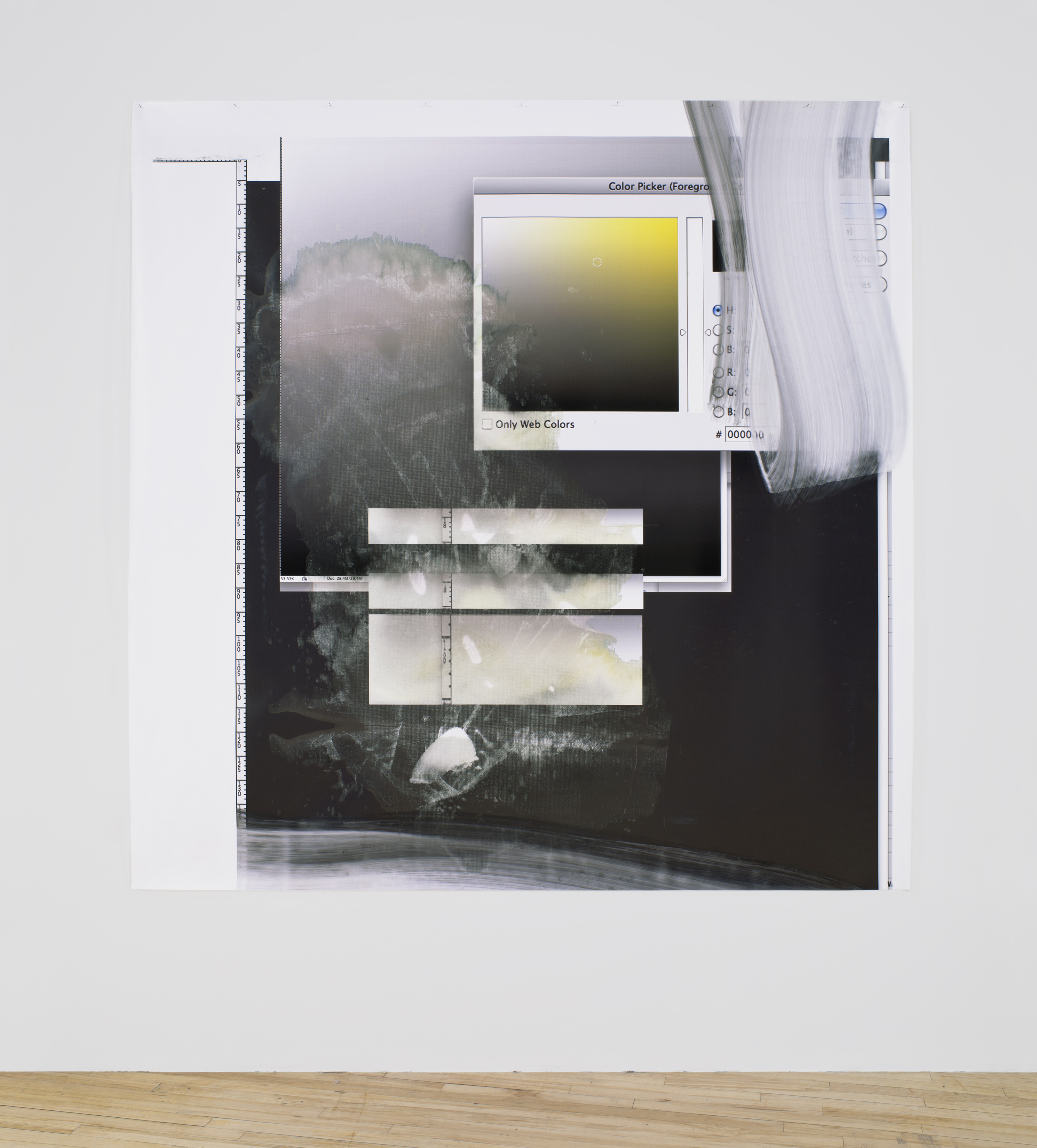
“Made on a giant inexact industrial printer (it can turn turn greytones into yellow), and printed onto a form of upvc canvas that could be the hoarding that covered a Doges Palace in scale and durability, Anders Clausen’s ‘Color Picker’ works draw on computer software icons, desktop imagery, emoticons, found imagery and Photoshop toolbars in their variously ‘collaged’ and pristine arrangements. Back to Illich for a moment, and his conviction that he needs to find a framework for evaluating man’s relation to his tools, “Neither a dictatorial proletariat nor a leisure mass can escape the dominion of constantly expanding industrial tools.” And Debord’s earlier notion that being is replaced by ‘having’, which is then replaced by appearing. Clausen asserts a bold relationship with the myriad personal, leisure, business, creative, practical or emotional fragments and essential tools for navigating through the desktop, on which we build our avatars, and acknowledges that they come through pre-existing material, images and texts. Copied and doctored.”- Broadway 1602
Tags: new media aesthetic, program interface, rgb
Posted in Uncategorized | Comments Off on Anders Clausen
Tuesday, 24 April 2012


Katja Novitskova & Amalia Ulman
Work from Profit | Decay
“A trophy decomposes, triumphs vanish and the symbol turns into dust. Everything goes back to the estate of calm, switching the energy infused towards production, to the lethargy of recuperation, the acedia of the spoiled and the otium of the wise.
The stillness that follows the storm keeps on working as a natural remedy for the anxious explosion of the oversaturated and the intoxicated. Austerity functions as an imposed salting of the earth (of the soil of wealth), stopping the invaders from continuing their duties but dispelling the affected from any chance of improvement: when the ceiling slowly falls down, movement is restricted and torpor is the most profitable path to survival.” – Katja Novitskova & Amalia Ulman
Posted in Uncategorized | Comments Off on Katja Novitskova & Amalia Ulman
Monday, 23 April 2012


Sol LeWitt
Work from Wall Drawings.
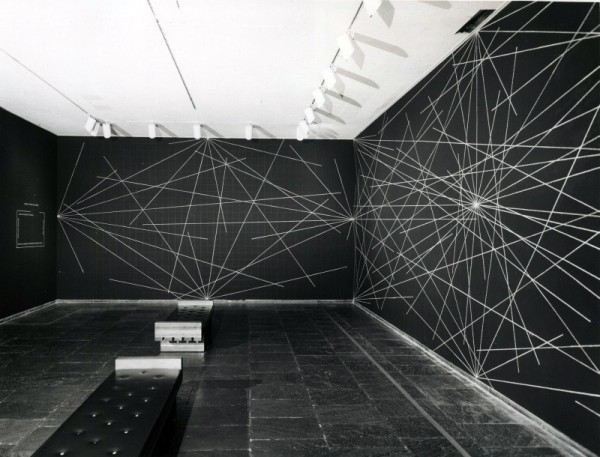
“In 1968, LeWitt began to conceive sets of guidelines or simple diagrams for his two-dimensional works drawn directly on the wall, executed first in graphite, then in crayon, later in colored pencil and finally in chromatically rich washes of India ink, bright acrylic paint, and other materials.[10] Between 1969 and 1970 he created four “Drawings Series”, which presented different combinations of the basic element that governed many of his early wall drawings. In each series he applied a different system of change to each of twenty-four possible combinations of a square divided into four equal parts, each containing one of the four basic types of lines LeWitt used (vertical, horizontal, diagonal left, and diagonal right). In 2005 LeWitt began a series of ‘scribble’ wall drawings, so termed because they required the draftsmen to fill in areas of the wall by scribbling with graphite. The gradations of scribble density produce a continuum of tone that implies three dimensions. While the forms of LeWitt’s highly saturated colorful later acrylic works are curvilinear, playful and seem almost random, they are also drawn according to an exacting set of guidelines. The bands are a standard width, for example, and no colored section may touch another section of the same color.” – via Wikipedia
Tags: classic, conceptual, doyens, drawing, epic, mega-famous
Posted in Uncategorized | Comments Off on Sol LeWitt
Sunday, 22 April 2012


Boris Dornbusch
Work from his oeuvre.
“Working with a range of media from video to more object based sculptural installations, Boris Dornbusch draws on a broad range of formal references to explore commonplace objects, social situations and environmental conditions that he alters and then documents.
Through this process he investigates the relationship between perception, visualisation and understanding. The resulting works reflect on the everyday whilst making visible the poetry of chance connections, moods and paradoxes.
As one of the departure points for his residency, Dornbusch will be considering the antiquated worker’s practice known in France as ‘Perruque’ that consists of using factory tools and machines during normal work hours in order to produce objects for a private, personal purpose or for an undeclared job.” – Gasworks
Tags: european sculpture, irony, paint, photocopy, sculpture, simple, wit
Posted in Uncategorized | Comments Off on Boris Dornbusch
Saturday, 21 April 2012
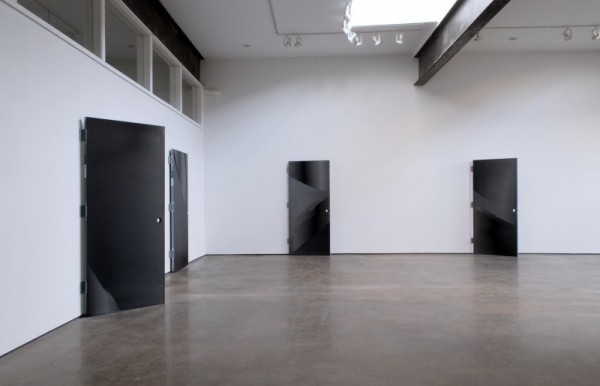


Ned Vena
Work from his show at White Flag Projects.
“Ned Vena�’s paintings combine the artist’�s astute readings of minimalism, post-painterly abstraction, and op-art with a unique technical process to render austere meditations on materiality and art history. For this exhibition, Vena will produce a new series of works utilizing common steel doors and adhesive vinyl, eschewing traditional substrates and mediums to emphasize fundamental concerns of form, process, and concept.” – White Flag Projects.
Tags: doors, lines, op-art, paint, rad installation
Posted in Uncategorized | Comments Off on Ned Vena
Friday, 20 April 2012


Emanuel Rossetti
Work from his oeuvre.
“Multiplex, with its various formal and contextual layers refers to a plural character of perception, like in a multiplex-cinema, where in different halls a multitude of images and illusions can be perceived at the same time. Rossetti’s ability of displaying elements accurately and unerringly within a space (be it the gallery or the virtual space in the films) echoe his longtime curatorial practice as one of the founders of the offspace New Jerseyy in Basel.” – Karma International
Tags: architecture, models, new media aesthetic, swiss
Posted in Uncategorized | Comments Off on Emanuel Rossetti
Thursday, 19 April 2012


Valerie Snobeck
Work from her oeuvre.
“The partially erased mirrors in Valerie Snobeck’s first New York solo flirt with avant-garde chestnuts like Duchamp’s “Large Glass” and Robert Rauschenberg’s “Erased de Kooning Drawing.” And as Ms. Snobeck deploys them in a scattered installation of wall and floor sculptures, they also perk up a tired post-Minimalist idiom.
Ms. Snobeck’s technique depends on the type of mirror she’s working with: she might use acid or a Brillo pad or a blade to abrade the surface. The resulting patterns vary from cloudy, as in “Static Movement,” to clean-edged, in “Replication.”
The mirrors are sometimes adorned with crumpled and draped sheets of printed plastic, as well as sheets of the adhesive film typically used to protect laptop and smart-phone screens. The screen film is a clever touch; it keeps some of the mirrors from looking too antiquey and invokes the narcissism of modern-day gadgetry. In a few of the larger works, chunks of dyed wood add color and structural support.”- NY Times
Tags: found materials, mirrors, painting
Posted in Uncategorized | Comments Off on Valerie Snobeck
Wednesday, 18 April 2012

Anna Sagström
Work from her oeuvre.
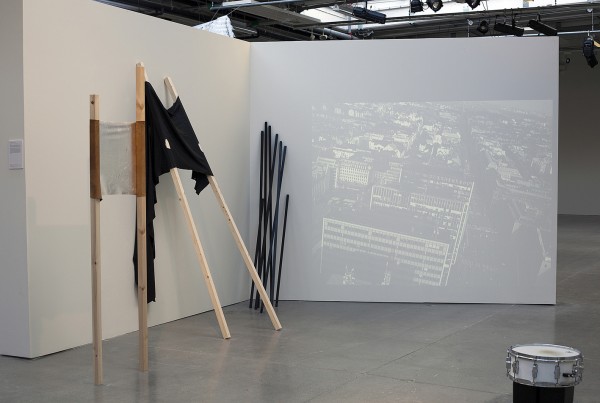
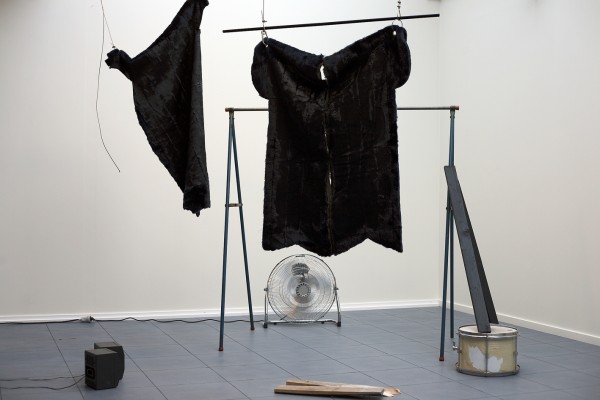
“Sound, light, plaster, yarn, cassette tape, wood, tar, image, text, concrete and fur, are all materials we have an experience of. We have touched them, felt them and we know how to relate to them, whether it is an experience of a solid material such as concrete or an ephemeral material such as sound. That inherent experience allows us to approach the works on a subconscious, more physical way, and this non-linguistic communication is central to my work.
Several works drift between a moving and static condition, as in an attempt to alter the perception of passing time. Cassette tape loops moves in and out of each other, a recorded monologue that by means of a set frequency and a snare drum creates an unexpected rhythm, or an installation in which seemingly still objects are in fact constantly performing small movements that balance against each other. Other works turn sensory observations into works that play with our sense of closeness and distance, like a video loop shot from a hot air balloon in which we drift in and out from a manually set focus, revealing the present to be perpetually in flux.
The borderland between the physically present and the ‘ghostly’ abstract is at the core of my practice, and the works are usually characterised by an undertone of melancholy and isolation; they can be described as trembling (and unsuccessful) attempts at communication. Recently, my work centres on psychological unwell-being, describing a sense of desperation and groundlessness, of trying to exist in a perpetuation of limbo.” – Anna Sagström
Tags: cold, contemporary nostalgia, european, found object, installation, minimal, sculpture
Posted in Uncategorized | Comments Off on Anna Sagström
Tuesday, 17 April 2012


Sherwin Rivera Tibayan
Work from Installation Views.
“After viewing many gallery and artist sites over the last few years, I became interested in the common photographic practice of installation views. These installation views (also called exhibition views) exist strictly as a class of images that provide proof for the material reality of specific works. Although this kind of photography is largely architectural and documentary in nature, I began to wonder if an alternative treatment of such installation views could occupy a discursive space beyond the mere photographic evidence of artistic production.
With that in mind, I downloaded and collected images of installation views from artists (and their respective galleries) whose own works deal with issues of photographic and institutional space and presentation. I wanted to create a layered viewing experience that began by emphasizing the distinct but uniform environments that housed the works of art, rather than the works themselves.
Over the course of several days at a local contemporary art gallery, I arranged and produced a translated version of these installation views as taped constructions. Using blue painter’s tape as the material framework for each photographic translation, I engaged in a reductive process that delineated only the architectural features in the source images. After photographing my own installation views of the finished works, I removed the tape completely, ensuring that the resulting exhibition could only be experienced indirectly. Finally—and in a gesture related to the tape’s outlining of specific physical spaces—I added a blue color cast in post-production to serve as a visual cue, re-situating the entire image as the site of negotiation.
This series of nine photographs only exist online and are presented via a simple post on the gallery’s past exhibition archive. In doing so, the images and their manner of presentation attempt to function simultaneously as both the work and its documentation, speculating on the changing nature of our encounter with the material and representational powers of contemporary art and the values attributed to their online counterparts.” – Sherwin Tibayan
Tags: awesome, installation, institutional critique, meta-gallery, photography, politics, tape
Posted in Uncategorized | Comments Off on Sherwin Rivera Tibayan
Monday, 16 April 2012


Scott Wolniak
Work from his oeuvre.
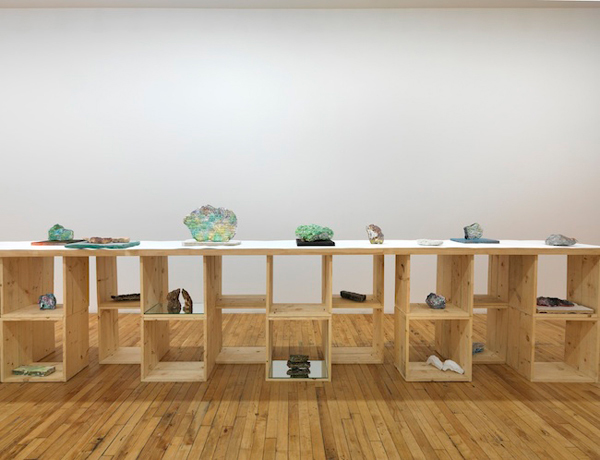
“With his new body of work presented in this exhibition, Wolniak continues his use of cause and effect to unlock what he perceives as a hidden interiority. He has created a series of plaster sculptures and relief paintings that investigate internalized process and bidirectional becoming, but the material stakes and methods are raised dramatically, including plaster casting, carving, etching and 3-dimentional fabrication along with chance operations and infused color. Sculpture, painting and drawing are combined in densely patterned, visually enigmatic objects that refer to ancient tablets, ceramic tiles, fresco painting, scholar stones, geologic souvenirs, psychedelic knick-knacks, and animism. Ultimately though, they remain unnamable.
The central work of the exhibition, Liminal Set, is a fabricated open-air cabinet that contains a curated series of these freestanding pieces, arranged in small groups or individual compartments and often resting on mirrored tiles or artist-made surfaces. The design relates to a lab display where the lower levels are used for storage and the surface for analysis and presentation. This context gives the objects a practical feel, as if they are natural specimens, but in their thoughtful insertion into a larger installation, they also play as precious objects. The cabinet was deigned and built in collaboration with artist Andy Hall.
Wolniak’s relief tablets, presented on wall cleats and minimal shelves in the gallery, occupy a hybrid territory between painting and sculpture. They function like something out of time and far away, historically ambiguous, simultaneously ethereal and physical. These pieces take material cues from the aforementioned sculptures but operate in entirely different ways. Where the objects deal with seeing the universe in localized gritty chunks of broken-off things, the tablets are about making (and unmaking) the universe from scratch.” – Andrew Rafacz Gallery
Tags: faux, imitation, installation, rocks, sculpture
Posted in Uncategorized | Comments Off on Scott Wolniak