Christoph Sebastian


Christoph Sebastian

Work from the series (or rather multi-faceted database) Fahrzeuge. I also recommend the series Transformation.

“”One must hurry if one wants to see something. Everything disappears.” Paul Cézanne.

The car is more than just a simple vehicle: It is surrounded by an aura of irrationality. From the very beginning, various fantasies have always been projected onto it. Peter Sloterdijk, a German philosopher, puts it this way: “All theories regarding the car as a means of transportation seem to miss a whole dimension: The automobile is not only an euphoriant, it is also an instrument of regression. It is like a rolling uterus, but unlike its biological prototype, it is linked to an idea of self-mobility and feelings of autonomy. The car is like an improved platonic cave built around the driver. The driver is not stuck in one place. This travelling ‘personal cave’ offers a view of the world floating by.” | Peter Sloterdijk: “Rollender Uterus” – Der Philosoph Peter Sloterdijk über Menschen und Autos, in: “Der Spiegel”, Nr. 8/195, S. 130.| In most countries, a life without cars is unthinkable. Over the years the car has totally blended in with society. In everyday life it doesn’t appear as a plain technical device. On the contrary, it gets charged in a projective identificatory manner based on a mythical pre-modern construction of the world. “Enlightenment was the disenchantment of the world; the dissolution of myths and the substitution of knowledge for fancy.” | Horkheimer/Adorno, Dialektik der Aufklärung. Barner, Detken, Wesche; Texte zur Mythentheorie, Stuttgart 2003 | Now, one question arises. How did the automobile as an object of Enlightment manage to escape this demystification of the world?

The visual long-term study “Fahrzeuge” doesn’t offer an answer to this question. Rather, tools and instruments of photography are used to break through our daily routine of experiencing and examining the mass-product ‘car’. The study focuses on its appearance in the course of time and space. Due to its copious distribution the automobile has almost become invisible to us. Everyday we pass countless cars, but we are not aware of them anymore. Cars have become an ambient noise of our everyday perception. Still it is impossible for us to look past them. “The car is not a rational and distant object. It is a quasi-natural part of our environment. …we deal with it in the same fantasy-driven and boundless way our pre-modern ancestors dealt with their natural surroundings.” | Johannes Bilstein, Matthias Winzen, Der Traum vom rasenden Körper. Ich bin mein Auto, Baden-Baden, 2001 | Examining the world through the camera viewer helps us to regain the lost distance between us and the automobile. The camera itself fills the gap between existing knowledge and the visible world. It reveals that the appearance of the automobile is fleeting. The appearance of the car is not only a product and an anonymous witness to an ever changing environment. It is always a reflection of a certain culture and a certain era.

The long-term study “Fahrzeuge” tries to isolate the automobile from its social functions. In this experiment the car is shown as an object. Photography transforms reality into an image. Here, the reality of the car is presented as an image, where formal aspects are of great importance. The autonomous photographs presented in “Fahrzeuge” try to preserve the appearance of the automobile by displaying cars in different locations at a certain period of time. This way visibility is generated and comparisons are made possible. The development of an archive is the study’s major long-term objective. With this archive different appearances of the automobile at the beginning of the 21st century will become observable.
At the moment the study consists of more or less 500 photographs, arranged in several categories. The categories are presented as typologies at the wall.” – Christoph Sebastian

Ralf Grossek


Ralf Grossek

Work from the series Collection Functional Intentions.

“The majority of our visual perceptions of the world around us is characterised by the attempt to functionalise our immediate environment. Due to the limited space in the big cities, we try to think up ways to guide traffic flows, protect property and privacy and provide security.

Everything lies close together; yet, different kinds of usage do not merely co-exist within the limited space but they have to be reconciled while still keeping up a clear distinction. The structures of our cities have grown immensely. In the course of time, the different requirements we put on our living space have come to interfere with each other. Already limited spaces of action intersect so that there is not only a need for mutual adaptation but also for systems enabling different ways of usage at the same time.

Although the presented scenes do not display people, they are evidence for the considerable amount of creativity people have to invest in order to successfully implement their intentions. The pictures tell about our environment which is animated with the human demand for regulations and functionality. ” – Ralf Grossek

Eyal Pinkas


Eyal Pinkas

Work from the series Covers.

“Under the conditions of the camera, objects and spaces reveal themselves in a gentle process of exposure. They perform a change, showing gradually different potential appearances that assumingly originate in their own fantasies. This search for the objects’ imaginable worlds within different surroundings has become a constant departure point for my work.  

The investigation on this conceptual strategy is divided in my working practice to two main methods, which are finalized and presented as series of photographic images and occasionally as video work.

In one way of working, I physically alter the structure and form of a given object, or as a parallel system, I change the order and appearance of an existing space. A bed for example, becomes a vessel by dismantling its turned into a theatrical stage when the chairs and tables are repositioned in arrangements that resemble a dance.

As a second way, I document my subjects without any physical interference. For instance, the rooms and objects of an army museum’s depot are depicted in photographs as vivid entities. In that case, the medium’s characteristics are used to represent the sleeping objects as expressive beings.

In both methods I approach the making of an image by physically and psychologically responding to the space I am working in, which is usually an interior. The rooms become for me a frame or a three-dimensional canvas where a certain directed activity of the subjects is performed. I perceive the room as a camera and the camera as a room; metaphorically – my work is done in the camera.

As an artist I want to create a world inhabited by objects captured in a state of conflict between their inner and the exterior realities. Performing a playful behavior can fill the existential gap that is created as a result of this conflict. On a visual level this behavior leads to forms of disguise and transformation. Even chairs, mattresses or wallpapers can be seen as costumes. As always, costumes represent the realm of the imaginary.

As a subject matter, I would like my work to be an allegory to this sensitive state of awareness.” – Eyal Pinkas

Anne Lass


Anne Lass

Work from Geography of Nowhere.

“The project “Geography of Nowhere” was photographed in the United States, where I resided the past couple of years besides living in Germany. In my work, I try convert my personal impression of parts of the US- American living space into a panopticon of absent self-situatedness. It is the absence of any reference of place and the randomness of shown locations that conducts me to the paradox title Geography of Nowhere. In this geography, the viewer is left to the sense of a misanthropic and cold atmosphere, caused by the dictate of ever repeating functional arrangements in the landscape. Especially in the urban cityscapes, I find the conflict areas that influence my images: conflicts of functionalism and individual development, the association with nature, the concourse of construction and vastness and, last but not least, to human interaction.” – Anne Lass

Sabrina Jungs


Sabrina Jungs

Work from the series Displays Unplugged and Himmel.

________________________

General Statement –

“To have a view is a visuell phenomenon capable of satisfying human longing, a experience extraordinaire. An impressive view is sure to leave an imprint in the viewer’s memory. Above all, an image of the view connected to feelings of grandeur, beauty, vastness, and freedom. To pause and let the mind wander sensitive men return to their viewpoints.

The German term „Aussicht“ translates both as view and as expectations, prospects. Thus, it can denote the hope for something new and to gain a special outlook, insight, or perspective in both their visuell and psychological meanings. It means the far sight of the horizon or overlooking a beautiful landscape as well as a look through a window. A view is normally only granted from an elevated vantage point, some views might even be available only at a certain time of day or year.”

________________________

Himmel – (my translation, apologies for flaws)

A video camera constantly films the sky above. These recordings are sent in real time to a projector in the exhibition space, and projected into a circular cutout in the ceiling. The projection creates an imaginary transparency through the ceiling of the building into the sky (site specific). The size of the projection corresponded exactly to the radius of the ceiling skylights that are blocked in the exhibition space. The projection will run continuously, thus it changes depending on time of day, weather and other factors.

Jeppe Hein


Jeppe Hein

Work from Social Bench.

You can see a great deal more of Hein’s work here. His work is far more varied than the Social Bench series.

“Jeppe Hein’s sculpture and installations explore the relationship between viewer and artwork. Using the minimalist aesthetic of the archetypical cube, Hein’s Shaking Cube is both sculpture and mechanical object. Framed by an invisible field of motion sensors, the work is impelled by the movements of the viewer. Using sculpture as an expanded field of social interaction, Hein calls into question traditional perceptions and functions of art, creating a work that can only be experienced through the viewer’s participation.

Jeppe Hein’s works address us individually; though, importantly, we might not have asked them to. Hein delights in apparently serendipitous events, suspending common sense laws of cause and effect and conjuring up scenarios in which, in direct response to our presence, seemingly sentient behaviour is coaxed from inanimate things.In some of his pieces he articulates a dialogue between the work itself, the person encountering it and the gallery space in which it is sited – though this is a conversation for which one is wholly unprepared. Works of this kind imply a wry relationship both to the Minimalist sculpture of the 1960s and to those forms of institutional critique that sought to question the authority of the museum or gallery space.” – Jeppe Hein

Atelier Van Lieshout


Atelier Van Lieshout

Work from Sport Nouveau.

“Sport Nouveau was created in the wake of Bad Furniture. This set of sport equipment has been designed with fantastic shapes, elegant forms and a noble character. The machine fits only thin people, preferably wearing silk socks. A heavier human body would break the machines, even with normal use.” – Atelier Van Lieshout

Interview with Design Boom here.

Tom Sachs


Tom Sachs

Work from his oeuvre.

Tom Sachs work operates somewhere between fetishization and critique of objects of contemporary American desire.  By reproducing these objects in readily available materials, using low-tech processes, Sachs is able to make the unattainable, attainable.  However, because these reproductions are “Tom Sachs'”, and are therefore expensive, fine art objects, available only to wealthy collectors and museums, they continue to be out of range of the average American consumer.  In the end, this reproduction only affords possession to Sachs himself;  the average viewer’s station in society is reinforced, and they are left with the same unquenchable desire, only renewed and amplified. – Ryan Mandell

“In the heart of the Meat-Packing District in lower Manhattan the Bohen Foundation, despite the prevailing climate of cut-backs and pessimism, recently opened its doors to a new exhibition space. The Bohen houses 15,000 square feet of raw warehouse space designed by architects/industrial recyclists/artists LOT-EK. It is fitting, given the shifting context of the district’s cultural production, that artist Tom Sachs should have inaugurated the space with his installation ‘Nutsy’s’. Representing two years of studio-based practice, the show spanned two floors and included, among other things, the world’s largest model of Le Corbusier’s 1952 Unité d’Habitation, a McDonald’s stall, a 10,000-watt boom box, a surveillance tower and a DJ station/bar. Extending over 4,000 square feet, the 1:25 scale world is connected by an elaborate, hand-wrought model car track fitted with speed cameras.

Wandering around the show, you quickly became aware of two things: the detail and the adolescent humour, which would undermine the work were it not for its labour-intensive sculptural quality. The artist’s painterly use of materials articulates a kind of raw, folksy take on authenticity. A million miles away from the miraculously clean joints of Donald Judd hand-made cabinets, Sachs’ drizzling glue gun shares a similar defiance of the factory-perfect finish. He is quick to shrug off the title ‘art’, preferring instead to call his do-it-yourself sculptures ‘bricolage’.

In the middle of the installation was a copy of Ludwig Mies van der Rohe’s Barcelona Pavilion lounge suite (1929). At first glance it blended in well with its surroundings and provided a convenient resting place. Closer inspection revealed the ensemble was made out of white foam board and clumsily welded steel, with ‘Barcelona Chair’ scribbled on its side in felt-tip pen. Sachs describes his messy welds as ‘the joint that exposes the machine-made fraud that is the handmade reality of the Bauhaus’.

Used as a model for housing projects the world over, Corbusier’s Unité exemplifies a coming together of the Bauhaus and the aims of the International Style – to build simple unadorned buildings that serve the needs of their users. Commissioned as a prototype to solve the post-World War II housing problem in Marseille, it became a blueprint for intelligent design. Not long after its completion Le Corbusier went on to say that ‘the 20th Century hasn’t built for men, it has built for money’. Placed alongside the McDonalds stall (complete with cleaning kits, grease storage, home-made shot-gun with a remote button spring release, and photocopier for making arse print copies for wrapping the burgers in), the artist’s giant model of Unité d’Habitation is a nod to the corruption of Modernism’s high ideals. Superficially Le Corbusier and McDonalds founder Ray Krok have little in common. Sachs proposes that they are both examples of successful models ‘blamed for dehumanising the world and replacing local culture with an international (soulless) style’.

For the duration of the show Tuesday night was model car cup race night. When I attended Sachs was defending his sole victory in eight races and someone was busy serving burgers and fries over at the McDonalds stand. After qualifying on the track downstairs, the fastest four cars (Sachs’ car has ‘Christ Killer’ written on the spoiler) set about the serious business of radio-controlled competition. At one junction there was the option of taking ‘a long, safe way through the Modernist sculpture park’ or risking a short cut through the obstacle-strewn ghetto. At another, just beyond the ‘bong station’, drivers had to negotiate a jump through a flaming ring of fire. Made to serve a dual purpose, the spectacular flaming hoop was also a barbecue where onlookers were encouraged to make roasted marshmallow and chocolate sandwiches (known fondly to Americans as ‘smores’). Pulling in to McBusier (2002) – the model designed by Sachs that is half Villa Savoye (1928-31) and half McDonalds drive-in – the winner was showered with Budweiser as he raised the trophy, on which his name was inscribed in permanent magic marker. It was a touchingly morose rumination on the advances of franchised culture over heritage. Sachs adds: ‘When you lose an eye or a leg, you get a glass eye or a peg leg … and when you lose culture, you get some of the things we do here.’ Watching people chilling out on Sachs’ leatherette Barcelona, designed as seating for the King and Queen of Spain to launch the 1929 Expo, I couldn’t help but wonder what Mies would have thought. But as he later admitted, ‘to tell you the truth, nobody ever used them.’” – Adam Mendelsohn from Frieze

Wesley Meuris


Wesley Meuris

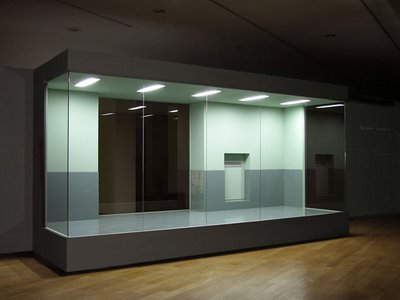
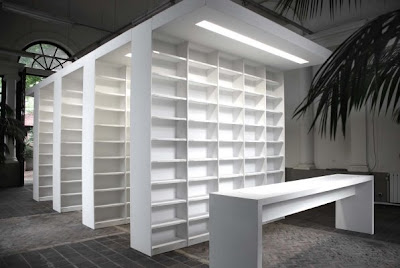
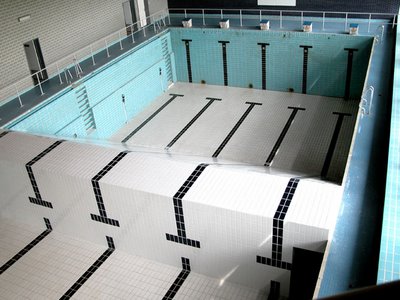
Work from Cages (my title, his works are various cages in the series), Botanical World Archive, and Swimming Pool.

“Since the nineties Wesley Meuris(*Lier,1977) has been fascinated by our relationship with architecture, and more especially by the way we convert particular patterns of thought, needs and desires into functions and codes of behaviour, which we then translate literally into architectural rules and forms. Meuris extracts these forms from their original contexts and reconstructs them, not as a faithful imitation, but as dazzling creations. For example, he distils the form and colour of changing cubicles (Kulak, 2005) and reduces them to a series of parameters, measurements and materials. These give rise to sculptures which he then transposes to ‘another’ context. This leads to powerful, refined and monumental forms often commended for their aesthetic beauty and perfection. (2)

Meuris recently commenced a thoroughgoing analysis and deconstruction of animal cages and aquaria and this led to a new development in his work, called ‘Zoological Classification System’. (3)
Meuris devised two large ‘cage sculptures’ for his ‘Artificially Deconstructed’ exhibition at De Bond, an art exhibition space in Bruges. (4)
The exhibition circuit starts at the back, on the right, at the glass home of a dwarf hippopotamus and then goes to the left, where we see an open cage intended for an okapi. It is striking that Meuris actively involves the entire space and its existing functions, including the toilets and emergency exits, in his sculptures, and vice versa. As a consequence we do not experience art objects standing detached in the space, but rather an ‘all-inclusive installation’ within which the spectator moves with apparent freedom.
As in previous works, the artist is in this case by no means imitating existing animal cages. He bases his cage sculptures on a sort of common denominator from which he designs his own form. He continues his analysis of the architectural form, unlike previous works, which acted as formal and functional statements. Examples of the latter are the Urinal (NICC, 2004), the marvellous Swimming Pool (Eclips, 2004), the mediaeval Trench Latrine 2 x 34L (Ename, 2004) and the 17 1-Person Cabins (swimming pool changing cubicles, Kulak, 2005).
These works are examples of an exploration of isolated objects, whereas the cages can be said to be a systematic analysis of various types and applications. In addition to the incisive study of the architectural aspects, Meuris turns his gaze beyond the physical boundaries and typology of the animal cage. Just as in a zoo or other scientific institution, he hangs extremely credible information panels above the caged animals next to his sculptures. They give the Latin name for the animal, various items of scientific data and a map of the world showing the original habitat. 
Where is Meuris taking us? It is in any case doubtful whether all he wants to share with us in the present animal cage series is just the visual splendour or sculptural qualities of these forms. One can interpret this attention to taxonomy and geography in various ways. Some critics opt for a mainly aesthetic analysis and associate this focus mainly with Meuris’ interest in classification, coding, etc. However, in the present article we have opted for another angle.
Whichever way we look at it, the function and origin of an animal cage is far removed from swimming pools, latrines and sports fields, which we can classify as forms of utility or recreational architecture. (5) Historically speaking, the cage lies at the intersection of several customs and cultures that placed great importance on observing, collecting and then exhibiting other people and other things, meaning foreign people and animals. (6)
Human history shows us that there is only a very small gap between seeing, the ‘scientific’ observation of other people, and domination, even appropriation and exhibition. We encounter this desire to dominate in language too. When we communicate with or about someone or something, forms of coding are of course indispensable. In this sense we are obliged to name the other person, and include them in a system of meaning. However, the question is whether we can do this in a non-normative whole and what our actual intentions are. It is perhaps simplistic to say that the wish and above all the ability to name, classify and ultimately to colonise those things or people who are external to ourselves is a matter not only of practical and intellectual interest, but above all of the analyst’s position of or hunger for power, but there is something to be said for it. It should come as no surprise that the first time we come across animal collections and zoos in the course of human history, they are the possession of kings and other powerful people. It was only in the 18th century that the general public was given access to the European menageries of the time. Nor is it at all astonishing that the mainly Western urge for colonial conquest and the birth of the natural sciences made the number of zoos increase exponentially. Of course there is nothing essentially wrong with such things as zoology, the theory of biological classification and taxonomy, or geography, etc. But we can hardly separate the history of these scientific methods and thinking from their anthropocentric and ethnocentric backgrounds. In this series of human discourses the desire for discoveries and scientific research went hand in hand with the occupation and exploitation of regions and all their inhabitants. This in its turn led to the birth of a more extensive cartography and taxonomy and the invention of a set of new buildings and constructions. The zoo and its collection of cages is one of the physical exponents of this. We cannot therefore consider the zoo as separate from other institutions, practices or art forms such as the wunderkammer (collection of curios) and the ethnographic museum, or from the often dubious colonial photography, certain types of travel literature, exotic painting, etc. They are all part of a complex process of interpretation, distortion and ultimately capture of the other, people and animals, which are seen implicitly as inferior.
Fortunately the zoos distanced themselves from this damaging colonial past, but then, despite their scientific aspirations, they opted for a shaky position as part of the ever-expanding leisure industry. Although the present-day zoo often has educational activities and in some cases the conservation of certain endangered species is a policy option, it remains above all an institution where one can satisfy one’s thirst for exoticism, curiosity and sensations. They hold the promise of a reconstruction of the most inaccessible habitats and their occupants, some of whom are dangerous to man. These animals are seized, neutralised and put on show. Both in the cage, and also in the world map and the Latin name, we shut them up in a territory which we ourselves have devised. This process is part of our construction of and relation to reality, but it is at the same time a reflection of an inner mental fact, which is our compelling desire for a strict separation from and the necessary remote control of the other. This may perhaps only have been an incidental intention, but in his combined study of the cage and the taxonomic and geographical description, Meuris touches on one of the cores of our spatial occupation and urge to possess. He rationally deconstructs these architectural forms and their related meaning systems, but at the same time exposes these buildings’ inherent cruelty, but without pedantry, pamphleteering or intending to convey a message.
In his cage sculptures, Meuris puts the emphasis mainly on the perceptibility of the object and the comfort in which we can view it. The animals can be seen from several angles; the sculptures mainly emphasise the position of the spectator. We are forced to consider the question of ‘what, or whom, is Meuris essentially putting on show here?’ Here too one can opt for a purely aesthetic analysis, but can one simply close one’s eyes to so much looking?
In the case of these cages, the viewer’s pleasure comes not only from the experience of the aesthetic brilliance of the sculpture, but is also, almost unnoticed, perfidious. 
After all, the spectator can delight in the spectacle of an imprisonment and domination that is perfectly pure because it is cleansed and painless.
The artist accentuates the visibility of a non-image, the absence of the animal, and in precisely this way turns the spotlight on the ubiquitous architectural context, its hidden background and the true protagonist. (7) We saw that an overpowering looking goes hand in hand with forms of literal dominance. The artist is here imprisoning us, shutting us up with our gaze in an animal cage, an emptied stage.
At De Bond, Meuris guides the visitor through a series of changing scales. On the one hand there are the ‘life-sized’ cages, which are themselves miniature versions of the animal’s natural environment, and on the other hand there are the signs with their world maps and the scientific data he makes use of. Finally, he literally absorbs us into the greater overall installation.
This time we wander around in his world. How do we get out of this cage system?


Notes
1. Foucault, Michel; Surveiller et punir, Paris, 1975, p. 234.
2. We here refer, among other things, to Herman Parret’s article in Kunst Nu (October 2005) and various reviews.
3. The first cage sculpture was shown at ARCO in Madrid (February 2005).
4. Meuris’ interest in the deconstructive methods of Jacques Derrida (1930-2004) is apparent not only from the title of this exhibition, but also, and above all, in his artistic practices.
5. Although there can be no doubt that looking at captured animals is for many people a form of leisure.
6. We should not forget that various African peoples were exhibited live, alongside or together with animals. One notorious example is the Khoi-San woman ‘Saartje’, who was displayed all over Europe, often shut up in a cage (see, among other things, Hall, Stuart: The Spectacle of the Other, London, 1997, pp. 264-269). This case turned out not to be unique, and this practice lasted at least until the world exhibition in Brussels in 1958. See, among others, Corbey, Raymond, Wildheid en beschaving, Nijmegen, 1989, including ills. 99, 103, 104, 107 & 108.
7. In this sense, Meuris turns Jeremy Bentham’s renowned panopticon inside out. The guard/spectator is now in the spotlight, and not the prisoner.” – Michel Dewilde

Jonathan Dankenbring


Jonathan Dankenbring

Work from Prototyping Fulfillment.

“Every object present in our daily life reflects ideological information about its maker and its audience. Yet, often we do not take time out of our busy day to ponder how our built environment is manipulated through visual and physical means. My most recent series of works are carefully selected, culturally relevant, forms that carry with them a vast wealth of information about our own culture. The information being investigated is that found in the purely form-based qualities inherent in the design of these objects. What does an overtly square / rounded / thin / thick / flat / glossy form say about designers and the culture in which, and for which, they are designing? I approach these questions from an amateur anthropological perspective rather than using more common research / writing tools of investigation. The result is a collection of streamlined visual representations of culturally sought after forms, placed back into said culture to ask for a reviewing process of the beliefs we hold. ” – Jonathan Dankenbring

via Ryan Mandell