Xavier Delory


Xavier Delory

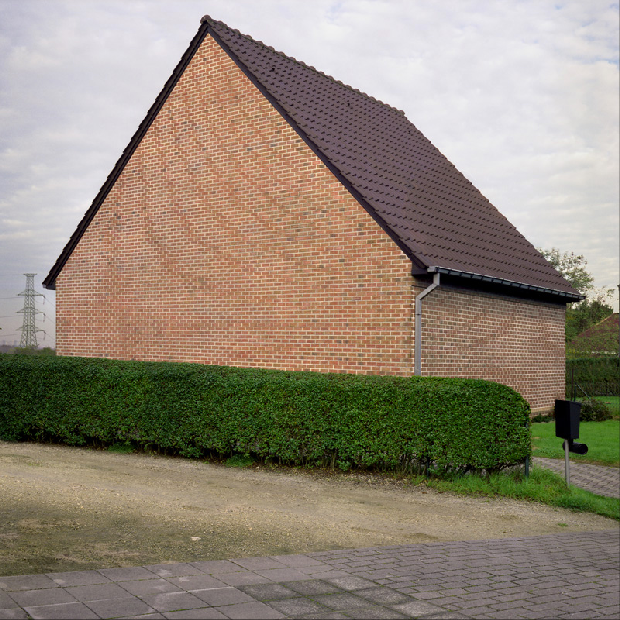
Work from Habitat.

“Our countryside (in Belgium as well as in many other western countries) is monopolized by one specific type of house called ‘clé sur porte’ (turnkey) (def:Urban prefab cluster of similar forms implanted in the landscape without any effort of integration).

The cycle ‘Habitat’ throws a look at this type of ‘architecture’. The concept of protection and stereotyped block is pushed to its extremes (similar to our withdrawl into ourselves and out formatted lives).” – Xavier Delory

Anne de Vries


Anne de Vries

Work from his oeuvre.

“some thoughts about my work and interests

photography is not the same medium anymore as what it used to be. after you once pressed the button of your digital camera, you will need a computer instead of a dark room.

since the 90s digital photography became the mainstream mass medium of today. and an enormous overload of new photographs are exchanged over the internet everyday. if you work as an artist with the same medium you cannot avoid the question, why make more images if there are already so many? this question became central in my practice, through my work i try to find answers and formulate more questions.

when in the 00s digital photography got combined with the internet and mobile phone devices and the use of photography changed completely by which everything that is acknowledge as happening gets practically constantly mediated. we got to see how step by step the process of knowing becomes more and more collective and corporately extended to the whole of human society, and will turn into a huge contextualizing network.

next to this as an artist (working with photography but also other media like installation performance and video and animated gif) i intend create self aware images with their own meaning in which i generate and illustrate new ideas. these can be seen as a re-contextualizing network, using several media to question meaning, sometimes to replace or alter the stability of received historical or cultural facts. here i would like to quote arjan mulder from his book: – understanding media theory – he explains the following: – we do not use media out of a desire for direct contact with reality, or even a need for information. we seek surrender: we connect to media out of a desire for a direct experience of something that is not ourselves. we wish to experience ourselves as we are not. again and again, in different ways, with different media – (umt, pp. 67-68).

the idea of photography as a way – to experience the world as it is not, in different ways – is fascinating to me, transforming the known into an unknown unapproachable virtual reality that is able to contain an enormous power. based on capturing the world with a camera and secondary the endless possibilities that we find in digital image manipulation. why does this exist ? where is it used for ? how can this power tool be used to promote an artistic aim? in my work i am interested to involve an universe where freedom, naivety, wild fantasies, fetishism and detailed uncanny perversity collide with abstraction, semiotics, technology and slick technological perfection.

by re-contextualisatising i induce a shift in recognizable conventional codes of our visual culture. dealing in my photographs with the banalities of the real world while suggesting a clearly visual or hidden abstract alternate one. where balls entering a hole and exiting another, waves that remain motionless in a wild media ocean. where with simple methods semi naif or more complex scenario’s are created and distorted again. constructing a scene that triggers, a layered reading functioning as a document of a self aware reality and a portal to the imagination.” – Anne de Vries

AIDS-3D


AIDS-3D (Daniel Keller and Nik Kosmas)

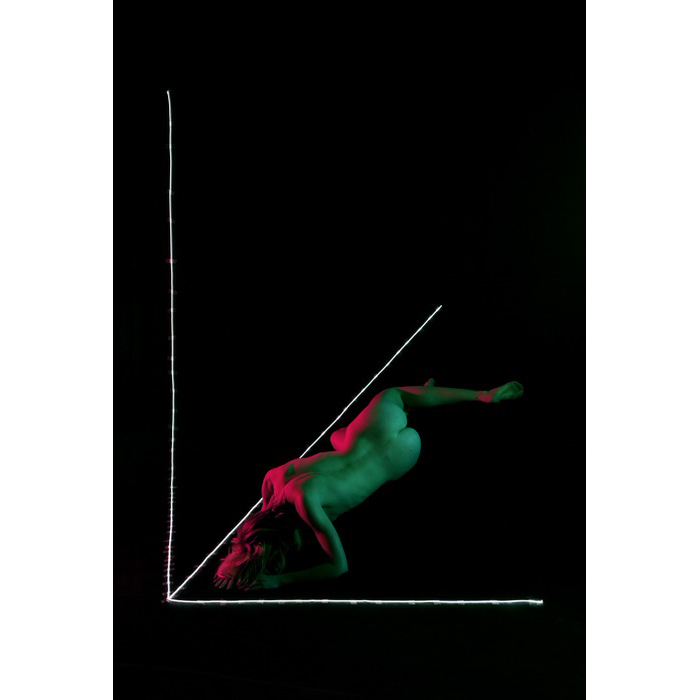
Work from their oeuvre.

The top image is a collaboration with Anne De Vries and Helga Wretman.

“The artist statements written by Berlin-based American artists AIDS-3D read as simultaneously post-apocalyptic and utopian. They are primarily concerned with the unfulfilled promises of emergent technologies and the ways in which our daily lives revolve around these media. Alienation, self-preservation, reproduction (sexual and otherwise), and the construction of lifestyles are common themes in their work, which takes the form of performances, sculptures, and installations frequently employing lasers, electroluminescent cable, and relics from a recent past promoting the heights to which novelties of various origin will change the world. On September 20th, the duo will open the show “Digital Awakening” at Athens, Greece-based K44 Gallery, in which they will elaborate two radically different future scenarios, one in which Earth suffers “a disastrous energy crisis leading to war, famine and the breakdown of the global capitalist system” and an another where “humanity lives in a techno-utopia, where communication tools and futuristic technology fueled by alternative energy have allowed us to fully transcend into a scientifically maintained balance.” Considering the potential impact of current directions in the field of energy production, these fictional accounts may not be the work of utter fantasy.” – Marisa Olson

Guillermo Faivovich


Guillermo Faivovich

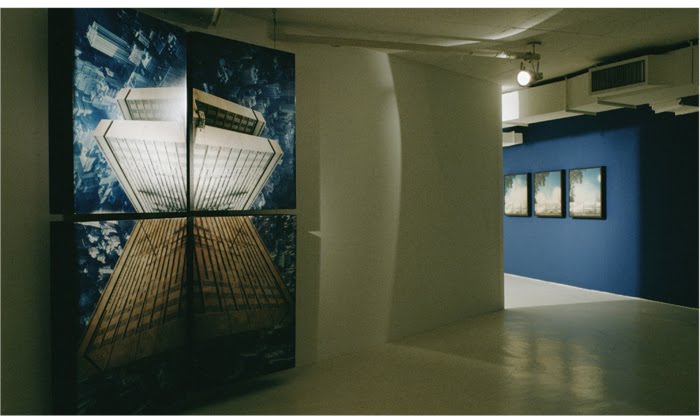
Work from Cubo12 and Rod.

“Based on the architect Clorindo Testa’s unrealized plans for the renovation of the premises on which the work takes place, FMV generated a permanent space consisting of 144 square meters of white paint on the exact site where the Centro de Artes Integradas at the Universidad Torcuato Di Tella would have been located. “

_____________________

“By means of the installation of a system of walls, the exhibition space is modified so that it has two differently-lit rooms through which to circulate; in this space, an arrage of five photographic works unfold. The space and time of the exhibition appear to be the only connection between the works given the diversity of their themes, techniques, and processes as well as the years when they were produced.”

both texts Guillermo Faivovich

Sam Falls


Sam Falls

Work from his oeuvre.

“I work with photography because I see everything in front of me all the time, but the more I see the less I know what I want, you know? So I make pictures that try to resolve what might not be being seen, the underlying pattern of what I find interesting and understanding how this can be compounded. Each picture leads to the next, and usually there are formal connections, but not repetitive content – so it’s non-serial. At first it was easy to photograph what I wanted to see, it was about isolation and highlighting already existing reality. The deeper I go though, the more of a challenge it becomes, the more abstract the images get, the more I manufacture, and basically the more I’m starting to create something from scratch where I mix what I know and what I want to figure out – this seems to output a new object that implicates the viewer too. So it’s about me and it’s about you, but it’s not about me and you.

It changes all the time, but usually there is a very concentrated period of actual photographing followed by a lot of sitting and looking at the image and then another dense period of either re-doing it or moving things around. Like recently I went to the Metropolitan Museum of Art a few times to photograph some paintings and sculptures I’d been thinking about and researching. I used my 4×5 and it was a bit taxing shooting like that in the museum light (no flash). When I got the photos back they looked great, but they also looked just like I thought they would, which was boring – they didn’t fully do what I thought they would. Then it’s like, what did I think they would do? and I have to sit with them and work that out and go further, flush it, then the actual work happens all through the night on the computer or by hand and re-photographing. When I wake up I see the image and it’s usually like what? Oh, fuck yeah! I work in my studio basically 5 pm to 12 am everyday painting and drawing and looking at things around my place and on the Internet and end up photographing a couple of these things so by the weekend there’s usually one or two prints being made.” – from an interview with Fecal Face

Liddy Scheffknecht


Liddy Scheffknecht

Work from scaffolding.

“All architectural elements except the scaffolding were removed from the photograph of a building under renovation. The result is an autonomous “drawing“, which suggests the form of the erased building. The scaffolding, normally a temporary urban structure, was retained whereas the building, a permanent urban structure, was eliminated.” – Liddy Scheffknecht

Sarah Gerats


Sarah Gerats

Work from her oeuvre.

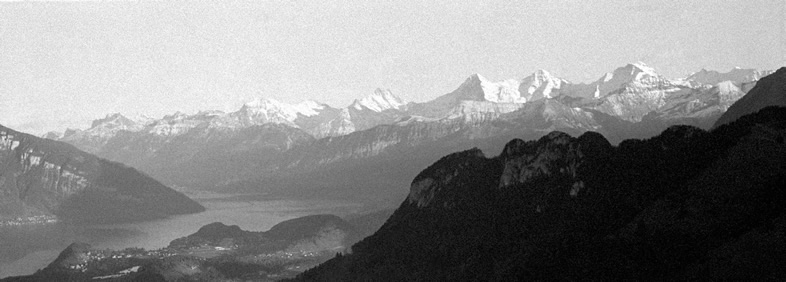
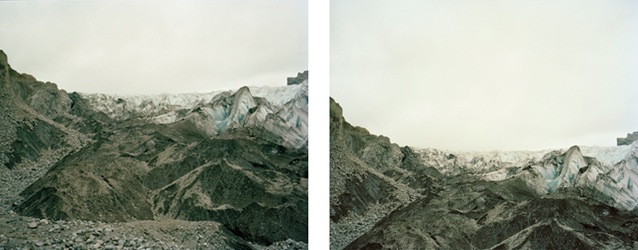
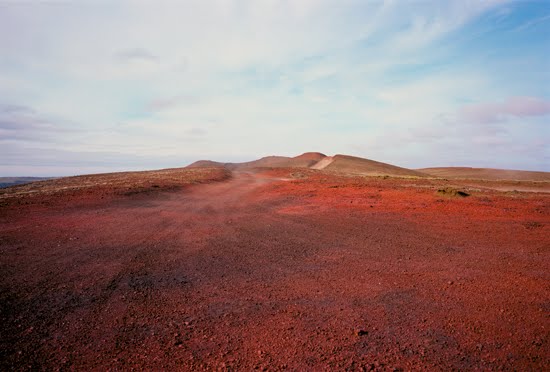
There is shockingly little written about Sarah Gerats, though her work seems to pop up in quite a few places. Aesthetically, she fits easily in her native land (The Netherlands) and the great majority of her works follow the aesthetic and conceptual concerns of contemporary Dutch meta-photographic works. The two most easily accessible example are her series Her and the very soothing Meanwhile-Landscapes, both of which challenge the tradition of their genre. The self-portraits from Her employ the awkward pseudo-sexual aesthetic that seems to be a fashion throwback to the early 80’s while addressing notions of gaze, reflexivity, and the role of artist as performer. Meanwhile-Landscapes deals with very similar conceptual concerns (to a degree) in the gentle flowing diptychs of serene landscapes. The works, much like Her, mirror (pun totally intended) the traditional role of the landscape photograph and allow the viewer to experience the landscape as a simulacrum of reality, moving the photograph simultaneously beyond mechanical reproduction while at the same time fixing reality in miniature.

Herbert Weber


Herbert Weber

Work from his oeuvre.

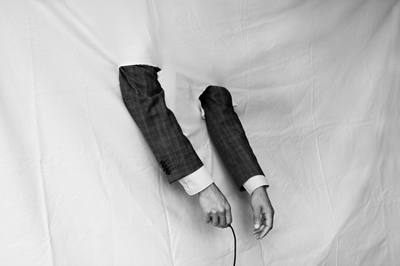
“The Toggenburg photo artist Herbert Weber is fascinated by basic issues of the medium he works with. There is definitely some romance involved in his inquiring the truth of images, in spite of the photography’s long-known loss of authenticity… The prominently placed wire may be interpreted as the umbilical cord of photographic self- reflexion. It is reminiscent of the time in which the medium had a leading role in the presentation of reality. And it literally links the picture with its observer, the artist with his audience. With his mostly small-format black-and-white photographs Weber cultivates a role play in service of a pseudo-scientific research. His body is his instrument, his photography is the investigation’s object and goal at the same time. He climbs picturesque trees, wanders on snow-covered ridges, explores the grounds of an inoperative factory or shoots moving clouds in a new moon night—and, with his photographing and photographed body, creates a topography of his own expeditions; this activity’s decelerated and slow habitus is reminiscent of early 19th-century expeditions. And yet, Herbert Weber is a present time artist; with his change of perspective he raises the question of the subject’s construction and the ego’s relation to its own history time and again.” Text by Christoph Doswald for Christinger de Mayo

Matthieu Lavanchy


Matthieu Lavanchy

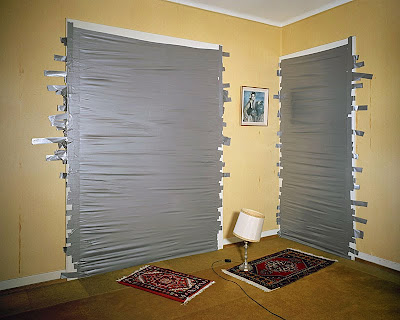
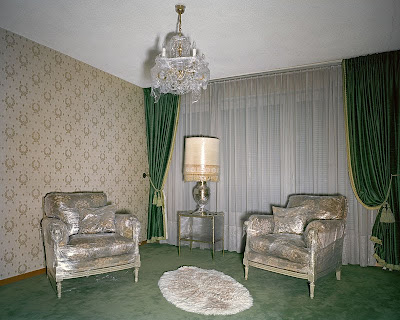
Work from Mr. Schuhlmann or the Man in the High Castle.

Below is an excerpt from an interview with Wallpaper Magazine.

You have used strong flash lighting in your Mr. Schuhlmann series. Was this intentional?
Yes. I believe light is an integral part of the overall meaning of an image. In this case I wanted the pictures to feel like a report, as if someone had documented what they had seen in a very straightforward way.

Who is Mr. Schuhlmann?
Mr. Schuhlmann is both an allegorical figure and the embodiment of Mr. Everyman. He was a way of personifying concepts that I had in my head. I chose an ordinary name for him because I wanted to highlight that his paranoid behaviour and thoughts are more ordinary than one might think. He’s a bit crazy, but at the same time, very familiar. He could be a neighbour who has just gone off the rails a bit. This fictional character has enabled me to structure my work. By imagining myself inside his head, imagining how and why he would have created these installations, I was able to give coherent form to my ideas.


Is there a thread of the autobiographical in your Mr. Schuhlmann series?

Not really. I consider it more like a critique.

Can you tell us about the setting of the story? Where is it and did you style the images yourself?
I was looking for places that had a 1960s and 1970s feel to them. At this time, interior decoration was suposed to turn your home into a paradise, an eden where you could retreat. I thought it would be interesting to set the story in this type of ‘ideal’ environment. So I convinced some friends of my grandparents, my old nanny, et cetera, to lend me their flats. Then, yes, I styled the images myself, sometimes using what was available on the locations, sometimes adding things myself.

What inspired the sense of fear that the images convey?
Well, we live in an age when we are bombarded by violent and dramatic images from the mass media and the entertainment industry. These images become part of our everyday life and create an inescapable climate of fear. My aim with this work was to make a commentary on these overprotective and paranoid times that we live in.

What is your next photographic step?
I would like to take the construction aspect of my work further. For the new project that I am working on now, I am going to build all of the furniture myself especially for the photographs.


Where are you based and how does the city you live in affect your work?

I currently live in Lausanne, in Switzerland. It affects my work in terms of practicality and access. Here, I know where to find everything I need for my pictures, and this usually means a lot of things! I know all the thrift stores, the DIY stores, the dumps, the empty houses, apartments, et cetera.

Who, what or where has been your biggest inspiration to your career?
Theatre decorations, movie sets, window displays, interior design. I like it when all the elements of a calculated set-up work together to form a narrative and a sense-generating whole. All in all, I guess I am inspired by the dramatic power of space…

Allison Davies


Allison Davies

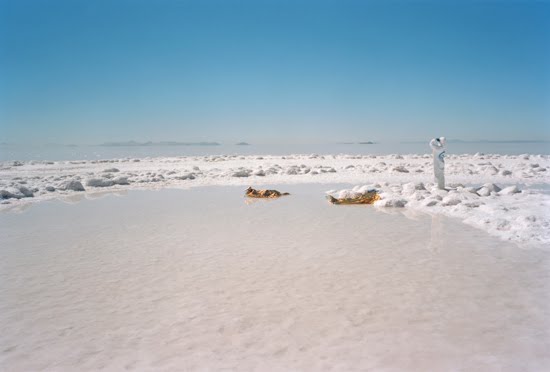
Work from Outerland.

“In Outerland, her debut collaboration with Charles Lane Press, Davies reveals for the first time her personal work of more than a decade. Portraying herself as a solitary wanderer in the spectacular vistas of alien worlds, she appears only obliquely in her images, veiled in a spacesuit of her own design. As Davies traverses the beautiful but deadly topography of Outerland, her purpose is unclear. What is the meaning of the strange insignia on her suit? Are the instruments she carries with her – and with which she subtly alters the landscape – for science or survival? Where exactly is Outerland, if it is not in fact a harsh and dystopian vision of our own planet deep in the future? Presented without text or explanation of any kind, and with only a handful of mysterious symbols to help us orient ourselves in Davies’ imagined cosmos, Outerland offers a compelling new perspective on self-portraiture within the continuum of modern landscape photography.” – via WIPNYC