Tuesday, 6 April 2010


Art Fun Club
Work from their oeuvre.
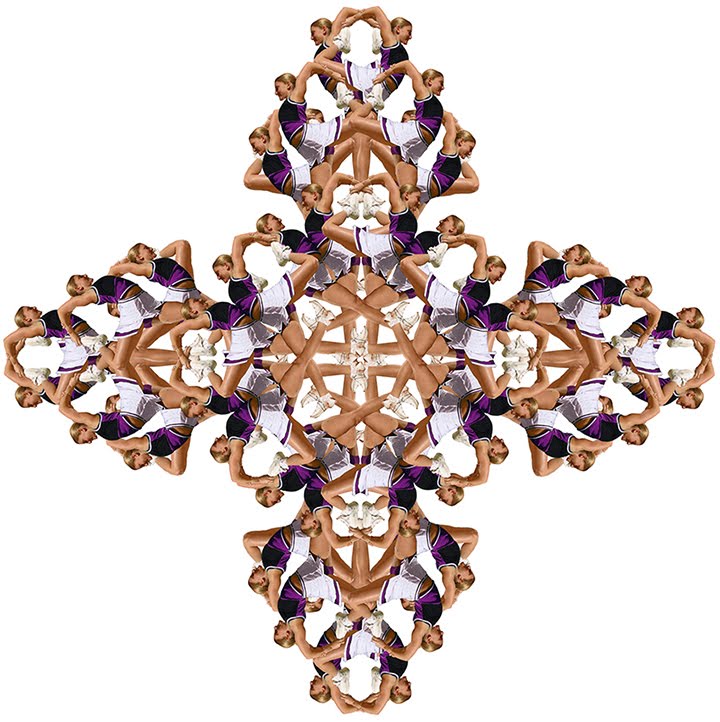
“Do not be fooled by our name. We do take art seriously.
We are a collaboration group of three artists who were beginning to reconsider their full devotion to the artist way of life. It was quite challenging for us to manage both life and art, since we liked both.
There was a moment when we realized that we were slowly stopping being just professionals, and becoming more of consumers. At this point we figured that we could blend these two positions – of art makers and art consumers.
If these two positions exist, then there also has to be a place in between the two of them. Usually you either declare yourself as an artist or as not an artist. Or one declares something as an art piece or as not an art piece. We want to be at this place where nobody wants to be – in between. Where we can take from both, and hopefully, give to both. This is why we do not say that we make art works, but works about art. Works that are related to art.
We make works out of books that are about art. A book of art as an art object. Books of art as a materialization of the entire art in one object. So when we use these books, we actually use them as a metaphor for art itself. When we place these books into different situations, adoring them, loving them, laughing at them, criticizing them, playing with them… we actually do that with art itself.
By doing so we are trying to add something that does not exist in contemporary art, even though we are not yet exactly sure what is missing, and what it is that we are adding.” – Art Fun Club
Tags: books, collaboration, kitsch, meta-art
Posted in books, collaboration, kitsch, meta-art, theory | No Comments »
Monday, 5 April 2010




Cassandra C Jones
Work from send me a link.
“While contemporary technology has brought forth droves of artists and amateurs alike using digital means to create a photograph, Cassandra C Jones explores digital media without adding to a world over saturated with images. In her current solo show titled Send Me a Link, with Baer Ridgway Exhibitions in San Francisco, Jones recycles images found through internet research and recontextualizes them through still and animated digital collage, creating a sense of motion and depth through static imagery. By incorporating images that are repeatedly used in amateur and stock photography, Jones redefines the viewer’s relationship to the appropriated photo and creates a new understanding of the world’s bond to the ubiquitous image.In this body of work, Jones constructs new assembled images from photos which would be considered cliche or mundane, due to the mass quantities existing in modern resources. For example, in Disco Girl and Car Fire, Jones demonstrates how the viewer is already linked to the visual symbols within each video. The appropriated images create new photos and videos without any direct manipulation, redefining the nature of collage through contemporary digital means. In the Lightning Drawings, Jones digitally overlays images of lightning strikes to create drawings, connecting the tools of drawing and photography. Similarly, Swarm and Iris expose the multiplicity in modern imagery through single figures being reconstructed to overlap creating pattern and depth. Each of these images allow the viewer to consider the individuality and multiplicity of the subject matter, revealing the repetitive and over saturated qualities of the modern photograph. The exhibition, Send Me a Link, not only demonstrates how easily photos and videos are shared socially through modern technology, but also gives a context for how we relate to these images in our daily lives.” Julie Henson for The Daily Serving.
Tags: birds, collage, found images, found photographs, humor, montage, recontextualization
Posted in birds, collage, found images, found photographs, humor, montage, recontextualization, wallpaper | No Comments »
Monday, 5 April 2010
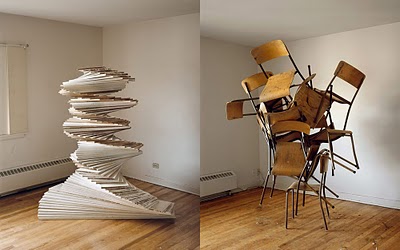

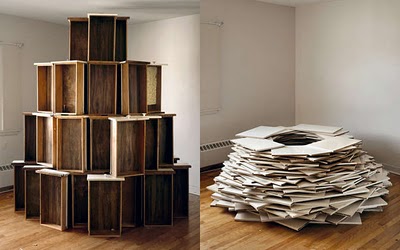
James Nizam
Work from Memorandoms.
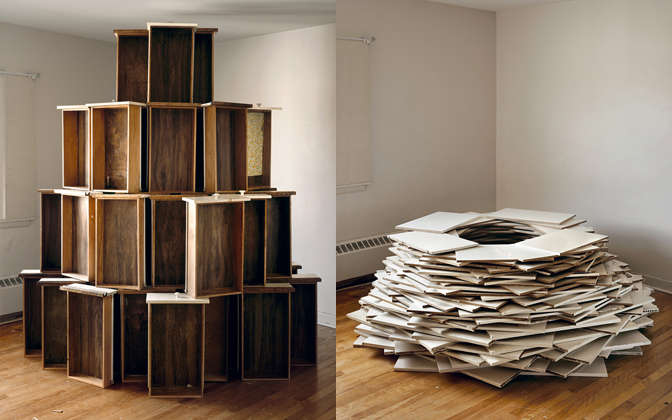
“That political battle between past legacies and future potentials is one point of departure to consider when viewing “Memorandoms,” an exhibition of new photo works by Vancouver artist James Nizam at Gallery Jones. For the series, Nizam used Little Mountain’s abandoned residences as a studio, exploring the site’s echoing histories and lingering physical traces. Nizam has practiced this strategy before. In series such as Dwellings and Anteroom he occupied soon-to-be-demolished homes, turning empty rooms into camera obscura which he then photographed, capturing the living outside world on the unhinged doors and broken walls of a derelict past.
Rather than projecting new life onto his subjects, Nizam, in his Memorandoms series, suggests residual life in them. Each photo depicts a sculptural construction that the artist cobbled out of Little Mountain’s detritus. Piled chairs, drawers and light bulbs become a kind of memento mori, impromptu gestures to monumentalize a fleeting existence. Knowing that the destruction of these spaces was near adds urgency to these photos, but perhaps Nizam’s mmessage is this: the wrecker’s ball doesn’t always have the final word.” – via Canadian Art
Tags: Canadian, florian slotawa, found object, installation, photo sculpture, sculpture
Posted in Canadian, florian slotawa, found object, installation, photo sculpture, sculpture, vancouver | No Comments »
Saturday, 3 April 2010

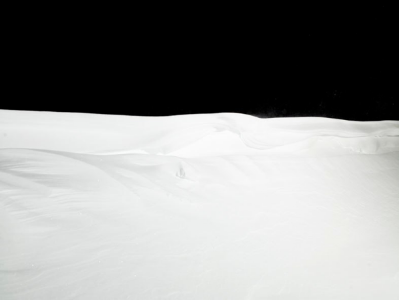
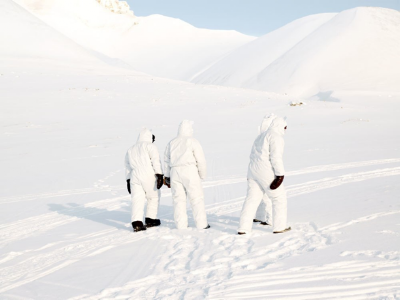
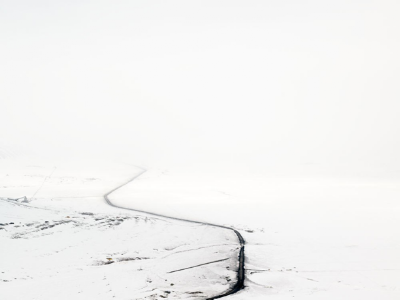

Niels Stomps
Work from Fire and Snow.
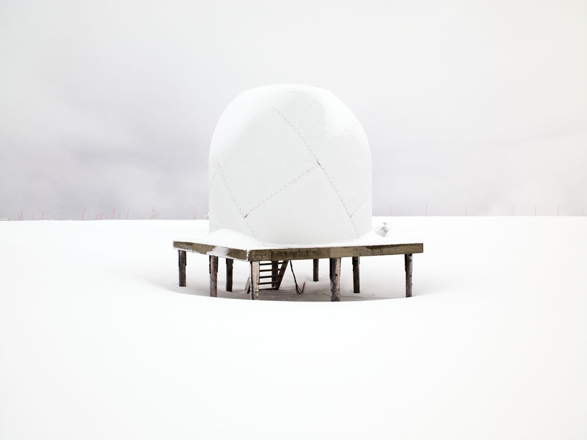
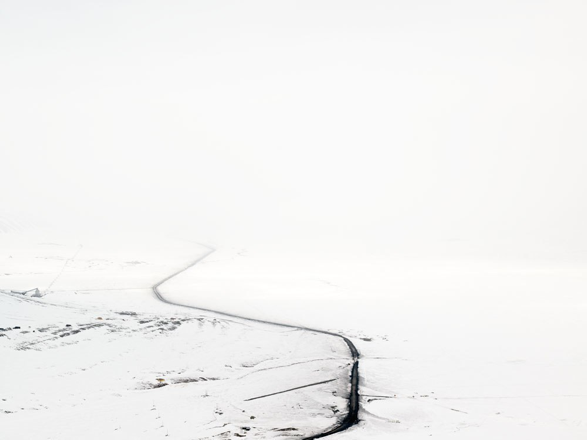
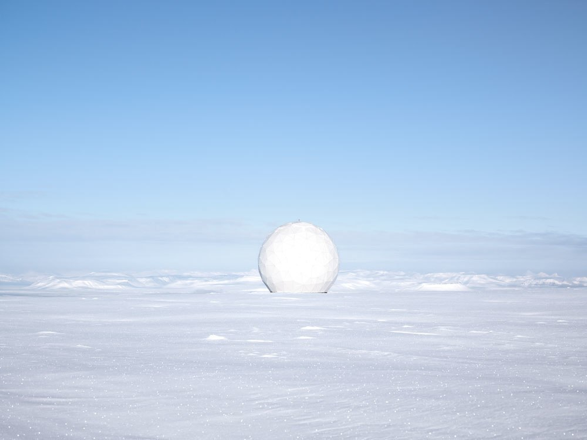
“Svalbard, Spitsbergen’s location at 78 degrees north latitude makes it the world’s northernmost permanently inhabited settlement. The island is literally cut off from the rest of the world by sea or ice. The rhythm of nature is so dominant that the only recourse is to adapt. Svalbard’s inhabitants did not arrive by accident. Many made a conscious decision to leave civilization behind. What could be a better place than an island within the polar circle?
Mining has always been the main source of income for Svalbard´s inhabitants. Nowadays, scientific research is also a source of income. Various installations throughout the island refer to the research that is conducted there.
It is the contrast between the past and future of the island that appeals to me, but particularly man’s persistent urge to broaden his horizons and literally seek out its boundaries.
The scientists can be seen as modern-day explorers. How people settled on this desolate site, how they adapt to their surroundings.”
Tags: cold, dutch, landscape, north, snow
Posted in cold, dutch, landscape, north, snow, vernacular professional | No Comments »
Friday, 2 April 2010

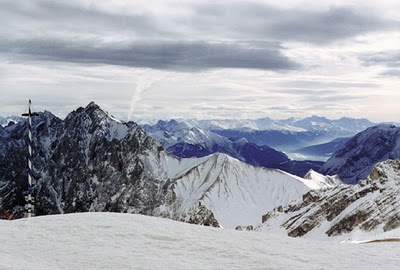
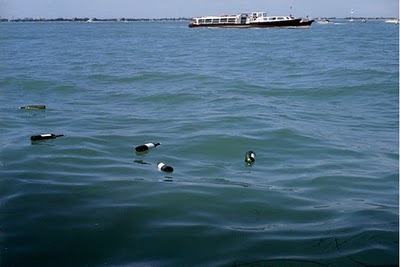
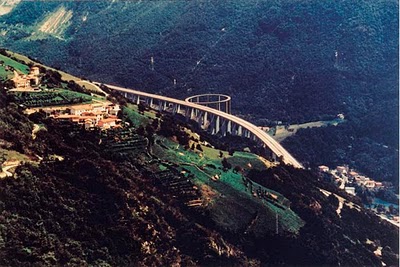
M+M (Marc Weis and Martin De Mattia)
Work from Meet the Artist’s Wife, Duftwolke, Mail in a Bottle and Autobahnschleife.
__________________________________________
The Buyer can get in touch with either one of the artists wife, Betty or Susan.
Betty is brunette, sensual, intelligent and witty.
Susan is blonde, erotic, romantic and has a good sense of humour.
For 500 Euro the buyer can meet the avatar of the chosen artist’s wife in Second Life for two hours. The code name and the exact meeting point will be issued. Other virtual meetings or a meeting in real life are not planned at the moment but can be discussed during the proceedings.
_________________________________
By means of a specially constructed machine, a perfumed cloud is dispersed at regular intervals from an Alpine mountain peak. A meteorological diagram gives its position within the climate system and explains its diffusion on a typical spring day.
___________________________________
“Mail in a bottle” is an attempt to establish, in consultation with experts, a ‘message in a bottle’ station for Venice. Expert opinions (from the Nuremberg Post Museum, a canal construction engineer, a Venetian postman, etc.) were solicited beforehand via an Internet forum and discussed.
The “Mail in a bottle” system is realized in accordance with their proposals. The system allows visitors to the Venice Biennale to send letters in specially designated bottles. In keeping with the natural setting of the city of Venice, the bottles, which are corked at the station, are entrusted to the waterways and the sea as carriers.
____________________________
The project offers the driver a chance to leave the motorway at a sign-posted exit and take a 360 degree bend which loops back to the motorway, rejoining it at the point where he left. The whole enterprise is being developed in close collaboration with an office for Construction building. In the same time an exact map for the construction was being developed. A digital image incorporating the landscape of the site located near Vittorio Veneto, illustrates the sculptural quality of the motorway loop in the surrounding countryside.
Tags: humor, intervention, proposal, second life
Posted in humor, intervention, proposal, second life, thought experiment | No Comments »
Thursday, 1 April 2010


Chad Muthard
Work from Lost in Thought.
“The work I construct is an attempt to resolve issues or conflicts in the mind. Most of the work is derived from events or moments in life, that I struggle to understand the affect of and/or outcome of the situation. These ideas are then taken and projected into narrative form in images, which tend to become elaborately fictional versions of the event. There is definitely a play between both reality and fiction in the pieces yet, I feel as though the work is still very much about documentation in how each body of work and/or series encapsulates a period of time.” – Chad Muthard
Tags: abstraction, american, framing, meta-photography, obfuscation, photographs of photographs
Posted in american, framing, meta-photography, obfuscation, photographs of photographs | No Comments »
Wednesday, 31 March 2010


Michael Lundgren
Work from Transfigurations.
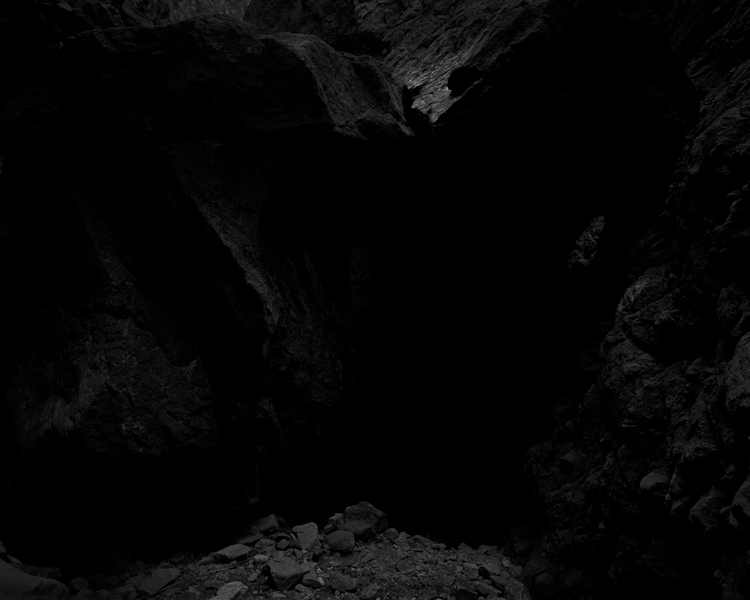
“As an artist, I have always been drawn to the field of landscape. It is the perfect subject with which to explore our history and our desire, two urges bound deeply together in the mythology and experience of the American West. As well, working in wild places always feels like coming home.
…If I have learned anything from Postmodernism, it is that photographs are not the thing itself. Photography’s burden of representation has been lessened and yet I am still able to access real experience with these pictures. While this work is about being on the surface of the earth, the images do not proceed by literal content; their meaning comes from an engagement with the transformative capacity of photography. Through sequence they speak of a search for the elusive, through layers of phenomena unfurled as a story of desert experience.
These photographs are a lust for the primitive, for what lies behind personality. They are a search to understand beauty and terror, which are bound to one utter certainty—change. In the desert nothing is static, even rocks move. Through intuition, I hope to photograph the impossible, to fix the fugitive on film.
Early on, landscape was grounds for the idealization of nature—the creation of an Eden whose existence is surely at question. Contending with the devastation enacted upon the earth, landscape photography has in many ways become a medium of political motivations—a necessary pursuit given the dire circumstances. However, a summary of intention for both of these approaches might be: “Look at how wonderful nature is, but do not mistake, it is better off without us.”
My work has always been an effort to shift this paradigm—we are nature. Perhaps our one chief distinction is that we are forever trying to control entropy—and things always fall apart. In Transfigurations, I hope to walk the line between apocalyptic-transcendence and our own perseverance.” – Michael Lundgren
Tags: american, black and white, landscape, nature, pheonix
Posted in american, black and white, landscape, nature, pheonix | No Comments »
Tuesday, 30 March 2010
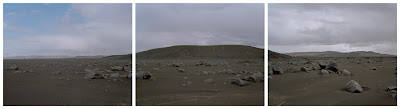


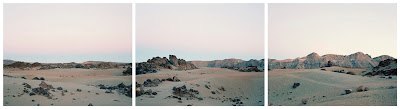
Shigeru Takato
Work from Our Elusive Cosmos.
“These are photographs of landscapes on Earth relating to the exploration of space and our cosmos. These relations could be scientific, mythological, factual, or religious. We often analyse, philosophise and romanticise our cosmos. Our knowledge of it is limited and much remains unknown and a mystery. In the late 60’s and early 70’s we began to see images of the lunar landscape. NASA’s Martian rovers “Spirit” and “Opportunity” send images of the Martian landscape everyday. These landscapes we see of space are loaded with thoughts, beliefs, ambitions and imaginations, in which we search for more clues and knowledge. But are we seeing anything other than what we expect? Are these landscapes from outer space anything beyond our imagination? When we are faced with these images, what are we really seeing? Can we imagine any extraterrestrials that do not look like our typical aliens?” – Shigeru Takato
Tags: fiction, german, humor, japanese, landscape, movies, panorama, space, suspension of disbelief
Posted in fiction, german, humor, japanese, landscape, movies, panorama, space, suspension of disbelief, typology | No Comments »
Monday, 29 March 2010


Christian Sievers
Work from Proposal for Tashkeel.
_________________________________________
Subject: Proposal for Tashkeel June 2008
Date: Thursday, May 15, 2008 14:07
Conversation: Proposal for Tashkeel June 2008
Category: Work
Dear Sam,
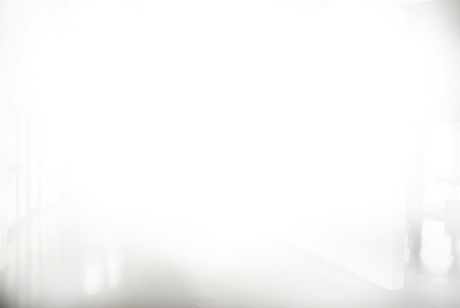
As part of my ongoing research into emergency systems I would like to install an anti-theft and -vandalism system that fills the entire space within a very short time with a dense white fog. This is an entirely new idea (and a German patent). It’s impossible to make a shop completely break-on safe, but you can make sure the burglars won’t be able to steal anything. Intruders are unable to locate the goods, panic and flee. Already department stores, jewelleries, boutiques, gas stations etc. use this method; apparently very successfully.
I am in contact with the agency that sells these systems to provide them for me. You can see their website here: http://www.nebelsysteme.eu/pages/en/home.php If collaborating with them fails we can simulate their devices with a range of powerful disco/club fog machines. I would need at least 5 devices, with a capacity to fill the available space in 30 seconds. (good standard fog machines have a capacity of 1,000 cubic metres/minute, the stronger, the better). We might have to do some calculations.
My thinking is that Dubai in June can probably use some artificial clouds against the desert sun. Also I love the idea that you won’t be able to see further than a metre or so in the entire gallery. The audience’s experience of art works will be radically different from what it would be like in clear view – suddenly there’s a room for intimate encounters with art. And with one another, if you like. Or see it, if you want, as a release from art. For a few moments you don’t have to look at it.
Health-and-safety wise there shouldn’t be any problems. The fog is safe to breathe and will disperse by itself in a few minutes. The audience will be warned well in advance, so no-one should get afraid. It’s an extraordinary situation, that’s for sure. But that’s why I like the idea so much, and I hope we can realise it at Tashkeel.
Best, Christian
via /seconds
Tags: conceptual, humor, in progress, performance, photo sculpture, proposal, sculpture
Posted in conceptual, humor, in progress, performance, photo sculpture, proposal, sculpture | No Comments »
Sunday, 28 March 2010


Miriam Steinhauser
Work from On the Prowl.
“Throughout history, art has served society’s rich and powerful individuals and institutions, helping to raise their public profile as has been the case with the church, the royalty and the bourgeoisie upper class. In modern times, politicians and CEOs are known to be photographed in front of a favoured piece of modern art, often wearing a tie suited to match the painting, to give the impression that they are intellectually ready to tackle complex situations, as Wolfgang Ullrich notes in his book “Mit dem Rucken zur Kunst.”1 Company art collections complete the corporate identity. This is a topic I will examine more closely here, since, in my opinion, today‘s corporate culture is an especially interesting aspect of modern society.
Corporations largely began expanding their art collections in the 1980s. During this time, many companies were merged or acquired and gave up their local identity in favour of a globally oriented image. Furthermore, many companies were no longer producing goods but instead offering technology and services, which are not visually appealing. Art therefore became useful for representation, helping to create a corporate identity and a positive atmosphere for clients and employees. Corporate art collections and globalisation, as we know it today, developed in tandem. When I took a closer look at what kind of companies are collecting art, or engaging in contemporary art, I found that it’s not just small and middle-sized companies, but also the largest international firms with great economic power. Art continues to serve the mighty and powerful and now it also serves corporate needs.
In the 1960s and 70s capitalism was subject to criticism by conceptual artists like Hans Haacke, Claes Oldenburg, etc. Ironically, critical works from this period are now found in corporate art collections – indicating that the economic powers have incorporated a previously critical counter position. This is an interesting power game but it does not matter who is the winner or loser. What matters is that artists are actively contributing to the corporate world, working for a global art market and producing highly valued goods. As JJ Charlesworth stated, artists are “the new aristocrats of the service sector.” 4 Descriptions and articles on corporate art collections are quite revealing about the value art is rumoured to bring into the corporate world: “We believe the arts serve as a constant reminder of the value of creativity, innovation, inspired action and energy – values that we at xxx (world’s 36th largest company in 2006) seek to bring to the relationships we share with our clients every day.”2 Do art and global economy really share the same values? Looking at what Stephen Willats calls the “fabric of reality,” I wanted to experience globalisation from a different perspective, using the tools that are available to me as an artist. I started to look at corporate headquarters – the architectural manifestation of what I knew from the stock market and the media.
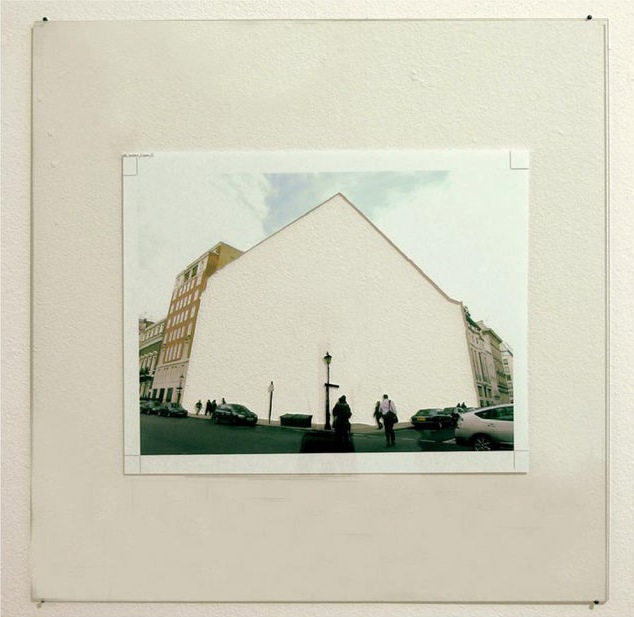
For my body of work “Inventory” (since 2006), I have been travelling to corporate headquarters, equipped with a camera. My aim for this project is to photograph the world headquarters of the global 500.”3 Each company has several locations but only one world head quarters, usually in the country of origin. While taking the pictures, it is important for me to have a subjective view of the building. Trees, cars, lampposts, people and anything that surrounds the building are part of the picture. I do not need special equipment nor do I ask for permission. In that sense, my method is different from Bernd and Hilla Becher’s documentary photos of industrial buildings, because for me it is a personal view – I am appropriating the building as a sculpture. For me, it is an adventure to visit these sites; it feels like being on the prowl. Sometimes, I even call the companies and ask them about their corporate art collection – information not easily obtained!
After gathering the photographs, conversations and notes, which all together is my raw material, it passes through a transformative process. I use a variety of techniques, old ones are mixed up with new ones, which means I use knives, paint and a computer to create silhouettes, cutouts, collages and 3D models. By using the images of the corporate world I aim to create a landscape of our time. My aspiration is to generate a very elegant kind of subversion that sneaks into the system through my work.” – Miriam Steinhauser for Control Magazine via /seconds.
Tags: business, corporation, cut print, cut-out, dutch, obscured, omit
Posted in business, corporation, cut print, cut-out, dutch, obscured, omit | No Comments »