Jacob Broms


Jacob Broms

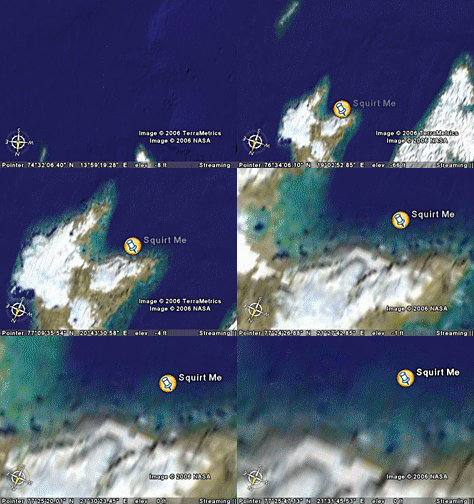
Work from Facebook Intense, a bit of space wandering in space, paths to enlightenment, and walk in the park.

The images above are mostly replications and screen captures, I highly recommend you follow the links to experience the full piece. 

“Jacob Broms Englom is an artist based in Stockholm, Sweden. His work is centered around the relationship between technology and art; testing their boundaries and intended function. His piece, Keep, forces communication between GeoCities GIF images and YouTube Flash mediums; and in turn creating a dialogue between old and the new…” – Internet Archaeology

Vik Muniz


Vik Muniz

Work from his oeuvre.


Lecture on TED Talks.

“Here’s the art history quiz for the day: What connects Leonardo da Vinci to Bosco chocolate syrup? Answer: Vik Muniz, an artist who specializes in unlikely means of not quite fooling the eye and calls the results ”photographic delusions.” Mr. Muniz has copied Leonardo’s ”Last Supper” in chocolate syrup. This is probably a first.

The famous fresco in Milan was already deteriorating in Leonardo’s lifetime because he refused to observe the time-tested rules that fresco painters followed. There are no rules for syrup pictures; the limited amount of unscientific research to date suggests their life expectancy is short. There is a rumor that Mr. Muniz sometimes eats his chocolate pictures (talk about consuming passions) but not before enhancing their prospects for a long and healthy life by photographing them.

What results in this case is a kind of cockamamie tour de force: a copy of a major artwork already frequently copied (preferably on velvet), here blown up large and looking at first glance more like a photograph by the Starn twins than a drawing in Bosco (whatever that looks like). It’s no surprise that Mr. Muniz is attracted to the attitude of Dada and Fluxus art, which he says is ”like conceptual art without a frown.”

His own art will make you smile faster than you can say ”cheese.” ”Vik Muniz: Seeing Is Believing,” at the International Center of Photography Midtown, includes about 100 images from the last decade by this Brazilian-born artist who came to the United States in 1983 and has since wrought gentle mayhem on photographic representation. An interview with the artist in an accompanying book (Arena Editions) by the same name proves he can sometimes be as thoughtful and dryly amusing on the hoof as he is on paper.

Charles Ashley Stainback, the Dayton Director of the Tang Teaching Museum and Art Gallery at Skidmore College, is the curator of this first museum survey of Muniz’s work, which insists that things are seldom what they seem but are in fact mostly illusion, and that most of what we know we know through representation — which we don’t even remember very well, so we may not know it after all.

These are not exactly new ideas, but Mr. Muniz serves them up in a relaxed, slyly humorous and occasionally goofy manner, as if Jean Baudrillard had appeared in a Hawaiian shirt, brandishing hot dogs and offering to barbecue them on a drawing of a stove.

At Wooster Gardens in SoHo, ”Flora Industrialis,” a new portfolio of 20 pictures, shows Mr. Muniz in uncommonly beautiful form but without the swift wit of some of the material at the international center. These pictures of individual flowers on dark grounds, heraldically displayed and richly toned to resemble late 19th-century specimen photographs, are actually loving portraits of fake flowers. Unreal flowers (or perhaps real fakes), they are copies at one remove from reality, so realistic that only the camera’s famously realistic reproduction of reality reveals their fakery.

Mr. Muniz generally prefers to invent his own fakes. ”Personal Articles” is a bulletin board cluttered with illustrated newspaper articles. One reports that small cameras have been outlawed in Yosemite. (This should have been headlined ”Making the World Safe for Ansel Adams.”) Another informs us that the Pentagon has admitted engineering the dyslexia virus. Yet another says a National Geographic photographer has been accused of falsifying nature documents by constructing images from his girlfriend’s underwear; the illustration resembles neither nature nor any known piece of lingerie.

These clippings, which hover at the edge of credibility, suggest that (a) paranoia and conspiracy theories are so widespread that for many people almost anything might be true; (b) photographs are manipulated so easily that almost anything might seem to be true; (c) real news has become so wacky that almost anything really might be true, and (d) who can tell what’s true?

Mr. Muniz dances the rhumba with visual perception and temporarily fools the viewer into thinking it’s a samba. In the book he says: ”I have neither the interest nor the means to produce illusions that expand the concept of what an illusion is — George Lucas and Steven Spielberg are doing that for us . . . I want to make the worst possible illusion that will still fool the eyes of the average person.”

So his ”Pictures of Wire” look like drawings, which they are in a way, but photographs of drawings, and the drawings are made of wire rather than traced by a pen or pencil. These simple images of a light bulb, a roll of toilet paper, a spiral notebook, are nearly as pure and elegant as drawings by Ellsworth Kelly, if a good deal shakier. A part of the viewer’s pleasure lies in discovering the agreeable deception at their core.

Mr. Muniz also makes drawings — I guess you can call them that — out of thread, amazingly complex renditions of landscapes, some copied from Corot or Claude Lorraine or Courbet. He uses as much as 17,500 yards at a time, photographs the final image, then scraps it and uses the thread for another picture.

This process is some rigorous form of artistic or perhaps ecological insanity, akin to performance art at its most exhausting, expending all that time, effort and skill on a photograph and then simply unraveling the model. Still-life photographers (and Bosco photographers) can at least eat the mise en scene. Photographers in the last couple of decades have been building elaborate environments for the sole purpose of photographing them; whether the garbage police have succeeded in getting them to recycle remains unclear.

Mr. Muniz specializes rather in materials unavailable at Pearl Paint. He has tried everything from M & M’s to live ants, rubber bands, black beans, electric sparks, oil and milk, but alas, without success, so he has had to resort to dirt, sugar, cotton, wire, thread, chocolate.

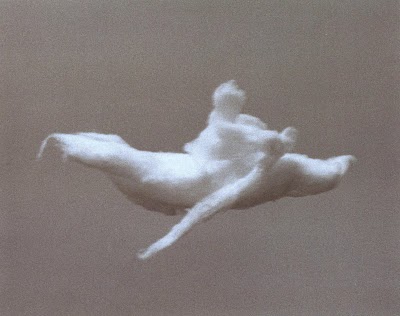
His ”Equivalents” are pictures of floating cotton ”clouds” that faintly resemble a cat, a snail, a rowboat and Alfred Stieglitz’s cloud photographs by that name. He copied his own photographs of the children of sugar-cane workers in sugar itself, grain by grain, then photographed the results. His pictures of nudes, hands, binoculars, a fish made of dirt cleaned speck by speck with miniature vacuum cleaners, Q-tips and straws are puzzlingly, beautifully convincing; they appear at first glance like photographs double exposed onto pictures of earth. His stereo images of such microscopic rarities as ”Vocal Cords Saying ‘Bon Giorno,’ ” the ”loser gene” and the ”sloth virus” were composed of spaghetti strands and a double helix of cheese doodles.

He could, if he wished to, point to a proud tradition for such work. In the age of mechanical reproduction there has arisen among image junkies an insatiable urge to copy major images by hand in materials cadged from the fridge: the Bikini Atoll blast atop a cake, Michelangelo’s David in ice, Iwo Jima in hamburger (as well as gunboats made of roses and topiary dinosaurs). God knows what goes into all those Statues of Liberty outside souvenir shops.

One of Mr. Muniz’s series, ”The Best of Life,” comments on the impact of photographic images. He drew some of the most famous photographs of the century from memory, then photographed the drawings and printed them through a half-tone screen as Life magazine did. At first they look like badly printed photographs until you realize something is off — an arm’s too long, a figure’s missing. If his memory is a little wrong, yours probably is too, so what is it that we remember when we all remember the same thing?

John G. Morris, author of ”Get the Picture: A Personal History of Photojournalism,” pointed out to me that none of the photographers of these images is credited. Corot and Courbet are named, but not Nick Ut for the child running from napalm, John Filo for the Kent State shooting, Stuart Franklin for the man stopping the Chinese tanks in Beijing, Joe Rosenthal for Iwo Jima, Eddie Adams for the Saigon execution of a Vietcong suspect, Alfred Eisenstaedt for the kiss at Times Square, J. R. Eyerman for a 3-D screening, Bob Gruen for John Lennon in Manhattan and Neil Armstrong for the man on the moon.

This is curious. Is it unfair appropriation, or are the most urgent images of our time effectively anonymous? Are the authors of news images erased or subsumed by the contents of their pictures? Have the most memorable images become such public property that they no longer need credit, whereas the less memorable images by artists still do?

Taken all in all, Vik Muniz’s work tells us that seeing is not quite believing, that perceiving and understanding are balancing acts, that experience itself is a see-saw. This is a drawing, he says, but then again, maybe it’s not. Ceci n’est pas un Corot.

What it is is an idea wrapped up in surprise and laughter. You might just give up Prozac for the day and see this show instead.” – Vicki Goldberg for the New York Times

Mark Boellaard


Mark Boellaard

Work from Collage.

I received an email from Mark this morning with this work, enjoy.

“By juxtaposing elements from a wide and unusual range of resources I attempt to create original works that invoke a sense of shock, wonder and delight upon the spectator. Works that are very much open to interpretation and that contain many possible narratives and undercurrents. Creating these collages is done in a very intuitive manner where chance and coincidence are important parts of the creative process, Inspired by a range of subjects as diverse as Dada, the writings of Philip K Dick, esotericism, medieval european art, comics and the work of Jung ,my work is lighthearted and humorous on the one hand but on the other hand it is a serious meditation upon art, history, culture and the passing of time” – Mark Boellaard

Sascha Weidner


Sascha Weidner

Work from Beauty Remains.

“Sascha Weidner looks for the Beautiful amongst the Everyday. His large-and small-format, spontaneous or staged, colour photographs present landscapes, still lives and people. At first glance, these motifs may appear banal: thickets, shrubs, flowerbeds, lakes, gravel, house walls, empty spaces, curtains, cloths, tarpaulins, and rubbish. People are shown in apparently unspectacular situations: alone, as a couple or in a crowd next to a swimming pool, in the countryside or in an indefinable space.However, behind these everyday, seemingly insignificant scenes lies a quiet melancholy: on closer inspection, an opulent bouquet of flowers is a gravestone decoration and a bizarre, silvery shining structure on a black background is actually a shattered pane of glass. A night sky full of stars is composed of pills in different shapes and colours. Used condoms, needles and other rubbish lie next to overgrown bushes that are, in fact, part of a hedge maze, where illegal dealings have been done.The superficial harmony of the pictures is constantly undermined.This beauty is not to be trusted.The carefully composed colours of the photographs often make reference to works of art from the classical canon. Piles of rubble from a demolished building, for example, evoke Das Eismeer [ The Sea of Ice, 1824 ] by the romantic painter Caspar David Friedrich. Weidner’s ice floes, however, have mutated into construction waste; thus, gracefulness emerges from the apparently »ugly«. His fondness for romanticism is revealed; we perceive a figure in the photograph, continuing the theme of being lost. In Das Eismeer II [ The Sea of Ice II, 2003 ] the artist refers to life’s constant changes and renewals. During the demolition process, the dilapidated roof joists have been compressed into a structure that conveys temporary stillness and peace to the viewer.Weidner experiences both romanticism and high drama in everyday locations and so makes us look at our familiar environment with new eyes.

This rupture and the concomitant antagonism in the photographs of Sascha Weidner is a metaphor of the human desire for beauty, happiness, harmony and perfection, and, at the same time, for the path to this desire, one that is always paved with sorrow, ugliness and horror.The pictures confront the viewer with the passions and desires of human existence and describe the constant interplay between desire and reality. The tension experienced in the photographs is a synonym for the unknown paths that our life leads us; the unforeseeable may well be more meaningful than our chosen goals.The enigmatic ambivalence of these photographs raises questions that remain unanswered.We do not find out why the gravestone decoration was overturned, why the pane of glass was broken, how the pills manage to float, what is actually happening between the hedges of the maze or how the building was demolished.We find no answers to these questions. It is up to the viewer to decipher the enigmatic moments captured in the photographs and to complete the unfinished story for him- or herself.Weidner’s method of presentation inspires the imagination of the viewer; the artist uses the entire wall space of his exhibitions, combining different formats to create an ensemble.The individual works re- main autonomous; nevertheless, their heterogeneous composition provokes new connections and creates new tensions.They all possess a certain beauty that is retained in the memory of the viewer.The familiar appears in a new light and, at the same time, frustrates.Sascha Weidner provides insight into his pictorial cosmos through the generous arrangement of his photographs in the exhibition space. Just as we can perceive different constellations in the starry heavens of the universe, here, these pictorial worlds offer the viewer endless opportunities for association.” – Susanne Köhler

Hubert Blanz


Hubert Blanz

Work from Vergina Sun.

“While related light processes are fundamental to every form of photographic representation, they are also among the most distinctive aspects of filmic production. Where there is no light, no image whatsoever can be generated; the absence of a light source makes it necessary to introduce or to produce one. Thus, technology which used the physical characteristics of light for producing and magnifying light – from the simple light bulb to (today’s computer operated) flash units – became necessary in the nineteenth century. Although still used in high-tech applied photography, this technology is no novelty in the sphere of artificial suns.

Different and new, from the point of view of its specific characteristics, appearance and use, is the role of light in digital media. Photosensitive layers and lighting are no longer used for representing things, nature, objects (including the human image), as they are most directly and compellingly employed in photogrammatic processes; images and information can now be produced through a mere “electric glow”. 1) While computer screens and displays make digital data visible and readable, they requisite the appearance of information codes in a form appropriate to their own categories and in turn produce a unique aesthetic of their own.

Alongside this fairly generalised account, there is yet another, almost unnoticed phenomenon: the light intrinsic to computers, to monitors. 2) Developments in what Peter Weibel calls the “light of technical media” have been advancing consistently ever since artists started probing the effect of images and the media of art: from the effects of light in early abstraction to video and computer art. This is where new artistic concepts emerge, concepts concerned with systems of information generation and visualization, which are altered, reformulated and combined in various ways. Art until then had mainly focussed on partial aspects of electronic media, stripping it of its functionality in order to view it as an isolated phenomenon. But, on the other hand, it also intentionally linked incompatible modes to produce aesthetic constructions.

Charles Sandison 3), for instance, is an artist who replaces traditional videos made with camera and set with images that are purely computer-generated in his video projections that he calls “data computer programmes”. In addition to borrowing digits and letters from the binary system, he also links the information layer with pictorial and conceptual subject matter. The result is something not intended by the medium, namely, a field of tension between rationality and magic. The “electric glow” from the infinite cosmic darkness of the subconscious penetrates to the surface.

Similarly, Hubert Blanz too links conceptual-emotive values in his work with (seemingly) rational-constructive ones. His electronic street map of Macedonia’s capital Skopje is a magical grid of stars, a manipulated street map, a flickering computer screen, an historical cadastral register, an identity forming archetype, a mathematical game of deduction; a filmic journey from a coldly calculated exterior to a deeply emotional inner world.
As in impressionist paintings, the process of transformation depends on the viewer: Vergina Sun is not simply a mesh of designations for street names and localities in a city but also the symbol for an erased identity, which now merely clings on to the letters and symbols of a standardised urban image. Here the city – the city map, an algorithmic wonder – emerges as an abstract lineament and not just as a vedute, a view. A city is the sum of the names of its squares and streets – or is it not?

Skopje is the capital of Macedonia, an independent state since 1991. With its 500,000 inhabitants and area of 225 km2, it is the country’s largest urban formation. Centuries of foreign occupation, invasions and wars, a complicated geo-political and cultural situation at the crossroads of the developments in the Balkans since the days of migration, have manifested themselves in the self-conception of the new state. Up until today, ethnic and religious problems are linked with historical and territorial implications. Even the republic’s very name is a matter of dispute: Greece claims the right to call its north-most territory by the same name. Once again, historical origin and founding myths serve both sides as justification. Similarly complex is the case of the state’s symbol, th e “Vergina Sun”.

Hubert Blanz has named his audiovisual animation after this controversial symbol, whose ambivalent and different attributions make it a rather open image. Ever since the sixteen pointed symbol came to light in 1977 during an excavation in Vergina in northern Greece, its interpretations have been multitudinous: sun or star, with sixteen or twelve rays, symbol for the Hellenist dynasty or of the Slavic majority in today’s state. Whatever the case, it undoubtedly stands for Macedonia’s difficult history and its equally difficult search for identity.

The Vergina Sun is also the title for Hubert Blanz’s computer generated filmic work based on a systematic representation of Skopje’s network of streets. All symbols on the actual map have been erased, what remains are street names: a coded system of letters, their phonetic translation verbalised by passers-by of various ethnic origins. A story without a narrative thus emerges, a densely woven fabric of reflections and associations, a grid of superimpositions and a vague and undefined space full of instabilities and conjectures. Although this space full of stars and the murmur of voices represents the absence of a narrative or literary images and symbols, it is nevertheless like a picture puzzle that oscillates between the past and the present.

The incandescent code-like graphisms refer both to the infinity of the cosmos and to the inscrutable range of medial space. Manfred Fassler advanced the claim that medial space does not necessarily denote communication and functional spaces but rather the fact that “auxiliary social spaces” must exist which demand of the recipient an ability to “interpret abstractly configured visual scenarios” 4), or that the initially unrecognisable space in which data is generated, processed and altered is transformed into “perceivable impressions of planes or surfaces”. In this sense, Hubert Blanz’s digital or manipulated map of Skopje is not merely a graphic pattern composed of data but a perceivable space in which the viewer – as a social, emotive agent – is confronted with the most various levels of knowledge and contents.

The fascination of witnessing an enigmatic process in a magical space gradually turns into an anxiety about being part of a metamorphic process that defies every rational explanation. The continual attempt at decoding the system behind the ghostly lights is replaced by a disinterested amazement, with a desire to simply wait and see what happens. The maelstrom of filmic processes sweeps the viewer into a journey between the microcosm and the macrocosm, between calculations of earth-bonded information and transcendental spirituality. Thirty years ago, in their short film Powers of Ten 5), Charles and Ray Eames took us on a similar journey from banal everyday strategies to structures of scientific theory and back, from conventional scaling to interstellar immeasurability and back again to microscopic nano-worlds. Transforming a simple scene into a system of codes and structures – depending on how the process of perception can be used and on the means employed for this – is a didactic measure borrowed from the history of perception.

Digital media-based artwork repeatedly shows how such strategies can be charged with emotional values. The artist pair Jeroen de Rijke and Willem Rooij set their films in such social spaces, indeed, these spaces become the very subject matter of their filmic plot. An atmosphere of insecurity, of nervous contemplation, independent of the narrative thread, pervades: “From a proper distance, history and geological history are shyly probed, in the search for ways to depict them,” 6) says Veit Loers of their film Of Three Men, which is mainly about stillness, waiting and empathy. And about the knowledge of the connection between them in the depths of our consciousness as well as the possibility of making these spaces experienceable for others. The place where dark and still spaces open, a place where the outside world can enter through a small chink, cannot remain hermetically or inexplicably closed. In that very place where Vergina Sun seems to explode like a Nova, it also begins to extend beyond the digital grid and to reclaim new light spaces.” – Margit Zuckriegl

1) “electricity itself,” one could say here in McLuhan’s words.
2) The Austrian photographer and media artist Günther Selichar has addressed this theme in his series Screens, cold (Hubertus von Amelunxen, Robert C. Morgan, Urs Stähel, eds., Günther Selichar. Screens Cold, Vienna, 2001).
3) Cf. ein-leuchten, catalogue, Museum der Moderne, Salzburg, T-B A21, Vienna, 2004, p. 110.
4) Manfred Fassler, Mediale Interaktion, Munich, 1996, p. 49.
5) This filmic masterpiece from 1977 by the doyens of furniture design puts in perspective the claim that “only since the recent past has it become possible [for us] to undertake virtual journeys to the real world via the Web, to visit at least the images of the real world”, Florian Rötzer,
“Hubert Blanz”, Eikon 58, 2007. Mainly “the nose dive from greater heights to a place that continually zoomed in closer” (F. Rötzer) is discussed here in full length.
6) Veit Loers, Jeroen de Rijeke/Willem de Rooij, After the Hunt, New York, 2001, p. 28.

Brea Souders


Brea Souders

Work from Islands and Streams.

“My work is concerned with private and individual psychologies, and with the human desire to deconstruct others in an attempt to understand them. I find the never-ending search for meaning to be a confusing and exhilarating experience. With each failed attempt, the world expands.

In this project, I dissect the dream journals of well-known writers, scientists, philosophers and other figures. I select potent fragments from the dreams, and then re-create them in a controlled studio environment. While working on each image, details that were left unclear in the dream description must be filled in – the color of a wall, the pattern in a sheet, the placement of an object. My choices throughout the process are intuitive, beginning with the selection of source material and carrying through to the casting of models, the props used and the general mood of each image. The resulting photographs could be seen as a distillation of the dreamer’s inner psychological make-up, however they have been tinged by the process of outside observation and analysis.” – Brea Souders

Lorna Mills


Lorna Mills

“…Lorna Mills is an artist who revels in the irreverent excesses of GIF culture, collecting and manipulating found GIFs from the most offensive and profane to the most abject and mundane. In her original GIF work, however, she creates contemplative animations that, unlike most other art GIFs, can be emotionally affecting. While Mills is deeply involved in the collective exchange and manipulation of found imagery, she will also often use her own video footage. She breaks the video down into a series of stills, reverse-engineering high-tech smooth motion in favour of the jerky motion inherent to GIF technology. Mills heavily manipulates the images, stretching the frame, pixelating the resolution, fragmenting and isolating specific movements and gestures…” – Sally McKay – excerpt from The Affect of Animated GIFs.

Emilie Halpern


Emilie Halpern

Work from her oeuvre.

Artist’s talk at Otis College here.

“Emilie Halpern trades on dissonance and contradiction. Working in a mix of mediums, from sculpture to photography, conceptualism to found object installation, she looks for ideas and images that play against each other in surprising ways. Through juxtapositions and combinations of these ideas, Halpern creates thoughtful, new relationships. Her work is precious and distant, intellectual and emotional, romantic and just a bit magical.” – via ArtSlant and i heart photograph.

Sara Angelucci


Sara Angelucci

Work from Regular 8.

“For the past ten years, my practice has encompassed photography and video, examining vernacular archival materials, including snapshots and home movies. Investigating the relationship between the still and moving image, my work has considered the limits of indexical media to translate lived experience, underlining the fragmented, ephemeral nature of the memory process. My current project Regular 8, staged photographs re-enacting home movie stills, perfectly coalesces these interests.

Regular 8 examines 8 mm film-making in the mid to late 1950s, a medium held in the hands of amateurs primarily documenting family life: special occasions, vacations and simple daily moments. As Pierre Bourdieu writes, the camera plays a key role in “solemnizing and immortalizing the high points of family life.”1 The genre provides a fascinating glimpse into the period, amateur film conventions and generational values.

The staged scenes in Regular 8 are inspired by found and borrowed family films, as if we as viewer had stopped to examine a scene as we scrolled through the hand-cranked film editor used to edit 8 mm film at home. Instead of letting the film roll to tell a story, the stills in Regular 8 present us with a freeze-frame, rupturing and suspending the unfolding of the narrative at a specific moment.

The still image, the frozen frame, takes film back to its origins, photography, for film followed and developed out of photography. Early on, such devices as the Magic Lantern and Zoetrope sought to develop the illusion of movement by stringing together a series of still images. By the 1880s the invention of roll film with its capacity to capture images in real time launched cinema. Yet to this day, film’s debt to photography is evidenced in the cinematographer’s title Director of Photography. In recent years, the exploration of movement has been replaced by a fascination with stillness, as such artists as Douglas Gordon, Bill Viola and many others have slowed film down, in fact painstakingly broken it down still by still, providing us with an examination of narrative structures and image making that honour film’s original source, the photographic still.

It is out my love for both photography and film in their vernacular form, that the series Regular 8 developed. In stilling these narratives one can linger over them, examine their contents and the dynamic of the relationships within them. The white “holes” appearing over the images make reference to Kodak’s tagging system, a series of numbers punched through the end of each film reel during the manufacturing process to identify the film stock and batch number. The Regular 8 photographs refer to the home movie viewing experience when the dots appeared, floated over obliterating the last few frames of the story, signaling the end of the film. Suspending these moments gives us pause to consider many things; stories and people who are long forgotten; the invention of the image of the happy family within the staging of films; a time and technology which have passed; and transcended cultural values.

One cannot consider these films without remembering the importance of the screening experience. As Peter Forgacs writes: “The family movie as a cinematic form is more than a simple film phenomenon. The private film is an imprint of culture rewritten by a motion picture that has a certain self-reflective impact on the overall face of culture. One of the sources of understanding for family films lies within the context of screening – specifically the role of narration or commentaries offered up by the family while viewing the films: “This is me, that is him,” “This happened then, and that happened then,” “Now we see this and this,” “How happy we were at that time.” Spontaneous comments that, in effect, constitute the metanarration.”2

This project developed out of the memory of those screenings. The white dots played a significant role in those recollections: they signified the film’s end, one that seemed abrupt, incomplete and merciless. Home movies represent the memories of us at our best, happiest, most polished and special. They evoke something we wanted to hold close forever. Of course we never can, and that immanent ending brings to light the painful beauty of the ephemeral nature of our lives.” – Sara Angelucci

via Screen 2010

Joe McKay


Joe McKay

Work from his oeuvre.

“…

Operating at the edges of what we think this consumer technology should and should not do, McKay’s art leads us into the gap between expectation and evidence, challenging the viewer to consider what one sees and how the technology works. But unlike the Wizard of Oz behind his curtain, McKay has thrown the curtain away and places the apparatus of his works before us without concealing his tricks.

…” – Chris Ashley for NYFA.