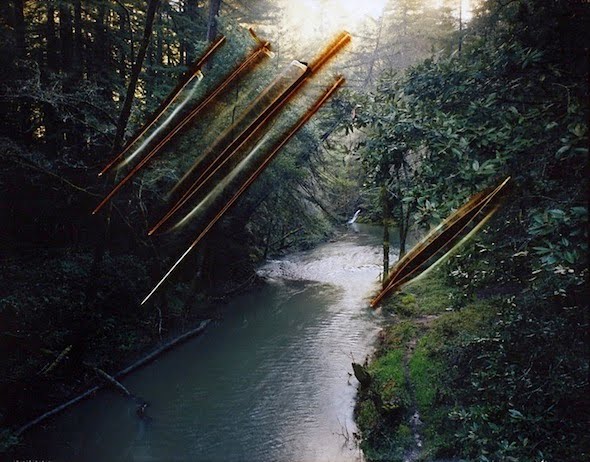
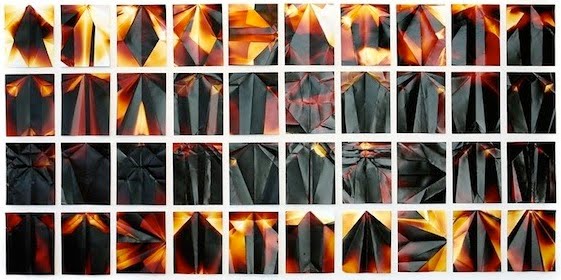
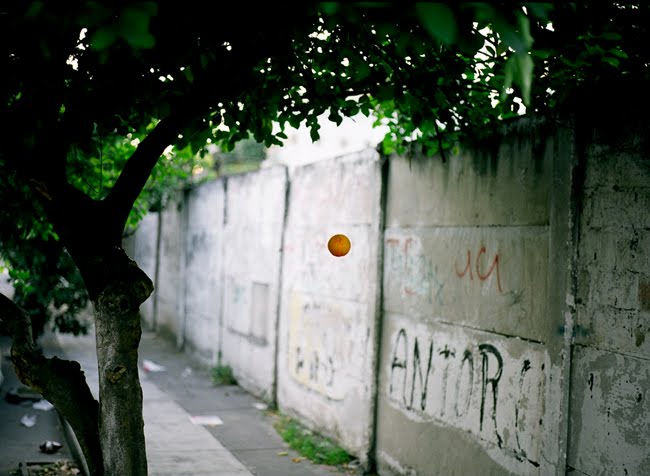
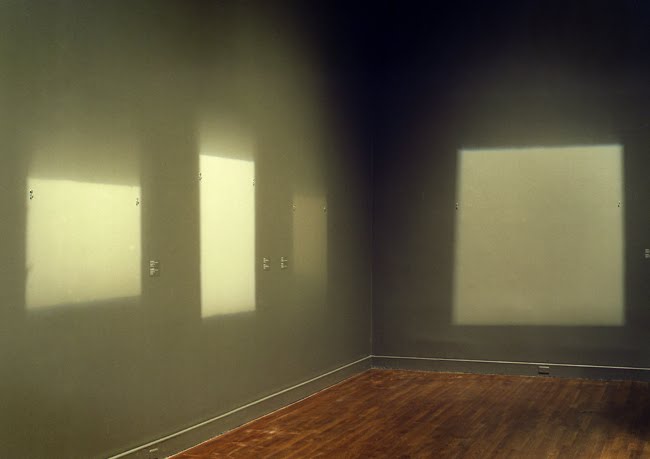
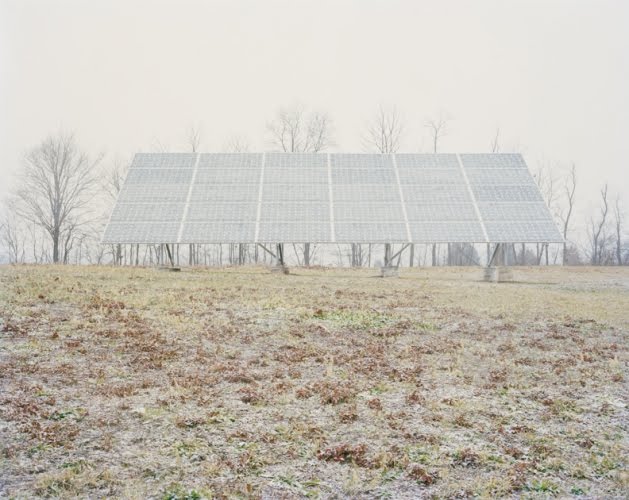
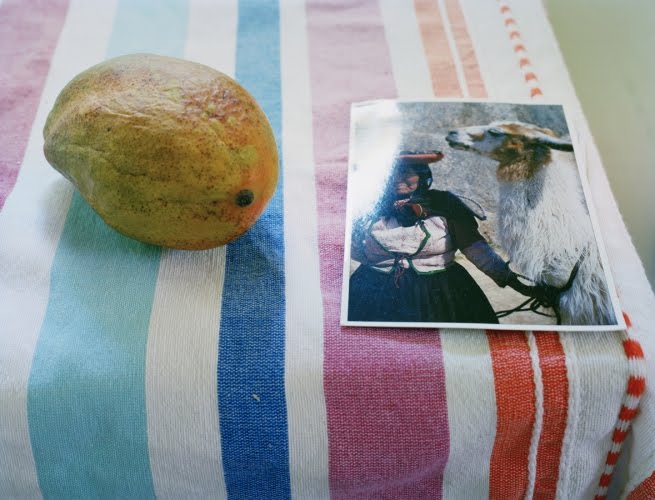
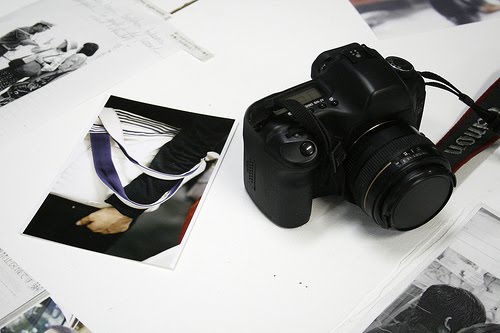
“Klea McKenna describes her series Slow Burn as “an ongoing series of experiments” in which each image reveals or teaches her something that leads her to the next. This approach—photography as a heuristic process, in which the “eureka” moment of one image pushes us forward toward new discoveries with every step—is ideally the foundation of any artistic practice to some degree or another. It can be a risky, but it can also be incredibly rewarding, for both the viewer and the artist. McKeeena’s unique prints are made with homemade cameras or without any recording device at all (paper airplanes made out of photographic materials!). The work has its points of intersection with other artists, including Walead Beshty and Miroslav Tichy, while also seeming to represent a personal means of grappling with the inherent capacities of photographic materials and processes. The resulting work has a certain amount of rawness and tension to it—a quality much appreciated by this particular juror. In reviewing the artists who have submitted and making this selection, I’m keenly reminded of how savvy the photo community has become as a whole—how much well-executed, carefully constructed, good work there is out there. What I find myself looking for, then, is the work that stands apart for its willingness to try to push a little bit against the expectations of “good.” Not work that is different for the sake of difference, but work that takes risks; that reveals deeply held beliefs and interests in how a photograph works—or doesn’t.” – Lesley A. Martin via Hey Hot Shot.
Radeq Brousil: Vincent, your works are filled with a certain type of irony and poetry. How would you describe your work to a person who has never seen your work before?
Vincent Lafrance: I am usually trying to avoid doing this. My work has gone in many directions and I hardly make sense of it; appart [sic] from it being indicative of my behaviour. I use art to filter my reality, it’s broad, it’s diversified. I have short and intense interest for things. But if I have to make an effort for you because you once invited me over in your family for easter I would say that I often use humor, visual gags and parody. My work also implies the vision itself, I use photography to underline aspects of my visual environment. I like watching. For me, seing [sic] is thinking. Somehow I am interested in perception, I create illusion and try to elaborate visual complexities. A lot of my pictures are about construction, like still life. I may be eclectic but I am also and deeply a traditionnaI [sic] photographer. I use film most of the time and print it directly on photo paper. I care about the surface. My discourse seems really inherent to the medium of photography, also because of the multiple reference to photography history. Now to end on something else, when I talk of my work to someone who doesnt know me, I usually try to speak about the present, about what I am doing now. It gives people a better sense of what you are interested in. It makes them believe that you are busy. We are attracted to busy people, we want to have a bit of their attention.
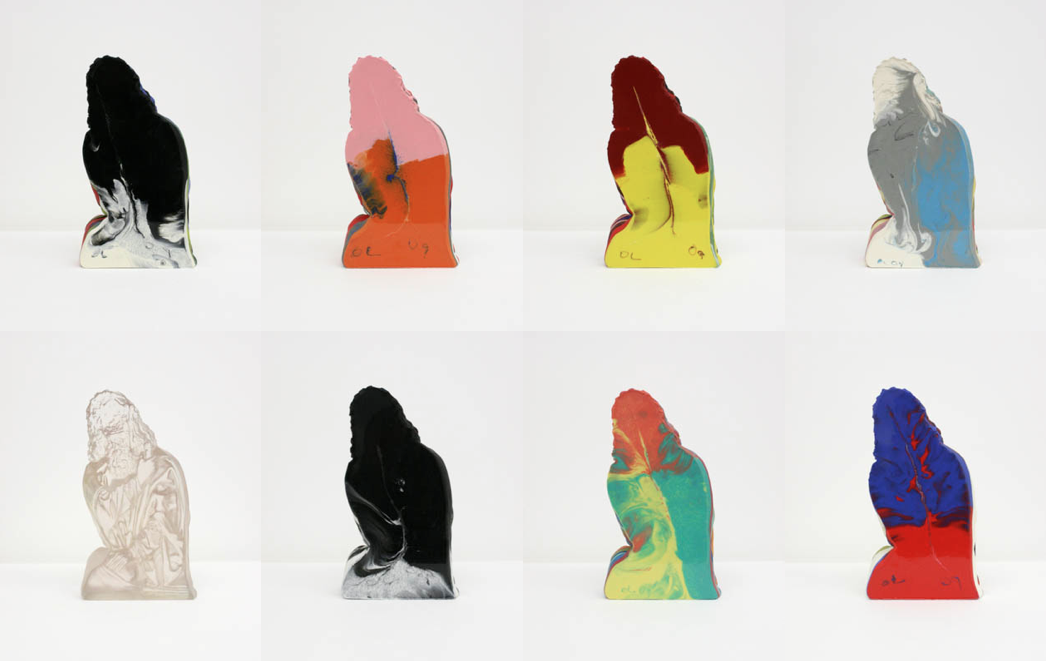
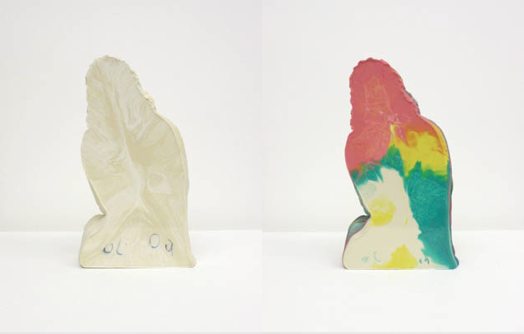
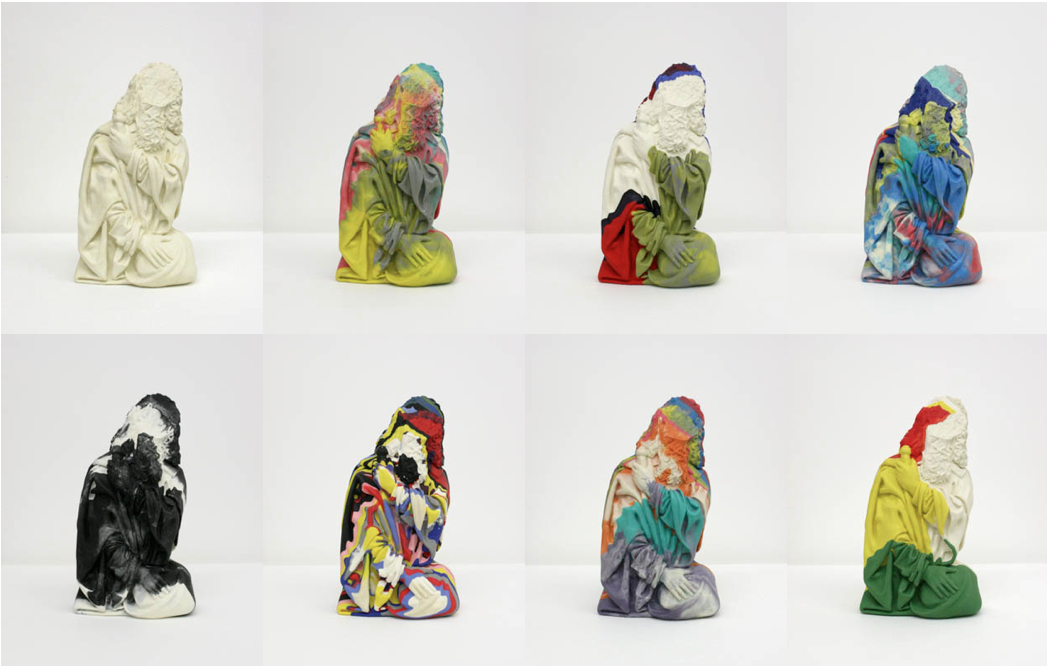
“At the level of the image, the determinations of the Protestant Reformation (1517-1648), as in so many other incidents of iconoclastic ‘image-breaking’ leading up to the present day, were predicated on a clear-cut Manichean sense of difference. During this period, statues and images of a religious order were subjected to sustained physical attack. Those that did not square with the heterodox self-understanding of the Reformation (as an exemplary monotheistic motion) were deemed false – in other words ‘idolatrous’ and worthy of destruction. Versions, Oliver Laric’s second solo show at Seventeen, circulates around both historical and contemporary ideas relating to image hierarchies. Central to the exhibition is a suite of polyurethane sculptures. In collaboration with 3D modellers, Laric has translated a reformation damaged icon from St Martin’s Cathedral, Utrecht, into a silicone mould from which a number of casts have been made. Each is identical in size and form, distinction coming only from their varied pigmentation. For Laric, these sculptures, their multiplicity, reflects a viable productive principle in iconoclasm. After the conceptual event of iconoclasm, after the physical inscription of that event as damage on the very surface of these icons, the formal hierarchy between the original and its modification is fundamentally undermined. Instead there is equipoise; no single truth, no original; no derivative; just versions…* In related speculation framed by a documentary video installation that forms the second and final element of the exhibition (also titled ‘Versions’), Laric suggests that in the contemporary age certain creative protocols are, in a more general sense, similarly challenging the hierarchy between ‘auratic original’ images and those determined to be derivative (and therefore of secondary importance).
Commencing with a digitally doctored image released by the media arm of the Iranian Revolutionary Guard in 2008, the documentary suggests a new mandate for image making, one which Laric identifies as finding its zenith in our networked internet age where bootlegs, copies and remixes increasingly take precedent over ‘originals’ in cultural production. Emphasising this plurality, Laric presents four equivalent ‘versions’ of the film in total. In each version, the same cycle of images is re-authored by a different narrator – respectively Momus, Guthrie Lonergan, Dani Admiss and Laric himself.
* That is, ‘versions’ amongst other possible ‘versions’.” – Paul Pieroni
Schippa’s statement is among the shortest I have seen (I am interested in translation between analog & digital, hand and machine.). Following an ongoing trend of techno-kitsch revival in new media, Schippa presents us with something that is familiar but at the same time inaccessible and foreign. His works are an examination of our emotional relationship with technology, while also serving as an experiment with accessibility, nostalgia, and our willingness to interact with techno-referrential art emotionally. This is where I find these types of works to be most compelling. They function virally and viscerally, but the art as object, rather than reproduction, is antithetical in process to their function as reproduced artworks. These particular images raise conceptual issues that the woven pieces cannot. While the tapestries address the idea present in his statement, their reproductions address far larger and more compelling concepts.
McCallum also has some rather interesting pieces that deal with the intersections between culture, technology and sound.
“The Neighbourhoodie is a hooded sweatshirt that augments the experience of game playing through an electronic infrastructure mounted in the garment. Neighbourhoodie explores the hoodie as a platform; what if the garment familiar to teenagers could actually enhance experiences? What modes of interaction are inherent to the garment?
The garment has a basic infrastructure of proximity sensing, speakers, and lights to augment game play. The proof-of-concept prototype is an augmented game of tag, where players are alerted to the presence of other players through unique sounds, and are given information about players’ states in the game by sounds as well as lights mounted on the garment.” – David McCallum
Apart from the stunning combination of visual complexity, accessibility, and kitsch, I have a very difficult time articulating anything about this work. I am not alone in this, as I can find nothing written anywhere about Berëzkin that is of greater length than this post has already achieved. What I find most compelling about these works is the difficulty in placing them chronologically. Many of the pieces fit squarely in a contemporary new media / technology-referrential space while others seem to read as Dadaist collage. Berëzkin seems quiet fluent in contemporary visual culture and subtle cues that refer to a wealth of other works and artists. In that regard, this work is powerfully contemporary and very appropriate to Tumblr blogs and blog posts that have no text. The referential nature of the works makes them readily accessible, yet beyond the visual payoff, I am still not quite sure what they offer; however for self-reflexive works on the state of contemporary visual habits and trends, this is a remarkably powerful contradiction.
The registration deadline for my course at the Visual Studies Workshop in Rochester, NY is approaching this week (Friday).
Check out the course catalog here. All courses are run for Graduate or Undergraduate credit.
__________________________
Art and the Six–Million Dollar Man July 26-July 30
This workshop will focus on processes and applications of technological reproduction through the use of cell–phones, image/data manipulation, and the animated GIF. The workshop will have both studio and seminar components, and we will discuss the theories behind, and implications of our works. Students will produce both web–based and print–based works and we will explore the internet as a venue for the presentation of contemporary art.
“The conceptual artist On Kawara has produced an ongoing series of “date paintings” (the Today series), which consist entirely of the date on which the painting was executed in simple lettering set against a solid background. If the painting could not be completed on the day it was begun, it was destroyed.
Date Paintings (YouTube) differs in that the date which comprises the work is auditory instead of visual, comprised of a text-to-speech file read by the computer and uploaded to YouTube. Here, the “painting” becomes an ephemeral object, the memory of the read-aloud date replicating the memory of the destroyed paintings On Kawara could not finish on a given day…” – Michael Demers
“Maybe it’s important to make a distinction between what gets called materialism and what real materialism might be. By materialistic we usually mean one who engages in craving, hoarding, collecting, accumulating with an eye to stockpiling wealth or status. There might be another kind of materialism that is simply a deep pleasure in materials, in the gleam of water as well as silver, the sparkle of dew as well as diamonds, an enthusiasm for the peonies that will crumple in a week as well as the painting of peonies that will last. This passion for the tangible might not be so possessive, since the pleasure is so widely available, much of it is ephemeral, and some of it is cheap, or free as clouds. Then too, the hoarding removes the objects- the Degas drawing, the diamond necklace- to the vault where they are suppressed from feeding anyone’s senses.” – (chosen by the artist) from “Walnut Veneer,” an excerpt from the book Inside Out, by Rebecca Solnit.
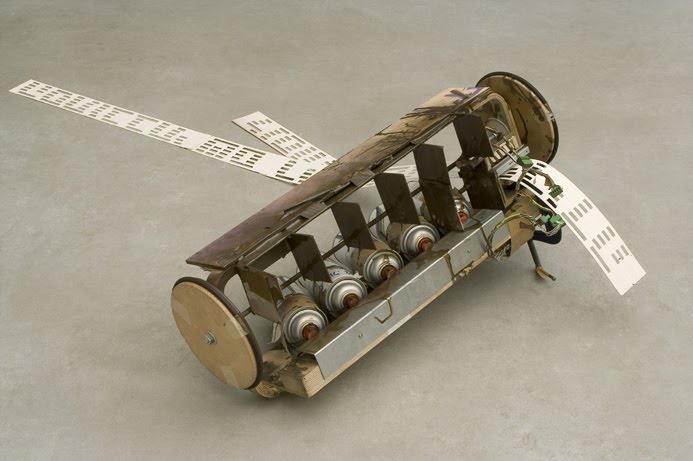
“For L’Angoisse de la page blanche (The Anguish of the White Page, 2007), two sheets of standard-size copy paper are pressed up against each other as they spin in circles on a low table. A homemade arcade game, Untitled (Football Players) (1999) is poetic play with fear and dread, child-like toying with the idea of death: when the viewer-player pushes down on two metal levers covered in duct tape, a high voltage transformer sends buzzing charges up and down the bodies of two metal footballers. The game’s apparently haphazard construction disguises a deliberate design, which is calculated down to details such as the decorative quality of plywood panels at its base and a strip of packing tape around two edges of its Plexiglass case. This is also the case in Untitled (Burned Turkmenistan Carpet III and IV) (2008), for which the seemingly casual act of burning two rolled-up oriental carpets creates a series of long, repeated lacerations that play off of the detailed geometric designs in the carpets’ intricate weaving.
As art historian Rudi Fuchs writes in the note to his lecture ‘Conflicts with Modernism or The Absence of Schwitters’,1 ‘in the end, art-making is a process of magic.’ Schlesinger calls attention to the magic nature of the artwork but purposefully reveals all of the secrets to his tricks. Two white wires taped to the gallery floor lead from a low platform, where Forever Young is displayed, to a wall socket, giving away the fact that the glowing ash is actually the end of an optic fiber. The two white pages of L’Angoisse de la page blanche perform their courtly dance on a table whose legs are fashioned from tip-less spray cans. The battered cans draw attention to the table’s underside where a small motor is revealed as the dynamo driving the paper’s animation. The flaps at the bottom of the cardboard box in Zu Erinnern und Zu Vergesse (The commemorable and the forgettable, 2008) are not tightly closed but leave gaps from which water should be leak, but oddly it doesn’t. This small detail provides a clue that inveigles its way into the mind of the attentive observer and betrays the illusion: the box’s bottom is not saturated but coated with water-resistant wax.
As phenomenologist Francois Cheng explains in Five Meditations on Beauty (2006), the beautiful is never a static way of being, ‘given once for always’ for ‘its ability to captivate lies in its revealing itself […] in its emergence.’2 In Schlesinger’s oeuvre, trauma and disaster are the spells that call objects forth from their quotidian hiding into the realm of the artist’s sorcery, a magic of constant revelation.” – Emily Verla Bovino for Frieze Magazine