Matthew Robert Hughes


Matthew Robert Hughes

Work from (Un)Dress Yourself in My Love.

“Matthew-Robert Hughes’s artistic practice is fundamentally concerned with the self as subject matter for the camera, and acts as a demonstration of the role of photographic technology in individual self-representation. Throughout his working practice, Hughes has continued to use ‘time’ as a tool to explore different modes of the self within its own representation. His current work explores the history and the embalming nature of photography and its subject. This has been visualised by Hughes through the practice of hand crafting unique photographic art objects.” – Matthew Robert Hughes

Ben Fry


Ben Fry

Work from All Streets and Print Studies.

Descriptions follow image order. Go to his website, you won’t regret it.

“All of the streets in the lower 48 United States: an image of 26 million individual road segments. No other features (such as outlines or geographic features) have been added to this image, however they emerge as roads avoid mountains, and sparse areas convey low population. This began as an example I created for a student in the fall of 2006, and I just recently got a chance to document it properly.”

“pockyvision.. two thousand dbn applets, that are on our courseware server at dbn.media.mit.edu. whenever a user saves their code to the server, an image snapshot is taken. an interactive version of this piece was the result of some productive procrastination.”

“video unravelled.. trailer from the movie fargo, each line of pixels is an entire frame of video unwound horizontally. mmm.. texture.”

All text from Ben Fry

Beni Bischof


Beni Bischof

Work from Bricked Castles.

Translation from German with a word I don’t know, but I have translated regardless. If you can fix anything, feel free to let me know.

“The longer I work on my artistic works, the more I sense a common thread, which shows myself. This involves the manipulation of things, like absurd changes to the castles, for example. The castles are scans from a Brockenhaus book, I have just cleaned up the image, or simply made it more concise. I have removed disturbing elements in the background, created a more homogeneous background from the forest and brought out the essential from the shape of the castle. I have left out the windows and doors and removed the towers. I would be very happy to view the original books in person again.”

Je länger ich an meinen künstlerischen Werken arbeite, desto mehr spüre ich einen roten Faden, der sich mir selber verdeutlicht. Dazu gehört das Manipulieren von Dingen, absurde Veränderungen wie bei den Burgen zum Beispiel. Die Burgen sind Scans aus einem Brockenhausbuch, ich habe einfach das Bild aufgeräumt, oder einfach prägnanter gemacht. Störende Elemente im Hintergrund habe ich entfernt, aus dem Wald einen homogeneren Hintergrund geschaffen und das wesentliche aus der Form der Burg herausgeholt. Ich habe die Fenster, die Tore weggelassen, die Türme weggenommen. Dann mache ich auch ganz gerne Originalbücher, in die ich direkt hineinmale.

Owen Mundy


Owen Mundy

Work from Give Me My Data.

Give Me My Data is a Facebook Application “that helps you reclaim and reuse your data.” This work, much like Jacob Broms’ Facebook Intense is an interesting peek into the scope and structure of Facebook, as well as a commentary of our cultural relationship with information. The brilliant twist, however, is that the application doesn’t stop at awareness or commentary. Give Me My Data facilitates and encourages action and in a very tangible sense. Mundy describes this work as a “facebook data liberation application”, viva la revolución!

Sebastjan Leban & Staš Kleindienst


Sebastjan Leban & Staš Kleindienst

Work from Buy Your Own Art Experience.

Catalog available here.

“One of the fundamental problems of the art world, the art market and last but not least art in general is their attachment to the original as some kind of fetish, which of course is properly evaluated as all the other society’s fetishes installed into a specific hierarchical valorisation system through valorisation criteria. The project Buy Your Own Art Experience explores and exposes the issue of idealisation of art and the artist, the valorisation system of artworks and capital produced through the culture industry.” – Sebastjan Leban & Staš Kleindienst

TERMS & CONDITIONS

GENERAL PROVISIONS
These general conditions and instructions for buying a performance or photograph form part of the contract concluded between the authors of the project (hereinafter referred to as Leban/Kleindienst), or their authorised representative, and the buyer who decides to purchase a photograph or performance.

PURCHASE
The purchaser may purchase any performance (or performances) or photograph (or photographs) on order via e-mail or through the authorised representative. Upon purchase, Leban/Kleindienst and the purchaser shall conclude a contract which is at the same time an attestation of a reservation and in which all costs concerning the purchased performance or the price of the purchased photograph are stated.

PURCHASE OF A PERFORMANCE
The performances offer the purchaser an individual art experience and are conceived as social activities that are presented in the exhibited photographs. By purchasing a performance the purchaser shall be allowed to take part in that performance and receive a certificate of participation. Besides the purchaser, Leban/Kleindienst shall also take part in the performance, the location of which is to be determined specifically by agreement between the contractual parties. The subject matter and the course of each performance varies according to season, weather conditions, specifics of the chosen location and other factors that may affect the course of events during the performance.

PURCHASE OF A PHOTOGRAPH
The photograph are one-offs. By purchasing a photograph, the purchaser obtains the rights to the purchased artefact, but cannot take part in the performance. With the act of purchasing any of the five photographs, both the subsequent selling of them and the execution of the performance shall be terminated.

PAYMENT
Upon reserving a performance or photograph, the purchaser shall pay 30% of the full price of the performance or photograph. The balance shall be paid by the purchaser 8 days before the beginning of the performative act or upon taking possession the photograph. The purchaser may pay on cash terms or by other envisaged means of payment.

PRICES
The prices of the performances or photographs referred to in the brochure shall be valid from the date of publication until revocation or publication of a new brochure. Leban/Kleindienst reserve the right to modify the prices according to the current exchange rate or change in prices of services offered for a specific performance. The purchaser will be notified in case of changes in prices. The prices quoted are determined on the basis of a calculation that takes into account the price which is charged for three persons (the purchaser and the performers Leban/Kleindienst). In case the performance is purchased by more than one person, the price to be paid shall be increased proportionally.

SERVICES INCLUDED IN THE PRICE OF THE PERFORMANCE
Except where otherwise provided, the price for the performance covers expenditure regarding the execution of the performance.
SPECIAL SERVICES
Special services shall be deemed to be services that are not usually included in the price of the performance (airline tickets, transport services, etc.)

CANCELLATION OF PURCHASE OF A PERFORMANCE
The purchaser shall have the right to cancel the purchase of a performance. If he/she does so, the expenses arising therefrom shall be covered with an amount to be retained from the purchase price paid in advance (i.e. from 30% of the full price of the performance). If the amount of the purchase price exceeds the expenditure incurred, the remainder shall be returned to the purchaser.

COMPLAINT CONCERNING THE PURCHASED PERFORMANCE
Due to the specific nature of the performance, complaint is not possible. FINAL PROVISIONS All prices of performances include value added tax. Prices of photographs do not include value added tax.

Performances or photographs can be booked or purchased at the following email address
BYOAE@YAHOO.COM

Ryan Boatright


Ryan Boatright

Work from Error, Color Checker, and Instrument Approaches.

Error: “These are initial studies that depict the gap between reality and a photograph. Inspiration for this work grew out of time spent planning and implementing a new digitization strategy capable of generating extremely accurate images. Concurrently, a process was created to quantify the error associated with digitization. Information gathered from these studies will help with the construction of an interactive installation that will utilize this process in real time.

…an image of a pear, the colors of which are gradually replaced with colors calculated from the difference between color measurements taken on the actual fruit and color measurements taken on the photographic representation of the fruit. The final image comprises the color information that is lost through digitization…a way of seeing the difference between the photographed and the real.”

ColorChecker: “The colors in Color Rendition Charts for Future Times Based on the Past have been modeled after to colors found on photographs which document my most memorable experiences. The charts may be used to improve the accuracy of specific images made in the future.”

Instrument Approach: “These silver gelatin prints were derived from a reenactment of an instrument approach into Runway 36R at Charolette/Douglas International by a flight piloted by my father on January 5th, 2009. I replicated the ILS procedure four times in a flight simulator in four different weather conditions ranging from calm to rough with heavy variable winds (similar to the conditions of my fathers actual flight). The activities were filmed and then imported into the computer for further processing. Screen captures of the instrument panel were made in ten second increments, and the Omni-directional Bearing Selector was further cropped in each frame. This instrument is a critical indicator of the planes position vertically and horizontally in space while navigating to the ground in the blind. When the cross hairs remain centered, a successful approach to landing is assured. The mapping of the fluctuation of the indicator needles while flying each approach became the source material used to create the respective photographic abstractions…”

Fred Camper


Fred Camper

Work from Figments.

“Each “Figments” group is created from a single image, transformed into 47 lower resolution images or “elements,” which are made by using software to reduce it in size, and then re-enlarge it, by varying processes. These 47 images plus the original constitute the 48 “elements” from which each “Figments” group is constructed. My hope is to create a sense of these varying versions of the image plumbing and probing and clashing with and intensifying each other, and to argue that all versions are of equal interest, meaning, and beauty.

A “Figments” group consists of five sub-groups. The “Elements” sub-group presents each element on a separate sheet, and could also be bound as a book. The “Alls” sheet arranges all 48 versions of the image in a seven-by-seven grid, the original in the center and the lowest res version (a solid color) repeated at the beginning and end. The “Alls” sheets are editions of 12. There will be up to 36 “Figments” sheets for each group, combining between two to thirteen of the 48 elements in different ways. These are all editions of one. In the “Supers,” each rectangular “cell” consists of superimpositions of between two and five elements, with the layers usually slightly different sizes and slightly displaced from center. Occasionally, a Supers “cell” will consist of an element without superimpositions. There will be up to 32 “Supers” for each group, all editions of one. Each “Clouds” is also an edition of one, and each consists of a small portion of one of the five-layer “Supers” cells, enlarged by a factor of five. One idea behind editions of one is to argue that no single arrangement is any more “true” than any other, in the same way that none of the 47 low-resolution elements is any more “true” than any other, or than the original.” – Fred Camper

Aleksandra Mir


Aleksandra Mir

Work from her oeuvre.

Mir is performing at Exit Art tonight.

Below is an interview from the Venice Biennale with Roberto Balò & Lorenzo Capanni.

The first question is obviously: what are you going to show at the Biennale?

I have printed 1 million fake postcards of Venice, entitled “VENEZIA (all places contain all others)“. The cards depict a range of waterways from around the world: frozen Nordic rivers, desert springs in Sahara, beaches in Miami, skylines of the shores of Sydney and Manhattan, lakes from German forests, the fountains of Paris.

The postcards are free giveaways to the public of the Biennale. You can take one home, or write them on the spot and send them out to your relations in the world through two Poste Italiane mailboxes that have been installed as part of the work and that will be emptied daily by an actual postman.

I have been interested in: Demography. Ephemera. Distribution. Tourist economies. Truth. Authenticity. Representation. Water as a symbol for globalization. Water as the constitution of our bodies. Water as determining the borders of our national geographies. Water as carrier and distributor of pollution. Water as language. Venice as extended out to the world’s oceans, rivers, lakes and ponds. Venice in every molecule of the rain.

In an interview with Brian Sherwin you said that your most important exhibition was in 1996 in Copenhagen because of its dynamism and freedom. What do you feel might be the result of exposing at the Biennale, in such a sacred and revered place for contemporary Art but at the same time a place where the artist’s creativity may be bound and influenced by this (over?)exposure?

I don’t feel that exposure itself is a danger. The artist is really not so relevant here and one’s persona can easily be managed. I have for example completely limited the PR around me and do very few interviews like this one, mainly because of my limitation of time and that it easily gets repetitive and boring. These are simple administrative measures that one can easily control.

It always comes down to the work though. If the work and the production apparatus set up for it can handle the pressure or not, this is what matters. The management and logistics around printing, shipping and distributing 1 million postcards which weighs 13 tonnes and arrives to Venice on 3 truckloads is an immense undertaking for everyone involved. I can only be grateful that the work has been accepted by the organizers of the show. And yes, this Biennale feels just as fun, risky and experimental as that initial show in Copenhagen did for me then. To be honest, I have no idea of what is going to happen.

Can you tell a name of a classic artist that has guided you through your artistic education?
‘Classic’ for me would be the both humble and fiercly political American 60-70s: Fluxus, Allan Kaprow, Eleanor Antin, Vito Acconci, Hannah Wilke, Ray Johnson, et al. These were the first artists I looked at in art school in New York in the early 90s.

And what about a contemporary artist?
Whether I relate to individual works or not, my contemporaries are my most influential teachers. With all the egos that abound, I still believe each generation is involved in a collective project to depict their own time. I am very proud of mine.

Picasso said: “Painting is an offensive and defensive instrument of war against the enemy”. Who do you think is the enemy today? If there is any, of course…

I don’t know. Only that my own enemy is always my own complacency and ignorance, my inclination to be lazy and to accept receive wisdom without further investigation or curiosity. Any anger is therefore best directed inwards, to kickstart the machinery and to make things truly happen and change. Anything else would seem like misguided frustration outwards and towards a purely invisible enemy — the first sign of insanity.

Now let’s talk a little about your artworks. I found ‘Living & Loving’ you and Polly Staple’ biographies of “ordinary people” very impressive, how did they originate?

See: http://www.aleksandramir.info/texts/pacemaker.html

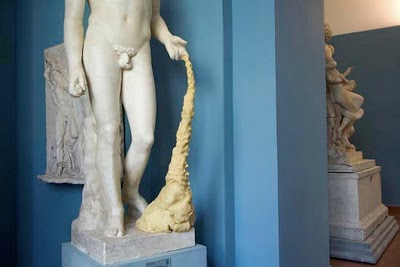
‘Marzarama‘, 2008, your performance with Lisa Anne Auerbach where you repaired with marzipan the broken noses, fingers and hands of various antique sculptures at the Gallery of plaster casts at the Academy of Fine Arts in Naples. Was this a homage or a debunking act?

It could work both ways. It was a very difficult project to realize. We finally managed to squeeze it through the loophole of ambiguity thanks to the very wonderful Professor and expert restorer Augusto Giuffredi who runs the Gipsoteca, loved the idea and let us loose in his newly restored gallery of priceless cast.

You have been the curator of Donna/Woman an art show with Laboratorio Saccardi in Palermo; you have worked with 16 assistants in ‘The Church of Sharpie’, and finally you often collaborate Polly Staple and with Lisa Anne Auerbach: it seems that collaboration plays a fundamental role for you.

Yes, I like people.

Do you think that feminism is still relevant? Your work ‘The first Woman on the Moon’, 1999, can it be considered as a feminist work? How much does politic count in your work?

Of course. Maybe. A lot.

But the work is open-ended. I received both congratulatory telegrams from Australian gender studies departments, as well as hate mail from American feminists who opposed my conflation of gender issues with imperialism (The use of the American flag in Holland). I also received severe protests from the Association of Autonomous Astronauts, contesting NASA’s monopoly on space travel, and saying that my work was showing the mere impotence of regular people’s capacity for space travel, as I wasn’t really intending to ‘go anywhere’ but muck around in the sands. I get all sorts of readings and that is my point, keeping the ball in the air. If the work can serve you in any way and you can kick the ball further, it is relevant.

Now it has been 3 years that you have been living in Italy: can you tell us something good and something bad about our Country?

Not really, for I don’t perceive myself as living in Italy. I moved to Palermo for its very specific qualities and by now I am a local here, but only here. I have a normal life, dealing with personal relationships, traffic, weather, TV, and bureaucracies, for good and for bad, like anybody, anywhere else.

Pierre Le Hors


Pierre Le Hors

Work from Firework Studies.

His blog is also pretty solid.

“Firework studies is a hand-bound book dummy compiling a selection of fireworks in the night sky. By constraining nearly all tonal values to stark blacks and pure whites, the trails, explosions and clouds of debris are reduced to a series of simple repeated formal elements: arced lines, spherical bursts, and randomly dispersed particles. I have made no effort to limit digital artifacts resulting from pushing the image files beyond their conventional range; the resulting noise becomes hard to distinguish from the texture of the fireworks themselves.

By de-contextualizing the firework show I sought to underplay its connection with public events, celebrations, and holidays. In sequencing the images I tried to remain faithful to the conventions of a form that inherently contains both spectacle and tedium in equal measure. Through sheer repetition and accumulation, I wanted to highlight both the hypnotic enchantment of such displays, as well as the fatigue resulting from an overabundance of visual information.” – Pierre Le Hors

Travis LeRoy Southworth


Travis LeRoy Southworth

Work from Detouched.

Spend some time on Southworth’s website, pay particular attention to his video work.

“My recent series of work Detouched is a collection of abstract portraits. Created from the physical “flaws” that define us—wrinkles, moles, blemishes, and stray hairs—which are often removed from commercial portraits. The new work shows little reference to the original photographs and instead become minimalist abstract drawings that play with the definition of portraiture. When printed on digital photo paper, the tiny markings retain their photographic quality upon close inspection.” – Travis LeRoy Southworth