Tuesday, 16 February 2010


Adam Parker Smith
Work from his oeuvre.
“Constructing the aftermath of invented ceremonies from materials including paper, wood and fabric, I create narratives by combining real events, daydreams and preexisting fables. Through this combination, I establish a site for disparate elements to congregate. These tragicomic installations are cartoonishly bright, overtly decorative and colorful. They are populated by subjects pulled from the fertile environment of my fears and longings, polluted with filth, obsessions, crushes, jealousy and grace. With no attempt to disguise the material makeup, my methods of construction parallel the imperfections, flaws and vulnerability reveled in the subject’s characters. As guilt, fascination and loyalty encroach, flawless heroines confront heart ache, fools distinguish beauty from the grotesque, and the wretched morn the loss of irreproachable purity.” – Adam Parker Smith
Tags: humor, illusion, irony, photo sculpture, sculpture
Posted in humor, illusion, irony, photo sculpture, sculpture | No Comments »
Monday, 15 February 2010
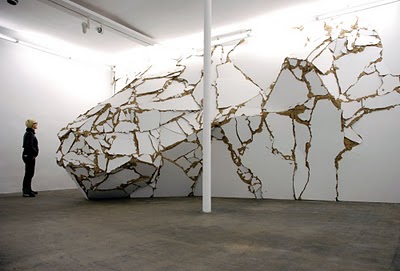


Baptiste Debombourg
Work from Turbo.
“The turbo wave of the 80’s left its mark on the industry and on the whole cultural situation in Western Europe. It became a model of behavior. The sound effect gives sensation of real physical power. To advance, the people from East Europe put some more “tuning” everywhere – for example in their folk music.The installation is part of the architecture.” – Baptiste Debombourg
“Baptiste Debombourg’s conceptual sculptures are artistic hybrids about noticing, which is what artists do these days: study the everyday for its reflective potential: how it can be both what it is and seem very different. A spaceship like interior, classical entablatures; miniature handmade slave palettes serve as preciously absurd plinths; a shopping cart is given a floral design, then painted in Cadillac gold; a five-meter-tall triumphal arch is made out of cardboard boxes as a disposable monument; a female body builder mimics a Michelangelo Venus; a functioning multi-colored urinal is made out of plastic Leggo-like parts, bringing Duchamp’s readymade back into use art; furniture smashed to smithereens is painstakingly put back together, the dysfunctional furniture recalling all the king’s men badly patching up Humpty Dumpty.
These are non-art objects transformed into anthropological statements. Although fraught with irony, the works are so well made that irony’s smirk is diluted. And as a progression of works, they exhibit exceptional consistency. Seeing them as evolutionary objects, rather than as historic ones, says something about their relationship to lineage. Transforming everyday material he makes us see those everyday things through the dream they might imagine for themselves. Styrofoam turned into marble, the businessman as hero, disposable objects as art forms, games as ceremony, furniture as psychological accoutrements. These are everyday things we need but tend to disregard. Debombourg puts into them the kind of dream we inculcate for ourselves. Time, history, and memory pass through us like dreams as we pass through them in time.” – Jeff Rian, April 2006
via Vvork.
Tags: awesome, meta-gallery, modification, organic, presentation, sculpture
Posted in awesome, meta-gallery, modification, organic, presentation, sculpture, vvork | No Comments »
Monday, 15 February 2010


Gordon Matta Clark
Work from his oeuvre (including Conical Intersect and Office Baroque).
“Like his father, the Surrealist painter Roberto Sebastian Matta Echaurren, Gordon Matta-Clark studied to be an architect. While it never became his profession, architecture—with its inextricable relationship to private and public space, urban development and decay—became his medium and subject matter. Using a practice that fused Conceptual art [more]’s critique of cultural institutionalization, Earth art’s direct involvement with the environment, and Performance [more] art’s engagement with sheer physicality, Matta-Clark literally sliced into abandoned buildings to create dizzying, Piranesian spaces sculpted from voids and fissures. By destructuring existing sites, he sought to reveal the tyranny of urban enclosure. The economic implications of private property are at play in Matta-Clark’s Fake Estates, which incorporate deeds to microplots of land—slivers of curbsides, and alleyways in Queens—that the artist bought at auction for 25 dollars a piece and combined with maps and montaged images of each site. Fascinated by the idea of untenable but ownable space, Matta-Clark purchased these residual parcels to comment on the arbitrariness of property demarcation.
Conical Intersect, Matta-Clark’s contribution to the Paris Biennale of 1975, manifested his critique of urban gentrification in the form of a radical incision through two adjacent 17th-century buildings designated for demolition near the much-contested Centre Georges Pompidou, which was then under construction. For this antimonument, or “nonument,” which contemplated the poetics of the civic ruin, Matta-Clark bored a tornado-shaped hole that spiraled back at a 45-degree angle to exit through the roof. Periscopelike, the void offered passersby a view of the buildings’ internal skeletons.
Office Baroque, a lyrical cutting through a five-story Antwerp office building, was the artist’s second-to-last architectural project before his untimely death. Inspired by overlapping teacup rings left on a drawing, the carving was organized around two semicircles that arced rhythmically through the floors, creating a rowboat shape at their intersection. Matta-Clark described the piece as “a walk through a panoramic arabesque.“ As in all his interventions, the building itself constituted the work of art. To counter the ephemeral nature of his sculptural gestures, he emulated their dynamic spatial and temporal qualities in unique photographs made by splicing and grafting negatives to create quasi-Cubistic images. No substitute for balancing precariously on the flayed edge of a structural cut, the photographs nevertheless document the essential aesthetic of Matta-Clark’s “anarchitecture.”” – Nancy Spector for the Guggenheim Collection.
Tags: architecture, awesome, building, construction, mega-famous, modification
Posted in architecture, awesome, building, construction, mega-famous, modification | No Comments »
Saturday, 13 February 2010
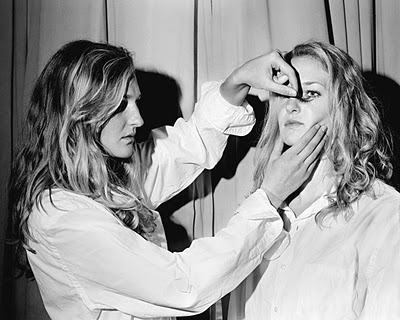
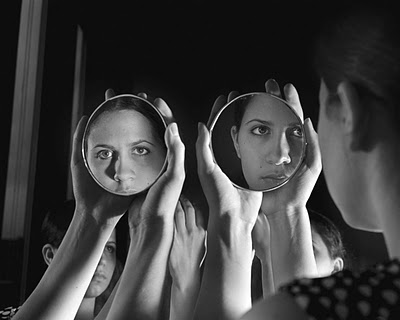


Dru Donovan
Work from her oeuvre.
“Young American photographer Dru Donovan’s photographs are ambiguous and sensitive and compelling. Looking at the images, its hard to know whether her work is staged, or more reportage based. She graduated from Yale last year, but information on her or her work is scant, which actually serves to make the images more intriguing and open to interpretation.
Taking place in a strange suburban limbo, and dealing with issues like body image and the awkwardness of teenage years, Donovan’s work shows subjects seemingly uncomfortable in themselves, often awkward in front of the lens. There are shades of Diane Arbus with her uncanny knack of capturing weirdness in mundane situations, but it’s Donavan’s ability to capture the vulnerability in her subjects in such a thoughtful way that makes her work so powerful. A talent to watch.” – text via Vision Field.
Tags: awkward, black and white, documentary
Posted in awkward, black and white, documentary, tension, vernacular, yale | No Comments »
Friday, 12 February 2010


Antoine Lefevbre
Work from his oeuvre.
““The exhibition’s multi-disciplinary character is a reflection of the diversity of Parsons Fine Art Program’s student body and their engagement with a wide range of current trends in global art practices,” notes Fine Arts Chair Coco Fusco. ”Students in the program hail from Turkey, Korea, Taiwan, Russia, France, Canada, Colombia, Bulgaria, Ghana and Japan as well as from throughout the U.S. They are encouraged throughout their course of study to explore connections between artistic methods, genres and cultures.”
The exhibition is accompanied by a catalogue designed by the students featuring an essay by the exhibition curator, Anthony Allen, who is an independent curator, scholar and translator who is the Associate Director of the Paula Cooper Gallery. The catalogue is available on the Parsons Fine Arts website.
In his text for the exhibition catalogue, Allen writes: “Many works on view put forth an understanding of identity as a performative and mobile concept. It is a question of forging alternate identities from disparate elements: male and female archetypes, totemic animals, historical figures, pop culture and cartoon figures, social selves caught in familial, religious and ethnic networks, mythological heroes and fairytales characters – all these structures are variously unmade and re-imagined, subverted, encrypted, hybridized, queered, re-located or cyborged. These constantly shifting self-fashionings are negotiated anew in each work – each work here is a provisional statement.”” – text via artcat.com for the 2009 Parson’s MFA thesis show.
Tags: action, conceptual, french, humor, intervention, multimedia, sculpture
Posted in action, conceptual, french, humor, intervention, multimedia, sculpture | No Comments »
Thursday, 11 February 2010


Robert Kulisek
Work from Photographing Sculptures.
“Offered here is artwork as a form of investigation, not artwork as an authoritative assertion. To perceive a photograph (or artwork) in such a way is to point to something unsure inside of it, to insist on the once and future presence of a thing, an event, or a scene before the camera. But it is also to place us in a particular relationship to that work, to stitch us into the perceptual and even the social fabric of what is being seen. This gives both it and us a certain power. As readers and observers of this artwork-as-encyclopedia, it is now up to us to use our new-found knowledge to see beyond whatever impediments remain in our view.
I am a photographer specializing in large-format location photography, detailed cataloging and other field studies of the photographic kind.
There most likely will never be another original photo taken; and so to those who think they can be completely original, the title of this site is dedicated to you.” – Robert Kulisek via i heart photograph.
Tags: 4x5, appropriation, color palette, meta-photography, photo sculpture, photography, representational, software, still
Posted in appropriation, color palette, meta-photography, photo sculpture, photography, representational, software, still | No Comments »
Wednesday, 10 February 2010


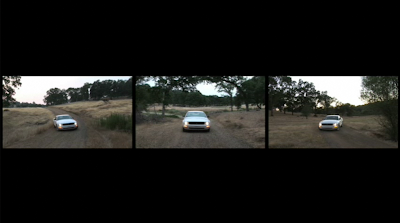

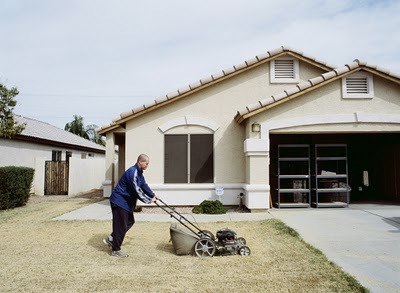
Greg Stimac
Work from his oeuvre.
The stills from above video projects in no way due justice to even the most basic appreciation of content. Please go to his website to check them out.
“Greg Stimac works within a mode of photography with a rich history, the photographic series constructed from images captured in travels around the United States. While individual photographs are generally not planned or staged, the ideas for various series are carefully considered. Mowing the lawn, gun portraits, snowmen, and roadside memorials are but a few examples of his subjects, and are selected to illuminate both the American character and document ways in which we structure our lives through activities and rituals. The straightforward but haunting color images simultaneously serve as portraits and documents.” – via The Museum of Contemporary Art, Chicago.
Tags: cars, chicago, columbia guys, conceptual, humor, kitsch
Posted in cars, chicago, columbia guys, conceptual, humor, kitsch, video | No Comments »
Tuesday, 9 February 2010


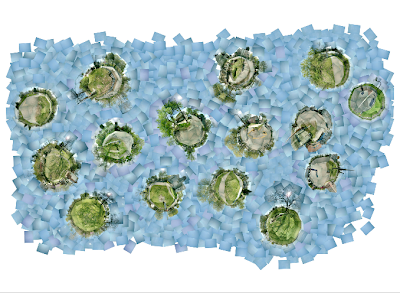
Nathaniel Smyth
Work from Maps and Spaces.
“Using the snapshot as a metaphor for visual perception, I experiment with strategies of arranging those perceptions to investigate the various ways our minds understand the space we inhabit. Using images from both personal and mass culture as a form of cumulative experience, I layer the images to arrive at a single combination of the whole, mimicking the way our brains process information.
All of my work is concerned with the perception and doubt of the embodied mind. I use the accumulation of perception and memory as raw material, challenging the viewer to decide whether that accumulation clarifies or clouds understanding and asking what the ramifications of that decision are. The world we live in is always mediated through our perceptions, and by encouraging the viewer to reconsider their perception and memory I hope to underscore the importance of both.” – Nathaniel Smyth
Tags: 2d, 3d, 3d implied, buckminster fuller, perception, snapshot
Posted in buckminster fuller, perception, snapshot, visual comprehension | No Comments »
Monday, 8 February 2010


Miranda Lichtenstein
Work from her oeuvre.
“Searching, misrepresentation, failure, and our troubled relationship to the natural world are components of my work. For this reason, living at Monet’s garden on a residency in Giverny a number of years ago had a tremendous impact on me. Recognizing the garden as a giant tableaux staged by a painter, I decided to take the discarded flowers and create still life images in the studio, as a response to the challenge of making an original photograph of the most photographed garden in the world. On my route to the garden, I would pass through the tool shed, which had shadows painted on the wall to designate where each tool should be hung. More often than not, the tools would be hung upon the wrong shadow. It struck me as a perfect example of a failed system. This image prompted me to draw the shadows of flowers and plants clipped in the garden. I started out by photographing the flower against a misaligned shadow drawing, but eventually the shadow drawings grew more elaborate. Because they are made from projected light, they look like a photogram. I view them as a send-up of Henry Fox Talbot’s “Pencil of Nature.” They appear to be a mirror of the original but are in fact produced by my own hand. Eventually, I ventured back outside of the studio, photographing trees that I then misaligned. The diptychs (Two Trees, After the Storm) refer back to the shadow – a shadow is at once nothing and a double of something.
I usually work on a few projects at once, so at the same time I was working with still subjects, I was making pictures that responded to a trend I’d recognized, of an increasing number of secular outlets for seekers of the spiritual. I called the project “The Searchers,” and I photographed people in various altered states. For the first time I used myself as a model in my pictures (Untitled (A self-portrait as a member of Heaven’s Gate), Dream Machine, Self-portrait as a Shaman). I wanted to locate my own connection to the desire for a transcendental experience. Recently, I have used photographs of airplanes (9 Planes, 5 Unrealized) to engage my interest in the sublime and failed utopias. Although they deal with the subject of representation, they are also deeply personal.
In 1996 I was in a crash landing and have since only known air travel as an experience of unspeakable fear. The pictures appropriate painted images of airplanes mostly from the 60s and 70s. When I exhibited them, they were shown with the images you see here – misrepresented shadows, fallen trees, and dreamlike quests for enlightenment. They represent a conflict between a fantasy of escape and a loss of control. Sigmar Polke asked: “Does meaning create relationships or do relationships create meaning?” I hope to pose this question and create a task of decoding for the viewer, by showing a broader range of work rather than a single series.” – Miranda Lichtenstein via WIPNYC
Tags: appropriation, disparate, representation
Posted in appropriation, disparate, representation | No Comments »
Sunday, 7 February 2010

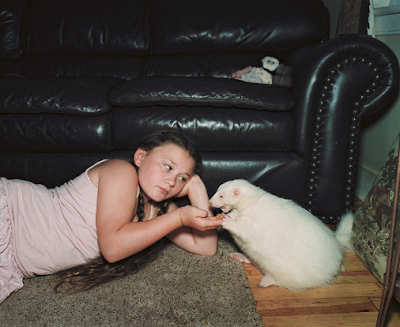


Robin Schwartz
Work from Amelia’s World.
“My photographs are drawn from real journeys undertaken with my daughter, Amelia. I am driven to depict relationships with animals but the photographs are not documents; they are evidence of the invented worlds that we explore and the fables we enact together. Photography gives us the opportunity to access our dreams, to discover the extraordinary.
Animals and interspecies relationships have always been an important part of my work. The animals in my photographs are not represented as beasts or nobility but as part of our everyday world. My first monograph, a series of primates at home with humans, guided me to the places of my own childhood fantasies.
I photograph myself with animals through Amelia. I am an only child who has an only child. Each of us has a strong fantasy world. Amelia and I play out our eccentricities in worlds where she and animals not only co-exist, but also interact. Animals are not props in my photographs and they are not photo-shopped in. The world that my daughter and I explore is one where the line between human and animal overlaps or is blurred.
An artist photographing her child can invite ridicule, but getting personal with my projects has always been both my need and my edge. This project evolves with my daughter’s maturing personality and aptitude. Amelia is my priority, my muse, my co-conspirator, my tormentor and my bliss. Collaborating with Amelia, I am able to go to any place in time.” – Robin Schwartz
Tags: animals, children, collaboration, fantasy, interesting
Posted in animals, children, collaboration, fantasy, interesting, vernacular, wipnyc | No Comments »


