Grant Willing


Grant Willing

Work from Svart Metall.

“‘Svart Metall’ is an investigation into the themes and ideals of the black metal music genre. Black metal explores the ideas of ancient pagan and satanic views and presents these feelings in a violent, often cacophonous style of music. Progressing from the themes of the music, a subculture has developed in which murders, church burnings, animal sacrifices, and other barbaric acts have occurred. Grant Willing’s photographic study into this world looks at consistent lyrical themes and an overall consciousness that is put forth by this way of life. The folklore and mythology are acting as the basis behind this fantasy, and the dire acts of violence that occurred being the basis in reality. By contrasting varying elements that are rooted in these central themes, Willing is creating an overall feeling of the inherent grimness and misanthropy that exists in black metal culture. ” – Grant Willing

Collin Zipp


Collin Zipp

Work from his video and collage series.

Below is a IM / email interview I conducted with Zipp.

The collages above are not originally diptychs, I have paired them for formatting reasons.

“Raw video footage is degraded using physical forces. The resultant images are then digitally captured and edited.” – Collin Zipp

JT: One of the most apparent aspects of your work are the relationships between the limits of technology and process, and how the two function in concert to be a discussion of the medium rather than the subject. How specifically is process related to the conceptual development of your works?

CZ: Process in my work is very important, specifically within the landscape videos. I enjoy taking things apart to be able to see how they work. Unfortunately, computers confuse me. I don’t use a MAC computer in my artistic process … I find them too “machine” like. I prefer to use a PC because it WILL crash. It makes me feel like I am working with another human being, one that is not always reliable and has flaws. So for me, process in my art making is related to the process of the relationship I have with the technology and the realization that I am exploring the medium of video is something very important to me. The influx of reality tv, youtube etc. is overwhelming. There seems to be a desire to create and capture something “real”. The medium of film and the structure it creates (beginning, middle, end) gives a notion of escapism. For me, exploring non-linear narrative and non-narrative works in a way free me from this forced escapism (regarding the content and reasoning behind the broken landscape videos and process).

JT: This leads me to my second question, you have a tendency to focus on the destruction and reconstruction of landscape, and in many ways, the virtual deconstruction of the concept of a landscape. Do you have particular interests that surround the structure and restructuring of information, and if so, how do you relate your analogue process to the degradation of your video works?

CZ: For me restructuring notions of storytelling and narrative is very important. In my work I try to find new ways to tell stories…

I know this is off topic but bare with me… I enjoy reading old fairy tales (i.e. The Brothers Grimm). The way they are written is fantastic. For example … immediately you have to accept the fact a fox, a piece of string, a mouse, or a crow, can talk. I feel that notion alone forces you out of a particular comfort zone and forces you to accept any sort of possible outcome. A kind of “forget what you know” kind of feeling and processing of information…

As for the analogue process … I feel that nothing is forever. Painting disappears over time, photos fade away, sculptures erode and break apart. Why should the medium of video be any different? besides, 2012 is just around the corner … another sort of contemporary “fairy tale” have you…

JT: How has the process of degradation and your collaborative relationship with technology affected the development of your work? I ask because you have a organically technological / purposefully random aesthetic that seems to be integral to the video pieces (landscapes andnon-landscapes alike).

CZ: I find that the deconstruction of my previous work has enabled me to appreciate an idea, object or landscape (for instance) for its barest structures. Taking something apart or looking at the unknown about that thing seem to drive my current artistic practice…I am also more prone to making my work look clean or sharp, but yet still having the “human touch”… almost an “I was here” sticker.

JT: How would you relate the concerns in your current works to both the video work and the collage work?

CZ: Currently I am exploring contemporary storytelling and aspects of narrative: almost as an exploration of a contemporary fairy tale. Concerns of technology, non-linear narrative, and deconstruction are all tools I am using to take apart my current ideas and explore these concepts. Being in school for my masters (after 5 years off) has forced me to think and work differently, which is a good thing of course…

One contemporary fairy tale is the “end of the world”. I am actually put off by that that movie with John Cusak called 2012 has hit the theatres; another boring Hollywood disaster movie with no doubt a happy ending. Such an interesting concept: the world ending on a specific date that correlates and shares so many coincidences with so many different cultures, religions, and current technological theories (singularity theory for instance). I’m not sure why the notion of our world being destroyed is so interesting to me, perhaps it is because we are currently destroying the planet? By no means am I not a hardcore environmental activist, but I am concerned not only about the planet’s well being, but the way the information about such topics is being relayed to us via the media, etc.

Petra Cortright


Petra Cortright

Work from Male Female Child.

There is a rather informative interview here. Her ANIM8D GIF work is also interesting, but I could not practically replicate the context. Check them out and you will understand.

“Her reference points (cats, dogs, psychedelia, youtube, geocities, and so on) are all things very near to our hearts, but there remains something blissfully and recklessly confusing about Petra Cortright’s work. The ways in which Cortright tosses her ideas against the backdrop of video compression, cheap image software effects, and the general soup of internet culture make us want to scratch our heads with one hand and high-five her with the other. In a crowded market of “new media” artists working coldly with bright colors and animated gifs, Cortright brings something far more authentically weird, human, and funny to the table” – Whose Fault is That

Abigail Reynolds


Abigail Reynolds

Works from  Universal Now and Mount Fear.

“The Universal Now, is a series of collages that uses imagery sourced from publications such as guide books and atlases, combining photographs of landscapes or monuments, enmeshing them together. In the process of splicing and joining the images, cuts are made into the printed surface and the paper is folded and pushed upwards and outwards, creating a three dimensional object, a grid-like construction that changes and moves with your perspective, underlining your presence as viewer. These photographs have come from books that are now historical documents rather than useful tools, and would be viewed for reasons of nostalgia or curiosity rather than to inform a holiday itinerary.
Within the piece Westminster 1915/1952 (2008), Reynolds has removed bookplates depicting the abbey and has woven the two pictures into one field. Oddly it seems that 37 years apart, two photographers have stood in precisely the same spot to capture their image. Reynolds is therefore able to take these two forgotten sheets and splice them into one another almost perfectly, creating a jarring uncomfortable object that refers to this unusual coincidence. Within these pieces parts of the images line up uncannily, where a landmark building remains, but the environs have often changed, underlining the passage of time.
The series title refers to the instant when the camera shutter opened and closed, often years apart, but both moments register a ‘now’. The precise nature of ‘now’, which is debated in many fields from psychology to physics, isn’t resolved within these works, however the objects are infused with an overriding sense of time, as the viewer also encounters these pieces within their own separate present.” – Seventeen Gallery

______________________

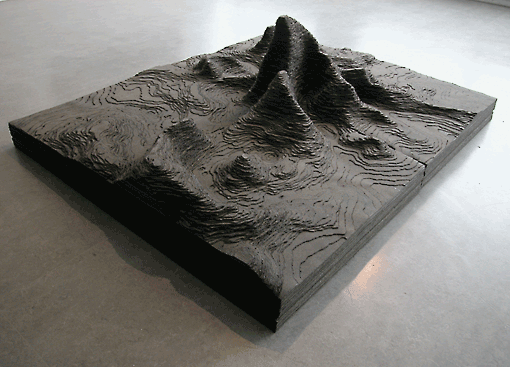
The terrain of Mount Fear is generated by data sets relating to the frequency and position of urban crimes. Precise statistics are provided by the police. Each individual incident adds to the height of the model, forming a mountainous terrain.

All Mount Fear models are built on the same principals. The imaginative fantasy space seemingly proposed by the scupture is subverted by the hard facts and logic of the criteria that shape it. The object does not describe an ideal other-worldly space separated from lived reality, but conversely describes in relentless detail the actuality of life on the city streets.

Jessica Eaton


Jessica Eaton

Work from her oeuvre.

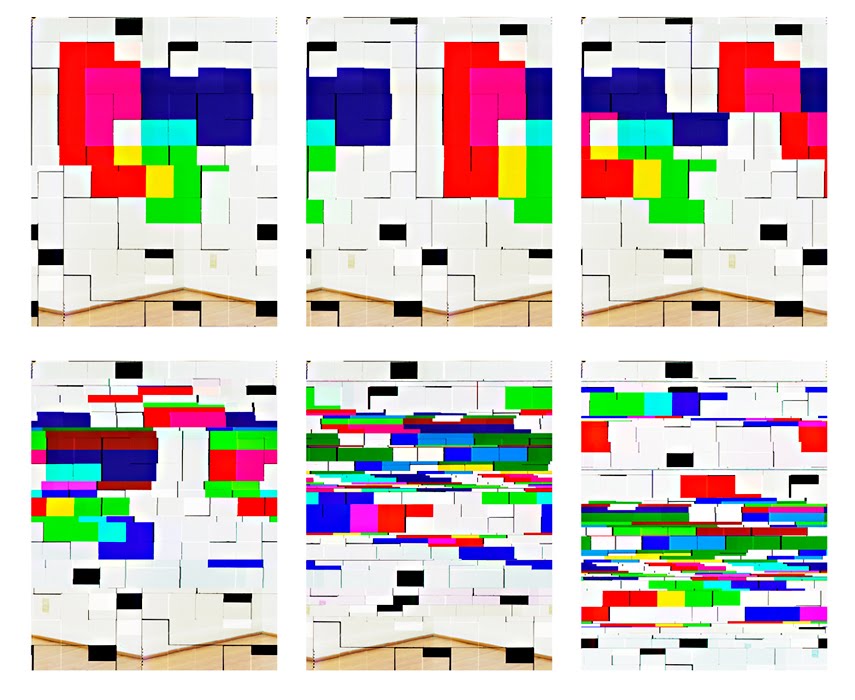
“Eaton’s exhibit is a display of virtuosity, each piece a microcosm of what could become the basis for a larger show. Every print in the Emily Carr Institute graduate’s show represents a technical practice she has been refining for a year or more, as she related at the opening. “108_06″ unveils a bare gallery wall as a wormhole to the whole photonic spectrum through a process called “masking,” the contemporary version of which is commonly used in digital imaging. Eaton, however, uses the earlier and painstaking analog version: to create “108_06,” she had over a hundred uniquely manufactured darkslides laser-cut to her specifications, which she then used to expose one piece of film at a time to red, green and blue separation filters. “These are the primary colours in light [additive] colour theory,” she explains. “By multiply exposing each square to different combinations of pure red, green, and blue, I can make ‘normal’ white light and a set of additive secondaries-magenta, yellow, and cyan-visible at the same time.” She’s been working on the technique for approximately five years.

Eaton’s work re-imagines ’70s-era minimalist and conceptual art: a time when artists aimed to strip the aesthetic object down to its most essential state and concept took precedence over traditional aesthetic concerns (a serial work of Eaton’s-a diamond pattern captured mid-liftoff from its foundation of grid paper-especially invokes Sol LeWitt). Like her predecessors, Eaton uses a purist’s palette, but, rather than baring the aesthetic object, she reveals it in the process of undressing.

In the best of cases, Eaton’s hesitation in paring down the object imbues her work with a heady sense of mystery. We look through “Shadow 9″ and “108_06″ and glimpse the sensory world’s inchoate elements quietly gathering, but Eaton keeps the curtains mostly drawn. Her modesty creates a worshiper of the viewer, compelled by the ever-unfulfilled promise of the unknown. Certain pieces reflect her strengths to greater effect: the light from a window covered in film gels that she installed in her own apartment carries greater conceptual and poetic weight in “Shadow 9,” where its rainbows filter through a cosmogonally black circle of heavy stock card onto a white sheet of paper, than in the photograph of the window itself. Ditto the print of the window’s technicolour reflection on her apartment floor. But the exhibit’s overall effect is erotic: it piques and prolongs the thrum of audience interest and does not explore the artist’s maturity as such. To that effect, Eaton’s patience with and innovative application of singular production methods, and the visceral pull created therein, make for a thrilling tease” – Teresa Saplys

Michael Naimark


Michael Naimark

Work from Viewfinder: How to Seamlessly “Flickrize” Google Earth.

“The tension between computing technology that augments human activity and technology that automates it goes all the way back to the 1960s.

It can be seen in Viewfinder, a demonstration of a photo-sharing or photo-placing system developed by a group of researchers and digital artists at the University of Southern California. The system, which was created with the help of a research grant from Google, is an intriguing alternative to Photosynth, a project developed in 2006 by Microsoft Live Labs and the University of Washington that automated the proper placement of two-dimensional digital photographs in a three-dimensional virtual space.

Demonstration video showing the possibilities of Viewfinder. (Viewfinder Project)
In contrast, Viewfinder, which is not yet a commercial service, is intended to make it simpler for users to manually “pose” photos in services like Google Earth — to place them in the proper location and at the original angle at which they were taken. It is already possible to insert photos into Google Earth, but the researchers said their goal was to make the process an order of magnitude simpler.

“We specify that a 10-year-old should be able to find the pose of a photo in less than a minute, and we are convinced that this goal is achievable,” the researchers noted in a progress report Thursday.

Google, Microsoft and Yahoo have all created 3-D world maps that allow users to virtually “fly” over the surface of the earth and view satellite and aerial imagery. The services are being expanded to include 3-D topography as well as 3-D buildings for some locations. The Viewpoint idea would essentially merge a photo-sharing service with a mapping service, making it possible for users to see what a particular point on earth looked like at a particular time.

The team of Viewfinder designers is a collaboration between the Interactive Media Division at U.S.C. and the Institute for Creative Technologies.

The project is made simpler by the widespread availability of geotagged digital photos, those that have been tagged with geographical coordinates indicating where they were taken. However, the researchers say that today such photos are generally treated as hovering “playing cards” in 3-D models, giving the world a flat 2-D sensibility.

The goal, the researchers wrote, is an experience that is both as compelling as Google Earth and as accessible as the photo-sharing service Flickr. The result is photos that appear perfectly aligned — and conceivably even transparent — to the underlying 3-D world.

“This is an attempt to viscerally and emotionally plant your picture in a virtual world,” said Michael Naimark, a research associate professor at the Interactive Media Division and the director of the Viewfinder project.

He said the group had patented its work, but had not attempted to commercialize it.

“We’re rabble-rousing,” he said. “This is as much an artist’s intervention as a technological invention.”

While photos are placed in Viewfinder, Microsoft’s Photosynth performs the same task by using image recognition and related artificial intelligence techniques to automatically analyze photos to create a 3-D “point cloud.” The user can then visually hop from one image to the next.

“We’re totally impressed by Photosynth,” Mr. Naimark said, but he added that people-centric techniques like “crowd-sourcing” are now giving traditional artificial intelligence a run for its money.

He envisions a world in which cameras not only have geotagging capabilities but also directional sensors that will make Viewfinder a more powerful way to enrich current 3-D world models.” – John Markoff for the New York Times

Janet Cardiff and George Bures Miller


Janet Cardiff and George Bures Miller

Works from the The Murder of Crows.

“You part two layers of thick red curtains to enter the atrium of Hamburger Bahnhof, where chairs, speakers, and a single table with a gramophone perched on it – all arranged in a circle – form The Murder of Crows, the new installation by Janet Cardiff and George Bures Miller. The 30-minute-long sound piece works as a sort of play without a stage and without actors – a symphony of disembodied voices and motion, a meditation on dread and the tyranny of nightmares. The piece fits in well with the notion of “Romantic Conceptualism,” which has been all the intellectual rage in Europe in recent years, while simultaneously combating the contemporary art world’s resistance to theatricality – a resistance that has become a major convention since the emergence and subsequent pre-dominance of pop, minimalism, performance art, and conceptual practices some four decades ago.

It’s quite unusual for a sound installation to draw massive crowds, but the popularity of Cardiff and Miller’s piece points to its intrinsic beauty and accessibility – two terms that may be taboo in the discourse surrounding contemporary art, but are nonetheless relevant to The Murder of Crows. The instrumental usage of ninety-eight loudspeakers, combined with the fact that the sound is so crisp that you feel as though you are in the midst of a live performance, endows the work with a symphonic strength. Of course, the massive open space helps – we are sitting in the arrivals hall of a former train station. We can hardly imagine the piece working in the comparatively claustrophobic confines of a white cube gallery, where sound art often comes off as a novelty genre.

The Murder of Crows is a fiercely introspective work. Essentially, the piece is about dread. It is textured with a series of descriptions of nightmares, spoken by a female voice (Cardiff herself), interrupted by bursts of frightening and joyful music, and sounds of movement, the ocean, drums, and, yes, crows overhead. It serves as a sort of sonic elucidation of the Goya painting, The Sleep of Reason Produces Monsters (1799).

The speaker wants, more than anything, a peaceful night of sleep, but is engaged in an existential battle with her own (seemingly) sourceless nightmares. Dreams of severed limbs and foreboding distort her waking reality, the dream narrative that is being recorded. The piece records the process by which one individual confronts her symbolic demons as a means of coping with larger conflicts in the external world. In the end, she is given relief with a lilting lullaby.

Janet Cardiff and George Bures Miller’s largest sound work to date releases us from the static sociology that so much conceptual work is based on. The Murder of Crows gives us a unique insight into a victimology in which the self is both aggressor and captive. In doing so, it is indicative of a new era that strives to go beyond reason and use the outcome of suffering – jubilation – as a foundation for self-discovery.” – Whitehot Magazine

Justin James King


Justin James King

Work from And Still We Gather With Infinite Momentum.

“Justin James King radically intervenes in the common spectacle of the tourist vista by removing the view itself. A lone figure stands on a promontory gazing out into the utter void. Commenting on the reflexive act of looking (and by extension, on the rich traditions of landscape photography), Justin says,

Perhaps all we see when we stand in front of the landscape are archetypes: preconceived notions and pre-experienced views….Our perception grows out of how we have seen the landscape represented and how it has been delivered to us historically and in popular culture.

By removing the sweeping natural view, Justin undercuts the entire premise of the conventional landscape, pulling off the tricky business of making a photograph about the invisible.” – via Hey Hot Shot

Maryanne Casasanta


Maryanne Casasanta

Work from suffices to decide if the necessary mood is there.

“Maryanne Casasanta’s work offers questions to unanswered histories and contemplates the elusive exchange between art and commonplace. These documents observe the space and pattern that ornaments the land, while paraphrasing a desire to be grounded.” – Maryanne Casasanta

Mark Wyse


Mark Wyse

Work from Disavowal.

“Disavowal is an engagement with our conflicted relationship to desire. If in a crude sense modernism is an embrace of desire and postmodernism is a critique of that desire, this show seeks to commingle the two. In doing so it explores key works by both contemporary and historical artists who restrain, displace, or distance desire with the intentional, or unintentional effect of accentuating desire. This show takes as its premise that desire intensifies in relation to restraint.

This show started as an act of curation. Wallspace asked me to curate a show of photographs. I quickly realized I was at the mercy of the artists I wanted to include and the availability of historical pieces.

This was unacceptable. It only made sense to not submit to the control and intentions of the artists I wished to show. The unintentional or disavowed aspect of their work was what I wanted to see. The solution dictated me cutting into my books, to show precisely the objects that had formed my thinking about the work. To show the reproductions themselves, by framing the reproductions. My desire was to shift the context to a context of individuals. In this sense I think of my show as a show of portraits, portraits of desire, as if each person’s psyche was in the room.” – Mark Wyse