Saturday, 4 July 2009



Sarah Pickering
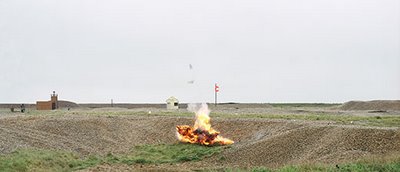
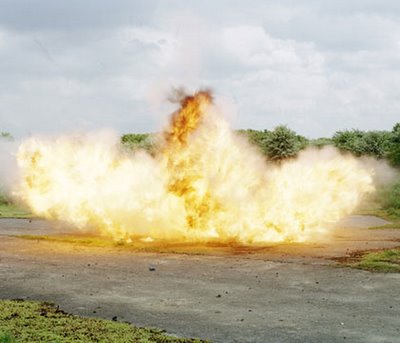
Work from Explosions.
In honor of the 4th of July, because no artists that I know of shoot fireworks.
“Explosions,” Sarah Pickering’s debut solo show, is both as understated and as boisterous as its title implies. The British artist’s eight large-scale photographs capture the pyrotechnics of various types of bombs and explosives, suspending the fiery or smoky bursts at the moment of simulated impact. The quality of each blast—land mine, smoke burst, electric thunderflash, and so on—is distinct not only in appearance but also in tone. Napalm produces a low-slung, compact gray cloud that menaces the flat, sullen British countryside; the ground burst, by contrast, emits a brilliant flash of sun and joyful rays of light that are incompatible with the quiet grassy landscape. Detonated on the proving grounds of the British military and police, the bombs are used to prepare troops for actual combat, and Pickering’s images cleverly investigate “representation” and “real,” and aesthetics and death, in photography and warfare. These explosions are the illusionist’s light show and the soldier’s shield. More subtly, however, they point to the fusing of these qualities, to misdirection’s thrilling flash. —Nicole Rudick for Art Forum
Tags: documentary, explosion, staged
Posted in documentary, explosion, staged, uk | No Comments »
Friday, 3 July 2009




Gerhard Richter
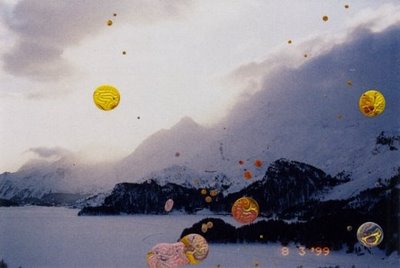
Work from Overpainted Photographs.
“A less well known aspect of the work of Gerhard Richter, the ‘overpainted photographs’ are not simply an answer to those who feared that photography had murdered painting, but an integrated work of material and colour. Countering the imposing format of his better-known paintings, these small overpainted photographs (mostly of a standard 10 x 15 cm) are fascinating both for their formal qualities and for the critical questions they throw up.
The show at the Centre de la Photographie presents more than 300 photographs. Taking as their starting point personal snapshots of landscapes, interiors, still-lifes and family scenes, the artist works paint onto them. Originally this gesture was a purely technical exercise, a way to check the tone of the colour Richter would choose to paint when transcribing images to painting. But becoming aware of the artistic value of these hybrid objects, Richter has since enthusiastically taken up this process: after a painting session in the studio, he produces a ‘snapshot’ painting – a sort of painting analogue of a photographic snapshot. Thus the abandoned leftover of a spatula or a large knife still coated with pigment or a few blobs of colour are smeared onto the photograph.
This modest recycling process produces a real tension between these images of the past and the cracked painting: improbable formal encounters that lead us, as viewers, to look beyond the painting. The tension between the two media is surprisingly fruitful: the depth and perspective of the photographs are blurred by the flat painting literally ‘adding a layer’ to the composition of the photograph. This technique leads to a delightful paradox: even though we privilege photography’s ability to reflect reality, here the painting, through its materiality and thickness, presents itself as more real than the photograph.
If Richter has been working with this technique regularly since the end of the 1960s, it has remained out of view. Only now, age seventy-seven, has Richter seen fit to publicly reveal this large chapter of his work, an additional link in his diverse and divergent oeuvre. And this from an artist long associated with photorealism, and who has emerged since the 1980s as one of the great abstract painters. Richter’s apparent heterogeneity of practice suggests nevertheless that his sole goal, constantly and unceasingly reworked, is always painting; the nature of the visible in his images and the reality of vision.” – Karine Tissot
Tags: awesome, conceptual, german, medium specific, obscured, painting, self-referential, self-reflexive
Posted in awesome, conceptual, german, medium specific, obscured, painting, self-referential, self-reflexive | No Comments »
Thursday, 2 July 2009



Anders Weberg
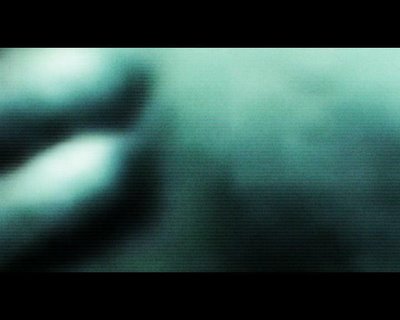
Work from P2P Art.
P2P art is a brilliant examination of the ephemeral nature of art, and in many ways, contemporary culture. It is art realeased into the wild and reliant on the viewer to keep the work in existence (in the most literal sense). Go check out the other videos on his website as well, it is a huge archive of good.
Anonymus (torrent file to download film)
080808 (torrent file to download film)
Filter (torrent file to download film)
“Art made for – and only available on – the peer to peer networks. The original artwork is first shared by the artist until one other user has downloaded it. After that the artwork will be available for as long as other users share it. The original file and all the material used to create it are deleted by the artist. ”There’s no original”. A project from Swedish artist Anders Weberg started in 2006. P2P Art – The aesthetics of ephemerality.” – Anders Weberg
Tags: awesome, conceptual, film, p2p, participation, self-referential, smart, swedish
Posted in awesome, conceptual, film, p2p, participation, self-referential, smart, swedish, video | No Comments »
Wednesday, 1 July 2009
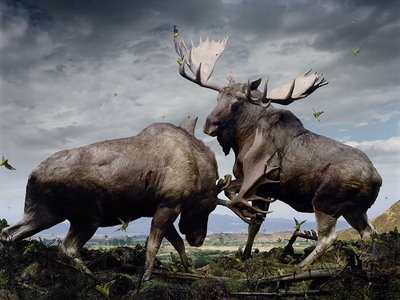


Simen Johan
Work from Until the Kingdom Comes.
Great articles here, here, and here.
“In Until the Kingdom Comes, Johan presents animals using escapism and fantasy to construct identity and purpose. Similar to his earlier work of children, this series explores our predilection towards imagination and emotion, rather than reason. Using digitally manipulated photography and sculpturally enhanced taxidermy, the artist presents scenarios that address ways in which we contend with inherent fears and desires.
A sculpture of an arctic wolf posed atop a circus pedestal/beauty display, its hair extensions threaded with crystalline jewels, transforms a childhood horror into absurd beauty (or serves as a symbol perhaps for all those things we deny, cover up, or manipulate in order to make our reality desirable). A large mammoth made of cement, standing in a natural landscape, creates an uncanny relationship between the organic and the artificial (or testifies to our ways of preserving history and honoring the dead in order to conquer our own fears of mortality and being forgotten).” – Yossi Milo Gallery
Tags: animal, documentation, false, fantasy, guilty pleasure, nature, sculpture, tableaux
Posted in animal, documentation, false, fantasy, guilty pleasure, nature, sculpture, tableaux | No Comments »
Tuesday, 30 June 2009


Ben Van Den Berghe
Work from The Handshake Society.
“Handshake Society is the outcome of an ungoing interest in power relationships between people, focussing on the – decisive – moment on which people shake hands. I reframe found images and place them in a personal archive. By cropping these frames I try to eliminate the image as a document, instead I look for the archetype behind these gestures. In a way this series can be seen as a research on human behaviour and answers to a need to capture these moments.” – Ben Van Den Berghe
Tags: belgian, conceptual, context, handshake, politics, rituals
Posted in belgian, conceptual, context, handshake, politics, rituals | No Comments »
Monday, 29 June 2009

“In order to study the day, I use my ass the night … From time to time I return to the apartment between noon and two for sleeping. It’s crazy to have arrived there. Fortunately I can still hide it. ” – Emma, 23, Master of Philosophy

“I have been in conflict with my family since I was sixteen. Since I have neither scholarship nor parental assistance, I always took care of myself. ” – Armin, 23, Master of Sociology.

“It happened to me several times in the evening, closing the university, to students at the door … I know it is not easy for them, but I have no choice … ” – Gerard, officer

“I can not go to the University Restaurant every day and I do not go to the Restos du Coeur. So I go to markets and cook for my friends.” – Armin, 23, Master of Sociology.
_____________________________________
Guillaume Chauvin and Remi Hubert
Work from the Paris-Match Competition.
I am borrowing this post heavily from Horses Think, as many of the sites I planned to use as source material yesterday are now moved or otherwise not where I left them.
__________________________________
“Paris-Match awarded their annual Grand Prix du Photoreportage Etudiant this week to two French students who submitted a photographic story that apparently presented images documenting the precarious lives of students today and the things they must do to survive.
When the two winners, Guillaume Chauvin and Remi Hubert, both art students at the Ecole Supérieure des Arts Décoratifs of Strasbourg, stood up at the Sorbonne to claim their trophy and prize money, they announced the true nature of their work. The images were not photojournalism but staged images featuring many of their peers.
The winners claimed that the idea was hatched a year ago when they looked at all the work students were competing with for the 2008 prize. They realized that the “world view of this work was limited and seemed more like vacation photographs as opposed to photojournalism. The photographs depicted small children with big wet eyes in order to illustrate the misery abroad.”
Speaking to Le Figaro, Guillaume Chauvin confided that they “wanted to enter the contest in order to show the codes used too often in photojournalism and to prove that something real could be translated into something staged.” – Horses Think
Tags: awesome, deception, lie, photojournalism, report, straight, student, study
Posted in awesome, deception, lie, photojournalism, report, straight, student, study | No Comments »
Sunday, 28 June 2009
I don’t normally post articles, but the irony of this is hilarious. Check
here and
here. Maybe I will post Banksy tomorrow in honor of the hilarity.
Tags: humor, irony, self-referential
Posted in humor, irony, self-referential, uk | No Comments »
Sunday, 28 June 2009


Tudor Bratu
Work from Album, Record, and Night Study #4.
Bratu’s website is a cornucopia of projects, go visit it.
______________________
Album: “By altering the initial order of images, using blanks and empty space as image, the seemingly real of the facsimilae reproduction of the album, is contradicted by the absence and displace-ment of the original images. Thus, what seems real and authentic in print, is in fact a manu-factured construct, a book in which ‘the senses deceive perception’. The specific, time-limited original album, is at the same time doubly preserved as a defined object belonging to a specific individual, and transformed into a vast and timeless cliche, belonging to everyone.”
Record: “‘Record’ is an artists book conceived as a journey through a limitless and overexpanding city. The 700 images used, depicting various streets from different Western and Eastern European and Asian cities ( see also ‘Archive’ ) such as Berlin, Bucharest, Amsterdam, Brussels, Seoul, Tallinn, and others, are so combined, that the different city images all flow into one another, creating the impression of an endless journey of repetitions. The size of the book – A3 format – fills the field of vision drawing the spectator into the journeys own reality. The differences between the various cities, and their specific political and social structures, is evened out. All is left, is a record, a mirroring of people by focussing on where they live and what they leave behind.”
Night Study #4: “Series of 20 black and white photographs made during trips at night in the Amazon rain forrest in Surinam. Each image 250×180 cm, inkjet on paper, framed. ” – Tudor Bratu
Tags: artist book, book, conceptual, dutch, originality, photocopy, reproduction, self-referential
Posted in artist book, book, conceptual, dutch, originality, photocopy, reproduction, self-referential | No Comments »
Saturday, 27 June 2009


Patricia Neligan
Work from Vorübergehend.
“The starting point of my photographic art is the observation of people in relation to space.
Here is definitely meant the ambiguity of the term „space“, incorporating both that of the
conceptual and the real reference space. I try in my photographic work to create tension
between reproduction and the originality of the pictures subject.
My work is titled vorübergehend (temporary) and is an analysis of the human being. It is a collection of discovered impressions and describes the state of movement. I am interested in how people move in their environment. It is about the process of „being on one‘s way“ in the world – about going away and returning, and about the passing moment. Environment is a basic component of our image of reality. Thepictures lie in the space between movement and stillness, and in them, the human appears as a figurine; as a projection on a screen. It is also part of my own movement and is a collection of located impressions. The settings are referential yet not clearly locatable – they are like little episodes or stopped moments.” – Patricia Neligan
Tags: german, observation, space, straight
Posted in german, observation, space, straight, voyeurism | No Comments »
Friday, 26 June 2009


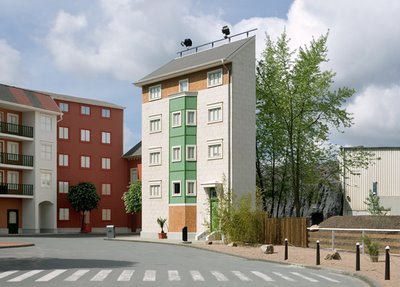
Rivkah Young
Work from the series Delos.
“‘Welcome to paradise’
Which world did you just came from? The slogan of the leisure world Delos in the science fiction film Westworld. Michael Crichton staged the vision of a futuristic leisure park in 1973. Who travels to Delos, enters a recreation paradise of swordplays and western heros. In place between deceiving real scenery of an ostensible past, every visitor can have the adventure of his life.
No other term inspires our dreams and expectations as much as paradise. In order to declare this, humans create special places, like in Stanislaw Lem’s novel Solaris, in movies like Westworld; at theme parks, shopping malls and urban residential- or sparetime complexes. The vision of something different – a tropical rain forretsts or african Savannah are designed at the zoo or at water parks. At leisure facilities real places can be copied exemplary or virtual ones can be build: the ‘Universe’ can be found next to the ‘Wild West’, the ‘Fairyland’ next to ‘Mexiko’. The look of an urban place becomes a scenery-like projection surface of our visions, too. An advertising sign on a facade is a promise and the attempt of a seduction, as well as a palm tree made of plastic at the Hafenstrasse in Hamburg. A public building which has the grace of an ufo promises to be unique and recalls all images of past science-fiction movies. Associations of a forward-looking society: join and foresight with us!
In her artistically discussion, Rivkah Young haunts these places, takes the viewers on a journey across a constructed and staged space. The image space appears like a deserted setting, abstract and without any dimension. Seperated from the concrete relation to their enviroment, the architecural constructedness even of an simple timber fence gets visible. An elementary relationship between the photograph and the scenery unveils on the images: the promise. Both refer to a real event and, nevertheless, show an imaginary world; the pay kiosk at the pleasure grounds corresponds to the image frame. Both call: enter and get enticed. Without noticing it, these are the own expectations which are reflected in the surface of the image, as well as in the mirrored facades of modern architecture.
To customise this newly-discovered paradisiacal space to her aesthetic imagination, the photographs are worked on digitally, sometimes even constructed. Just as with the paradise the validity of the occurrence is not to question. The recreated constructed image is not a documentation of true occurences, but a documentation of the characteristcs and enchantment of her personal paradise. Spare time and everyday life, vision and reality, future and past melt to a scenery of longings.” – Rivkah Young
Tags: conceptual, constructed, environment, fantasy, film, german, straight
Posted in conceptual, constructed, environment, fantasy, film, german, straight | No Comments »


