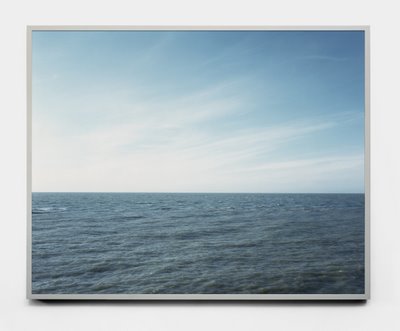
“There is more genetic complexity in a milliliter of water than the whole of the human genome. This is what Sonja Thomsen told me when we first met, about four years ago, and the sort of thing she thinks about a lot.That such an immense universe of organisms could be contained in something so elemental and small fascinated her and informed what was then new work: photographs of the surfaces of water.She has far from exhausted the potential of these rich, liquid landscapes, and has recently begun exploring the mysterious and seductive nature of petroleum as well.Her subtle abstractions of water and oil are resonant with ideas about scarcity and global politics, and the reflective quality of the work invites self-examination, including from the artist, whom we occasionally see as a silhouette, her hair falling around her face and camera.Water has become an apt metaphor for Thomsen’s creative voice. Like our constantly altering lake, her presence has a sort of clear invisibility to it. In other words, it is defined by the way it reflects the world around her.Which is why her most recent project, “Lacuna,” now on view at the Haggerty Museum of Art along with one of her major oil pieces, feels like such a departure.Thomsen is one of 10 artists in the Haggerty’s “Current Tendencies,” a survey of contemporary Wisconsin art. She earned bachelor’s degrees in art and biology from Kenyon College in Ohio, a master’s in fine art photography in 2004 from the San Francisco Art Institute and is an adjunct professor at the Milwaukee Institute of Art & Design.In “Lacuna,” her point of view remains beautifully tentative but personal. She has a large family, a tribe that gets together in big, chaotic, wonderful confabs. Many of them frequent “Lacuna,” which includes 70 or so images scattered across two walls in varying sizes and in distinct groups and sequences.”What I’m trying to pursue is how I can have these images communicate the idea of the intangible or communicate the suggested narrative rather than being specifically sentimental,” she’s said in a podcast at her blog.The word lacuna means an unfilled space or gap in knowledge, literature or bone.Often, it is more than empty space. It’s a holding place for something that once existed, like the fragment of a manuscript or a memory.Thomsen says she started hoarding the “Lacuna” imagery when her grandfather and father-in-law began experiencing dementia. Personal traumas have, she says, inspired shifts in her work.When her grandparents had to give up living in their home of 40 years, they stubbornly refused to leave until they had harvested the last of the raspberries growing in the yard.One of Thomsen’s images is of her grandfather’s hands and the last of the berries, gathered up in a square cake pan. The pan is centered against the lush green of the bushes, which fall quickly from focus and are denuded of their fruit. A garage sale price tag on the pan is a reminder of that moment of transition. She also included an image of the back of her grandfather’s head, with a beautiful, blurry whiteness beyond.There also are images of intimates and familiar landscapes. One is of a simple, homemade gate, another of the vulnerable gaze of a close friend. There’s the boy with his tub of worms, the lily pad-like ice formations in the lake and the series of hands presenting specimens from nature, like a feather or water creature.”The series with the hands, . . . I would go for walks with people and they would be like ‘Photograph this’ or ‘Look at this,’ ” she said, likening that act of discovering to her own photography. “Even if it was fairly ordinary, in that moment it was like magic.””Lacuna,” which is at least in part about the nature of forgetting, feels a lot like the act of remembering. Some images are high on the wall, some are isolated, others are quite small. We strain to see, to fit the pieces together, to make connections. Memory is a necessary tool for looking at the dispersed imagery.Some images hang on the wall in stacks, like small tablets. We are invited to peel an image away and take it with us. The images fade as the stacks diminish. When the pages are gone, what’s left is an outline etched onto a piece of glass, an opaque, fixed after-image.Thomsen has created beautiful objects in their own right, studies in light, form and line.The roundness of one young man’s shaved head and the pale pink of his lips contrasted with his muscular arm and craggy brush behind him.The continuous sloping line of hand, hair, cheekbone and arm in the very Sally Mann-like image of a young woman looking directly at us with a sense of knowing unease.The muddy field that recedes into an impenetrable white fog. The thick, perfectly horizontal branch, caught in the saplings. The way it holds the snow like a suspended white line.But they are more than aesthetic excursions.Thomsen doesn’t like to articulate what her work is “about,” though she admits she envies some of her students who stake a claim to meaning quickly and boldly.More than memoir and more than renderings of things, Thomsen’s images are acts of devotion. They are evidence of a humane artist developing a new visual vocabulary. Charged with quiet metaphor, they betray a set of treasured beliefs about youth and sensuality, about nature and wonder, about aging and loss.The mingling and sequencing of conceptual, pictorial, narrative and physical lacunae create a form of open storytelling, as much like literature as anything else.” – Milwaulkee Journal Sentinel, Apr. 23, 2009. – Mary Louise Schumacher
Paul Kooiker
Wednesday, 6 May 2009
Works from Hunting and Fishing.
Bonus post! I found some more blurry / out of focus works today. My theory of all out-of-focus photography coming from German born or trained photographers is shot, Kooiker is Dutch all the way. I am fully aware that these images are spreads, but I decided to leave the page number on the verso because they add a balance that I can only assume was very intentional when designing the book.
“Kooiker’s photos are rich with allusions. Out of focus, filled with warm dappled light, they recall the lush canvases of impressionism or the optical experiments of Vermeer. His subjects, young women running nude across grass-covered dunes and through lightly wooded forests and meadows, remind us of the complicated history of the female nude in art: Bernini’s Daphne, chased by Apollo, who escapes her pursuer by turning into a laurel tree; Venetian painting, with its preponderance of warm, fleshy Venuses, nymphs, and Madonnas; and a century-and-a-half of French painting devoted to bathers, odalisques, and prostitutes: Boucher to Ingres, Delacroix to Courbet, Manet to Gauguin and Matisse.
The soft focus and tone of his photographs reminds us of Balthus’ titillating canvases, 1950’s blue movies, airbrushed soft-pornography, or 1970’s advertisements for shampoo, or condoms, with their wholesome, back-to-nature sensibility, cribbed from radical i96os hippie naturalism and watered down for mainstream consumers.
And then there is the title, “Hunting and Fishing,” which reminds us of the links between photography and hunting: the linguistic and practical associations between terms like “shooting” and the hurried “snapshot.”
Kooiker´s photos are imbued with mytho-historical quotations, however they resist easy readings. Are his subjects being hunted, or are they the hunters, enticing viewers into the landscape? Do they run from us, like Daphne, or lure us, like the sirens? He traffics in Images that are tremendously powerful: archetypes or, perhaps, cliches, borrowed from art and history and the media and remade a new. Looking at them, we don´t know whether to laugh or protest. Are we observing the goddess of the hunt (Diana), or the hunted (Daphne)? Should we decry the use of female bodies in art, or applaud these women, who scamper through the countryside like nudists out for a weekend jog?
Kooiker Stands back from his photos, offering nothing-except the example (and weight) of history. Photographs, he seems to say, stand on their own; as Roland Barthes once described them, messages “without a code.” But his photographs acknowledge and reflect what came before them. And so Kooiker becomes a curator, culling from art and advertising, mythology, photography and film to create Images of women that are both startling in their novelty and anciently familiar.” – Martha Schwendener, courtesy of the artist.
Slinkachu
Wednesday, 6 May 2009
Slinkachu
Work from Little People.
I stumbled across Slinkachu’s book the other day at the bookstore and decided to look up the project and share it. I couldn’t find much in the way of a thorough statement, but the work sort of speaks for itself.
“Slinkachu has taken street art to a new scale, painstakingly hand-painting tiny characters that live in a world that’s too small for us to always notice beneath our feet. His street installations are constructed in all sorts of public spaces, the portrayal of little lives that mirror our own. Working in miniature opens up the city landscapes in unexpected ways and this is explored in Ground Zero where he literally brings you down to a new level. Ground Zero is both street art installations and photography. The two go hand in hand with the subsequent photograph uncovering his hidden world. The show depicts the little fears and anxieties of city life and the general feeling of being alone or insignificant in a large city. While the scenes reflect the loneliness and melancholy of urban life there is always an underlying sense of humour and feeling of empathy” – Cosh Gallery (I think)
Yuki Onodera
Tuesday, 5 May 2009
Work from Eleventh Finger
I saw some of Onodera’s work (albeit not this work) at Photo Paris this year, and I reencountered her work at Van Zoetendaal and decided to share.
“Paris-based Japanese artist Yuki Onodera makes intellectual hybrid art that plays in and around photography.
For this series of surreptitious snapshots of strangers in the streets of modern metropolises, she created elaborate cut-out lace-like patterns of enigmatic shapes and symbols, which she then superimposed on the photographic paper before she exposed the enlarged prints.
These flat photograms both shield and reveal the faces of the anonymous subjects, much like a mask, or a fan, or a lampshade. The quirky results could also be interpreted as cartoon-like thought bubbles that represent the visual thought patterns of the strangers in the photographs.
When asked about the title of this series, Eleventh Finger, she said, “Well that refers to the unknown collaboration of the subject (with ten fingers), and me as photographer with one finger pressing the shutter release.” — Jim Casper on Lens Culture
Carolin Reichert
Tuesday, 5 May 2009
Work from the series Light, Untitled, and Fakes.
“In my work I deal with an inventory of memory. The human memory as triggered by situations, encounters and objects referring to and rooted in the past, yet recurring and manifesting themselves anew in the present. I am interested in exploring the individual’s perception of reality and the role and capacities of memory and recollection within that process. This process affects and moulds both past and present. Thus, by drawing upon an inherited ‘visual library’, both personal and public (personal recollections, media-related and culturally-induced images), study the difference between ‘Space Perceived’ and ‘Space Represented’.
The depicted images portray brief moments, belonging to the past, frozen, re-framed and deliberately transported to their new context, with which they are at odds or incompatible. The evolving picture results in a multi-layered image built-up and consisting of apparent layers, rough interferences, functioning as vehicles for the replaceable projection of the viewer’s recollections, temporary photographic frames, originated by given situations and marked by the individual’s perceptive recollections.
At the core of my work is the study and exploration of ‘memory’, its capabilities and its very nature.My work therefore ultimately deals with the attempt, possibility and implications of visualizing ‘absent presence’.”
Cory Arcangel
Monday, 4 May 2009
Works from Super Mario Clouds, Super Mario Movie, F1 Racer Mod, and Colors (which he gives a step by step on how to make your very own). Even his splash page is art.
HUGE BONUS: You can the download the ROM of Arcangel’s video game modification of the classic Space Invaders, Space Invader here.
If you want to “play” any of these games, he has many of the ROMs on his site.
This much more work than I usually post, but Arcangel’s work is just too much fun to pass up. Arcangel combines kitsch, nostalgia, humor, and technology in a way that I haven’t seen in a long long while. Also check out On C, an article examining jpg compression that ran in Frieze Magazine. The website is fantastic, and make sure you browse all the newer works in the Things I Made section.
____________________________
Super Mario Clouds is an old Mario Brothers cartridge which I modified to erase everything but the clouds. It was originally posted on the internet in 2003. This project was very much in the line of the stuff various BEIGE representatives (Paul, Joe, + Joe) were doing then. Check below for the ROM, source code, installation pictures (sometimes I have installed in art type ish spaces) and even a video (posting a video of it wasn’t possible even 5 years ago, so I’m happy to be able to do this now).
____________________________
This is a simple mod I did of the old Japanese famicom driving game F1 Racer. Basically I just took out the game, cars, etc, and left the road. Check below for the ROM and source code….. ps – sometimes I also refer to this project as “Japanese Driving Game”…which isn’t such a good title, but……..
____________________________
A couple years ago I made a video called “Colors”. This video came out of my interest in wanting to make something using slit scan. This is a very common and quite easy technique where basically something is photographed through a slit. For more information see Golan Levin’s page about slit scan here. After spending some time trying to teach myself how quicktime works and how video is displayed on a modern computer, I finally ended up with Colors. Anyway, basically Colors PE (the personal edition version which is available below as both a binary and source) is a small application that will play any quicktime movie using a slit scan technique one line at a time starting from the top. Personally, for my version, I used it to play the movie Colors by Dennis Hopper (to play every color in the movie takes 33 days). So below is the program in case anyone is bored, has some time on their hands, and wants to try it at home. Disclaimer: This version requires some legwork to get working, FYI. Also is a video excerpt of what it looks like.
____________________________
Another amazing find via The Exposure Project. Thanks to UBUWEB for the embed links.
Gert Jan Kocken
Sunday, 3 May 2009
Zeebrugge (Belgium) March 6 1987: The Herald of Free Enterprise capsizes just outside the harbour of Zeebrugge killing 192 people.
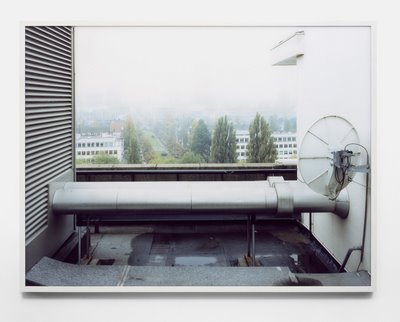
On June 11 2001 Herman Brood commits suicide by jumping of the roof of the Amsterdam Hilton Hotel.
Voetboogstraat, On August 16th 1996 Joes Kloppenburg gets beaten up by four drunk guys. Soon after he dies because of his injuries. In 1997 a monument simply stating ‘HELP’ is placed at the site.
________________________________________________________________
Works from the series Defacing, Disaster Areas, and Amsterdam.
Fantastic work by Dutch photographer/installation artist. Please also check out The Past is in the Present.
________________________________________
THE ART OF ICONOCLASM – Sven Lütticken
…
During the past few years, as part of a wider project on historical turning points, Gert Jan Kocken has photographed the remains of Reformation iconoclasm in Holland, England, Germany and Switzerland. A picture taken in Utrecht cathedral shows a coloured and gilded gothic stone relief of an enthroned Saint Anne in the midst of a company including Mary and Christ, with God the father appearing above the throne. The chipped-off faces create an uneven yet quasi-regular pattern of raw stone parallel to the picture plane. Strangely, the face of God the Father, whose representation is theologically most dubious of all, is the only one that hasn’t been completely removed; his eyes remain. While this may be due to practical factors, to his literally high position in the church, such factors play no role in another image photographed by Kocken: a painting on wood of the Mass of Saint Gregory. That the face of Christ on this panel is unscathed, still looking straight at the viewer out of he painting’s space, clearly reflects the iconoclasts’ reluctance to harm the Saviour’s icon – even if they disapproved of it. The Mass of Saint Gregory is a common type of image in the late Middle Ages, which was particularly prone to attack by anti-“popish” iconoclasts: it shows the miraculous apparition of Christ during a mass said by Pope Gregory.
Christ is displaying his wounds and the instruments of the passion. Among these is the Veil of Veronica, on which Christ’s face appeared after he used it to wipe his face during the walk to Golgotha. Not only is the Christ that appears before Gregory untouched, the same goes for the face of Christ on the veil. The faces of most of the onlookers, by contrast, have been severely attacked; they represented various local religious and secular grandees.7 This should serve as a reminder that the Reformation did not arise out of some “pure” theological debate about images, but from the rejection of the church’s hierarchy and its use of rituals, objects, and visual propaganda. Kocken’s photos demonstrate the numerous choices iconoclasts needed to make, either in the rush of the moment or after some deliberation – for Reformation iconoclasm occurred both in spontaneous outburst and in more controlled actions led by local magistrates. In England in particular, the removal of images was a top-down affair, ordered at first by Henry VIII’s first minister, Thomas Cromwell.8 A prime target were images of an English saint, Thomas Beckett, the archbishop of Canterbury who was murdered on behest of one of Henry’s predecessors; Kocken’s series includes a disfigured Beckett, whose upper body is turned into an informe blot, from the church St Andrew in North Burlingham.
Such a photo is rather suggestive of Wols or Fautrier, and in fact Kocken’s iconoclasm photos frequently recall modern and contemporary art. Perhaps the best example of this is the stunning picture that shows part of a wall and a pillar in the Grote Kerk (or St. Michaëlskerk) in the Dutch town of Zwolle. Part of the wall is occupied by a white stone relief that has been chipped off considerably by the iconoclasts; probably an epitaph representing a deceased donor surrounded by his patron saints, with the Virgin Mary appearing above, one now sees little more than a vague figure suspended in mid-air, in front of gothic church architecture. Little more, that is, except for the irregular surface of the “modified” parts of the relief, which enter in a complex dialogue with what remains of the representation; the illusionist space of the relief interrupts the shallow space of the chipped parts, and vice versa. Furthermore, this relief is set in a whitewashed wall next to a column, creating a montage of surfaces that is held together (just barely) by some painted red lines. Associations with abstract paintings and collages of the 1910s and 1920s are unavoidable. Such associations were made even more explicit in 2006 collaboration of Kocken and Krijn de Koning, an installation which combined three of Kocken’s iconoclasm photographs with a mural that framed those pictures with a meandering meandering blue-and-white geometric pattern by De Koning – a bulky, modern ornament spreading out over the walls and ceiling.
How are we to interpret such a juxtaposition? A substantial contribution to the theoretization of possible connections between the Reformation and modern was made by Werner Hofmann with his 1983 exhibition Luther und die Folgen für die Kunst (Hamburger Kunsthalle) which argued that one of the consequences of the Reformation for art was that it was released from the grip of the church; it was the Reformation that enabled modern art, and the modern, secular and critical approach to images in general. Far from equating the Reformation with physical iconoclasm, and condemning it on those grounds, Hofmann places great emphasis on Luther’s insistence that art itself is neither good nor bad, and that art could also be shown in churches (including depictions of Christ, but not of God the father). Images are now dependent on context and use, and Hofmann states that it is with this redefinition that modernity begins.9 In a sense, this was a more radical iconoclasm than that of Calvin or Zwingli, who insisted on art being banished from churches, and who condemned representations of Christ. Although Luther’s rejection of iconoclastic fury was tied up with a conservative social attitude – he rejected iconoclastic destruction at least in part because such actions could lead to full-scale revolt against the existing order – it is true that his non-physical iconoclasm, his ruling that images are neither evil nor necessary, destroyed the images’ traditional place in the cosmic and social hierarchy more effectively than outright bans.
In his slalom-like historical argument, Hofmann also argues that Calvin’s rejection of art from the church and his strict insistence on only representing the visible world fed into modern art through Dutch painting, which emphasized realism from the Reformation to Van Gogh and beyond; in Saenredam’s paintings particular the church itself became an apparently purely physical space, defined by geometry, resulting in compositions whose subtlety still could be read as glorifying God’s creation. However, the danger of freely drawing such long-distance historical connections is that they are used to construct simplistic genealogies of modern art in the manner of a Rudi Fuchs, in whose writings it is a mere step from Vermeer to Mondrian and from Rembrandt to Karel Appel, all in the name of a seamless tradition of Dutch art. Rather than contributing to such oneiric ideological constructions, Kocken uses the art context to reflect on the returns and transformations of iconoclasm. In this respect, Kocken’s work is closer to the recent study of German Reformation art by Joseph Leo Koerner (a participant in Latour’s Iconoclash), which also focuses on the Reformation’s Nachleben in German Romanticism and in Modernism.10
Apart from pictures of the traces of Reformation iconoclasm, Kocken’s exhibition at Stedelijk Museum Bureau Amsterdam also includes a photo of an enlarged microfilm of the September 11, 2001 New York Times front page – which only shows news that would become rather irrelevant that very same day, when Islamist iconoclasm brought down the Twin Towers. Kocken’s work does not draw an uncomplicated line from Calvin to modern art but investigates its recurrence in various contexts, religious and secular, and symbolic as well as physical: Mondrian meets Bin Laden.
Reading art
Someone who wishes to learn more about the specific circumstances of the German or the Swiss Reformation needs to consult specialist literature. In Kocken’s series, images from Henry’s England and from Calvin’s Basle exist side by side, abstracting from specific social circumstances, and only hinting at the theological-political debates about images, and the question which types of images were to be banned. While some of Kocken’s pictures could also function as illustrations in (art) historical publications, they are presented in a different context, in which they do not illustrate any texts.11 Furthermore, as high-resolution photos made with a large-format camera, they have a different scale than illustrations; Kocken usually prints them at the same size as the objects they depict. Rather than reducing these objects to disembodied representations, the photos zoom in on their physical qualities. Kocken’s camera is usually stationed not centrally, right in front of the motif, but slightly to one side; this brings out the shadows and results in an emphasis on texture and relief, while the use of perspective correction makes sure that the motif still appears parallel to the picture plane.
The enhanced materiality of the image helps to undermine the hierarchy between the “original” image and its modification. In all putting iconographic elements and iconoclastic scratches and blots on equal footing, Kocken encourages the viewer to look at the image as a sum of additions and erasures, of construction and destruction, representation and abstraction, symbol and blind indexicality. In modern art theory and criticism, the “readability” of art has often been disparaged: ever since Romanticism, it has been a central tenet of the modern ideology of the aesthetic that a work of art should not be reducible to a clear-cut representation of a narrative, or to a discursive statement. Even in Conceptual art, the use of language is usually anything but conventional and transparent. In this context it is intriguing that Kocken’s work also includes instances of “textual iconoclasm”: one photo depicts an opened copy of an English missal (a book containing all the prayers for the liturgical year) with some stained passages, while another shows a crossed-out passage in which Erasmus discussed Luther (the alteration in this case presumably having been made by Catholics rather than by Protestants).
In tracing the reversal of writing into surface or pattern, Kocken can be said to further distance his work from art-historical illustration. Although it is a product of the modern ideology of the aesthetic, the discipline of art history has secured its academic status by subjecting the visual to language and reducing its complexity.12 Panofskyan iconology is a prime example of this tendency. But resisting this iconological reduction and trying to salvage the complexity of the image – as Georges Didi-Huberman does in contemporary art history and theory – is not without its dangers either.13 Opting for the tools of Marxist iconoclasm, one could state that “complexity” and “resistance to readability” are perfectly compatible with the reduction of the work of art to a highbrow commodity fetish with plenty “theological whims.” Attempts by the great artistic iconoclasts to counteract commodification have in the end only strengthened it, just as the introduction of photography as a cheap and “deskilled” medium in conceptual art has led to the triumph of big and technically perfect art photographs – like Kocken’s.
All this may be all too true, but it is what Marx’s idealist teacher would call an abstract negation: a purist iconoclasm that does not bother to salvage what is worth keeping in what it seeks to negate. But perhaps what Kocken’s work shows us most of all is that negation can never be really abstract, that no break can be absolute: Latour’s grandiloquent claim to “go beyond the image wars” could not be more irrelevant. There is no way out of the looped now-time of iconoclasm, but there is difference in its repetitions, if one chooses to see them and create them. Seeing them is creating them.” – Sven Lütticken excerpt from larger text (original text).
Koen Hauser
Saturday, 2 May 2009
Work from the series De Luister van het Land, A la Recherche de l’Aventure Perdu and Opus Magnum Atomium. All of Hauser’s works have a distinct pseudo-scientific, pseudo-realistic aesthetic that reminds me of old phrenology portraits from the early years of photography.
____________________
Galerie 37 Spaarnestad invited me to make new work with material from the Spaarnestad Photo archive, one of the largest pressarchives in Europe. De Luister van het Land is a caleidoscopic collection of over 400 photographs. By means of a selection based on personal interests, fascination, and my obsession with the notion of ‘the diorama’, it interweaves impressions of a (re-created) fantasyworld with pictures on the process of creation, using my personal appearance. These images of the creation process – I call them performéances -, are the residu of performances held to invoke the spirit of creation. Together with the narratives of old photographs they form an installation on imagination and ephemerality.
____________________
In 2006 I started taking photographs in musea, amusementparks and other man-made tourist attractions. Looking at these places from a different angle, a parallel world emerged, consisting of movie-still like imagery that together form the basis of the artistbook A la Recherche de l’Aventure Perdu, that will appear at the beginning of 2009.
____________________
‘As a child I used to think that atoms were actually planets in space, like the earth on which we live. A divine universe in which the tiniest particles are perfect replicas of the whole universe.’
For me, the photo’s in this Opus Magnum Atomium series form personal dioramas on a metaphysical world. A world that lies at the heart of my fascination with themes such as isolation, birth and death, childhood, animals, science and physical alienation.
Semâ Bekirovic
Friday, 1 May 2009
Work from Water in water, Picture of a fire burning, Maps, and Untitled (metal ball). Bekirovic’s work drew my attention through its lighthearted, witty, linguistic, and reflexive critique of the medium. Works like Water in water, and Picture of a fire burning address the representative nature of photography in an intelligent and humorous way. This medium specific critique is not limited to her photographic works. Untitled (metal ball) is a sculpture that gradually destroys itself through a robotic arm that deals a blow to the inside of the work at predetermined intervals.
“Semâ Bekirovic creates photographs, videos and installations which capture the friction created by the chances of nature and design of culture. In some works she plays with the tension between gaining and letting go of control; creating situations in which things can occur or happen spontaneously, and letting chance decide how the work will develop. In other works she presents nature as something beyond control – that which we try so hard to control by means of culture. Sema’s photos, videos and installations evolved from her fascination with photography. She is interested in the basic qualities of images, but also in the effect they can have – giving new significance to things without actually altering the things themselves. She considers photography an organic medium that can be shaped in many directions as long as the images don’t show what is, but what might be.”
found via Capricious
Matthew Gamber
Thursday, 30 April 2009
Work from This is (still) the Golden Age
“As one of the first photographic methods, the photogram was empirically valued for its ability to trace an object by direct contact. To view a photogram is to witness the recent absence of an object that had touched the paper. The need to experience that moment of contact outweighed the shortcoming of its description.
Television programs are broadcast and lost. The signals can be transduced into another form. They are replayed from a recording, though the presence of the initial broadcast is lost when replayed. Pressing the photographic paper against the tube, heat and light emanating from the television are relayed. Producing its own light, the television image is self-inscribed, fulfilling the desire to span distances, making illusions more present.”


