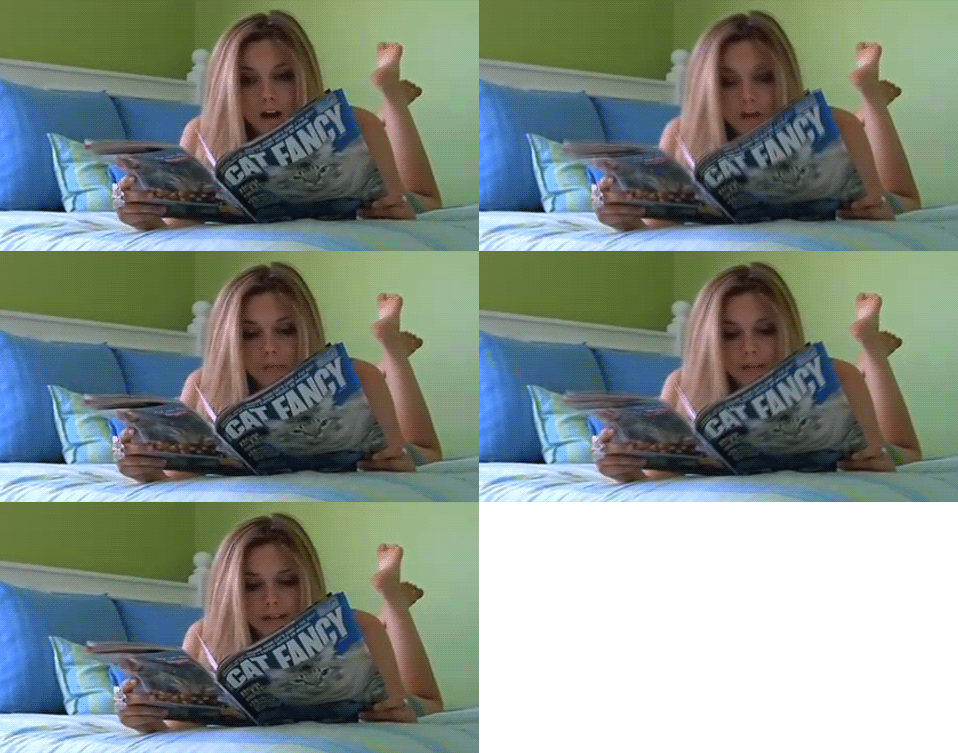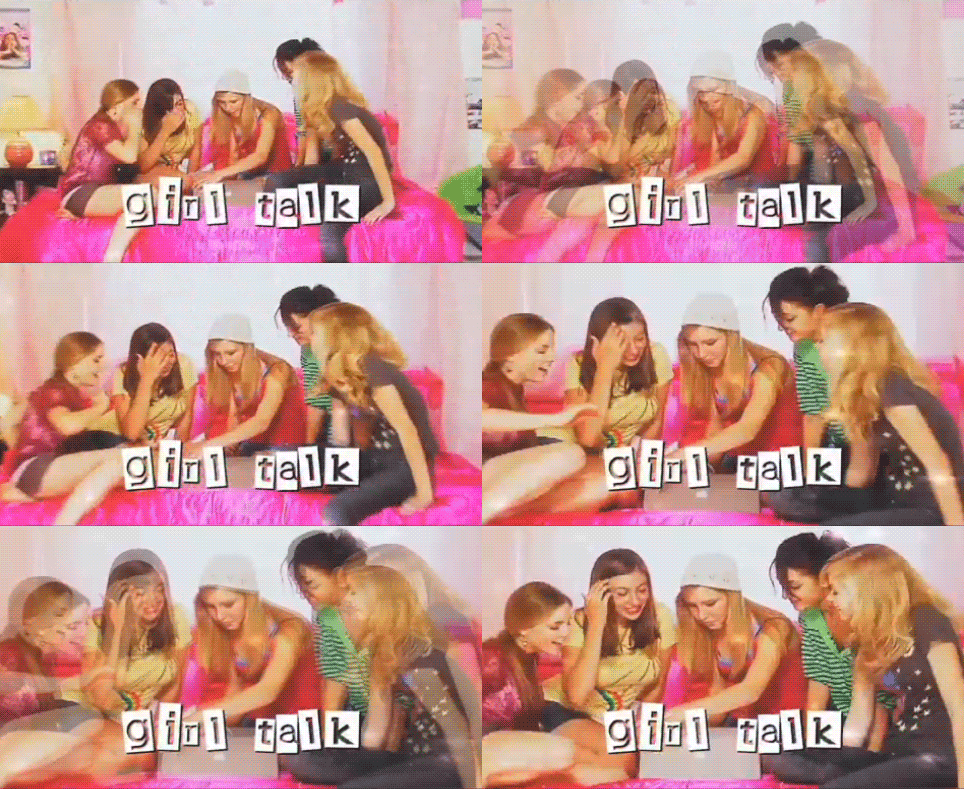
“Stephanie Davidson’s works are, for lack of a better word, super bratty. Like she totally knows it, too. It’s loaded with post-modern irony lost in the throes of youthful know-it-allness. (My Swedish friend calls them: Besser-Vissers. Better knowers? I always liked this invented word.) It’s kinda like wearing a scrunchie and reading the Babysitter’s Club while blasting Boyz II Men just for the kicks of a patronizingly late 90’s obtuse reference, regardless of how little I actually like it. Or, like staring into a gradient-laden orb slowly rotating a white wizzard in the middle of space.” – Beautiful/Decay
Hans-Christian Schink
Wednesday, 9 December 2009
Work from 1h.
““1 h” was a long term project which German photographer Hans-Christian Schink undertook in 2003. The result of the project – a photography series – consists of two parts each made up of 12 photographs taken in different places in the northern and southern hemispheres. The images depict the “movement” of the sun in the sky during one hour. The artist’s aim was to create images depicting time as an abstract phenomenon.
The inspiration for the project came from American photographer Minor White’s image “The Black Sun” (1955) in which due to a frozen shutter that caused extreme overexposure White had accidently captured the sun as a black hole in the sky. Schink wondered whether this effect known as “true solarisation” might also work with a much longer exposure, i.e., an exposure of one hour. Another notable fact is that the angle of the line of the sun’s “course” varies depending on the latitude where the photograph is taken – in the far north during the summer months when the midnight sun can be observed the line is horizontal, but on the Tropic of Cancer in the summer solstice it is almost vertical.” – RIXC Gallery
Wakaba Noda
Tuesday, 8 December 2009
Work from Blink and Making a Map.
“The above work is taken from Noda’s “Blink”, a series of diptychs. This series was given an honorable mention by famed critic Kotaro Iizawa at the 2006 Canon “New Cosmos of Photography” competition. About this work, Noda says that she “tried to make the physical body reaction (blink) into a photographic image. To blink is something that we can not really control. (Of course we can blink intentionally.) I wondered and visualized what I am missing in the little moment when I blink. So that is why I used two pictures to show a little difference and moment between there.” – Japan Exposures
______________________
“Trying to create a perfect place by assembling photographs of small wonders, Noda makes a map of a world not defined by geography, but by the possibilities that photography offers. Making A Map is Wakaba Noda’s first book.” – Farewell Books
Jillian McDonald
Monday, 7 December 2009
Work from Horror Make-Up.
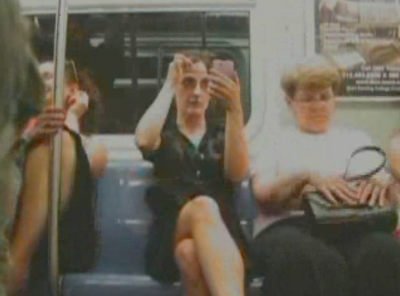
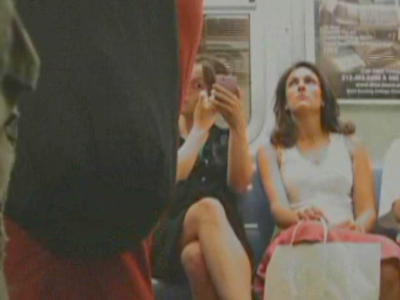
“IT was a sweltering Saturday afternoon on an L train hurtling across Manhattan toward Brooklyn. The last car held the usual assortment of characters: two women shrieking about a recent outing to a hardware store while a man lounged before them, guffawing; a young woman hiding behind sunglasses and iPod earbuds; a scruffy man slumped beside his messenger bag. Nobody paid much attention as a slender, elegant young woman began to enact a ritual familiar to subway riders: peering intently into a tiny mirror, she carefully started to make up her face.
Swiftly, though, it became clear that this was makeup with a difference. She was slathering her face with thick white paste, applying dark circles around her eyes and enhancing her frown lines and nostrils with blackmarks. Although she attracted a few glances, most of the other passengers maintained studiously blank expressions. Only when she slipped in a pair of green teeth and began daubing her face with fake blood did people start to stare, exchange meaningful glances and roll their eyes.
When the train reached Morgan Avenue in Bushwick, the woman stood, grimaced delicately and staggered to the doorway. As the man with the messenger bag hurried out behind her, one of the noisy women hissed, “I think it’s performance art.”
And it was, the latest chapter in the oeuvre of Jillian Mcdonald, a Canadian-born artist who in the last three years has developed something of an underground reputation for work inspired by movie mania. Her climb to cultdom began in 2003 with a series of videos and performances derived from her purported passion for Billy Bob Thornton that have been shown widely at small galleries and nonprofits around the world; her spoof fan site, meandbillybob.com, is linked to by countless blogs.
More recently Ms. Mcdonald has delved into the so-called “zombie renaissance” that some say has been sweeping the nation since around the 2004 remake of George A. Romero’s film “Dawn of the Dead” (1978), the second in his classic zombie series. Her subway performance was filmed with a hidden camera by her boyfriend and sometime collaborator, Beckley Roberts, the scruffy fellow with the messenger bag. Called “Horror Make-Up,” it will make its debut on Sept. 8 at Art Moving Projects, a gallery in Williamsburg, Brooklyn.
Curiously, until four years ago Ms. Mcdonald, now 35, had little interest in either celebrities or zombies. After receiving a master’s of fine arts in nontraditional media in 1999 from Hunter College, she was known mostly for interactive performances that relied on chance encounters with strangers, like placing ads in Canadian newspapers offering her services as a shampoo girl, and then performing in a hair salon or gallery, or passing out chocolate to people in the Union Square subway station in Manhattan.
She found direction when “I was trying to figure out how to make work about celebrity crushes,” she said in an interview. “They fascinate me, and I’d never had one myself.” The answer hit her on the red eye from New York to San Francisco. The film on the flight was “Bandits” (2001), starring Mr. Thornton and Cate Blanchett. Ms. Mcdonald awoke in the dark to see the actors’ lips moving toward each other in slow motion. “I knew immediately and irreversibly that I should be kissing him instead of her,” she wrote later on her Billy Bob Web site. “I was in love.”
The result was “Me and Billy Bob” (2003), a video in which Ms. Mcdonald creates the tale of a doomed love affair by digitally inserting herself into clips from his films. Using scenes from “One False Move,” “The Man Who Wasn’t There,” “Monster’s Ball” and others, she charts the relationship from sappy first encounter to tearful farewell. In the final scene she re-enacts her deus ex machina “Bandits” moment: holding Mr. Thornton’s face in her hands, she slowly moves in for a final, despairing kiss.
In 2004 Ms. Mcdonald videotaped a monthlong performance piece, “Billy Bob Tattoo,” during which she inked her leg each day with his name. Then came “Screen Kiss” (2005), now on view at the Sixtyseven Gallery in Chelsea. In it she splices herself into make-out scenes with other actors, including Ben Stiller, Ewan McGregor, Vincent Gallo and Johnny Depp, culled from movies like “Down With Love,” “Along Came Polly,” and “Before Night Falls.” “Dear Billy Bob,” explains the introduction, “I still love you the best but I can’t wait forever and there are a lot of other fish in the sea.”
After most of the kisses, Ms. Mcdonald turns and stares triumphantly at the camera. But the high point comes in a scene (taken from the campy movie “Original Sin” ) in which she locks lips with Mr. Thornton’s ex, Angelina Jolie. As she nears Ms. Jolie, Ms. Mcdonald’s lips and eyes quavering ridiculously with expectation, it becomes clear that the actress’s features are doing exactly the same thing.
What intrigues viewers of both videos is how Ms. Mcdonald manages to transform herself so completely into a variety of personas, and how cleverly she modulates her expressions and gazes to match — and thereby send up — those of her digital partners. Technologically, the works look surprisingly sophisticated; yet Ms. Mcdonald made them at home on a Macintosh, using editing and special-effects software that she mastered through Internet research.
Before filming her scenes, she spent hours analyzing her chosen excerpts and memorizing the actors’ movements. Then she set up a camcorder on a tripod and, counting beats, performed before it, using green poster board from a craft store instead of the green screen normally used for special-effects sequences.
She intended to introduce “Me and Billy Bob” on the Web from the start; the site went up before its gallery debut. “Conceptually my plan was to get attention from Billy Bob,” she said. She swiftly drew an enthusiastic response from his fans. “A lot of people think it’s real,” she marveled. “They think I’m in touch with him.” Although at first she feared the actor’s lawyers would complain, Mr. Thornton’s official Web site now links to her fan site, but he has never made contact with her himself.
Along the way, Ms. Mcdonald admits, she did become infatuated with Mr. Thornton. “My friends would tease me about it,” she said. Now, she maintains, the one-sided romance is over, although her boyfriend, Mr. Roberts, bears a striking resemblance to her former crush. (“Everybody tells me that, but I don’t share that with him,” she said.)
Her interest in zombies began in a similar fashion: she was driven to analyze an obsession she didn’t understand. “I find it amazing and fascinating that people are so spellbound,” she said. She has always been terrified by horror movies; initially she conducted research by playing DVD’s while she cowered with the lights on at the other end of the room. But now she’s hooked on the genre, just as she became hooked on Mr. Thornton. And, as in the kissing films, “it came out of my interest in exposing the artifice that lends itself to humor,” she said. “If you can get to the point where it seems ridiculous, then it’s not scary anymore.”
“Zombie Loop,” the first piece in her “Horror Cycle,” is a two-video projection installation that Mr. Roberts filmed this summer on a deserted Wisconsin country road. In it Ms. Mcdonald plays two roles: a white-garbed ingénue who flees, squealing, and the reanimated rotting corpse who staggers forward relentlessly in pursuit. At the end of each loop the figures switch places.
In “Zombie Portraits” she and nine friends morph into zombies in stages, in a lumpish fashion that suggests B-movie stop-motion animation. (Excerpts from the zombie projects can be seen at jillianmcdonald.net.) As with the digital editing, she researched her special-effects makeup techniques on the Internet. “I’m a big fan of learning things on the Web,” she said.
Yet runaway Web popularity does not necessarily translate into art-world success. Although she continues to receive Billy Bob fan mail, she said, no major art dealers have called. Even so, before long she may begin gathering her own share of zombie acolytes. And in the meantime, “this is my excuse to watch a lot of cheesy movies,” she said. “It’s research.” – Carol Kino for the New York Times
Semiconductor (Ruth Jarman and Joe Gerhardt)
Sunday, 6 December 2009
Semiconductor (Ruth Jarman and Joe Gerhardt)
Work from Black Rain.
“Black Rain is sourced from images collected by the twin satellite, solar mission, STEREO. Here we see the HI (Heliospheric Imager) visual data as it tracks interplanetary space for solar wind and CME’s (coronal mass ejections) heading towards Earth.
Working with STEREO scientists, Semiconductor collected all the HI image data to date, revealing the journey of the satellites from their initial orientation, to their current tracing of the Earth’s orbit around the Sun. Solar wind, CME’s, passing planets and comets orbiting the sun can be seen as background stars and the milky way pass by.
As in Semiconductors previous work ‘Brilliant Noise’ which looked into the sun, they work with raw scientific satellite data which has not yet been cleaned and processed for public consumption. By embracing the artifacts, calibration and phenomena of the capturing process we are reminded of the presence of the human observer who endeavors to extend our perceptions and knowledge through technological innovation.” – Semiconductor Films
Jean Klimak
Saturday, 5 December 2009
Work from Chew by Numbers.
“I make artworks that have contradictions in them, artworks that lie somewhere between the sublime and ambivalence. Through these processes, I focus on materials that are dissimilar in nature or exhibited in curious ways. By working in this manner, tensions are created between the materials I choose or through the manipulation of their original contexts. For instance, tensions between attraction and repulsion insight disorder or chaos, at which point I impose my sense of order. In other words, I try to take the mundane and simply reorganize its significance.
By involving this process, I create a playing field where the materials I choose, the process I work in and sometimes the time frame I work within are determined before I begin. Most often the work unfolds as I create each piece. My work has a purpose that guides the activity with variables that are controlled and some that are purposely not controlled. A purposeful purposelessness as John Cage puts it. By using a sense of order to control some variables, I bring attention to or focus on the variables that I do not control.
My work has been informed by aspects of the everyday through the materials I choose and through simple activities that feed my interest in the passing of time. I am interested in moments in time and how numerous moments make up our daily lives. In particular, it is the small activities and experiences – banal moments – that I find interesting. Moments that may be considered nothing, but at the same time contain everything that is present: sights, sounds, smells, texture, life in general. I am interested in the banal moments in life that are easily dismissed or overlooked. Their relevance is still valid, if not in our thinking, at least in relation to the continuance of time.
…
In my work, chew-by-numbers, I explore the relationship that exists between gum, time, and pastimes. My project substitutes gum for paint in paint-by-number sets in order to show the relationship between the passing of time and the activity that fills it. The separate color sections represent blocks of my time that has been invested in each piece. I illustrate this time measurement with Letraset.
This project originates from 12 landscape paint-by-number kits. The colors of gum I chose corresponded as closely as possible to the provided colors of paint. The resulting colors on the surface of the kit, whether in pure form or by mixing the gum, is determined by the provided instructions. The total time of my activity is recorded on the picture surface with Letraset.” – Jean Klimac
Simon Berg
Friday, 4 December 2009
Work from APAN ÄR RÄDD.
You can buy the book here.
“An intense portrayal of a seemingly meaningless everyday life. But these intimate close-ups show us something other than just eternally recurring routines. For out of the cracks from the civilized facade seeps another story forward, the story of a life where every desire is dictated by nature, a nature which tries everything to escape their own terms.” –
Lisa Tan
Thursday, 3 December 2009
Work from Based on a True Story and Happenstance.
“Included in this exhibition is the piece titled, Letters from Dr. Bamberger, 2001-ongoing. I have aestheticized my relationship with my general physician, Dr. Mark Bamberger. It is his practice to send letters to his patients after they have had an annual physical. The quasi-performative act of going to see Dr. Bamberger began in 2001 and will continue until either event occurs: my death, or the close of his practice. The piece is further complicated by my decision to not only depict myself through these letters, but also my romantic partner in any given year.” – Lisa Tan
[…] and thematically from the introspective testimonial to the historical account, all works in the exhibition explore the narrative procedures at play in relaying first-hand knowledge and experience. Here, identity is not perceived as a construct of outside forces or predetermined paths, but rather, it manifests only momentarily, through the personal experiences that form the basis of each work. But, personal experience as the privileged locus of identity formation—if it is to be understood as a temporary situation where agency is present only for an instance—must also be measured against the artists’ desire to render meaningful that which is available only as a fleeting impression. The embellishments of one’s feelings and memories, the willful, even forceful attempts at signification make it impossible to render transparent any supposed primacy of experience as a conduit to the true, authentic, or uninhibited self. […]” – Christian Rattemeyer, from the catalog for Based on a True Story, Artists Space, New York.
________________________________
““…The exhibition investigates subtle, absurd and fantastical spatial and temporal experiments, based on chance and construction, primarily in the mediums of photography, video and sculpture, in an effort to question translation, invention and perception. Many of the artists in the show engage in a process that Mark Godfrey has noted in an Artforum article entitled “Image Structures: Photography and Sculpture” (February 2005): ‘photography and sculpture have entered a more complex phase of their relationship, folding over each other, reversing positions, flipping back and forth, the one becoming the other.’” – Lauri Firstenberg, from the press release for Happenstance
Nicholas Gottlund
Wednesday, 2 December 2009
Work from Plain and Fancy and Day Book.
“Plain and Fancy plays with the concept of animism to present objects (oak leaves, a rug, tools, antlers, a cut branch from a spice bush) which may seem to have an inherent spirit or almost palpable sense of history. The photographs are shot with a strong flash (and most in daylight) to lend an almost overdone visual depiction of a spirit.
From the dictionary: Animism (from Latin anima [soul, life]) is a philosophical, religious or spiritual idea that souls or spirits exist not only in humans and animals but also in plants, rocks, natural phenomena such as thunder, geographic features such as mountains or rivers, or other entities of the natural environment, a proposition also known as hylozoism in philosophy.” – Nicholas Gottlund
Nick van Woert
Tuesday, 1 December 2009
Work from his oeuvre.
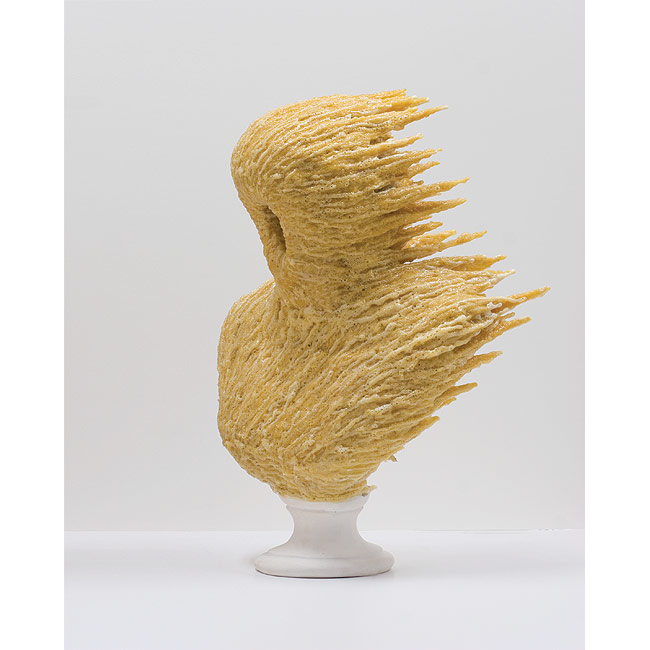
“Van Woert, on the other hand, addresses classical sculpture through his totemic works, which feature busts of Franz Schubert or David and, in the case of “New Order,” Ionic proportions. However, where one might expect classical materials, van Woert favors a kind of Home Depot aesthetic, employing insulation foam, plexiglass, and sculpted heaps of polyurethane adhesive. This subversion continues as van Woert riffs on the use of the pedestal in classical sculpture, in which an ostensible vehicle for an unmitigated presentation of the work becomes an agent of obfuscation. In both “New Order” and “Fool’s Gold,” classical busts are removed from atop the pedestal, deformed, and incorporated into the columns themselves. In the stunning “Blind Spot,” a coal-black bust of David is bisected at eye level, where a precarious wooden pedestal is inserted. No longer relegated to a supporting role, the figure of the pedestal has been shoehorned into the work of art itself..” – John Motley for The Portland Mercury