Monday, 3 August 2009


Ulrich Görlich
Work from 15 Landschaften.
Görlich’s work is a kind of anti-portraiture/landscape that maintains powerful relevance 10 years after its initial creation. 15 Landschaften (15 Landscapes) is an exercise in meta-photographic seeing/thinking. This work calls to mind other photographers who share conceptual relationships with Görlich, but whose aesthetic is far more rooted in their specific time (Nikki S. Lee comes to mind). Only one of the images visually references the existence of a subject, but there is a distinct aesthetic to these images that brings to mind vacation snapshots (albeit taken by a skilled photographer), yet it is not entirely apparent that someone has been removed from the photographs. The rectangles appear to be a specific muted color chosen from the palate of the image, but always in a way that serves to minimize the impact of their presence. The images, when viewed together, read like the remnants of a road-trip through the desert whose tone fluctuates between peaceful and lonely.
Tags: blocked, color, german, landscape, meta-photography, obscured, omit, shape
Posted in blocked, color, german, landscape, meta-photography, obscured, omit, shape | No Comments »
Sunday, 2 August 2009


New Catalogue (Luke Batten and Jonathan Sadler)
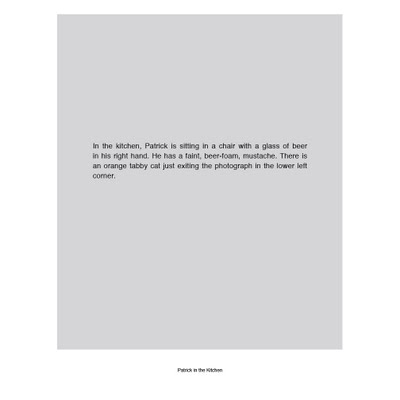
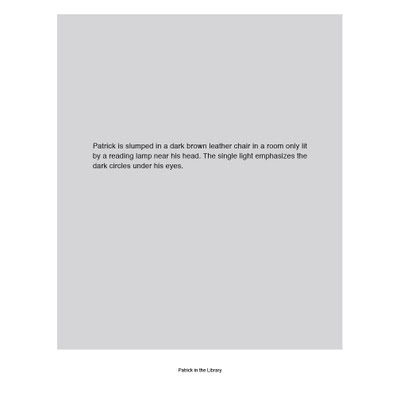
Works from Color Theory for the Economist and Nine Portraits of Patrick Swayze.
“New Catalogue is an artists’ collaborative that adopts the model of a stock photo agency, presenting thematic series of images with the crisp aesthetic and pared-down descriptive titles of their commercial prototypes. Yet the artists carefully merge diverse references from popular culture, historical sources, and fine art in their photographs to create an elaborate compression of elements culled from, in their words, “postmodernity’s visual psyche.” While revealing a subtle eye for satire, their work stands as a pointed examination of the nature of representation and image-making in contemporary culture. In their recent series Tiger Afternoon the artists develop a narrative of American suburbia that they describe as “a Jean-Luc Godard version of a John Hughes film,” exploring and ultimately questioning the idealization of youth in our time.” – Courtesy of the MoCP
Tags: chicago, conceptual, denial, descriptive, humor, meta-photography, photography, ski mask, smart
Posted in chicago, conceptual, denial, descriptive, humor, meta-photography, photography, ski mask, smart, text, text-only | No Comments »
Saturday, 1 August 2009



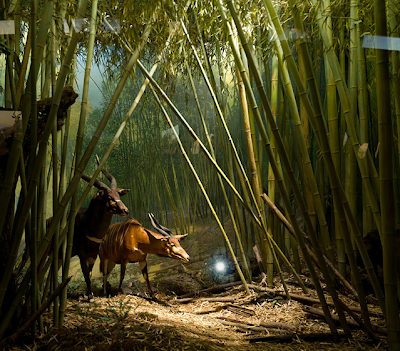
Amy Stein
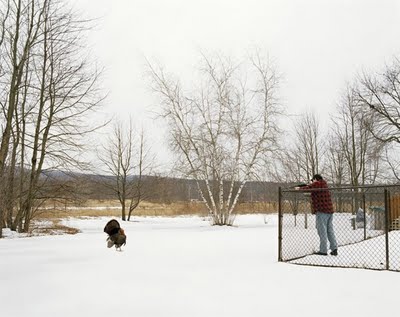
Work from Domesticated.
As with many of my weekend posts, you probably do (or should) know of Stein’s work.
“My photographs serve as modern dioramas of our new natural history. Within these scenes I explore our paradoxical relationship with the “wild” and how our conflicting impulses continue to evolve and alter the behavior of both humans and animals. We at once seek connection with the mystery and freedom of the natural world, yet we continually strive to tame the wild around us and compulsively control the wild within our own nature. Within my work I examine the primal issues of comfort and fear, dependence and determination, submission and dominance that play out in the physical and psychological encounters between man and the natural world. Increasingly, these encounters take place within the artificial ecotones we have constructed that act as both passage and barrier between domestic space and the wild.
The photographs in this series are constructed based on real stories from local newspapers and oral histories of intentional and random interactions between humans and animals. The narratives are set in and around Matamoras, a small town in Northeast Pennsylvania that borders a state forest.” – Amy Stein
Tags: animal, color, environment, everywhere, human, photography, reconstruction, staged
Posted in animal, color, environment, everywhere, human, photography, reconstruction, staged, taxidermy | No Comments »
Friday, 31 July 2009


Jeff Otto O’Brien
Work from Revaluations.
“Photography is often seen as an individual endeavor concerned with the documentation of external ephemera and objects. Taking a photograph, as it were, is an intensional act for the photograph is of something- the photographic subject. This commonly held view of photography, which often goes hand-in-hand with the notion that “the camera never lies”, ought to be challenged for it is a reductivist view that demarcates photography from other art forms and relegates it to somewhat of a technical phenomenon.
My current series, titled “revaluation”, is about revaluating photography. I am interested in examining the prescribed limits of photography and whether or not it need be an intensional act. The photographs presented here have been edited in two separate, non-traditional manners: the first being a pixelisation of the digital image that examines the minimum data required to represent a subject, the second being a slight editing of the data behind the photograph that radically alters the image to a point where it is unrecognizable and non-representational.” Jeff Otto O’Brien
Tags: blur, conceptual, meta-photography, obscured, pixelation, scale
Posted in blur, conceptual, meta-photography, obscured, pixelation, scale | No Comments »
Thursday, 30 July 2009


Anoush Abrar
Work from Californication.
“The film studios, the celebrities, the entertainment capital of the UnitedStates- the state of California revolves around the film industry and its success. Projecting an image of fame and fortune, beauty and happiness, Hollywood draws people like a magnet.
I started this photo project in Los Angeles because I wanted to get as close as possible to the young people who flocked to this city seeking fame and fortune. The main idea was to focus on women ? the hopeful starlets and models ? because, as opposed to the men, I felt that they have more opportunities for success through appearances in TV shows, TV advertisements, lingerie campaigns, and erotic calendars
In a world where maximum media exposure is akin to success and image is everything, any and all television, magazine, cinema, and Internet coverage is important, sought after and in a sense, vital. Running from casting to casting, appearing on shows and getting their photographs taken, these women will stop at nothing to be noticed.
What are they ready to do to achieve their dream? How far will they go to achieve celebrity status? Who are these girls that come from all over the world. What drives them? What do they look like? Through body care, excessive aerobics, gym visits, and even plastic surgery, they try to create the perfect image that caters to the whims and demands of the cinema and star industry.
Following the casting trail, I easily established contact with some of the models I portray in these images and found others by creating a casting call on the Internet.” – Anoush Abrar
Tags: california, meta-photography, photography, self-reflexive, swiss
Posted in california, meta-photography, photography, self-reflexive, swiss | No Comments »
Wednesday, 29 July 2009


Erik Dalzen
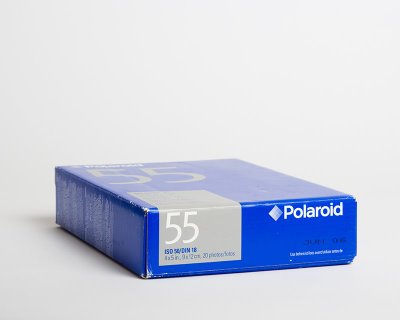
Work from Commodities.
Active auctions here.
“Commodities is a collaborative project between me and spirited bidders. Art pieces are created based on specific marketable goods and cater to niche audiences of collectors and enthusiasts. The works are then exhibited on the auction website, eBay, under search terms that coincide with the vernacular from which each piece derives. Potential buyers may experience the thrill of shopping and the excitement of competition by vying against one another to win the art piece. The culminating action occurs at the close of each auction once rival bidders complete each piece by determining its value.” – Erik Dalzen
Tags: commodity, conceptual, ebay, object, photography, representation, sale
Posted in commodity, conceptual, ebay, object, photography, representation, sale | No Comments »
Tuesday, 28 July 2009


Reiner Riedler
Work from Fake Holidays.
“When wishes are out of reach, simulation is taking over our leisure time and our holidays. Imaginary worlds are created, often under massive technological exertion, in order to offer us experience as reproducible merchandise. Although the quality of these adventures on demand sometimes proves to be rather dubious, the boom does shed light on one thing: the yearnings and dreams underlying people’s daily lives.” – Jens Lindworsky
Tags: austrian, color, fake, holiday, indoor, photography, simulation, straight
Posted in austrian, color, fake, holiday, indoor, photography, simulation, straight | No Comments »
Monday, 27 July 2009




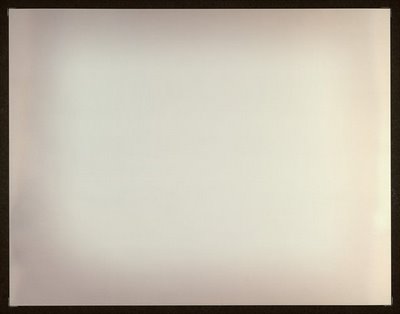
Phil Chang
Work from Double Exposure.
“In her 1977 essay “Notes on the Index,” Rosalind Krauss defined contemporary art as indexical. The work that fascinated Krauss was that which indicated an elsewhere, that is, work that was proof or evidence of what was not apparent in the work itself (such as documentation of earthworks or performance art). Most notably, this term “index” has been applied to photography, as photography, like no other art, purports to index what it captures. Krauss’s contention, however, was problematic. Her definition of the photographic index relied on a certain qualification: the parasitic attachment of the caption was what created the photographic index. The photograph alone, without such a qualifier, has a more problematic relationship to its indexical ambition.
Phil Chang’s work has evolved to question this basic premise of photographic meaning. The object of Chang’s work appears to always disappear, to be just beyond the moment of exposure, as if the photograph is only a hint of what was intended to be captured. Reason and effect are moved to the periphery in an image like Ami, Fogging a Window, McArthur Park, Los Angeles (2005), where a woman, leaning in to breath on a plate glass window, leaves an ephemeral mark the camera is challenged to depict. A similar motive drives Chang’s recent series Double (Exposure) (2007). Here photographic paper, a digital scanner, and the effects of photographic exposure, all collapse beneath the flatness of a single photographic image. Chang’s photograph witnesses a process with an outcome just beyond the horizon of exposure. Like all of his work, this cleverly titled series imparts the supreme lack of photography – it’s uncertainty as a direct witness.” – Chris Balaschak
Tags: color, conceptual, meta-photography, photographic, self-referential, self-reflexive
Posted in color, conceptual, meta-photography, photographic, self-referential, self-reflexive | No Comments »
Sunday, 26 July 2009
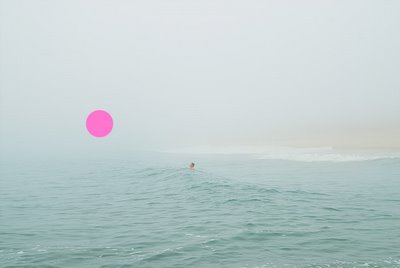
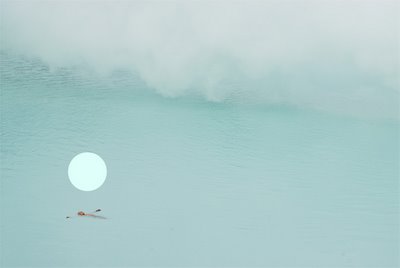

Carlo Van de Roer
Work from Orbs and Blinded by the Light.
Van de Roer has some amazing, critical, and conceptual projects that cover a wide range of photographically-specific commentary. I advise you to peruse his website. There is also a great interview / article from Pilot Magazine about Blinded by the Light that you should read.
Also, two of the Orb images are available on 20×200.
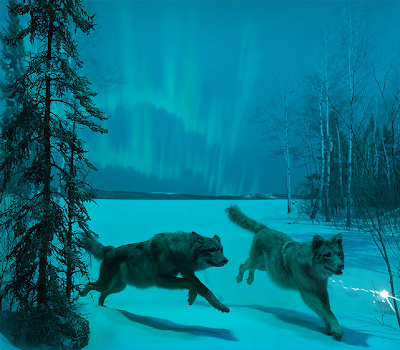
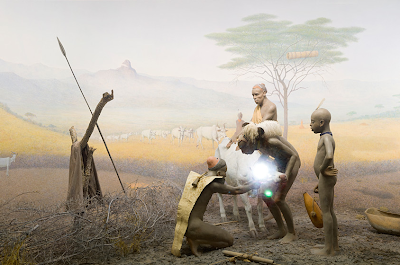
“The term “orb” is typically used to describe circular artifacts in photographs—artifacts which have been interpreted by some as spirits. Despite being debunked and explained (most commonly as backscatter from precipitation or dust), there’s a surprisingly widespread belief that orb photographs document the supernatural. There are organizations, conferences, hunts, field experts, detectors and websites dedicated to spiritualist orb photography.
This photographic search for something larger than ourselves was the starting point for this project. I photographed people in landscapes that are partly obscured by precipitation. The subjects are seen searching for or interacting with orbs, which are represented as dots covering parts of the scene.” – Carlo Van de Roer
Tags: 3d implied, awesome, conceptual, meta-photography, mysticism, new zealand, obscured, orb, pseudo science, self-referential, self-reflexive, smart, spiritualist
Posted in awesome, conceptual, meta-photography, mysticism, new zealand, obscured, orb, pseudo science, self-referential, self-reflexive, smart, spiritualist | No Comments »
Saturday, 25 July 2009


Cara Barer
Work from The Book Project.
“My photographs are primarily a documentation of a physical evolution. I have changed a common object into sculpture in a state of flux. The way we choose to research and find information is also in an evolution. I hope to raise questions about these changes, the ephemeral and fragile nature in which we now obtain knowledge, and the future of books.
I arrive at some of my images by chance. Others, through experimentation. Without these two elements, my work would not flow easily from one idea to the next. A random encounter on Drew Street with the Houston Yellow Pages was the primary inspiration for this project. After that chance meeting, I began the search for more books, and more methods to change their appearance.
I realized I owned many books that were no longer of use to me, or for that matter, anyone else. Would I ever need “Windows 95?” After soaking it in the bathtub for a few hours, it had a new shape and purpose. Half Price Books became a regular haunt, and an abandoned house gave me a set of outdated reference books, complete with mold and neglect. Each book tells me how to begin according to its size, type of paper, and sometimes contents.
As I begin the process, I first consider the contents of each volume. I didn’t spend more than a few seconds on “Windows 95,” but the “New Century Dictionary of the English Language,” is a treasure that, because of its fascinating illustrations, and archaic examples, saved it from taking on a new form. Sculpting segued to thoughts on obsolescence and the relevance of libraries in this century.
Half a century ago, students researched at home with the family set of encyclopedias, or took a trip to the library to find needed information. Now, owning a computer, and connecting to the internet gives a student the ability to complete a research paper without ever going near a library. I have fully embraced that technology, and would not want to be without it, but, I also fear that it is rapidly leading us to rely less and less on the reference books common in the last two centuries.
With the discarded books that I have acquired, I am attempting to blur the line between objects, sculpture, and photography. This project has become a journey that continues to evolve.
A final note – No important books have been injured during the making of any of these photographs.”
Tags: artist book, damage, decay, evolution, flux, scanogram
Posted in artist book, damage, decay, evolution, flux, scanogram | No Comments »


.jpg)
.jpg)
.jpg)
.jpg)
.jpg)


