Roni Horn


Roni Horn

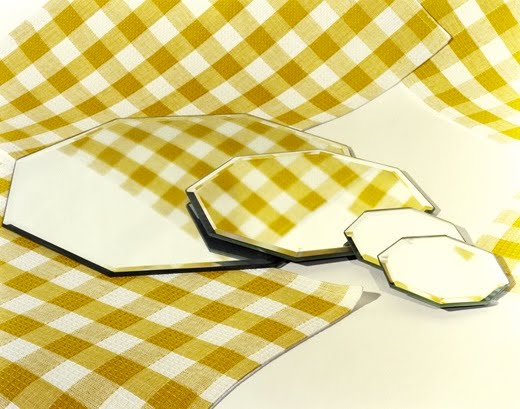
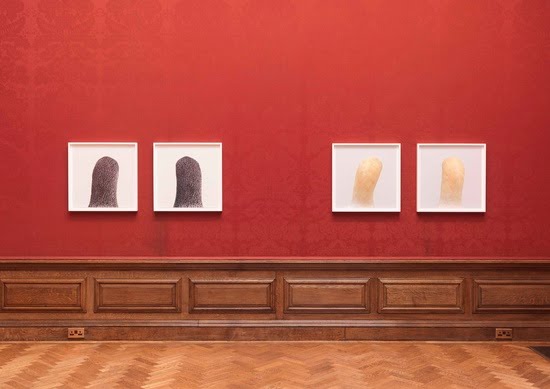
Work from her oeuvre.

“…Horn explores the mutable nature of art through sculptures, works on paper, photography, and books. She describes drawing as the key activity in all her work because drawing is about composing relationships. Horn’s drawings concentrate on the materiality of the objects depicted. She also uses words as the basis for drawings and other works. Horn crafts complex relationships between the viewer and her work by installing a single piece on opposing walls, in adjoining rooms, or throughout a series of buildings. She subverts the notion of ‘identical experience’, insisting that one’s sense of self is marked by a place in the here-and-there, and by time in the now-and-then. She describes her artworks as site-dependent, expanding upon the idea of site-specificity associated with Minimalism. Horn’s work also embodies the cyclical relationship between humankind and nature—a mirror-like relationship in which we attempt to remake nature in our own image. ..” – via Art 21

Maury Gortemiller


Maury Gortemiller

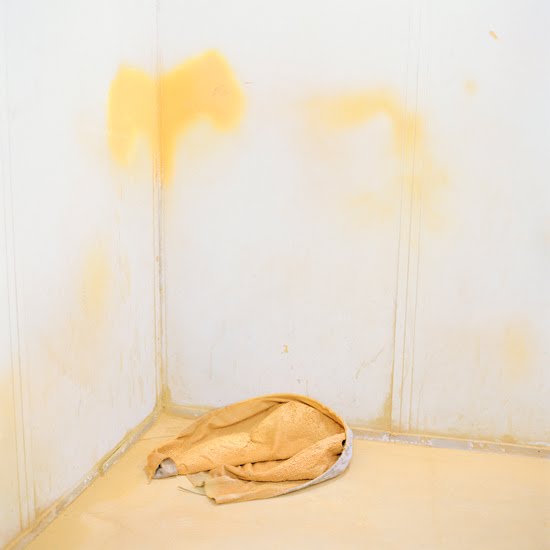
Work from All-Time Lotion.

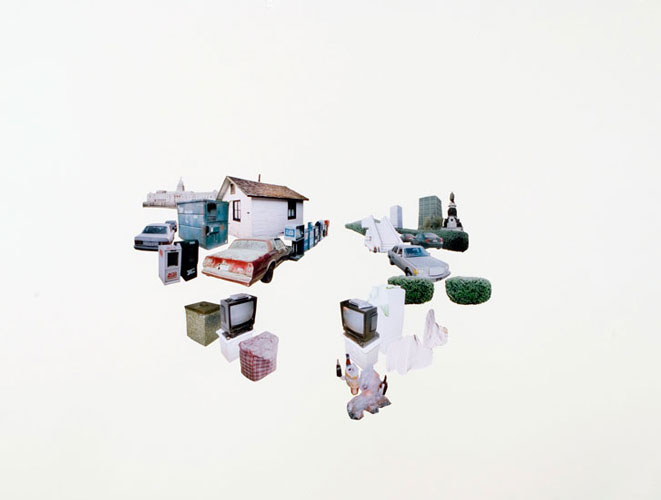
“My photographs are the product of image-making that is both intuitive (responding quickly to visual phenomena) and ambiguously choreographed. I am interested in reinterpreting and altering the intentionality of spaces and found items. Somewhere between instinct and cognition lies the overlooked residue of experience. This series maintains the semblance of ordinary, everyday things while investigating their latent conceptual meanings.

I hope to investigate fully Robert Storr’s notion of the estrangement of the photograph, the medium’s capability to depict persons and objects in such a way that transforms context and intention.” – Maury Gortemiller

Lars Tunbjörk


Lars Tunbjörk

Work from The Office.

“Tunbjörk’s images observe the sterile interiors of nameless business offices that, though different in name, share a lexicon of commercial iconography: neon lights, industrial ventilation systems, thin metal framed windows, computers, filing cabinets, and—most pronouncedly—white and grey cubicles. The series remains firmly grounded in this commercial world with little or no reference to the external environment as though this universe exists as a totality unto itself. Like the artificiality of Thomas Demand’s assembled office photographs, the tone in Tunbjörk’s series reflects the constructed nature of the world it documents and hints at the immense workings of power occurring behind these thin office walls, as though the sterility of these environments serves to cloister the true workings of a powerful, arcane elite.

Yet, by dwelling on the marks and signifiers of the human presence, Tunbjörk’s work finds a new acme above the tepid implications of these artificial surroundings. These signs sometimes blatantly reveal themselves in individuals attempting to accommodate their environment to their needs: a person talking on the phone underneath his desk, a man stretching his shoeless feet, women spreading papers out across the floor. Other times they appear in a more covert manner through human absence: a tie sticking out of a closed locker door, barren rows of cubicles like graveyards, empty garbage cans, structures and objects that supposedly abet human action but also conceal human identity; in essence, Tunbjörk illustrates the conflict of the corporate world as it attempts to commercialize our humanity. Through this presentation of the insipid and hackneyed universality of the office place contrasted with the human attempt to project personality and accommodate individual needs Tunbjörk constructs a humorous yet melancholic statement about the human condition in the twenty first century.” – text via the Amador Gallery

Harrison Haynes


Harrison Haynes

Work from Distruptive Patterns.

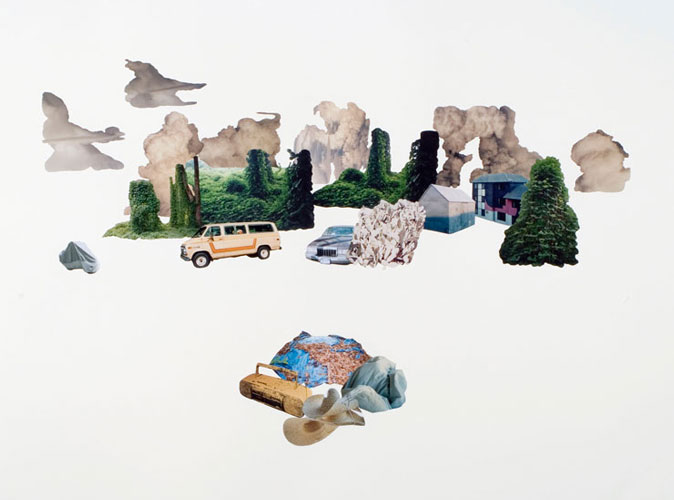
“LB: Your work often contains an isolated object/figure in an open field as is the case here. Is this an aspect of the work, or a way of discussing the work?

HH: I have a preoccupation with decontextualization. Focusing on details or objects within my everyday surroundings and thinking about what they might mean outside of their original environment, what they might mean to the viewer and also what they mean to me. The latter question is a more recent one. I’m trying to better understand my own intuitive approach to visual taxonomy/subject matter. i.e., what do I ‘gravitate towards’ and why?

Kudzu was just something I saw my whole life, an omnipresent part of the landscape of NC. Moving away and returning a few times probably allowed me to see it for what it is: an insane monster of a plant that forms some very compelling shapes as it blankets the tree line.
Isolation in this collage-Untitled (Form 1), 2009-is literally manifested. The discrepancy between the figure and the ground is amplified: overwrought density in form (collaged photos of kudzu) and absolute neutrality/negativity in the background (raw canvas). So, I guess it’s both an aspect of, and a talking point in the work.

LB: I am curious how this interest in decontextualization might inform your material choices? You could say that this ‘removal of details from the world’ constitutes a definition of a photographic practice, but you have often chosen other means like collage or painting. Do you see the snapshots used in your collages as things to be decontextualized? Are the photographs as objects themselves aspects to be isolated? In short, I am interested in why you choose to construct the image out of physical photographs rather than make the same kind of juxtapositions digitally, and whether or not this has to do with the photograph itself as a detail of everyday surroundings to be manipulated and focused on?

HH: I wanted to use the cut up pieces of photos as a material to describe something layered and leafy like kudzu. There’s that direct sculptural impetus. I also like the redundancy of it: using photos of kudzu to make a sort of clumsy recreation of kudzu. It has a deadpan quality.

LB: I really like this notion of clumsiness! I feel that there is a lot of power in giving someone a mechanical vantage point; a view of the parts as well as the whole. I am wondering about another level of the relationship between kudzu (or the clutter of yard sales from other pieces) and photography. Would it be a stretch to say that there is a relationship between the ubiquity of photographs and the more insidious colonization of the plant?

HH: No I don’t think its a stretch, although those connections might not reveal themselves until later in the process. The palimpsest-y quality of kudzu, or any rampant vine, like English Ivy or Virginia Creeper, is hard to miss. And it’s as much a symbol of decimation as it is of progress. Or, you could characterize it as an obsolete and now reviled technology, like Asbestos. I do connect it to the phenomenon of piled up crap.

LB: I would like to talk for a second about kudzu as as an obsolete technology which is a really great way to frame it, and to come back to this tactic of redundancy you mentioned earlier. In these terms your work, or at least these collage pieces, are dealing with obsolete technologies (kudzu, piles of junk, photographic prints) in both material and content. I think this delimits collage practice in a really interesting way, where I think it normally slips into a much less discursive space.

HH: I want to tell a little bit about the histories of kudzu and collage. Kudzu was imported from Asia and marketed to the South Eastern US agricultural industry in the early 20th c. as an impediment to erosion (all that slippery red clay). As a non-native species, it lacked natural predators and on top of that can grow as much as a foot a day. It is also very hard to kill, so that now we’ve got this crazy homogeneous backdrop along roadsides from Virgina to Florida.

Collage was also once a radical technology, a way to break up space on the picture plane. And it caused a huge tectonic shift in the way we think about and make art. I’ve been reading Ann Baldassari’s book Picasso & Photography: The Dark Mirror. It’s an incredible reminder of how significantly Picasso changed everything in the early part of the last century. The Picasso work she focuses on (especially the studio tableau photographs) is so pertinent to what many artists are doing right now. Also, George Baker’s The Artwork Caught by the Tail: Francis Picabia and Dada in Paris, is a good companion, as it chronicles Picabia’s practice right around the same time. Interdisciplinarity is at the forefront of both artists’ approach and collage could be described as a micrcosm of that approach, since it compounds elements of sculpture and painting, and with Picasso, photography.

But collage isn’t new any more, and it’s use has trickled down to even the most quotidian realms. So, to use collage now requires an acknowledgement of how far away we are from that moment of innovation. I think my collages are less about that radical, shocking disruption of space and more about using the technique to depict something rather ordinary. I named the series of collages ‘Disruptive Patterns’ after the science of camouflage which uses the fragmentation of positive and negative shapes to create an atmospheric, invisible field, something not there, something marginalized.” – excerpt from a discussion with Lucas Blalock on The Photography Post.

Jill Sylvia


Jill Sylvia

Work from Balance Sheets and Reconstructions.

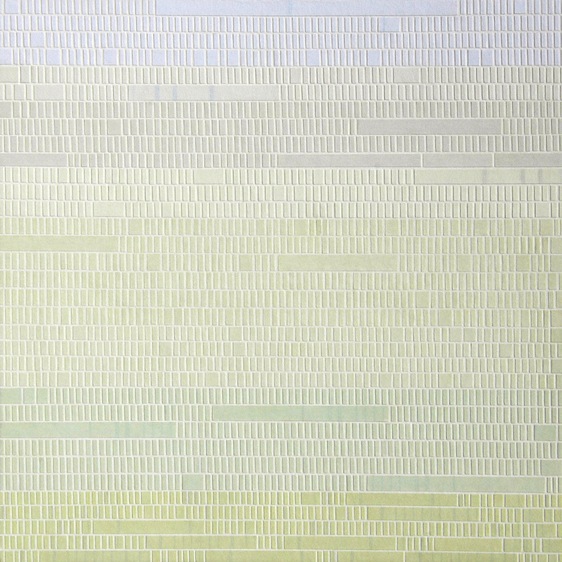
“Ledger sheets are traditionally used to record the financial transactions of a business or an individual. These papers host the data necessary for accounting information to be compiled, and for analysis in determining profit and loss. They are the material of economics.

In an attempt to understand our need to quantify our transactions, I employ this paper. I use a drafting knife to individually remove tens of thousands of boxes from this paper, leaving behind the lattice of the grid intended to separate the boxes. I involve myself in this routine of trying to make time and labor palpable while communicating its loss. I am concerned with the manner in which this material is recontextualized by way of process, (and consequent futility), and how the resulting voids suggest “that the methods we employ to arrange our world provide more insight into ourselves than that which we seek to organize.”

The skeletal pages drape and accumulate, demarcate the time cost for their creation, and become the buildings for which they have laid the groundwork. Grids are reconstructed using the excised boxes in order to create a new sense, a new value. The boxes become the units of the picture plane, the medium of color fields.

With each piece, the notion of “value” is called into question – be it the value of our quotidian pursuits, the relative value of labor, or the implicit values of economic advancement.” – Jill Sylvia

Naho Kubota


Naho Kubota

Work from Unrevealed and Minimum Structure.

“Unrevealed, a continuous body of work, takes unknown organic forms and transforms them into abstract color patches using subdued colors and a soft focus. The simple use of muted colors removes the observer from the conscience and allows a disconnect from its inherent pattern making and dominance in our senses. These mysterious forms of color and texture therefore engage the mind on an unfamiliar level of perception.

The project “Minimum Structure” started three years ago as a photo collection of strangely appealing machinery parts and landscapes. My interest lies not in the functionality of thesestructures, but rather in thestructuresthemselves. With a little exploration, we can always find a hint of nonsensical abstraction hiding in our everyday life. Excluding the subjects from their original purpose creates an image that is imaginatively isolated from reality.” – Naho Kubota via WIPNYC.

Lucas Blalock


Lucas Blalock

Work from I Believe You, Liar (I think).

____________________

Dear Ms. Patty Pacifica or Current Resident, 

I like to think of cooing. it is among the warmer thoughts. especially nice in French which seems a warmer language except when it’s not. Isn’t it funny how cold warm things used badly become. I would accept your TV if you had it, but seem truly and earnestly (to my own embarrassment) more interested in truth than fact and all that uninterrupted information would bring us back to the palimpsest (a screen) and a possible becoming tedious because the volume controls of strangers – even friends and lovers – are always different from the ones internal. It’s probably better if I listen to your speakers instead of getting greedy for headphones, or serialized programming.

As to. . . all of this is more lonely than sad but I am starting to relish this energy of impossible languages and unbridgeable gaps. The failures are all we have and I am no nihilist! I BELIEVE YOU, LIAR!! Light, sad? ‘luc’ is particle and wave both at the same time. I am torn. can you explain?

Thank you kindly,

Lucas Blalock

Beth Dow


Beth Dow

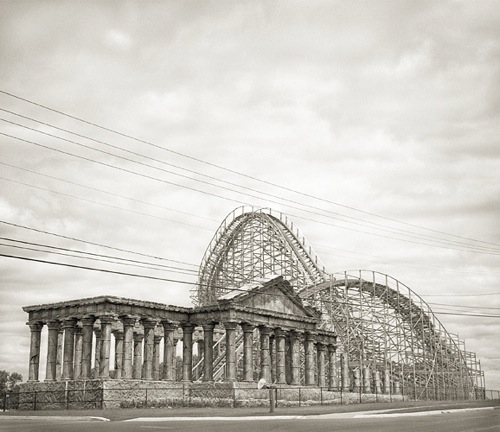
Work from Ruins.

“I’m drawn to subjects that puzzle me, especially incongruous elements in unlikely places. These are the first photographs in a new portfolio that looks at the ways we appropriate and approximate the romance of ruins into modern American environments, and what this says about our longing for historic precedents. While genuine ruins remind us of our own mortality, they also suggest the opposite by showing it’s possible to endure, even if only in a reduced and degraded form. We fake antiquities in curious ways, preferring them pre-crumbled to models of the spanking-new. This places the counterfeits at a curious point in time – somewhere between pristine original construction and the present, indicating that we value our nostalgia for something lost over what was actually lost. This circular thinking about authenticity is the biggest draw for me.

I have been looking at Victorian photographs by Francis Frith, Felix Bonfils, and Giorgio Sommer, as well as sepia ink and wash drawings by Claude Lorrain, a 17th century artist who used classical ruins to create ideal scenes of pastoral splendor. My pictures of faked antiquities are an attempt to evoke nostalgia for inaccurate history, to wrestle with ideas of authenticity, and to question the value we place on classical ideals. It is natural to challenge the relevance of nostalgic longing, and I exploit this dynamic in my contemporary landscapes. I approach these pictures as a tourist. These photographs of authentic sites include whatever clutter exists around the actual subjects, and people mill around, much as they do in Frith’s photographs. Life goes on among the ruins.

As photography straddles three centuries, so does my process: 20th century medium-format roll film, 21st century digital technology, and 19th century platinum printing. Since platinum is a contact (not enlargement) process, I scan the film and use an inkjet printer to make final-size negatives. Although the costly, hand-coated platinum process may seem excessive in this digital age, I use the medium to suggest longevity and historical precedent. I shoot with a handheld camera like any other tourist, which allows me to work quickly and unobtrusively. I like how my lens, which is slightly wide-angle, converges verticals and disorients space, especially evident in electricity poles that unify the images. This distortion also helps to center visual weight in the compositions. I want these to be beautiful objects in the way the original reference pictures were beautiful. Platinum is rare, precious, and the most permanent photographic printing medium – an apt metaphor for my search for the authentic and enduring.” – Beth Dow
Daniel Everett


Daniel Everett

Work from his oeuvre.

Everett’s work is on view at the Museum of Contemporary Art – Chicago until May.

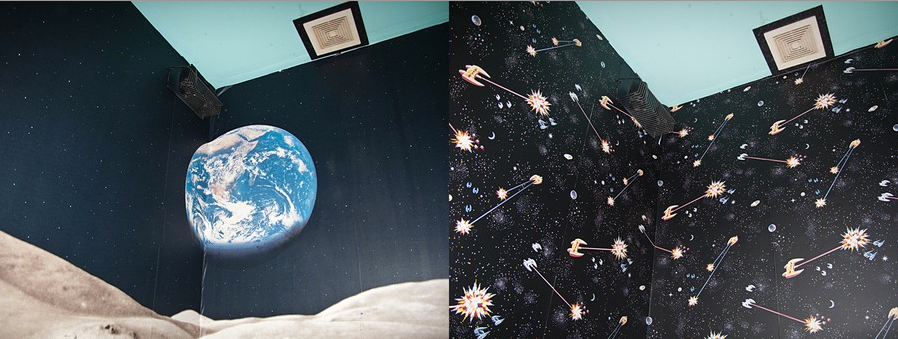
“Daniel Everett works across media, exploring the possibilities and limits of personal meaning in public spaces, both real and imagined. Much of his work focuses on the aesthetics and implications of the outdated and now-obsolete technology of his youth: videogames, computers, and the early Internet.

Everett repurposes these technologies, disrupting their functions and putting them to use in often funny and quite moving ways. Likewise, his photographic works capture uncanny moments within commonplace postmodern architecture — suggesting the presence of spirituality or even godliness in the most banal of places. Creating clean, coolly formal work, Everett projects profoundly personal questions onto the spaces, products, and leftovers of the public domain. ” – MOCA Chicago

Pauline Bastard


Pauline Bastard

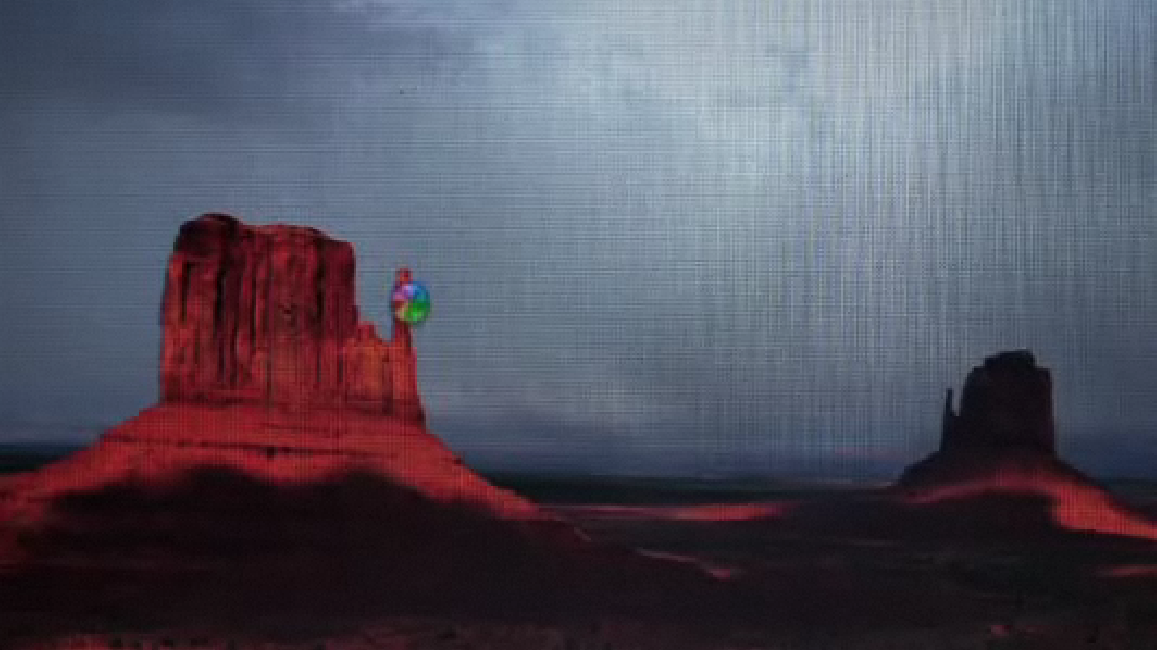
Works from Western.

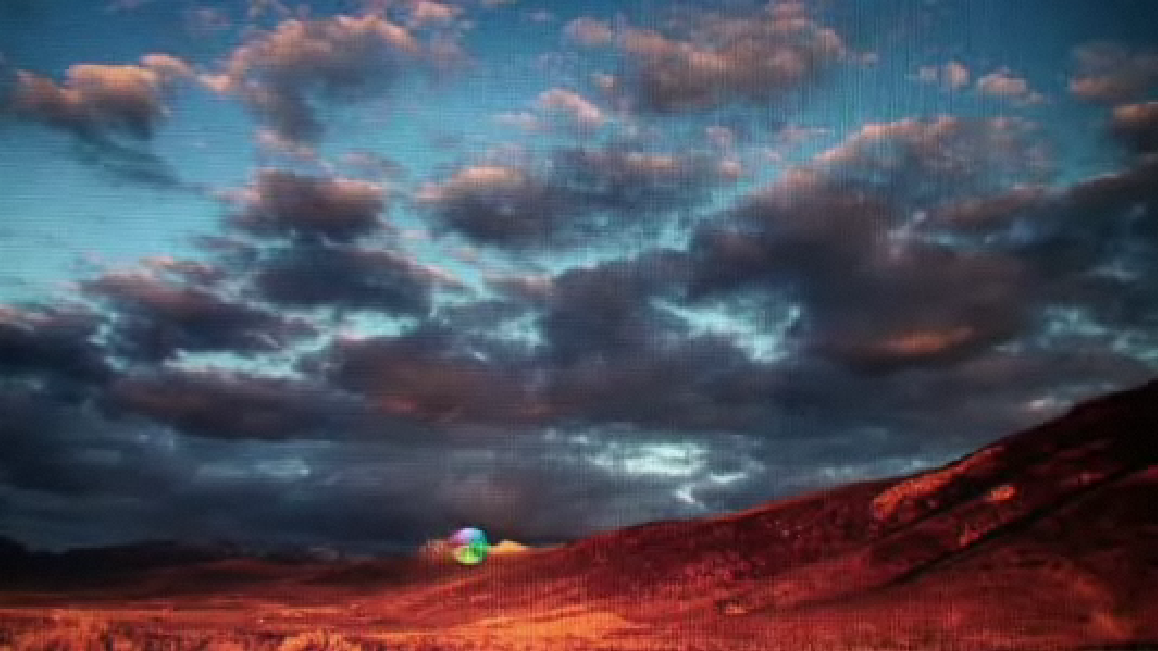
These are stills from Bastard’s video in which she traces the contours of the landscape with the spinning color wheel. Much of her other work is quite fascinating as well, I highly recommend her website.

“My work is about objects. By making sculptures and images, I create an extravagant dialectic that break common use of the things. I work to find what objects contain; I observe and use their functions, qualities, materials and symbolic. My work formulates things ironic or poetic that objects are nearly express them self. By this work I make them quit their utilities function and bring public in a contemplative moment.” – Pauline Bastard

via Valentina Tanni