Arthur Ou


Arthur Ou

Work from To Preserve, To Elevate, To Cancel.

“To Preserve, To Elevate, To Cancel.” These three concepts define the German word “aufheben,” a term used by Walter Benjamin in his essay “Thesis on the Philosophy of History.” It seems fitting that the tri-fold meaning of this term would resonate in Arthur Ou’s work, which incorporates architecture and sculpture within the realm of photography. Central to the exhibit is a large replica of a Marcel Breuer fireplace. It anchors the gallery space as an empty vessel that in turn provides a platform and ornamental base for Ou’s “Double China” ceramic works. These pieces ask questions about how things are created and manufactured to convey notions of a globalized culture. It is no accident that the Breuer-inspired hearth is an ornament and symbol of Western prosperity while the “Double China” pieces suffer from an inability to function based on their hyperactive design. In Ou’s Untitled (Earthworks) photographs, formations are built from dirt and then placed on lacquered bases, locating them as sculptures and collected objects. The earthen forms at once reference notions of the landscape and ancient Chinese scholar rocks. For Untitled (Mirror Lake) #1 and #2, Ou brought copies of well-known Chinese ink paintings to the site where American photographers such as Carleton E. Watkins, Edward Weston and Ansel Adams took iconic images of the American West. For Ou, taking on the persona of nature photographer was a personal transformation. Not only was the pilgrimage to Mirror Lake a conflation of past and present, but it also created an act of cancellation. The manufactured landscape of the East and the iconic landscape of the West cancel each other out in a pictorial juncture of dislocation. Ou’s work is informed by quiet anxiety, laid bare by his effort to locate the work within the space where two cultures meet. Perhaps the only possible resolution lies in the grammar of Ou’s presentational language, employed effortlessly — of building, preserving, elevating and canceling — only to build again his own thesis on a philosophy of history. ” – Shannon Ebner 

via The Exposure Project

Ryan McGinley


Ryan McGinley

Work from Moonmilk.

“McGinley describes his work as a journey, and his photographs form a ʻtravel logʼ which captures his experiences across the American landscape. This particular adventure pushed his troupe to new levels of bravery, testing the participantsʼ fortitude and endurance in hazardous conditions. McGinley recalls, “there is something prehistoric about a cave that makes one feel comfort and impending doom all in one breath. Theair is often thick with dust, humidity and the smell of minerals while the ground is slick clay, or rubble that fell from the ceiling. It is slow going when burdened by the excessive amount of lighting options needed to pull off an 8-hour shoot. Most caves are no more than 50 degrees inside while some house ice stays intact all year round, making it a challenge to endure the long exposures and precarious setups necessary to shoot with such limited light.” 

McGinleyʼs goal is to explore, experiment, take risks. He works thoroughly, deeply and obsessively. He is curious and open, while remaining interested in very specific things. These new cave photographs demand that viewers accustomed to his previous work throw away everything they might have thought about McGinley — gone is the snapshot kid. As he puts it, “I wanted a challenge, so I decided to do the cave project because I needed to slow my film. Shooting these pictures was like directing theatre – I had to pay attention to every little movement.” 

Some of the inspiration for this work came from childhood adventure stories such as Mark Twainʼs Tom Sawyer and Jules Verneʼs Journey to the Centre of the Earth. McGinley also took cues from the illustrations to be found in childrenʼs books and even in the Bible stories, such as Jonah and the Whale, his mother read to him as a child. 

McGinley rejected working in commercial caves, focusing instead on what are commonly referred to as ʻWild Cavesʼ. Some of the terminology associated with explorers and other kinds of pioneers can be applied to McGinley and his work process: trailblazer, pathfinder, seeker, searcher, frontiersman, surveyor. For the cave photographs, McGinley plunged himself, his models and his crew into an awesome and impenetrable blackness and brought back evidence from the hidden realm – pictures from inside the earth.” – Alison Jacques Gallery

Glenn Ligon


Glenn Ligon

Work from his oeuvre.

Ligon has an opening at the Illingworth Kerr Gallery tonight.

“It’s late on the morning of the US presidential election, and Glenn Ligon is talking about Jasper Johns. “His notion that you take an object – or in my case a text – and do something to it and do something else to it: that’s always been the touchstone for the way I’ve thought about my work.” The displacements and iterations Ligon effects, from returning to source material a decade after first use to hiring an appraiser to perform a condition report on an earlier painting, well attest to this legacy. Yet anyone who has stood before one of Ligon’s text paintings and seen its thick encrustation of oil stick, a product of the artist repeatedly running the medium through stencils, will be hard-pressed to not also think of his forebear’s paint handling. Nor was this connection lost upon New York Times critic Michael Kimmelman, whose review of the 1991 Whitney Biennial identified Johns as ‘the unlikely source’ of Ligon’s paintings. As Darby English previously commented, ‘unlikely’ is the operative word: Ligon, while gay, is also African American, and in an early 1990s moment of what the artist calls “high multiculturalism”, any but the most explicitly identity-based work failed to compute.

“There was an assumption that artists of colour could only and would only talk about their identity”, he recalls. “From the beginning, myself and a whole group of artists – including Lorna Simpson, Gary Simmons, Fred Wilson and Kara Walker – resisted the notion that there was some easily identifiable, unified, readily agreed-upon thing called blackness that we could present in our work.”

Ligon’s engagement with literary and vernacular quotations, beginning with a painting excerpting a sign wielded by demonstrators at a 1968 black sanitation workers’ strike (Untitled (I Am a Man), 1988), reveals a far subtler understanding of the personal and sociocultural delineations of the self. As a statement, ‘I am / a man’ captures the complexities of political action, in that its assertion of a seemingly evident fact calls attention to the very condition of social invisibility that necessitated it, while its circulation through collective action risks inscribing a group of individuals with still another set of norms. By transposing this message from the placards of protestors to the surface of a canvas, and dividing up the quote (‘I am / a / man’), Ligon widens the discursive rift, and we are left to consider the subject for whom this phrase has hauntingly returned.

Subsequent text paintings, many originating from etchings, introduced Ligon’s now characteristic use of oil stick and text stencil, with seminal lines from Zora Neale Hurston, Ralph Ellison and other authors repeating over page- and scroll-proportioned surfaces, progressively muddied by the accumulating paint. “The way I use quotations is almost like adapting a novel for a film”, Ligon remarks. “It’s based in the text, but it’s not the same thing. It has its own structures and desires.” The thick, material life Ligon gives his quotes can be taken as symptomatic of “the text’s unconscious”: a latent realm of wish and fantasy that manifests at the limits of legibility.

Hurston’s 1928 statement ‘I feel most colored when I am thrown against a sharp white background’ receives analogous visual form in many of Ligon’s renditions, the black paint settling with increasing randomness upon a white surface that appears as its seeming and ever-eclipsing precondition. As with the artist’s other bodies of work, the ready significance of the colour palette is less a conceptual endgame than one pole of an axis traced between absent body and absent voice.

Hurston’s address retains its specificity and resonance several decades hence, while its compulsive multiplication draws out the community it synecdochically serves. ‘Much of Glenn’s investigation has been about how the “we” replaces the “I” when the black subject is being considered’, curator Thelma Golden has observed. In other words, while using the first-person voice, his quotations ‘speak for an entire experience’.

If this repetition of source texts overstates, so as to highlight a community’s historical lack of representation, it also points to Ligon’s tenuous status as a member and as the artist doing the quoting. His decision to speak through borrowed words is bolstered by the indirect, stencil-based handling of his medium, such that the resulting paintings’ very evidence of making is the residue generated by his execution of a predetermined script. Any definitively authorial trace is thus substituted with a presentation of alienated labour to accompany those of the other partial and qualified selves on display.

Ligon also problematises his role in other bodies of work, adopting particular modes of biographical narration in a fashion that reveals more about their relative conventions of storytelling than their alleged subject. Two-channel video The Orange and Blue Feelings (2003) finds the artist engaged in a session with his therapist, the cameras notably angled away from the talking heads and respectively towards the office bookshelf and the therapist’s legs, and the conversation generally affirming the well-known truth that the ‘talking cure’ is a performance like any other, with a 45- minute running time and an office for a set. A series of etchings entitled Narratives (1993) masquerade, in format and style, as the opening pages of nineteenth-century slave narratives, often replete with an amendment, by a fictional white abolitionist, authenticating the authorship of the tale to follow. The accounts detailed on these pages are pointedly biographical, including one about Ligon’s early education in a predominantly white New York school and another summarising his life as a homosexual. During the same year, Ligon invited friends to write short descriptions of his appearance, which became the content of a series of lithographs modelled after runaway-slave notices (Runaways, 1993). The implication is that these formats continue to inform the construction of the minority subject in both personal and public consciousness, a point Ligon emphatically makes in one print from Narratives by connecting the double-edged consumption of slave narratives with that of contemporary black art (‘Glenn Ligon / … / His commodification of the horrors of black life / Into art objects for the public’s enjoyment’) and in Runaways by asking friends to write their descriptions as if they were describing a suspect for a police report.

As much as these different working methods have helped Ligon avoid the ‘minority artist’ moniker, they have also allowed him to sidestep the institutional trappings that commonly befall midcareer artists. Ligon could not properly be said to work in series or periods: he visits and revisits quotations and bodies of work, at times producing more than a dozen print and painting variations on a single source quote and even crossing media to append his ideas. The process affords the artist a twinned perspective on his own output: as the author of work that by its very nature challenges assumptions of authorship; and as an interpreter who sources bits of his own practice as he would any other good in the cultural domain. This may explain the hesitation of the curators of Glenn Ligon: Some Changes, the recent touring survey of the past 17 years of his output, to characterise the show as a retrospective. “Calling it a retrospective would imply fixed bodies of work that can now be studied”, Ligon reflects. “My show was deliberately titled Some Changes with the idea that the work was always work-in-progress and could take other forms in the future.”

Among the products of Ligon’s cyclical process, A Feast of Scraps (1994–8), a vintage scrapbook interwoven with assorted homosexual imagery, was revisited in 2003 as the aptly titled Annotations, a digital variation that allows users to click on photos and uncover chains of associated images and songs, some disclosing the flipside of the scrapbook’s buttoned-up veneer. Ligon has also borrowed the phrase ‘negro sunshine’ from Gertrude Stein’s 1909 novella Melanctha for a series of drawings that he later turned into his first neon piece, Warm Broad Glow (2005). The black paint customarily applied to the back of neon instead covers its front, diverting the light into an intense halo that emanates from behind, and elegantly touching on the issues of opacity, repression and invisibility that occupy his practice as a whole. Even then, Ligon produced other versions of Warm Broad Glow, including one for his 2007 exhibition at Regen Projects, in Los Angeles, which was painted entirely black. “If phrases are resonant enough”, he observes, “they cannot be exhausted. Other meanings can be teased out of them, partly by a change in medium or approach.”

In recent years, Ligon has returned to a group of paintings made a decade earlier, which featured jokes from Richard Pryor routines. “I wasn’t done with Pryor or he wasn’t done with me”, he says with a laugh. “If you go back and listen to his albums, they are very pointed critiques of American society. They are from the 70s, but he was quite prescient.” While a series begun in 2004 traded Ligon’s earlier monochromes for a palette he playfully calls “off-colour”, his 2007 Regen Projects exhibition comprised 33 renditions of the same joke, in black, on square gold canvases. The paintings encircle the gallery like a thin gold band, punctuated by differences in paint application as well as by three equally sized paintings with other Pryor jokes. If these works position the audience at the threshold of reading and viewing, then the installation in turn builds an affective syntax, letting us scan the paintings as we would a line of text in an environment that also necessitates bodily engagement.

“It was important to me to return text to the speaking voice”, Ligon comments. “Jokes seem to require that you say them out loud, which is different than a text from an essay. I noticed that people in that show performed the work, performed it for each other, told each other the jokes. There was something in how that installation worked that brought up memories of Pryor’s physicality and forced a performative relationship with the text.” – Tyler Coburn for Art Review

Lacey Terrell


Lacey Terrell

Work from Offset.

“In this series, I have used my experience as a still photographer on motion pictures as a starting point, but have turned my camera away from the action – off set. Slipping behind the metaphoric curtain of center stage, I will look back at the constructed reality being played out, or wander into uninhabited areas. I am intrigued by where the artifice of movie making and the ‘real’ intermingle. As I hunt for images that occupy this space, I become a flâneur of sorts; a solitary figure roaming the outskirts of the location, studying the spectacle before me, yet looking for things unnoticed by others. In this realm, I have the freedom to capture the unscripted: authentic moments found within the contrived environment of a stage set, images that feature traces of the artifice being created in real-world locations, and quirky details normally hidden just out of frame. Re-contexualizing these images, I create my own mysterious slivers of narrative that highlight the overlooked, the unexpected, and the poetic.” – Lacey Terrell

Lance Wakeling


Lance Wakeling

Work from Sic, Notes from a keylogger and Parking at the Pentagon.

“As we type and edit our attention jumps from paragraph to paragraph and from program to program, leaving a trail of disconnected phrases and commands. Much of what we type is deleted before the final product is saved, but the data have not dissapeared. Sic is the record kept by a keylogger installed on my computer. Since the keylogger records every key pressed, the data contain information best kept private, but the range of information is so great and cluttered with such noise it remains impenetrable. Sic is ongoing and chronological—it is a strict, linear record of non-linear processes. From a step back, the many colored key-commands and black phrases of text illustrate an abstract and personal topography of thoughts and actions. The illusion of Sic is that everything is displayed, but the reality is that without the final products of the labor to compare, the record will always be incomplete, and will remain pieces whose sum is less than the sum of the whole.” – Lance Wakeling

Gert Jan Kocken


Gert Jan Kocken

Work from Judenporzellan.

“Street photographers have only a vague notion of what they’re looking for. But the moment the right situation does reveal itself, they recognise it immediately and leap into action. In the case of Dutch visual artist-photographer Gert Jan Kocken, the process is exactly the opposite. He knows what he’s looking for but has no idea what it will look like. I visited him in his Amsterdam studio early in 2007 to discuss our shared interest in iconoclasts.

While working on a project for the Utrecht Museum Het Catharijneconvent, Kocken discovered that images and bas-reliefs damaged during the Dutch iconoclastic riots in the sixteenth century still exist in Europe. In contrast, the history books are filled mostly with depictions of sledgehammer-wielding riff-raff on ladders taking church interiors to task. Is it possible that historians attach greater importance to subjective representations in illustrated books and eyewitness accounts than to the actual remains of the images and bas-reliefs themselves?
Unlike most historians, Kocken is first a viewer and only later a reader. He spent years searching for damaged images and bas-reliefs, focusing increasingly on making perfectly executed, crystal-clear photographs with his (8 x 10-inch) large- format camera of religious depictions that had never been restored. If I were to have to describe in one word what I felt when looking at his life-sized colour photographs, it would be – pain. Like when I saw the bas-relief of the Virgin and Child that once graced the interior of the Geneva cathedral where Calvin preached for so many years. It was so badly mutilated with an axe by iconoclasts that virtually the only elements of the original image still recognisable are the Virgin’s mantle and the contours of the bodies. Of the face of the Holy Child, cradled in the Virgin’s arms, only the lips are distinguishable. It is precisely on this detail in Kocken’s photograph – the baby lips searching for a nipple – that my glance repeatedly stumbles. The deeds of the iconoclasts were later justified in the name of the Second Commandment, which is violated in churches that are full of images. In reality, though, these rebels were probably hacking away at the carved bas-reliefs in protest at the repressive Catholic regime. But they didn’t quite finish the job, and this is precisely what gives the photographed image its historical significance.

There’s one image in particular in Kocken’s series of photographs of damaged religious images that appears to have nothing to do with all the others: it is a photograph of four watercolours lying in the shallow open drawer of a grey metal cabinet. As the ‘spoils of war’, these watercolours ended up in the military art collection of the Pentagon in Washington, D.C., after the Second World War. Four diligently executed watercolours that crossed the Atlantic and now represent the paper incarnation of a turning point in history. They were made by the youthful Adolf Hitler at a time when he still had artistic aspirations. Biographer Ian Kershaw describes him as a pitiful little man roaming about Vienna like a genius manqué.

One of the watercolours, in which several buildings and a flight of steps are depicted, was to prove fatal to him or rather, to the world. It was partly on the basis of this painting that Hitler was refused entrance to the art school in Linz, Austria. If only he had shown the admissions committee the beer mat on which he had sketched a rather good prototype of the Volkswagen; he might have been admitted after all and become a draughtsman in a car factory after finishing his studies.

For several years, Kocken has been working on a series of photographs for the Nederlands Fotomuseum entitled ‘turning points in history’. In this context, while trawling the internet in 2003 in search of watercolours by Hitler, he read on a website that four indisputably authentic watercolours from Hitler’s hand were located in the military art collection of the Pentagon. Thanks to a letter furnished with every stamp the Nederlands Fotomuseum had in its possession, in 2004, one and a half years after submitting his first request, Kocken was finally granted permission to photograph the watercolours.

A few months ago, curious about the conditions under which these watercolours are being stored in the Pentagon and the reasons for the Pentagon’s refusal – despite numerous requests – to return them to the heirs of their original owner, I suggested to him that we go together to see them again.

The original owner was Heinrich Hoffmann, a fervent nazi and Hitler’s private photographer. In addition to the watercolours, the Pentagon collection includes Hoffman’s two and a half million negatives (that is, some 70,000 film rolls). This means he must have seen Hitler through the lens of his camera about two and a half million times: Hitler making faces at himself in the mirror to see how he comes across, Hitler looking angry, Hitler wearing lederhosen, Hitler with his mistress, Eva Braun, who worked in Hoffman’s camera shop.
In the 1930s, the Führer gave his watercolours to the designer and guardian of his public image, whom he also considered to be one of his few true friends. Hoffmann spent years in gaol after the war, but no sooner was he released than he submitted a claim to the American government requesting the return of his watercolours and negatives. To no avail; Hoffmann died in 1957. His daughter decided to pursue the claim. Unable to file a complaint herself against the American government because she was a German citizen, she engaged Billy Price, an American collector of Hitleriana, to assist her. Hoping to benefit financially, Price sued the state in her name for ninety-nine million dollars. After a prolonged series of lawsuits, the claim was finally rejected in 2004 by judges of the Supreme Court in Washington, D.C. The watercolours are never allowed to leave the drawer again. Personally, this decision pleases me. As the child of a Jewish father who barely survived a German concentration camp, I have always felt powerless. There is very little you can do to ease the pain, let alone take appropriate revenge. I wouldn’t want my father to be confronted with these unsolicited watercolours. The very idea of smashing the frames, shattering the glass and slashing away at the watercolours themselves with a sharp object gives me satisfaction, though there’s no need to act as long as they stay in the drawer.
One might wonder why the watercolours were never destroyed by the Americans. That might have been a problem if Hitler had been a good instead of a useless painter. But in this case, from an aesthetic point of view nothing would have been lost. Is destroying, sometimes asking for trouble? Because – Nazi-sympathisers might reason – what’s worth destroying is apparently significant. That the Americans decided to preserve these watercolours has resulted in the bizarre situation where Hitler’s knick-knacks are now better protected than a fresco by Giotto, Vermeer’s View of Delft or Mondriaan’s Pier and Ocean.

Hitler’s watercolours are safely stored away in a pitch-black drawer behind a locked door and two safe-doors, in order to prevent them from acquiring an iconic status among neo-Nazis. Thousands of confiscated art works were returned to Germans and Austrians after the Second World War. Only pieces in which Nazi leaders, swastikas or other Nazi propaganda are visible plus these four watercolours were sentenced to life-long house arrest by the Pentagon.
Thousands of art works confiscated by the Nazis were stored in the monastery at Mauerbach near Vienna for more than four decades after the war ended. Not even victims of the Nazi regime attempting to track down looted family art works were allowed into the heavily guarded monastery. For a claim to be honoured, one first had to submit convincing proof – like the Jewish woman who knew that a dart had once landed in the painting of her deceased grandparents, courtesy of their grandchildren. A small canvas patch was found glued to the back of the painting at that same spot.

There may even be paintings that were taken from my grandfather’s Amsterdam house at Mauerbach, but as heirs we stood no chance at all of recovering them because there were no photographs or insurance papers. As far as my father was concerned, the Austrians could keep the paintings anyway; they ‘wouldn’t bring back’ his father, brother and other family members.
It’s strange that I wasn’t allowed into the monastery at Mauerbach in the late 1980s, while I was granted permission so quickly to see Hitler’s watercolours at the Pentagon.

Washington, D.C., 22 June 2007. At about ten-thirty, Kocken and I arrive at the US Army Center of Military History, a noticeably solid office building. Two American flags flutter lazily on the front façade, the poles resting in bombproof steel cylinders. The building belongs to the office complex that falls under the Pentagon.

We report to the reception desk, where we’re thoroughly searched, our bags examined and our passports withheld. Renée Klisch, the Army Art Curator, is notified of our arrival by telephone as we sign the visitor’s list. She takes us by elevator down to her office in the basement of the building, which borders on the depot where the closed collection is stored.
Klisch is an energetic woman. She enthusiastically tells us about her life in this office, where she seldom receives visitors. Guests once called her ‘the world expert on the art of Hitler’. ‘Me?’ she said, pointing to herself, ‘this lone mole in this underground vault?’ Waving her short, stocky arms in the air and throwing her eyes upwards, she laughs and says, ‘The world expert on the art of Hitler! Informed, yes. World expert, no’. Klisch talks of her love of Cycladic art, her interest in evolutionary biology and her safaris in East Africa. So long as Hitler isn’t the subject, she seems to be in her element, but any mention of the Führer and painful memories of her father are evoked.

It couldn’t be more ironic. Klisch is Jewish, and her family suffered badly at the hands of the Nazis. Her father survived Auschwitz and emigrated to America shortly after the war. ‘He’d turn in his grave,’ Klisch intoned repeatedly during the conversation, ‘if he got wind that his daughter had become an expert on Hitler’s “art”.’ After the elderly Klisch landed in America, not a single German object was allowed into his house. And under no circumstances would he ever have allowed himself to be transported in a German car, not to speak of Hitler’s Volkswagen.
The curator picks up the book Hitler comme peintre from the table and starts leafing through it. As I glance around the office, strewn with piles of paper and books, I reflect: the strange thing isn’t that her father turns in his grave every now and then, but that he ended up in a grave at all. A grave with a stone on it on which you could choose to leave out one of your first names if you wanted. Only after he died did Klisch discover that the ‘A’ in his series of initials stood for Adolf. He’d managed to conceal it even from his own daughter.

Klisch enters the code for the safe and instructs us to follow her to the museum depot. Hundreds of paintings and drawings hang on extending racks. Most are of little artistic interest, though they may sometimes have documental value. There are a lot of paintings by artists who were specially hired by the American army to give an impression of life on the front. Between scenes of soldiers in combat, bomb explosions and advancing tanks and aircraft, two lovely landscapes strewn with oak leaves catch my eye. They date from the seventeenth-century, are probably French, and were given to the Pentagon by a grateful Jewish couple who survived the war. Nearby stands a portrait of Hitler on the floor that has been badly slashed with a knife several times by a right-handed soldier.

There’s a long tradition of artists painting war scenes at the front. The American army sent artists to the battlefront in the First and Second World Wars and during Vietnam. Watercolours with war scenes from Iraq are streaming in now too, though they’re being tampered with. One ‘army artist’ works regularly in Klisch’s office. Dressed in a patterned camouflage American uniform, he sits behind the computer with his sleeves rolled up and searches for spectacular photographs from the war photographers in Iraq. Occasionally he selects one and reworks it using Photoshop, until all the sharp contours are gone and the photograph resembles a veritable watercolour. Apparently there’s safe art as well as safe sex. This man is probably the best-protected watercolourist in the world.
After showing us around the collection, Klisch leads us back to the safe-door behind which is the grey cabinet. Opposite the cabinet stands a bronze bust of Hitler. As Klisch opens the drawer and the watercolours become visible, the Führer’s eyes pierce my back.
One of his watercolours, made during the First World War, depicts the entry to a bunker, a railway and soldiers no bigger than large wood ants. The words ‘Am Bahndamm, Bische, 3. Mai 1917’ are inscribed on it.

A drawer in a cabinet. A cabinet concealed in a safe, with a massive, heavy safe-door for which only Klisch knows the code. Located in a much larger safe, behind another locked door, in an underground office. An office in a highly secure building that forms part of the Pentagon complex. A series of buildings spread over the heavily guarded city of diplomats – Washington, D.C. In a country that has been on a constant state of alert since 9/11. Whoever makes the journey to see these watercolours will be aware of a ‘Droste effect’, with Hitler in the lead role; a mass murderer instead of the devoted Droste nurse on the cocoa tin.
When Kocken photographed Hitler’s drawer with his plate camera, it was no easy feat. To get the desired depth of field, a great deal of light was required. He therefore had to construct the photograph layer upon layer by flashing sixteen times with an open shutter. Every time he flashed, the horrifying image stuck to his retina before it slowly faded away. A short time later he would flash again, and the image and after-image would reappear. This was no longer photographing light, but constructing it. It took two full days before he achieved the desired effect. Back in Amsterdam he printed the photograph, then didn’t look at it again for a year and a half. He realised the final result could never compete with the actual experience of making the photograph.

Now, two years later, here he is standing in front of that same drawer again. He looks relaxed, knows what to expect and doesn’t have to work; this time it’s my turn to come into action.
As we gaze intently into the drawer one last time, Klisch tells us enthusiastically about the almost fluid movements of her tame ferret, who plays so sweetly with her cat. Then we leave the vault and say goodbye.

It is only on the train to New York a few hours later that it starts to dawn on me what Kocken did and why. For thirty years, the only text on Hitler’s drawer was ‘The Watercolors’. There was no description of the content, no name of the maker. It is precisely the complications of looking at these watercolours that fascinates him. ` And there’s a striking paradox that I too don’t quite know how to deal with. If Kocken should decide to hang his photograph in an exhibition, I’ll undoubtedly look at his work with interest and appreciation. He created art, with Hitler’s dismal watercolours as the most important ingredient. When I stood in the safe looking at them, they didn’t really affect me much, though they did evoke horrible associations. Normally, I’m not a fan of the Pentagon’s methods, but this time I actually appreciated the careful way they’d dealt with this matter.

But there’s one thing that shouldn’t be forgotten: should the watercolours ever be removed from Hitler’s drawer, to leave the safe and be exhibited somewhere, with respect for their maker, the deeply suppressed and dark iconoclast in me may well awaken from his slumber and I may no longer be able to vouch for myself.”

Randa Mirza


Randa Mirza

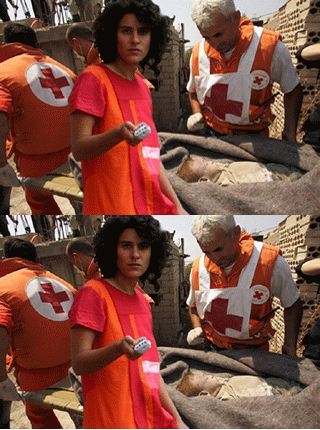
Work from Parallel Universes.

“Parallel Universes offers the spectator the gift of ubiquity. The title nods at the “Multiverse theory”, the hypothetical set of multiple possible universes embracing together all of reality.

Mirza’s work exposes the coexistence of past and present layers of war and peace realities. Through her visual constructions of horror and leisure, she challenges the gap between politics and entertainment. Manipulating images from the 1975 and 2006 Lebanese wars, Mirza targets the sacred cow of the war photograph to reveal the contraptions of truth lying behind.

The artist softly disturbs the viewers’ comfort with surreal representations. Parallel Universes’ reciprocal intrusions bring the spectator’s self into conflict. “Where were these pictures taken? Are they ‘real’ or ‘false’? Where does the picture begin and where do I end? Mirza eliminates the surface of the photograph, forcing the viewer to renegotiate their habitual relation to images.

Like a mirror, Parallel Universes incorporate the spectator’s gaze in the fabric of the image itself.” – Randa Mirza

Susan Unterberg


Susan Unterberg

Work from Doubletakes.

“..In Double Takes, Unterberg begins to abstract her idea of portraiture. As the only small and intimate series, these works depict various precious objects and spaces. The reduced scale draws the viewer in, promising secrets through the mundane. In depicting things rather than people, Unterberg clearly takes a step away from conventional portraiture, abstracting the idea of what defines a person.

While Double Takes uses allusion as its primary vehicle, the remainder of the exhibitions roots itself deeply in metaphor. Unterberg uses aesthetic to convey these ideas. With Insects, Horse Eyes, and White Horses, Unterberg uses the subjects as a metaphor for self. Each possesses qualities that she identifies with as an individual and artist…” – Jacque Liu

Tema Stauffer


Tema Stauffer

Work from American Stills.

“To perceive and subsequently reveal an inherent beauty in what may be characterized as “commonplace” requires the observer (i.e. the photographer) to consider specifically the act of seeing what is “there” or simply what “is.” Images that suggest recognition and acceptance of the banal differ from those, perhaps more pervasive images, that confer emotion and meaning with loaded subject matter or blatant content. These latter images may allow for an accelerated or undemanding “read” of the image, and as a result, may be more immediately accessible to the viewer. Considering the ubiquitous use of photographic images employed across a multitude of contexts (e.g., commercial, corporate, academic, artistic), less ease may be experienced by the individual when viewing what could be described as ambiguous or indirect images. When confronted with an image that does not at once suggest a narrative or an emotional state, for instance, one may be tempted to label the image as empty or lacking meaning. However, these same images may provide the rare opportunity for individual interpretation and interaction with the work, or for unadulterated acceptance of the image on its own terms. In discussing intrinsic value contained in what may be described as the “real” or the “actual”, noted photographer and author Stephan Shore states, “Chinese poetry rarely trespasses beyond the bounds of actuality. Whereas Western poets will take actualities as points of departure for exaggeration or fantasy, or else as shadows of contrast against dreams or unreality, the great Chinese poets accept the world exactly as they find it in all its terms, and with profound simplicity find therein sufficient solace. Even in phraseology they seldom talk about one thing in terms of another, but are able enough and sure enough as artists to make the ultimately exact terms become the beautiful terms.”

It is in this way that Tema Stauffer makes known the subject of her photographs without prejudice, and allows the viewer to observe situations, objects, or environments in a new context, and to reveal the subtleties present in these ostensibly ordinary images. In a series of photographs taken at what appears to be a vacant water park, the viewer is afforded the opportunity to consider the artist’s motives. One might take into consideration narrative possibilities, emotional content, and socio-cultural commentary. Ultimately, the images act to invite our attention to a scene that we may have encountered but ignored, uninterested in considering it further. In making this selection, Stauffer begins to elevate the perceived “usual” into something unexpected, imbuing objects with an importance that heretofore went unnoticed. The scale of many of her works also acts to emphasize the significance of the image, imparting status via size. Allowing for recognition of details, this format (at times) permits the viewer to associate with the subject matter more closely, effectively challenging previous photographic conventions and commenting on the discrepancies between the real and the represented. To attempt to fully understand these images or determine absolutes concerning the artist’s intentions or the viewer’s responsibility can, at times, become problematic or wholly undesired. Referring again to the possibilities of interpretation, the artist can purposely and repeatedly (working in series) provide multiple means of conceptual or theoretical entry into the work, directing but not entirely dictating the analysis. In responding to an enquiry regarding the meaning of his work, Carl Philip Heuschrecke states, “By writing you an answer, Sir, I will undoubtedly deny you the pleasure of opening your Own eyesÉI will provide you with figures and with parallels, but I leave it to you to figure their relevance.”

The work contained in this exhibition, American Stills, features large-scale photographic C-Prints (a specific method of color photographic printing) representing Stauffer’s most current projects. As an example, Front Yard (2003) depicts a winter residential scene, seemingly not long after a new-fallen snow. It is dark, but a definite light source appearing to originate from the street distributes light to the ground, resulting in a reflective glow. Due to the character of this illumination, the image, although printed in color, takes on a distinctly monochromatic appearance. One could argue the conventional idealistic representation of a similar scene would consist of a frontal or more direct view of the house and it’s surroundings, with a camera position or perspective originating at the street, looking in on, not out from a specific location. Presenting nearly a reversal of this view, Stauffer captures an unexpectedly idyllic scene, despite that a driveway inhabits the majority of the foreground. Also noteworthy is a political sign posted in the front yard, its lettering reversed as merely the back is visible. Although the subject matter is subdued, it’s placement and inclusion in the photograph becomes exceedingly important. By presenting this scene in such a manner, Stauffer skillfully and subtly illustrates the significance of perspective or point of view, allowing the viewer to consider the role of observer versus observed.” – Kris Douglas for the Rochester Art Center

Cassander Schattenkerk


Cassander Schattenkerk

Work from The Andromeda Strain and Series #2.

Statement for The Andromeda Strain:

“After making many landscape photographs I realized the search for special places is more important than the place itself. The notion of discovery has always been intimately linked to photography. The cliché of the photographer as an explorer of unknown and rough places became a starting point to construct images.

I played with the “National Geographic”-language essentially without leaving my hometown. I searched for locations that, after small interventions, can fit in an imaginary travelogue. Using low-budget special effects and lighting I staged natural phenomena and imagery.

To this work made on location I added still-lives constructed in the studio. Referring to nature and scientific photography, the tabletop landscapes create confusion on the overall status of the series.

I often choose material that has a perishable or unpredictable quality, like foam or spaghetti. No Photoshop is used to achieve the effects. The artificial and the real, and the different sources the image is based on, should be present simultaneously.” – Cassander Schattenkerk