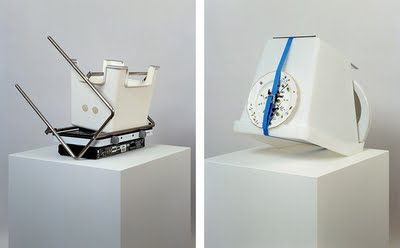
Uta Barth


Uta Barth

I have been wanting to post Barth’s work for quite some time, I was a little shocked to find I hadn’t yet.

“Color photography’s recent ability to rival painting in scale and stylistic range seemed particularly well exemplified by Uta Barth’s mid-’90s work from the “Ground” and “Field” series; in some images, she reinvented pointillism as dramatically as Chuck Close. Yet as Barth increasingly worked in diptychs and triptychs, as in the 1999 series “nowhere near …,” it became clear that distinctions between related images were evincing uniquely photographic properties. “Nowhere near …” featured views of the artist’s backyard shot through window-panes and distinguished from one another by slight shifts in angle; changes in atmosphere, light and time of day; variations in focal depth, shutter speed or camera motion. The series carried the phenomenological interests of an earlier generation of structuralist filmmakers and photographers to a new level of beauty and variety. Coming after other multipanel photographic works, “nowhere near …” nevertheless seemed unprecedented in its structuring of concise but intuitive, nonsystemic and very postminimalist variation. 

Barth’s latest untitled series (2002) isolates a single partial motif from “nowhere near …”–a clump of trees and telephone wire in the distance–and finds yet more worlds there. Sequences of two to six panels, each a 21 1/4-by-28 1/2-inch archival pigment photograph mounted unframed on Plexiglas, are installed in a horizontal band around a room. (The series debuted simultaneously in New York and at ACME in L.A.) Through sensitive, irregular spacings, the sequences maintain their separateness but also join into a single composition punctuated by intervals. Most sequences contrast sharply detailed views of unremarkable bare branches against the blankness of a nearly white California winter sky. Sometimes the shift between panels is as subtle as fog rolling through, so that one looks closely to identify the change. Other times the shift seems total, from a “natural” tonality of dark umber branches on near-white sky, for example, to an apparently solid, intensely cadmium red panel that only slowly reveals faintly darker ghosts of branches, perhaps in analogy to the afterimages of retinal exhaustion.

Far from being simply decorative, the interpanel variations suggest a conceptual nimbleness. The duotones which Barth pulls out of blurred contrasts of branches against sky, for example, in their jerky linear complexity remind one of Brice Marden’s ink drawings. In one set of panels the branches disintegrate through camera movement into mere jittery dashes. In subsequent sequences, one is made to notice how birds, after they disappear, seem echoed by a few remaining unfallen leaves. With fuchsia buds and a blue blush in the clearing sky, a final panel blooms into an image of spring that sets all the other meditations on bare winter branches into newly emotional perspective.” – P.C. Smith for Art in America

Florian Slotawa


Florian Slotawa

Work from Hotelarbeiten and others.

“A nondescript zone lies close to the start of Kurfürstenstraße. This should be the core of the city. Neither entirely residential nor commercial nor administrative, this curiously neglected quarter of central Berlin exudes a sense of fun’s absence. It’s where Florian Slotawa likes to work. His new studio is a former office divided into four rooms. The aging carpets and functionally compartmental spaces bear traces of a vanished world of small business bureaucracy circa 1979, lending the new tenancy the air of a squat—which seems entirely appropriate given the nature of Slotawa’s work.

Table and chairs are arranged with formal symmetry in the central room. They could be a work in progress—regress?—or just a place to eat. Turns out it’s the latter. This is one of the effects of Slotawa’s work: you start to notice structures in incidental clusters of things, be they arbitrary accumulations or functional arrangements.
 
In a corner of an adjoining room, a crate of framed photographs has been recently returned. The series Hotelarbeiten [Hotel Works], 1998-1999, brought Slotawa’s work to the attention of a broad audience. Over the course of a night spent in a hotel, the artist would dismantle the furnishings and fittings of his room and re-assemble them into something between a makeshift shelter and a child’s fantasy hideaway. His journey entailed stopovers in Switzerland, Italy, France, and Germany, resulting in a series of black-and-white photographs of these one-night affairs, which were published in the magazine of the Süddeutsche Zeitung newspaper. And so, the work of Slotawa, who was then still a student, reached an audience well beyond the precincts of the artworld. The public resonance of these images—both quantitative and qualitative—lends them a certain archetypal status in his practice. They are evocative in many ways. While he literally dismantled and abused the hotel rooms, his transgression of the guest-hotelier contract was a matter of the spirit rather than the letter of the law: has any draft of the hotel’s regulations, however pernickety, foreseen this type of behavior? And besides, at the end of his clandestine operation, Slotawa scrupulously returned each room to its prior condition.

Here, the photograph is both an artwork and a document, that is, both a primary and a secondary work: it is both a framed, tonally nuanced picture and simultaneously a document, a piece of evidence that registers an absence, an event that has passed. The event’s clandestine aspect heightens the resonance of the photographs’ evidential nature. They don’t just document a performative intervention, they register a very particular transgression. Imparting knowledge of the transgression makes the audience complicit, however reticently. What’s more, the act’s seeming ineffectuality too has an affective charge. For it seems to rhetoricize its own inconsequentiality: room furnishings are shifted around and then painstakingly put back where they belong—although, of course, the intervention questions where they in fact belong. So, then, has anything happened? Has nothing happened?

Slotawa, the hotel guest, accepts the furnishings and fittings as a kind of inventory, as a given limit, while refusing their configuration. This is a question of dwelling insofar as the remade rooms declare themselves as zones of subjective identification and occupation. They deny the impersonality that’s assumed to be a condition of the hotel room’s function as a hotel room.

What about the specific features of individual re-arrangements? Throughout the hotel works, mattresses with bedding are placed on the floor. Some kind of roof or planar structure—usually a door or similar panel lying on its side—gives shade and shelter. Take Hotel Intercontinental, Zimmer 2116, Leipzig, Nacht zum 12. Dezember 1999, for example. No fasteners are used. Things rest on each other, bearing their loads precariously. The shelters inevitably establish a dialogue with the surrounding furnishings, setting up a kind of formalism-by-default that is constantly deflated by the pragmatic, amateur-engineering logic of their construction.

The Hotelarbeiten rehearses the concerns that have been key to Slotawa’s practice over the last decade: the foregrounding of a movement, often in the form of an exchange between private and public domains, which is intimately connected to the question(ing) of the imperative of display (in art); the insistence on composition; and the temporary nature, that is the moment, of composition. There is remarkable consistency in what—for want of a better word—you could call his method. Its elements are: acceptance and delimitation of a given; intervention upon this given; composition.
 
The first moment involves a crucial dose of passivity. Something—a situation, an institution, a chair, a night in a room or whatever—is given. An archive of sorts, it is received. It is thrown at the artist; the artist too is thrown into it. In this first moment, the ethic is to accept the condition of passivity, to accept what is given in its totality, and to refuse to select from among its parts. If the artist is to make a move that will allow the work to exceed what is given, it won’t entail editing out elements, preferring some bits while omitting others. As such, this ethic of passivity denies preference——aesthetic or otherwise. Of course, such denial of preference has a familiar historical pedigree. Yet, the originality of Slotawa’s work lies in its surprising attempt to yoke the logics of non-preference and givenness, which a structure like the inventory betokens, to a conception of sculpture as composition.
 
If the acceptance of what’s given comes first—accomplished perhaps by naming and so delimiting it—the second moment is the structuring of an intervention. Over a number of museum and public institutional exhibitions, Slotawa’s interventions have investigated the boundary between public and private, by way of an exchange between what’s displayed and what’s stored or concealed. In an important early work, Schätze aus zwei Jahrtausenden, 2001, Slotawa displayed all of his personal possessions en masse at the Museum Abteiberg in Mönchengladbach, while he hung works from the museum’s collection in his Berlin apartment. In 2002, as part of his Gesamtbesitz project for Kunsthalle Mannheim, he borrowed pieces from the museum’s ceramic collection to make temporary sculptures by placing them on arrangements of things from the museum’s offices. Also in 2002, he sold his personal possessions to a collector. Four years later, he attempted to reverse the process by borrowing the collector’s personal possessions to use them as materials for the assemblage he contributed to the 2006 Berlin Biennale. But these institutional interventions are not programmatic. For Solothurn, Aussen, 2007, at Kunstverein Solothurn’s Slotawa decided to work exclusively with existing sculptures in an adjacent park. He simply moved all the sculptures together in one spot, creating both a new composition and sites of absence discernible to visitors familiar with the individual sculptures’ usual locations.

In Kieler Sockel, 2004, a series of temporary works at Kunsthalle zu Kiel, he placed figurines from the museum’s historical sculpture collection upon makeshift structures and pseudo-plinths made out of objects from the museum’s offices and shop. As Sabine Rusterholz has observed1, when the museum later bought some of these pieces, it paid for artworks composed of things it already owned. While the Kieler Sockel series is perhaps Slotawa’s most relaxed and playful works, it still features the central polemic of his work: a challenge of the terms of creativity. In a sense, he does not make anything new here.
 
Nothing is transformed. He only composes—that is, literally, displays together—what already exists. This points to a broader conversation about creativity and the creative behavior of critical art today, when the consumer-citizen-subject faces constant and unrelenting injunctions to be creative. In the early noughties, Sony’s epochal “Go create” tagline was exemplary in this regard, yet only at the more lucid end of a continuum that extended to Canon’s “You Can” and Microsoft’s “Your potential. Our passion.” Such language characterizes a state of affairs beyond the older consumer society, formerly described by the phrase “consumption = production.” The dynamics of cognitive capital now requires the activation of the consumer-citizen as an expressive, creative subject who extends and safeguards niche markets. In this context, Slotawa’s practice deftly picks out a path around the looming double-bind, where, on the one hand, invention is demanded—”Go create”—and therefore impossible because it already serves other interests, and, on the other hand, invention is apparently a requirement of the artwork’s agency.
 
But composition is not the only operation at play in Slotawa’s work. In Ohne Titel [Untitled], 2007, the imperative of display returns with a vengeance. Here, it is figured by planarity and frontality. He revisits the division between the visible and the invisible yet necessary substructure of the visible with reference to the effects of painting. The work is both insistently flat and deep, compelling the viewer to consider the construction that underlies the planar composition. The oblique view from the side reveals the things whose topsides are frontally visible in the work. The things in question are domestic appliances and furnishings, though in the fiction of the frontal plane they are cast as pictorial inflections.
 
Alongside his interventions occasioned by invitations, Slotawa, who is not yet a post-studio artist, continues a parallel sculptural practice. These self-initiated works, entirely unlinked to an institutional site or frame, have tended to attract fewer words, perhaps because their conceptual narrative is less imposing. And so I will try to redress the balance somewhat. These remarkable pieces extend his working procedure—Slotawa’s method—and enact a mode of sculptural composition, however dysfunctional. From a subjective point of view, Slotawa wants to have stuff to do in the studio, irrespective of which museum phones him next. Small collections of frames removed from a variety of more or less canonical steel frame chairs lean on one of the studio walls. One bundle is from an Eames chair. In Slotawa’s recent works, the chair has become the institution. In a sense the Eames chair is just another institution—another given cultural circumstance, a state of affairs—that will be re-constellated by the work. Again, as in Hotelarbeiten, a certain ethic is in play that shuns fasteners and adhesives. In works such as SG.043.2, 2008, gravity and the chair frame alone must hold in place the steel structure that Slotawa inserts into the dialogue with the chair frame.

I have used the word “composition”—admittedly a loaded one—to describe Slotawa’s method and works. It’s my word, not his. Although Slotawa is an admirably fluent and persuasive talker about his projects, he has little if anything to say about composition. I’m glad he stays silent about it, not because it is ineffable or too banal to mention, but because it is something that he cannot avoid—something seen and found rather than spoken. An aggressive equilibrium holds together recent pieces like GS.002, 2007, or KS.042, 2007, where dumb gravity is aided and abetted by friction. In that sense, these are nearly unauthored compositions, rendered by gravity and awkward balance.

Other works declare that, while composition is the work’s operative condition, it remains radically contingent. In sculpture groups such as SG.02, 2006, Slotawa assembles a small inventory of components in varying configurations. In this serial work, the same parts—folding table, ironing board, and stepladder—are used in four distinct self-supporting arrangements. Composition is here severally contingent: structured first as a side-effect of gravity, and then proposed as a provisional and mutable arrangement. But one thing is crucial: while composition is established as radically contingent or even fully arbitrary, it is not a McGuffin—in Hitchcock’s sense of a plot device that leads the audience by the nose but turns out to be vacuous or irrelevant. In other words, it’s not an instrument of some further target of the work. Theorist Quentin Meillassoux has recently argued for an ontology that not only radically affirms the contingency of the world and its constituent multiplicities, but also finds it to be necessary.2 Meillassoux develops the surprising paradox that contingency itself is not ontologically contingent, but necessary. In other words, the claim is that things could be other than they in fact are—that is, things and situations are contingent—while this condition of contingency itself could not be other, that is, it is not itself contingent. Shifting freely the terms of Meillassoux’s equation, Slotawa’s practice delivers one essential lesson: notwithstanding the contingency of individual compositions that are overwhelmed by the arbitrary, composition as a generative horizon of appearance is absolutely necessary.

Leaving the studio I ask Slotawa what he is doing for P.S.1 in the autumn. He looks very relaxed, smiles, and says, “I don’t know yet.”” – John Chilver is an artist and writer based in London. His texts have appeared in Starship, Afterall, Art Monthly, and Untitled. He teaches at Goldsmiths College. – via Art Papers

via The Exposure Project

Darren Sylvester


Darren Sylvester

Work from his oeuvre.

“It may seem a little perverse to describe Darren Sylvester’s exhibition at sullivan+strumpf, his fifteenth solo show in ten years, by a definition of a Pantone category, but bear with me. In 2008, Pantone, global purveyor of colour trends, declared Pantone 18-3943 (’Blue Iris’) to be the colour of the year, claiming that, ‘the stable and calming aspects of blue with the mystical and spiritual qualities of purple […] satisfies the need of reassurance in a complex world, while adding a hint of mystery and excitement.’

It would seem that the Melbourne-based photographer / sculptor / part-time designer / pop musician / producer is not just the maestro of ‘slash vocations’, but a wily observer of trends – from fashion to music to popular culture. The scattering of gaudy purple detail in the latest collection of clean, ultra-glossy digital photographs – namely a woman’s dress, a pair of bed sheets and an eye-splitting backdrop – are a subtle reminder that the referencing of trends has been a regular feature in Sylvester’s repertoire. This was most recently seen in I Care for You (2008), a large acrylic painting featuring 12 blocks of colour that perfectly match that of a Clinique ‘Colour Surge’ eye shadow compact. 

Over the last five years Sylvester has developed a reputation for producing highly stylized photographs that render the nuances of mass media advertising palpable. He does so by presenting and embracing the dynamic tools of the industry. Painstakingly constructing each photograph like a commercial shoot, Sylvester starts with a ‘pitch’ (or rather a line from one of his short stories), moving on to a sketched story board, test shots, casting of actors (or friends), set constructions, wardrobe fittings, prop hunting, hair, make-up and finally digital re-working. Nothing is left to chance. 

Announcing Sylvester’s fascination with the pop industry, the first photographs you encounter in sullivan+strumpf are doppelgänger portraits of Grace Jones and Brian Ferry. They provoke a moment’s hesitation as one looks for details to confirm the subjects’ identities. But the photographs are constructed along the lines of Sylvester’s advertising-inspired images. The backgrounds – a graduating mauve for Jones, in Take me to you (2009), and a luminous Mediterranean blue for Ferry, in Take me to you again (2009) – suggest a longing for an era of care-free, glittery disco-pop, but are refuted by the tired, waxy looking protagonists, who would likely stumble across the floor rather than glide.

Two additional portraits, again stage-managed productions, show a blonde, toothy starlet posing with hand on hip, elbow crooked and adorned with a purple silk dress and a turquoise crocodile clutch in front of a backdrop of logos: UNICEF; Malawi Orphan Care Initiative; and Gucci. We have seen countless images like these in the weekly gossip mags. (Perhaps literally in this case, given that the photographs re-stage PR snaps of Rihanna and Jessica Alba taken during a Madonna-hosted, Gucci-funded fundraising event at the UN headquarters in 2008 for orphaned Malawian children.) Any consideration of how genuine a starlet’s investment in a cause, not to mention the intentions behind a collaboration between two diametrically opposed organisations, is overshadowed by our desire to see what the starlet is wearing, who she came with to the charity event and whether she’s lost weight, or gained it. Such images reference pop-culture’s spectator sport: the game of B-list celebrities boosting brand visibility. It also hints at the fact that sales pitches come at us from many sources, whether it be ‘humanitarianism or handbags’, as Anthony Carew points out in the accompanying catalogue.

Drum Machine (2009)

These highly contrived works hint at Sylvester’s fascination with hero adoration. However, the additional pieces in the show – highlights of which include a video titled I Was The Last In The Carpenters’ Garden (2008); a turntable playing Sylvester’s self-titled pop album (currently available on vinyl, but due for CD release by Unstable Ape in June 2009); and a fully functioning replica of the Simmons Suitcase Kit (a drum kit made briefly famous by New Order) – suggest that the exhibition is neither simply a critique of fan culture nor a moment of nostalgia. The fact Sylvester never once set foot in the Carpenters’ back garden -– which featured as a recreated sound-stage set for the artist to walk through in the video – means he’s not so much nostalgic (in the sense of desiring a return to a time or place he once knew) but rather, amusingly, trying to prove he is the archetypal fan, or perhaps even a borderline stalker. He knows every detail of the garden, or the drum kit, despite having owned neither.

This point is most obvious in Sylvester’s first attempt at a pop album. The record plays on perpetual loop, casting a soft melodic blanket over the gallery. As a background noise it is smooth and joyous, a perfect complement to the photographs, but if you take the time to listen to it in full there is a slight grate in the constant appropriation. It’s almost as if Sylvester is trying to gauge whether the level of musician worship among his listeners is more refined than his; asking who can hear the highest number of references to beats, riffs and lyrics. Nonetheless it’s worth a spin, because really, isn’t pop always layered with self-gratifying referentiality? Coupled with Sylvester’s sentimental imagery the album gives the exhibition a light and entertaining value, with just a ‘hint of mystery’, as Pantone would put it, to top it off. ” – Nicola Harvey for Frieze Magazine

via i heart photograph

Jana Gunstheimer


Jana Gunstheimer

Work from Status L Phenomenon.

“Darkness is a constant refrain in Jana Gunstheimer’s consistently black-and-white drawings and aquarelles. It almost seems as if daylight can never dawn on the derelict spaces and desolate zones, reverted to nature, that are her preferred territory. Her reports tell of a shadow reality characterized by flowing transitions between fact and fiction, dream and nightmare. The murky twilight that broods over her scenes spawns an existential feeling of nowhere-ness and disorientation. 

It is precisely here, where the radiant shopping malls of our consumer reality give way to a counter-world permeated by a feeling of utter desolation in the wake of an apocalyptic catastrophe, that NOVA, PORTA the “organization for overcoming risks”, has found its field of activity. With impenetrable rituals, evaluation procedures and leisure activities, it offers all those who suffer from unemployment and a lack of prospects a structure that combines close group cohesion and a rigid hierarchy with a structured lack of goals and meaning. The project thus resonates with the great romantic yearning for another reality – free of the constraints of efficiency and utility – while ultimately developing it ad absurdum by showing how its promises lack consequences as it churns in circles without going anywhere. 

It is a sign of the intelligence of her work that Jana Gunstheimer avoids any hint of unequivocal meaning and uni-dimensionality as she tenderly explores and encircles her – obviously invented – corporate cosmos. The same applies to her new work group. “Regulars’ meeting place” creates the illusion of the Villa Hügel, the former family home of the Krupp dynasty in Essen, as the domicile of NOVA PORTA, a place where “Persons without a task” (POAs) are taught the art of etiquette and perfected form at an advanced level. The series consequently combines the aura of that peculiar place, saturated with representation and power, with the meaningless rituals of politeness performed by neophyte no-hopers in which nothing resembles itself any longer. The constant balancing act between image and invention that leads to a conflation of fiction and reality makes the work into a metaphor of all artistic activity: a creation of worlds that draw their explosive power from their potentiality rather than their factuality. 

Although it is certainly grounded in sociological realities, this artistic microcosm is no critique of social policy, but rather an allegory of a sensory hallucination that consists in an invention of mutually contradictory images. To this extent, we may see Jana Gunstheimer as an “artist of possibilities” who sows adventures in the niches of everyday life that leave behind a lasting impression precisely because they destabilize themselves.” – Dr. Stephan Berg, Kunstverein Hannover

Drew Leshko


Drew Leshko

Work from Simple Solutions.

“Simply Solutions is a documentary project spawning from the problem solving skills of Peco energy. Each photograph was recreated in miniature in my studio. I was first drawn to the telephone lines because of the quick fixes, or in some cases no fixes at all. These potentially hazardous situations are quite ridiculous to think about.  

Telephone lines are beautiful. They are structures that i have always been drawn to. Obviously I am not alone on this thought. I can remember in one of my first photography classes, we had a “line” project. I am pretty sure that 9/10 students photographed telephone lines. Its really funny.  

Presenting another photograph of telephone lines is really boring. My series pushes the viewer to detect the surreal nature of the photographs. In person, the viewer sees a sculpture installed accompanying the photographs. Given the clue, the viewer is then able to detect that the cables are nothing more than threads, and that the knots in the wood, are simply burns with lighters. ” – Drew Leshko

Roula Partheniou


Roula Partheniou

Work from Handmade Readymade, Bookstall, and Works, Works I.

The Handmade Readymade project is an ongoing series of canvases painted to resemble books. The paintings function as trompe l’oeil in the round, as text works, found poetry, as constructed mini-narratives and as stand-ins for grand universal themes.

An exercise in scale, appropriation and repurposing – language is offered up as a material, occilating between the visual and the communicative.

Through the transformative properties of re-making, the found text and images mutate and become malleable to new meaning. 

__________________________

Works, Works 1, Twice is a double-take. What at first appears to be two sets of two identical books is in reality one set of real books and one set of painted books. Works, Works 1, Twice is a pair of pairs by a pair of people – a collaboration between one artist who likes to find things and another who likes to fake things.

-Roula Partheniou

Kelly Mark


Kelly Mark

Work from Horridor, The Kiss, and REM.

______________________________

Review of Horridor can be found here.

A new work created for Scotia Band Nuit Blanche 2008, Horroridor is a 6-channel dvd installation utilizing found footage from various genres including horror-thriller-sci/fi-action-drama-comedy. The installation examines Hollywood’s construction of the reaction to the unknown. Horroridor strips away narrative to a non-articulated response of fear, horror, pain, madness, rage and frustration, by isolating men and women screaming to unknown forces that threaten existence.

___________________________

The Kiss

“Part of the Glow Video Series in which I use television content, in this case a hard core porn movie, as a simple source material for reflected light installations.
The light source for this work was created by simply recording the cast light of a gang bang scene in a hard core porn film as it bathed my apartment wall while viewing. No image or sound was captured only the reflected light. The porn genre tends to be fairly routine and pragmatic in terms of editing, therefore the resulting glow is steady and rhythmic with few camera changes but with quickening pulses of colour…mainly pinks, oranges and red hues.” – Kelly Mark

_______________

REM (CC)
11:00 pm HARTHOUSE 136 min 2007 PG-14

“A true story of assassination, apocalypse and apnea that begins in the barren arroyos of New Mexico, when a hitchhiker is picked up by various people who will influence his fate and draw him into a mystery of murder and intrigue. Thrown to the side of the road the hitcher wakes up in a world where identity and reality fade like smoke curls. But is he really a trained killer who can’t remember who he is? During the assassination attempt he looks through the cross hairs but loses his nerve and pulls away at the last second. Or does he? A detective, small town sheriffs, bloodhounds, and the LAPD’s gang unit investigate the shooting but conflicting accounts give the sniper a head start on his run and he escapes into a dream eerily si milar to his own life, which he watches on TV. Arrested, he pleads as a defense that he was, in fact, asleep.

As he’s being coerced into a confession, he dreams of two Mormons driving through the night to confront a woman about her beliefs. Is it the beginning of her true destiny or an elaborate dream? While sleeping she receives a campy vision of a flaming angel and a stone Christ writhing on the cross. Hijinks ensue at work when she begins to think of herself as the savior of humanity. Institutionalized, the woman joins in group therapy, resulting in an outpouring of emotion, and nervous smoking. At night, the woman’s doctor at the institution (special guest star Malcolm McDowell) awakes from a nightmare of dirt. Or does he? The doctor then dreams of a man who dreams of the doctor dreaming of a chase sequence that ends with the classic fight scene between Keanu Reeves and Bruce Lee.

Reeves runs from Lee until trapped in room 303. A policewoman investigates, only to find 303 in a shambles. Running from an unknown terror she’s then pursued through a forest. In bed, she drifts out of sleep only to discover it was all dream she had having fallen asleep watching TV. Her boyfriend walks in and turns off the TV and goes to sleep beside her. Later, the boyfriend sleepwalks down the hall to a neighbour’s apartment and attempts to strangle him. At a psychiatrist’s office the boyfriend learns there’s nothing wrong with him, even though he’s on a pharmacy’s worth of anti-depressants. Going to sleep after an overdose he dreams of waking up next to his long time companion (special guest star Boris Karloff in one of his final roles) and, before he dies, a hallucination of a couple high on cocaine fighting. After an extended coke jag the man watches TV, where a woman wakes up and then investigates her darkened home with a flashlight.

A flash of light and the sniper awakens again, but this time at his computer where he makes the decision to launch a virus that will cause chaos, destruction and violence. Bombs fall, cities burn, the dead walk, the president (played by Jack Nicholson) soothes the public while a biological agent is unleashed that kills every last human being. A monkey tolls for the dead. The last man alive then drives around an empty city, talking to himself and hearing phantom phone calls in the middle of the great silence. He awakes to the sound of a ringing phone in a strange motel. He leaves, now apparently free, but at the motel desk he’s asked to initial phone charges. This leads to an elaborate series of phone calls within phone calls that enmesh the man into a conspiracy of crime, love, suicide and accusation. The man demands more money, slams the phone down, makes another call and begins to have phone sex in public—a scene that shocked upon the film’s initial release. On the other end of the line a woman stares out in insomniac agony. This wakes a woman who turns on a lamp and then the room lights. This wakes up a man—who was dreaming of puppets of his childhood—who is then told to leave the lights off. The shadowy figure in the room tells the man that there are no answers and “you are a puppet.” This upsets the man so much he wakes up to discover many people waking up, which causes a stressed out film director to wake up screaming about a noise that isn’t there. A challenging film with a stellar cast.” –Brian Joseph Davis

Alison Carey


Alison Carey

Work from Organic Remains of a Former World.

“Organic Remains of a Former World are contemporary ambrotypes inspired by the invisible past of the Paleozoic era. The images draw from data and illustrations of scientific research, and are shot using clay models submerged in 55-gallon aquariums. Carey photographs her vision of this ancient ocean by combining the forces of scientific study and artistic imagination, in effect animating science and history, while reflecting the subjective, incomplete and ever-shifting nature of both disciplines.” – Michael Mazzeo Gallery

Jonas Criscoe


Jonas Criscoe

Work from the West Collection.

“My work depicts the new monuments of the contemporary American landscape – walled-in track homes, chain restaurants, and elevated highways. It explores how our ever-expanding consumer culture has shaped the environments in which we live. My paintings are shiny postcards that depict these monuments of contemporary America, reflecting the viewer’s own image back to them, blending them into the landscape, making them a tourist in an unknown yet familiar place, an environment where everywhere is nowhere in particular simultaneously.

Most of the works in this series explore the idea of the individual amongst a group of exact replicas-both in imagery and in fabrication. The fabrication methods that I utilized help to mirror the way in which many things in our society are produced, (rather than created), primarily for commercial consumption. This can be seen by looking at the materials that each of the works is made from: plastic, synthetic lumber, semi gloss house paint; to the techniques that I have incorporated in their production; silkscreen, stenciling, Xerox copying, and digital illustration. All of these elements combined help to depict the trend of homogenization that is so prevalent in the contemporary American landscape while also conveying the feeling of displacement and estrangement that this homogenization generates.” – Jonas Criscoe

Chris Doyle


Chris Doyle

Work from Unititled House Series.

“A modest suburban house landscaped with palm trees and decorated with a pine wreath, a serene yet ominous in-ground swimming pool, a solitary abandoned lawn chair. Converting the unused white sheet into an empty landscape, Doyle creates a juxtaposition of personal place with the void, highlighting the anxiety associated with unfulfilled domestic expectations. Together these poignant passages capture the disjointed psyche of the American landscape.” – Jessica Murray Projects